

Informacje o artykule
DOI: https://www.doi.org/10.15219/em111.1726
W wersji drukowanej czasopisma artykuł znajduje się na s. 22-31.
 Pobierz artykuł w wersji PDF
 Abstract in English
Jak cytować
Chen, C. (2025). Paradigm evolution in educational digitalisation in China: a policy analysis based on Hall’s model (1978–2025). e-mentor, 4(111), 22-31. https://www.doi.org/10.15219/em111.1726
E-mentor nr 4 (111) / 2025
Spis treści artykułu
- Abstract
- Introduction
- Research Objectives and Methodology
- Review of Historical Policies on the Development of Digital Education in China
- Challenges of Educational Digitalisation in Higher Education
- Conclusion
- References
Informacje o autorze
Paradigm Evolution in Educational Digitalisation in China: A Policy Analysis Based on Hall’s Model (1978–2025)
Chen Chen
Abstract
Educational digitalisation has become central to China’s higher education reform, yet existing studies often portray this process as a linear expansion of technology, overlooking deeper shifts in policy logic. This study aims to systematically examine how China’s educational digitalisation policies have evolved over time and to identify the depth and nature of policy change using Hall’s policy paradigm model. To achieve this, the study analyses the evolution of China’s educational digitalisation policies from 1978 to 2025 through qualitative policy content analysis of key national policy documents, and distinguishes between first-order technical adjustments, second-order instrumental changes and third-order paradigm transformation.
The findings identify three major stages: an initial phase of technical introduction (1978–1999), a period of large-scale ICT integration (2000–2017) and a paradigm shift towards smart, data-driven education (2018–present). The Education Informatization 13th Five-Year Plan (2016–2020) is identified as a transitional stage bridging second- and third-order change. Overall, this study shows that educational digitalisation in China has evolved from a supplementary teaching tool into a core driver of governance reform, pedagogical innovation and lifelong learning in higher education.
Keywords: educational digitalisation, digital education policy, Hall’s policy paradigm model, Chinese higher education, smart education
Introduction
Over the past few decades, there has been a marked shift towards technology enabled teaching and learning, driven by a new generation of students and teachers shaped by Information and Communication Technologies (ICT). Digital technologies have become an important component of high quality education (Luo et al., 2020).
However, despite this progress, substantial disparities persist between regions and institutions, and teachers’ digital competences remain uneven. Since 1978, educational digitalisation has taken a range of forms, including visual and audio visual media assisted teaching, synchronous and asynchronous remote teaching, computer assisted teaching, internet and social tool supported teaching, and the application of new technologies. The integration of digital technologies into education aims to embed them across all areas of the education system, to develop and utilise information resources, to facilitate information exchange and knowledge sharing, and to promote the modernisation of education.
Against this background, it is essential to examine the evolution of China’s national educational digitalisation policies. In China’s highly centralised and policy driven education system, major reforms in the adoption of digital technologies have consistently stemmed from top level policy design rather than local experimentation. National policies determine not only investment priorities and infrastructure development, but also the conceptual framing of digitalisation, the expected role of technology in teaching and learning, and the standards by which institutions are evaluated.
Studying policy evolution offers two key insights. First, it shows how the Chinese government has progressively interpreted the role of digital technologies – from supplementary teaching tools, to system wide instruments, and, more recently, to drivers of intelligent and personalised education. Second, it helps to explain how shifts in policy goals and instruments have shaped the realities of higher education institutions. By tracing these policies from 1978 to the present, this study clarifies the logic, direction and intentions underpinning China’s long term digital education strategy, providing a necessary foundation for evaluating both its achievements and challenges.
For conceptual clarity, this study distinguishes between several closely related terms. ‘Educational digitalisation’ is used as the core analytical concept, referring to the long term, systemic transformation of education driven by digital technologies, including changes in governance, pedagogy and institutional functions. ‘Digital education policy’ refers more narrowly to specific policy instruments and regulatory documents through which the state guides this transformation. Although the term ‘education digitalisation’ appears in some policy texts, ‘educational digitalisation’ is adopted here as the standardised academic expression.
This paper reviews key national policies to clarify how China has approached the digitalisation of education, with particular attention to addressing educational inequality and promoting wider technology use among teachers and students.
Research Objectives and Methodology
Research Objectives
Although there is a substantial body of research on the impact of advanced educational technologies, the effectiveness of Chinese policy interventions in this area has received comparatively little attention (Bai et al., 2016). To address this gap, this study investigates how national policies have shaped the digitalisation of higher education.
The primary research objectives of this paper are as follows:
- R01: Examine the historical evolution of China’s digital-education policies using Hall’s framework;
- R02: Identify and interpret first-, second- and third-order policy changes in China’s educational digitalisation in line with Hall’s policy paradigm model;
- R03: Evaluate the implications of these paradigm shifts for the future development of higher education.
Research Design
To meet these objectives, this study adopts a qualitative policy content analysis approach, which is particularly appropriate in the Chinese context, where education reform is strongly policy-driven. Given that digitalisation initiatives in higher education have been implemented mainly through government directives, the analysis of policy texts is essential for understanding the underlying assumptions, mechanisms and strategic implications.
The analytical process is structured around Hall’s (1993) policy paradigm model, which differentiates between incremental adjustments, shifts in policy instruments and paradigm-level transformations. This framework enables the study to capture both the technical evolution of educational technologies and the deeper transformation of the higher-education sector.
Analytical Framework: Hall’s Policy Paradigm Model
Hall’s (1993) policy paradigm model is particularly suitable for analysing China’s educational digitalisation because it enables policy change to be examined beyond incremental adjustments, capturing shifts in instruments and underlying policy assumptions. Given the long-term, state-led and highly policy-driven nature of educational reform in China, this framework provides a systematic basis for distinguishing between different depths of policy change and identifying moments of paradigm transformation.
In this study, Hall’s framework is applied through systematic analysis of national education policy documents, with particular attention to changes in policy goals, policy instruments and assumptions about the role of digital technologies in education.
Hall’s model identifies three levels of policy change:
- First-order change involves minor technical adjustments to policy instruments without altering the underlying goals. In this study, policies issued between 1978 and 1999 – including planning for audiovisual education, early adoption of computers, network construction and initial distance-education initiatives – are categorised as first-order changes.
- Second-order change occurs when new instruments or mechanisms are introduced to address emerging policy needs. Chinese policies from 2000 to 2017 – such as the establishment of nationwide resource platforms, the development of the CERNET academic backbone, the expansion of MOOCs and the integration of ICT into pedagogy – fall into this category.
- Third-order change constitutes a transformation of the overarching policy paradigm. Policies from 2018 onwards – including the Education Informatization 2.0 Action Plan and the 14th Five-Year National Informatization Plan – represent a shift towards smart education, data-driven governance, personalised learning and lifelong-learning ecosystems.
Applying this model allows the study to map the progression from incremental digitisation, to system-level integration, and finally to a new smart-education paradigm. The three-level classification is grounded in observable differences in the depth of policy change over time, as evidenced in successive policy documents, rather than being imposed in advance.
Data Sources
The analysis draws on multiple authoritative and publicly accessible sources, including:
- National-level policy documents issued by the Ministry of Education (MOE), the State Council and other central government agencies;
- The Educational Statistics Yearbooks of the People’s Republic of China, which provide quantitative indicators on infrastructure, broadband access, online platforms and the use of digital resources;
- Government white papers, official reports and press briefings;
- Scholarly studies on digitalisation, smart campus construction, MOOCs, ICT integration and educational equity in China.
Only policies directly relevant to digital technology, ICT, online or blended learning, resource sharing, smart-campus development, or digital governance were selected.
Data Selection and Inclusion Criteria
Policy documents were included based on the following criteria:
- Relevance – The policy must address digital technologies or education informatization.
- Authority – Only policies issued at the national or ministerial level were analysed.
- Temporal scope – Policies from 1978 to 2025 were selected to capture the full evolution of China’s digital-education policy landscape.
- System-wide influence – Major strategic documents such as Five-Year Plans, informatization action plans and major national platforms were prioritised.
Data Analysis Procedure
The analysis followed five steps:
- Chronological categorisation
Policies were arranged by year to identify major historical phases and shifts in state priorities. - Thematic coding
Policies were coded for core themes, including digital infrastructure, teacher development, resource platforms, pedagogical innovation, equity, governance and lifelong learning. - Classification using Hall’s framework
Each policy was categorised as a first-, second- or third-order change, based on the nature of policy instruments, goals and paradigm assumptions. - Triangulation
Policy interpretations were cross-checked against statistical data and empirical findings from academic research to support validity and reduce subjectivity. - Synthesis into developmental stages
The findings were synthesised into three historical stages reflecting Hall’s framework:
- 1978–1999: Foundational and incremental digital development (first-order)
- 2000–2017: Systemic ICT integration (second-order)
- 2018–2025: Smart-education paradigm shift (third-order)
Within the second-order phase (2000–2017), the 13th Five-Year Plan (2016–2020) is treated in the analysis as a transitional policy bridging second- and third-order change.
Review of Historical Policies on the Development of Digital Education in China
This section reviews the historical policies that have influenced China’s educational digitalisation. 1978 is used as the starting point, as it marks a decisive turn in the development of modern Chinese education. Following the Reform and Opening-up policy, the state began to prioritise educational modernisation and issued the Preliminary Plan for Audiovisual Education Work, the first national directive to formalise technology-assisted teaching. In the same year, the Open University of China was established, signalling the beginning of large-scale distance education delivered through electronic media. These initiatives represent the earliest systematic efforts to integrate technological tools into education, making 1978 the most appropriate point from which to trace the evolution of China’s digital education policies. The policy documents were analysed through thematic coding, focusing on infrastructure development, resource platforms, pedagogy and teacher development, equity, governance and lifelong learning. These themes informed the stage-based analysis presented below.
Table 1A Short Brief of Policies Reviewed in this Paper
| Year | Department | Policy | Contents | Hall’s Order of Policy Change |
| 1978 | Ministry of Education | Preliminary Plan for Audiovisual Education Work | Using radio and video in education, laying the foundation for ICT usage. | First-order change (technical introduction of educational technology) |
| 1998 | Ministry of Education | Action Plan for Revitalising Education in the 21st Century | Beginnings of distance education. | First-order change (expansion of early digital tools) |
| 2003 | Ministry of Education | Action Plan for the Revitalisation of Education (2003–2007) | Stated the process of educational informatization. | Second-order change (development of ICT instruments and systems) |
| 2010 | State Council | National Medium - and Long Term Education Reform and Development Plan (2010–2020) | Integrates educational informatization into the national informatization strategy. | Second-order change (integration of ICT into strategic policy instruments) |
| 2012 | Ministry of Education | Ten Year Development Plan for Educational Informatization (2011–2020) | Cultivating students’ abilities in information-rich environments; enhancing information literacy and innovation. | Second-order change (institutionalising ICT as a core educational tool) |
| 2016 | Ministry of Education | The 13th Five-Year Plan for Education Informatization | Narrowing rural–urban gaps, expanding ICT infrastructure and applications. | Transitional policy (bridging second- and third-order change) |
| 2018 | Ministry of Education | Education Informatization 2.0 Action Plan | Eight key actions to expand access, improve quality and create personalised, innovative learning environments. | Third-order change (paradigm shift toward smart, data-driven education) |
| 2021 | Ministry of Education | The 14th Five-Year National Informatization Plan | Integrating 5G, AI, big data; building smart campuses; strengthening digital talent training and lifelong learning. | Third-order change (deepening the smart-education paradigm) |
Source: author’s own work.
First-Order Changes: Foundational Introduction of Educational Technology (1978–1999)
The period from 1978 to 1999 corresponds to what Hall (1993) terms first-order policy change: incremental adjustments and the technical introduction of new tools, without altering the fundamental goals of education. This phase was initially signalled by the Preliminary Plan for Audiovisual Education Work, introduced at the Third Plenary Session of the 11th CPC Central Committee in 1978. The Open University of China was also established in 1978, with the aim of providing distance education. During this period, universities began to build campus networks and increase the number of computers (Gu, 2019, pp. 33–35), reflecting the importance attributed to education within broader social modernisation.
The Ministry of Education issued the Action Plan for Revitalising Education in the 21st Century to raise standards of technology use in education. In 1995, the first nationwide education and research computer network (CERNET) was established and connected to the global network. In 1999, the Ministry of Education launched the Modern Distance Education (DE) Project, beginning a pilot programme at four higher education institutions: Tsinghua University, Beijing University of Posts and Telecommunications, Hunan University, and the Central Radio and TV University (CRTVU; later the Open University of China) (Baggaley & Belawati, 2010; Li & Chen, 2019).
Overall, policies in this era focused on adding digital tools to the existing education system. They adjusted parameters – more computers, greater connectivity and more remote learning – while the core framework of teaching, learning and educational governance remained unchanged.
Second-Order Changes: Expansion and Integration of Digital Technologies (2000–2017)
Between 2000 and 2017, China entered a phase of second-order policy change, in which the state introduced new policies that fundamentally expanded the role of technology within the education system. Rather than merely refining existing tools, policy began to use ICT to reshape teaching methods, resource sharing, and efforts to promote equity.
Between 1999 and 2003, the Ministry expanded the Modern Distance Education (DE) Project to include up to 68 universities, and by 2006, the pilot network had grown to include even more institutions, offering diploma, bachelor’s, graduate, and non-degree continuing education programmes (Baggaley & Belawati, 2010). Collectively, these institutions established thousands of off-campus learning centres – including over 2,000 by 2003 – to support the delivery of distance education (Baggaley & Belawati, 2010).
A key infrastructure development was the enhancement of the China Education and Research Network (CERNET) – the national academic backbone – whose bandwidth surpassed 2.5 Gbit/s by the end of 2000, connecting over 2,000 research institutes and 1.2 million PCs, enabling broad Internet access across universities (Tsinghua University, 2012).
In 2004, the Action Plan for Revitalising Education (2003–2007) explicitly mandated the construction of digital education infrastructure in higher education, promoting high-quality computer courses and shared resources via networks (Wang, 2022).
Further institutional support followed in 2006, when the Ministry of Education established the Office of Educational Informatization, thereby centralising the planning and management of education reform initiatives across all levels, including higher education (Nong et al., 2023).
The Outline of the National Medium- and Long-Term Education Reform and Development Plan (2010–2020) emphasised the critical role of technology in educational development. It called for improving teachers’ use of information technology, encouraging students to learn willingly with the support of technology, strengthening students’ ability to analyse and solve problems through information technology, and accelerating the spread of technology. In addition, the policy stated that ‘by 2020, China will construct a learning society by building a powerful, vibrant and modern education system, which can offer equal education opportunities, quality education resources and life-long education for citizens.’ A learning society embodies a social culture that encourages continuous self-improvement, knowledge acquisition, and skills development, ensuring that education extends beyond schools and becomes a sustained societal norm. The goal is to enhance human capital, support social development, and promote continuous learning across all levels of society.
The Ten-year Development Plan for Education Informatization (2011–2020) presented technology as a key means of advancing education reform and innovation. The aim of the plan was to bring the overall level of educational digitalisation closer to that of developed countries (MOE, 2012).
In Hall’s terms, this period reflects a reconfiguration of the instruments of educational policy. ICT became embedded in pedagogical strategies, administrative systems, and mechanisms for resource distribution, marking a transformative expansion beyond the incremental improvements of the previous era.
The Transitional Role of the 13th Five-Year Plan (2016–2020)
The Education Informatization 13th Five-Year Plan, issued by the Ministry of Education in 2016, constituted the principal policy framework for China’s digital-education development in 2016–2020. The plan set out three strategic principles – popularisation, integration and innovation – and specified quantitative targets for broadband connectivity, national resource platforms and faculty training (MOE, 2016). In doing so, it consolidated earlier efforts to integrate ICT while aligning the education sector with the wider ‘Internet+ Education’ and innovation-led modernisation agenda.
Using Hall’s (1993) policy-paradigm framework, the plan is best understood as transitional, straddling second-order and third-order change. Although its core instruments were typical of second-order reform – such as infrastructure expansion, platform development and capacity building – it also introduced policy assumptions and a governance logic that foreshadowed the paradigm-level transformation formalised after 2018. It is therefore neither simply a continuation of second-order integration nor a fully-fledged third-order shift, but an intermediate stage linking the two.
In higher education, the 13th Five-Year Plan had tangible effects. First, universities across China substantially upgraded their digital infrastructure. By 2020, almost all institutions had high-speed broadband connectivity, and many had developed ‘smart campus’ systems integrating teaching, administration and research functions (MOE, 2016). These developments strengthened the technical basis for flexible online and blended provision and signalled an early move towards more data-driven campus management – an initial indicator of emergent third-order change.
Second, the plan accelerated the expansion of China’s Massive Open Online Course (MOOC) ecosystem. Under strong policy incentives, universities developed thousands of high-quality online courses, contributing to one of the largest MOOC systems in the world. As Zhang et al. (2019) note, this expansion was not merely quantitative but also strategic: elite universities extended their teaching reach nationwide, while rural and disadvantaged students gained greater access to high-quality digital resources.
Third, the plan promoted pedagogical innovation by encouraging blended approaches such as flipped classrooms, supported by learning-management systems. Teacher-training initiatives were expanded to strengthen digital literacy and support the routine integration of ICT into teaching, although uptake varied across regions and disciplines (British Council, 2016). These shifts further illustrate how the plan moved beyond infrastructure provision towards reshaping instructional practices.
Finally, digital technologies began to reshape university governance. Data-driven management tools introduced under the plan enabled institutions to monitor teaching quality, allocate resources more efficiently and align institutional strategies more closely with national development priorities. Scholars argue that these developments reflect a deeper embedding of digitalisation within higher-education governance, positioning universities not only as users of technology but also as active participants in China’s wider digital modernisation agenda (Shen et al., 2024).
Taken together, the 13th Five-Year Plan can be read as a transitional policy: it consolidated second-order ICT integration while introducing conceptual and structural elements – such as smart-campus systems and data-driven university governance – that prepared the ground for the post-2018 third-order paradigm shift. Accordingly, this study treats the 13th Five-Year Plan as a separate analytical category, capturing the point at which China’s educational digitalisation shifted from large-scale ICT integration to a more data-driven, governance-focused and system-level transformation. Analysing this plan separately also allows a clearer account of how third-order policy assumptions emerged incrementally rather than abruptly.
Table 2Overview of 13th Five-Year Plan’s Major Features
| Feature | Hall’s order |
| Broadband expansion | Second-order |
| MOOC scale-up | Second-order |
| Smart campus governance | Proto-third-order |
| Data-driven management | Proto-third-order |
| Policy discourse on ‘innovation’ | Paradigm transition |
Source: author’s own work.
Third-Order Change: Smart, Data-Driven Education (2018–present)
In April 2018, the Ministry of Education of the People’s Republic of China (MOE) issued the Education Informatization 2.0 Action Plan. This marked the onset of what Hall (1993) terms third-order policy change, as digital technologies moved from serving as external supports to becoming internal variables that reshape the goals, assumptions and structures of education. The Plan’s declaration that ‘the new era has given educational informatization a new mission and will inevitably drive educational informatization from the 1.0 era to the 2.0 era’ (MOE, 2018, p. 1) signalled a new stage in China’s education reform. It aims to transform not only learning environments and content, but also the wider educational ecosystem. The Action Plan sets out eight actions to accelerate the transition to the 2.0 era (Zheng, 2018).
Table 3Eight Actions of the Education Informatization 2.0 Action Plan
| No. | Action | Description |
| 1 | Popularisation of digital educational resources | Build a national public service system for educational resources. |
| 2 | Digital technologies in impoverished areas | Support the development of educational digitalisation in impoverished areas. |
| 3 | Development of online learning spaces | Build an inclusive teaching environment and strengthen system-level educational management. |
| 4 | Innovative development of smart education | Guarantee thousands of schools and millions of courses to share case studies and experiences. |
| 5 | Optimisation of educational management | Improve standards for the management of educational digitalisation. |
| 6 | Promotion of exemplary teaching cases | Standardise emerging teaching methods enabled by digital tools. |
| 7 | Development of digital campuses | Encourage schools to integrate digital technologies into teaching and to build information-rich learning environments. |
| 8 | Enhancing information literacy | Strengthen the information literacy of teachers and students. |
Source: author’s own work.
The 2.0 phase of digital education development emphasises overcoming constraints of time, space and geography, and expanding access to high-quality educational resources. From the perspective of educational service provision, digitisation 2.0 seeks to use information technology to promote high-quality, more balanced and innovative education, thereby improving educational quality (Yang, 2018).
Key features of the 2.0 era include the deployment of 5G networks to address bandwidth and connectivity constraints; increased personalisation of teaching and learning resources; deeper integration of new technologies into in- and out-of-class activities; more flexible approaches to the evaluation of teaching; and a shift towards technology-enabled educational information management.
China’s Education Informatization Action Plan 2.0 builds on and naturally extends earlier policies. The preceding phase focused on the use of information technology equipment in classrooms and on strengthening technological connectivity between schools and institutions, whereas Action Plan 2.0 places greater emphasis on educators’ and learners’ experiences within a technology-rich teaching environment. Education in the 2.0 era is envisaged as operating within a more open online environment, promoting more personalised and diverse learning and providing students with access to high-quality educational resources. Unlike traditional educational models – characterised by fixed locations, curricula, pedagogies and assessment practices – education in the information age is technology-enabled and offers greater flexibility, diversity and wider accessibility.
The 14th Five-Year National Informatization Plan, released in December 2021, further deepens this third-order paradigm shift. It situates educational digitalisation within China’s wider national digital-transformation strategy and emphasises the integration of emerging technologies – such as 5G, big data, artificial intelligence (AI) and cloud computing – into economic, social and educational systems (CERNET, 2022). The plan calls for developing a comprehensive smart-education system, advancing digital campus initiatives in universities, and cultivating high-level digital talent through closer cooperation among industry, academia, and research sectors (CAC, 2022). In Hall’s terms, this represents a continuation of third-order change, as digital technologies become central to redefining the goals and functions of higher education.
The implementation of this policy has already reshaped higher education in measurable ways. Most notably, the Ministry of Education (MOE) launched the National Smart Education Public Service Platform in March 2022. This platform integrates digital resources across disciplines, enabling universities to expand online teaching, research collaboration and student services in ways that align with the state’s digitalisation goals (MOE, 2025). According to the Ministry of Education of the People’s Republic of China, by the end of 2024, ‘more than 30 online course platforms have been built across China, with over 97,000 MOOCs available online and 1.39 billion learners. China ranks first in the world in both the number of MOOCs and the number of learners’ (MOE, 2024a).
Furthermore, higher education institutions are increasingly serving as hubs for developing talent in cutting-edge digital fields. Universities have introduced new degree programmes in artificial intelligence, the digital economy, and intelligent marine engineering, reflecting the Plan’s emphasis on aligning curricula with emerging industrial needs (MOE, 2025). Pilot programmes have also supported AI-enabled teaching and the development of smart campuses, thereby advancing personalised, data-driven learning. For example, universities in Qinghai experimented with ‘slice-style’ digital content delivery and self-directed learning task sheets, while medical schools such as Suzhou University deployed VR-assisted surgical training (MOE, 2025). These reforms have further embedded technology in pedagogy, particularly in higher education.
The policy has also stimulated lifelong-learning initiatives, with higher education institutions playing a leading role. At the beginning of 2024, the National Open University and its branch network operated more than 55,000 learning centres for older adults, offering over 436,000 online courses to millions of adult learners (Guo, 2024; MOE, 2024b). This aligns with the Plan’s explicit call to establish an inclusive and equitable digital education system that supports citizens’ continuous upskilling, thereby positioning universities as key nodes within a lifelong-learning society.
Provincial-level evidence also demonstrates the policy’s impact on higher education modernisation. For instance, Hunan Province achieved universal digital connectivity across schools and universities, linked smart campuses to the national platform, and launched digital education initiatives that have generated over 16 billion learning sessions nationwide (Hunan Provincial Department of Education, 2024). Such cases show how central policy directives have translated into tangible digital infrastructure and educational innovation within universities.
In summary, the 14th Five-Year National Informatization Plan represents more than an aspirational blueprint. Together with Informatization 2.0, it represents a mature instance of third-order educational policy change, in which digital technologies reshape governance processes, redefine learning environments and reposition higher education as a critical driver of national digital transformation. Through platform expansion, talent development, pedagogical innovation, and lifelong-learning initiatives, universities have become central actors in realising the state’s vision of a comprehensive smart-education ecosystem.
Timeline Summary of China’s Educational Digitalisation
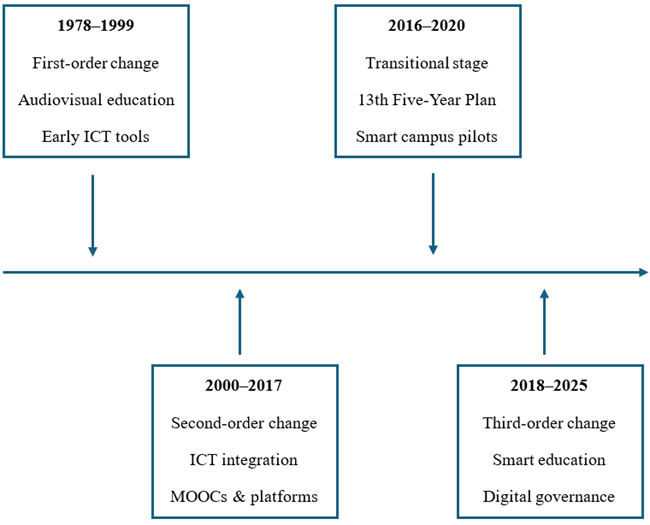
Figure 1 summarises the evolutionary trajectory of China’s educational digitalisation identified in this study, illustrating the progression from first-order technical adjustments to a third-order policy paradigm shift under Hall’s framework.
Figure 1Timeline Summary of China’s Educational Digitalisation
Source: author’s own work.
Challenges of Educational Digitalisation in Higher Education
Inequity in Digital Infrastructure and Resource Allocation
Despite these advances, significant challenges remain in the modernisation of higher education within the context of the 14th Five-Year National Informatization Plan. While flagship universities in major metropolitan areas have rapidly implemented smart-campus systems and advanced digital curricula, regional and under-resourced institutions often lag behind, perpetuating disparities in the quality of digital education (CERNET, 2022).
Although infrastructure coverage has expanded nationwide, the quality of access – such as bandwidth and device availability – varies considerably, particularly at universities in less developed provinces. Technology-led reforms can inadvertently widen the digital divide among students, especially between those from urban and rural backgrounds, unless institutions introduce targeted support mechanisms (Guo, 2024). These gaps underline the need for higher education institutions not only to align with national digitalisation objectives, but also to assess equity, inclusiveness, and long-term sustainability in their digital transformation strategies.
The 14th Five-Year National Informatization Plan has also brought substantial investment in digitally oriented degree programmes, including artificial intelligence (AI) and big data. However, some scholars caution against over-specialisation without adequate integration into broader liberal-arts and general education, which may constrain graduates’ holistic development (CFIS, 2022).
Disparities in Digital Literacy, Pedagogical Adaptation and Academic Workload
Rapid expansion has, in some cases, resulted in superficial engagement with digital learning. MOOC completion rates have remained modest, and many university students find fully online formats less engaging than blended or face-to-face provision. Moreover, not all educators are equally prepared – or willing – to integrate digital tools into their teaching, with training and uptake lagging in some disciplines.
While some argue that information technology can reduce repetitive tasks and improve efficiency, others note that digitalisation has increased demands on teachers, including continuous upskilling, expectations of innovation, and greater accountability. These pressures may lead to overtime and work interruptions, complicating the everyday realities of academic labour in higher education.
Data Governance, Privacy and Network Security Risks
The policy emphasis on large-scale platforms and national integration may facilitate resource sharing, but it has also raised concerns about data governance, privacy protection, and institutional autonomy (CAC, 2022). In particular, data-driven platforms have prompted debate about privacy and the potential for digital surveillance within higher education governance – issues likely to require further policy refinement.
Network security has likewise emerged as a significant challenge. The security of information systems is closely linked to the stability and sustainability of educational reform. In addition, teachers may struggle to identify appropriate online resources within a vast and uneven digital content environment, which further complicates effective pedagogical implementation.
Conclusion
China’s efforts to promote the digitalisation of education have delivered substantial improvements in teaching and learning, while supporting the wider development of higher education. Drawing on Hall’s (1993) policy-paradigm framework, this study traced the evolution of digital-education policy from first-order technical adjustments in the early period, through second-order reforms marked by the introduction of new policy instruments and the large-scale integration of ICT, to third-order changes in which digital technologies reshape educational objectives, governance arrangements and institutional functions. The historical literature and policy documents analysed here chart a progression from early audiovisual teaching and initial network construction to the establishment of digital campuses and MOOCs, and ultimately to smart, data-driven and service-oriented education supported by emerging technologies.
The Education Informatization 13th Five-Year Plan played an important bridging role, signalling a shift from infrastructure expansion and the wider uptake of ICT towards a more systemic and transformative agenda. Subsequently, the Education Informatization 2.0 Action Plan and the 14th Five-Year National Informatization Plan indicate a clear third-order paradigm shift, emphasising personalised learning, flexible teaching, integrated online platforms and mechanisms of digital governance. Within this paradigm, digitalisation moves beyond the enhancement of classroom tools and becomes a central driver of educational modernisation and higher-education development.
Nonetheless, several issues remain unresolved and continue to shape progress. Despite strong national policies, regional disparities persist, particularly in economically underdeveloped areas where infrastructure, digital literacy and educational resources remain limited. Outdated pedagogical approaches, insufficient teacher training and uneven institutional capacity further hinder the effective integration of digital technologies. Moreover, the rapid expansion of data-driven and platform-based provision raises new concerns about data governance, privacy and the long-term sustainability of smart education initiatives. These issues suggest that achieving more balanced and higher-quality digital education will require not only technological innovation but also more substantial reforms to teacher education, curriculum design and institutional governance.
Overall, applying Hall’s policy paradigm model clarifies how China’s digital education policy has shifted from incremental improvement to more fundamental transformation. The framework helps to account for both the achievements and the continuing challenges of educational digitalisation, and offers insights for policymakers, universities and educators as China moves towards a more equitable, intelligent and high-quality digital education system.
Despite these contributions, this study has several limitations. First, the analysis relies primarily on national-level policy documents, which may not fully capture variations in implementation across regions and institutions. Second, although the study supplements the policy analysis with statistical data and the existing literature, it does not draw on original empirical data or fieldwork. Consequently, the findings reflect policy intentions and macro-level paradigm shifts rather than micro-level practices. These limitations point to the need for future research incorporating case studies, interviews, or quantitative evaluations to examine how educational digitalisation policies are implemented in diverse higher education contexts.
Moreover, as a qualitative and interpretive policy analysis, applying Hall’s policy paradigm framework inevitably involves analytical judgement in classifying policy stages and identifying paradigm shifts. Although this study sought to remain as objective as possible by grounding these judgements in the existing literature, alternative interpretations remain possible. Future studies adopting comparative perspectives or mixed-methods approaches could help to validate and refine the analytical conclusions presented here.
References
- Baggaley, J., & Belawati, T. (Eds.). (2010). Distance education technologies in Asia. SAGE Publications India Pvt Ltd. https://doi.org/10.4135/9788132106616
- Bai, Y., Mo, D., Zhang, L., Boswell, M., & Rozelle, S. (2016). The impact of integrating ICT with teaching: Evidence from a randomized controlled trial in rural schools in China. Computers & Education, 96, 1–14. https://doi.org/10.1016/j.compedu.2016.02.005
- British Council. (2016, July 29). China sets out goals for reforms to ministerial universities during the 13th Five Year Plan period. https://opportunities-insight.britishcouncil.org/short-articles/news/china-sets-out-goals-reforms-ministerial-universities-during-13th-five-year
- CAC. (2022, March 8). Experts Discuss the "14th Five-Year Plan for National Informatization": Accelerating Educational Informatization to Support Lifelong Digital Education. Cyberspace Administration of China. https://www.cac.gov.cn/2022-03/08/c_1648363725755324.htm
- CERNET. (2022, January 11). Accelerate the construction of a dedicated network for Chinese education! The "14th Five-Year Plan” for National Informatization has been released, including a quick overview of its educational content. China Education and Research Network. https://www.edu.cn/xxh/focus/zc/202201/t20220111_2201712.shtml
- CFIS. (2022, March 29). Experts Discuss the "14th Five-Year Plan for National Informatization": Accelerating Educational Informatization to Support Lifelong Digital Education. Center for International Security and Strategy. https://www.cfis.cn/2022-03/29/c_1128607125.htm
- Gu, X. (2019). Jingyan yu bentu shijian: Jiaoyu xinxihua tuijin zhanlüe yanjiu [International experience and local practice: Strategic research on promoting educational informatization]. East China Normal University Press. https://baike.baidu.com/item/%E7%BB%8F%E9%AA%8C%E4%B8%8E%E6%9C%AC%E5%9C%9F%E5%AE%9E%E8%B7%B5%EF%BC%9A%E6%95%99%E8%82%B2%E4%BF%A1%E6%81%AF%E5%8C%96%E6%8E%A8%E8%BF%9B%E6%88%98%E7%95%A5%E7%A0%94%E7%A9%B6/61071855
- Guo, X. (2024, February 26). Advancing educational digitalisation to make lifelong learning a reality [Guangming Commentary]. https://epaper.gmw.cn/gmrb/html/2024-02/26/nw.D110000gmrb_20240226_3-02.htm
- Hall, P. A. (1993). Policy paradigms, social learning, and the state: The case of economic policymaking in Britain. Comparative Politics, 25(3), 275–296. https://doi.org/10.2307/422246
- Hunan Provincial Department of Education. (2024, March 13). Mid-term Evaluation Report of the "14th Five-Year Plan for Education Development in Hunan Province" https://jyt.hunan.gov.cn/jyt/sjyt/xxgk/ghjh/202403/t20240313_33190468.html
- Li, W., & Chen, N. (2019). China. In O. Zawacki-Richter, & A. Qayyum (Eds.), Open and distance education in Asia, Africa and the Middle East (pp. 7–22). Springer. https://doi.org/10.1007/978-981-13-5787-9_2
- Luo, W., Berson, I. R., Berson, M. J., & Li, H. (2020). Are early childhood teachers ready for digital transformation of instruction in Mainland China? A systematic literature review. Children and Youth Services Review, 120, 105718. https://doi.org/10.1016/j.childyouth.2020.105718
- MOE. (2004). Action Plan for Revitalising Education (2003–2007). Ministry of Education of the People’s Republic of China. https://www.ndrc.gov.cn/fggz/fzzlgh/gjjzxgh/200709/P020191104622989161130.pdf
- MOE. (2012). Ministry of Education's Notice on Issuing the "Ten-Year Development Plan for Educational Informatization (2011-2020)". Ministry of Education of the People’s Republic of China. http://www.moe.gov.cn/srcsite/A16/s3342/201203/t20120313_133322.html
- MOE. (2016). Ministry of Education's Notice on Issuing the "13th Five-Year Plan for Educational Informatization". Ministry of Education of the People’s Republic of China. Ministry of Education of the People’s Republic of China. http://www.moe.gov.cn/srcsite/A16/s3342/201606/t20160622_269367.html
- MOE. (2018, April 18). Ministry of Education's Notice on Issuing the "Action Plan for Education Informatization 2.0". Ministry of Education of the People’s Republic of China. http://www.moe.gov.cn/srcsite/A16/s3342/201804/t20180425_334188.html
- MOE. (2024a, December 16). China boasts over 97,000 MOOCs and 1.39 billion students: My country leads the world in both the number of MOOCs and the number of students taking them. Ministry of Education of the People’s Republic of China. http://www.moe.gov.cn/jyb_xwfb/s5147/202412/t20241217_1167307.html
- MOE. (2024b, January 26). Introduction of the preparations for the 2024 World Digital Education Conference and the progress made in promoting the digitalization of education over the past year. Ministry of Education of the People’s Republic of China. https://www.moe.gov.cn/fbh/live/2024/55785/twwd/202401/t20240126_1112549.html
- MOE. (2025, April 17). Entering a "New Track" and Accelerating Development: A Review of the Achievements of my country's Three-Year Implementation of the Digital Education Strategy. Ministry of Education of the People’s Republic of China. https://www.moe.gov.cn/jyb_xwfb/s5147/202504/t20250417_1187747.html
- Nong, L., Liu, G., Tang, C., & Chen, Y. (2023). The design and implementation of campus informatization in Chinese universities: A conceptual framework. Sustainability, 15(6), 4732. https://doi.org/10.3390/su15064732
- Shen, S., Yang, H., & Zhou, Q. (2024). Development of academic programs in the digital age: Practice from China. In M. Li, X. Han, & J. Cheng (Eds.), Handbook of educational reform through blended learning (pp. 125–157). Springer. https://doi.org/10.1007/978-981-99-6269-3_3
- Tsinghua University. (2012). CERNET Backbone. Network Research Center of Tsinghua University. https://web.archive.org/web/20120216124621/http://www.nrc.tsinghua.edu.cn/7_english/Situation1.htm
- Wang, D. (2022). China’s information education policy: Analyzing and philosophical reflection on e-education. Scientific and Social Research, 4(6), 109–114. https://doi.org/10.26689/ssr.v4i6.4057
- Yang, Z. (2018). Xidian University President Yang Zongkai: The Disruption and Innovation of Education Informatization 2.0. https://news.xidian.edu.cn/info/2106/199171.htm
- Zhang, J., Sziegat, H., Perris, K., & Zhou, C. (2019). More than access: MOOCs and changes in Chinese higher education. Learning, Media and Technology, 44(2), 108–123. https://doi.org/10.1080/17439884.2019.1602541
- Zheng, X. (2018). Understanding and action: Interpreting the Education Informatization 2.0 Action Plan (Part 2) from the perspective of vocational college teachers. Journal of Guangxi Vocational and Technical College, 11(6), 60–67.
 https://orcid.org/0000-0002-2778-391X