

Informacje o artykule
DOI: https://www.doi.org/10.15219/em111.1720
W wersji drukowanej czasopisma artykuł znajduje się na s. 54-61.
 Pobierz artykuł w wersji PDF
 Abstract in English
Jak cytować
Brodowicz, D. P. (2025). From smart to agentic environments: AI and innovative technologies transforming learning, work and urban living. e-mentor, 4(111), 54-61. https://www.doi.org/10.15219/em111.1720
E-mentor nr 4 (111) / 2025
Spis treści artykułu
- Abstract
- Introduction
- Theoretical Foundations of Smart and Agentic Environments
- Practical Applications of Agentic Environments in Urban Life, Work and Learning
- Methodology and Results of the Study
- Conclusions
- References
Informacje o autorze
From Smart to Agentic Environments: AI and Innovative Technologies Transforming Learning, Work and Urban Living
Dominika P. Brodowicz
Abstract
This article examines agentic environments, an emerging paradigm that moves beyond the conventional smart city model by embedding artificial intelligence across diverse settings. Unlike earlier systems, which were technologically advanced, yet siloed, agentic environments integrate generative AI (GenAI) with edge computing and multi agent frameworks to create adaptive, privacy preserving, context aware and sustainability oriented systems. They bridge personal, professional and public spheres to support proactive decision making, sustainable resource management and personalised user experiences across daily activities, including learning, work, commuting and civic participation. The study uses an exploratory design that combines theoretical modelling with empirical methods to assess this evolving concept. Primary data come from a survey and a focus group with AI and machine learning experts, used to validate the conceptual framework through practical applications. Ethical, social and environmental considerations are foregrounded, including data sovereignty, algorithmic transparency and the energy demands of large AI models. The findings suggest that modularity, cross domain integration and ethical governance are foundational to agentic systems, while significant challenges remain around privacy, individual autonomy and environmental impact. Overall, the research positions agentic environments as key building blocks for human centred, sustainable and resilient urban ecosystems.
Keywords: agentic environments, generative AI, smart cities, privacy, urban sustainability
Introduction
In recent years, the smart city concept has evolved beyond its early emphasis on optimising digital infrastructure and data driven governance. Traditional smart environments, focused on smart mobility, smart governance and smart living, have struggled with siloed operations and limited responsiveness. The lack of integration between systems constrains the adaptability of urban infrastructure. At the same time, evolving societal needs and advances in digital technologies, most notably generative AI (GenAI), edge computing and autonomous multi agent systems, have catalysed the emergence of agentic environments. This new paradigm links interconnected systems with context aware capabilities to enable proactive, personalised and ethically aligned user engagement across work, learning and everyday urban life.
This article examines how agentic environments redefine urban intelligence by shifting from reactive automation to dynamic collaboration among AI agents across personal, professional and public domains. By integrating modular AI systems, edge based processing and multimodal interfaces, these environments point towards cities that are not merely efficient but adaptive and human centred. Drawing on theoretical foundations and empirical research – including surveys and expert focus groups – the study shows how agentic systems can uphold data privacy, support sustainability and enhance user wellbeing. Through real world examples in transport, education and civic participation, we position agentic environments as central to the next wave of urban innovation. We also recognise that progress depends as much on governance and equity as on technical capability, and that solutions must operate within diverse regulatory frameworks while responding to varied social needs.
Theoretical Foundations of Smart and Agentic Environments
Over the past two decades, the notion of the ‘smart city’, and, more broadly, the ‘smart environment’ has evolved considerably. The term initially referred to urban areas that used digital technologies and data-driven governance to improve the efficiency of infrastructure management, service delivery and resource utilisation (Komninos, 2002). In practice, smart cities apply information technologies across domains such as transport, communication, education and public administration to foster sustainability, innovation and citizen engagement. According to Giffinger et al. (2007), smart cities comprise six interrelated dimensions: smart economy, smart people, smart governance, smart mobility, smart environment and smart living. Subsequent frameworks have expanded and refined this perspective.
The concept of Ambient Intelligence (AmI) emphasised environments that sense human presence and adapt to it through unobtrusive, background operations, reducing the need for direct human interaction (Aarts, 2005; Weber et al., 2005). This work led to the development of intelligent environments that move beyond automation by incorporating cognitive and responsive capabilities which learn from user behaviour to optimise operations and better meet user needs (Wrede et al., 2010). Despite their transformative potential, most current models still operate independently and are largely reactive. This is often described as the silo effect, referring to the lack of integration and communication between different data owners (Soe, 2018) – for example, across departments responsible for transport, education and social services. Such fragmentation constrains overall efficiency and adaptability, impeding the creation of truly interconnected and responsive urban management. These limitations provide the impetus for agentic environments, which aim to bridge silos through integrated, context-aware and proactive systems across domains.
Nearly a decade ago, Wolter and Kirsch (2017) observed that many ‘smart’ solutions optimise discrete local functions, while devices such as smart meters and traffic lights still operate in isolation, with little or no inter system communication or co operation. Generative AI (GenAI) and multi agent systems (MAS) offer a response to this limitation, shifting from static, reactive technologies to active, goal directed ecosystems. GenAI denotes AI models that can produce original content – text, images and video – by learning from data (Brown et al., 2020). Edge computing reduces latency by bringing computation and data storage closer to data sources (for example, sensors and devices), enabling real time decision making (Shi et al., 2016). Autonomous agents are self governing software entities that perceive their environment and pursue objectives through automated processes with minimal human oversight (Wooldridge & Jennings, 1995). Agentic environments combine large language models (LLMs), multimodal interfaces, decentralised edge inference and modular AI agents (Guo et al., 2024). They differ from conventional smart systems by supporting cross domain reasoning, contextual awareness and predictive personalisation (Bibri & Krogstie, 2017).
Current research increasingly treats agentic systems as a distinct paradigm that extends beyond the smart city model. Tiwari (2025) distinguishes between automation, which executes pre defined tasks; autonomy, which allows systems to optimise themselves within specified limits; and agency, which enables systems to achieve goals through cross domain co ordination, negotiation among AI agents and contextual understanding. On this view, agentic environments surpass data driven, personalised smart cities by enabling purposeful co ordination across personal, professional and urban systems. Whereas smart infrastructure prioritises operational efficiency and data driven service delivery within discrete functional areas, agentic environments allow systems to work together through negotiated decision making.
The significance of this approach lies in reframing the human technology urban relationship from a narrow focus on service optimisation and energy efficiency to a co operative ecosystem that advances sustainability while maintaining high standards of user privacy. In essence, agentic environments are AI driven, adaptive urban systems that integrate personal, professional and public domains through autonomous agents and context aware decision making. Throughout, we refer to urban areas rather than cities, recognising that post COVID patterns of work, learning and daily life increasingly extend beyond traditional municipal boundaries through remote work and online provision. Privacy is a central concern. In many contexts, ostensibly smart systems have enabled excessive and opaque data practices, including facial recognition and mass surveillance. For example, in China, extensive closed circuit television (CCTV) networks and other tools are used to monitor public behaviour, apply facial recognition in public spaces and track individuals in real time without explicit consent (Keegan, 2019). A more recent case is Amsterdam’s decision to withdraw from a smart traffic light scheme that collected data from citizens’ smartphones, due to concerns about tracking and a lack of transparency regarding subsequent data use and sharing (Ioplus, 2025). Such examples highlight the need for alternative approaches based on agentic environments, which by design are more secure and privacy preserving, minimising the transmission of data to central hubs. However, agentic solutions can also introduce new structural governance challenges. Technologies that span personal, professional and public domains risk reinforcing algorithmic exclusion, making decision processes opaque and entrenching inequalities in the distribution of benefits. Accordingly, new safeguards are required – ensuring accountability, distributional fairness and robust public oversight – and must be developed in parallel with the deployment of agentic systems.
Practical Applications of Agentic Environments in Urban Life, Work and Learning
The shift from smart to agentic environments is unfolding at both theoretical and practical levels. AI driven systems are moving from passive automation to proactive orchestration across domains such as mobility, education, governance and healthcare. The Estonian Zelos platform – analysed by the author as part of intelligent solutions deployed during COVID 19 (Brodowicz, 2021) – illustrates decentralised, agent based civic engagement by matching isolated residents with volunteers. By co ordinating logistics, communication and emotional support, such platforms exemplify a move beyond isolated smart city applications towards responsive, co ordinated systems. Agentic environments have potential to reshape commuting. Vehicle to everything (V2X) systems integrate personalised agents that co operate with vehicles (Ding et al., 2022). Platforms developed by firms such as Qualcomm and Huawei enable vehicles to interoperate with home and city systems, with the aim of reducing driver stress and emissions during journeys (Rehman et al., 2023). For example, an in mirror vision system can detect driver fatigue by tracking eye movement, prompt rest breaks via a voice agent, check responsiveness and even offer to book a nearby hotel or restaurant. Deployed thoughtfully, these AI enabled agents can enhance personal safety and improve travel efficiency. Similar dynamics are evident in work and learning. Productivity in coding, document generation and process automation is being transformed by tools such as Microsoft Copilot, IBM Watson, GitHub Copilot and OpenAI’s ChatGPT, which provide interactive support for writing, research, brainstorming and problem solving across disciplines (Mosaiyebzadeh et al., 2023; Susnjak, 2022). The evolution of these tools’ merits close attention: they are shifting from basic, reactive interfaces to personalised agents that understand context, orchestrate optimised workflows and help to reduce cognitive overload – a growing concern in both educational and workplace settings (Durst et al., 2024). Taken together, these examples demonstrate how agentic environments extend beyond single purpose smart applications to deliver integrated, context aware and user centred capabilities across everyday urban life.
Workplaces adopting agentic environments allow personal AI agents to orchestrate calendars across work and home, recommend sustainable commuting options and manage home office energy use – capabilities that are particularly valuable for remote and hybrid arrangements (Tawalbeh, 2025). Similar advances are evident in education. As lifelong learning and frequent career transitions become the norm – especially for urban residents who may reskill or change sectors multiple times – more adaptive support is required. The education sector already employs generative AI for tutoring, assessment and content creation, but agentic frameworks go further. For example, a student learning assistant can combine city transit data to recommend less crowded routes aligned with class schedules, while monitoring stress via wearables to adjust workload (Benkhalfallah et al., 2023). Pilot projects in Amsterdam and New York have tested AI assisted urban classrooms, where multimodal AI agents (Mischos et al., 2023) dynamically adjust temperature, lighting and task difficulty in response to student feedback and behaviour.
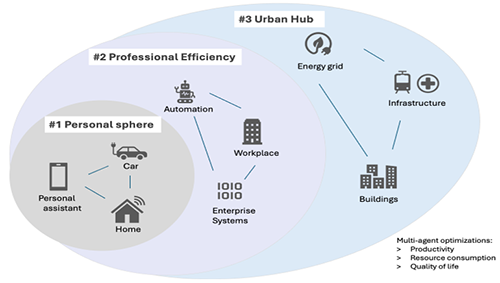
Contemporary urban areas face environmental and social challenges that demand solutions beyond isolated ‘smart’ products and services. Agentic environments offer a holistic route to resilience and sustainability (see Figure 1). Building management systems (BMS) from Siemens and Johnson Controls already deploy AI agents to optimise HVAC, lighting and space use in real time, responding to occupancy patterns (Burzagli et al., 2022). These agents can scale to neighbourhood level, co ordinating energy consumption with waste and transport operations. Barcelona’s ‘City OS’ platform links environmental data with social services, illustrating multi agent co ordination in practice (Alam et al., 2012). The adoption of such systems supports circular economy principles, defined by the European Commission as ‘a model of production and consumption, which involves sharing, leasing, reusing, repairing, refurbishing and recycling existing materials and products as long as possible’ (European Commission, 2020). Agentic environments address efficiency and effectiveness alongside data privacy and security. By using edge computing for local data processing, they can reduce reliance on the cloud and minimise exposure to security risks – as exemplified by devices such as Meta’s smart glasses and Google’s edge Tensor chips (Shen et al., 2024).
Large scale AI systems are highly energy intensive. The IEA (2024) estimates that a single generative AI query on ChatGPT can use roughly as much electricity as a 60 watt light bulb running for 17 minutes. Training a single large language model can emit hundreds of tonnes of CO₂ (Luccioni et al., 2022). Agentic environments offer an alternative pathway by prioritising small language models (SLMs), on device edge inference and modular AI agents with adaptive scaling, alongside hybrid architectures that dynamically offload computation. Moving towards this design could reduce the carbon footprint of urban AI while maintaining personalised services and strong operational performance. Figure 1 presents the Agentic Environment Lenses, showing how agents integrate across personal, professional and urban spheres. These domains can operate independently to safeguard privacy and data security, while still enabling information exchange and seamless collaboration with the user’s explicit knowledge and consent.
Figure 1The Agentic Environment Lenses with Agents’ Integration Across Personal, Professional and Urban Spheres
Source: ‘The agentic environment lenses with agents’ integration across personal, professional and urban spheres’ [working paper], P. Pospieszny and D. P. Brodowicz, 2025 (dr2.ai).
Methodology and Results of the Study
Given the nascent state of theory in this field, the study adopts an exploratory design to analyse the interplay between generative AI and agentic environments. A three stage methodology combined secondary and primary data. Stage one comprised a desktop review of the literature, drawing on peer reviewed sources indexed in IEEE Xplore, Scopus and Web of Science, alongside white papers, industry reports and relevant regulatory documents. This phase mapped the technological evolution of smart environments and current AI applications, establishing the conceptual basis for the empirical work.
Stage two comprised an online survey administered via Google Forms between January and February 2025. Participants were recruited through LinkedIn and the dr2.ai team’s professional networks, using purposive sampling to reach experts in artificial intelligence, machine learning and related fields. Eligibility required at least three years’ experience with AI/ML systems to ensure respondents were likely to have completed a full implementation cycle – from development and deployment through to user feedback. Respondents brought hands on experience of technical performance as well as governance, privacy and user acceptance challenges, across projects involving wearables, smart home systems, in car interfaces and other consumer technologies in Europe, North America and the Asia–Pacific region. Stage three consisted of an online focus group held in February 2025, bringing together eight expert participants and two researchers representing dr2.ai and the Warsaw School of Economics. The session assessed the emerging framework for clarity, relevance and cross domain applicability, generating practical feedback used to validate and refine it for real world use.
The study applied data triangulation, combining a literature review, a survey of AI/ML experts and a focus group. The primary research aimed to elicit insights into current conditions and anticipated developments in agentic environments. The survey targeted professionals with hands on experience of AI deployment and analysis in commercial and urban settings, as these practitioners are central to the development and operation of emerging agentic infrastructure. In total, 32 experts responded (out of 50 contacted via LinkedIn and email). Selection did not consider gender, as the emphasis was on qualifications and topic relevance. Respondents reported international project experience developing AI based products for major global technology firms, including Google, and leading IT consultancies such as EPAM and Cognizant. The questionnaire covered five domains aligned with the study framework: language models, ethics, capabilities, services and sustainability.
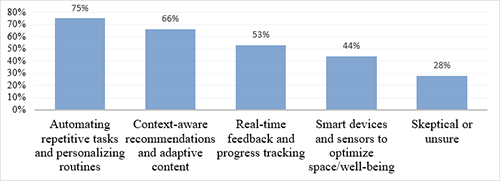
In relation to the first question on daily use of language models (see Figure 2), most respondents (75%) expected agentic environments to enhance learning and professional activities. The mechanisms most frequently cited were the automation of repetitive tasks and delivery of context aware, personalised content and routines (66%). Real time feedback mechanisms were also highlighted as important (53%). A notable minority (28%) were sceptical about the practical impact of these technologies, likely reflecting first hand implementation experience.
Figure 2Language Models in Daily Use
Source: author’s own work.
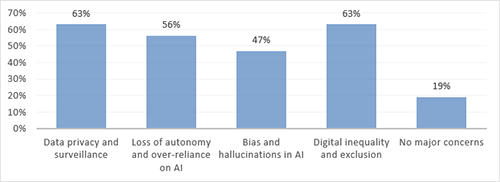
The second survey question examined anticipated challenges in implementing AI based agentic environments (see Figure 3). Respondents’ concerns were chiefly ethical and societal: data privacy and surveillance (63%); erosion of human autonomy due to dependence on AI systems (56%); and the risk of algorithmic errors or bias (47%). These responses indicate a sophisticated understanding of AI integration into public and civic infrastructure, extending beyond technical issues to encompass social, political and regulatory considerations.
Figure 3Ethical and Societal Concerns in AI Integration
Source: author’s own work.
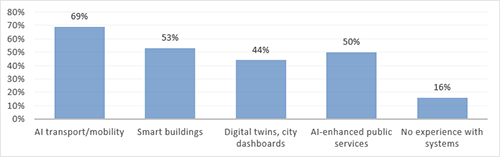
Experts were also asked which AI enabled urban services they had personally used (see Figure 4). Most had experience of AI supported mobility systems (69%) and intelligent building management (53%). These findings suggest that, for this cohort, agentic technologies are already part of everyday urban life rather than abstract concepts. Engagement with citizen facing dashboards and AI enhanced public services was also common (44–50%), indicating broad familiarity with emerging smart city applications.
Figure 4AI-enabled Urban Services and Smart City Spplications
Source: author’s own work.
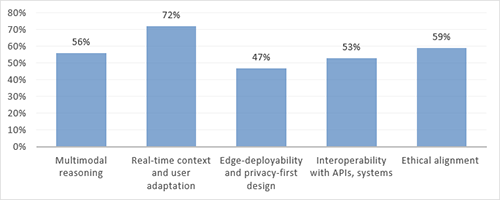
The survey also asked about the technical and ethical features of AI agents in agentic environments (see Figure 5). Respondents’ top choices for future capabilities were real time contextual adaptation (72%), ethical alignment and explainability (59%), and multimodal reasoning across diverse input types (56%). These findings suggest that participants expect agentic environments to marry advanced technical performance with transparency, accountability and human centred design.
Figure 5Key Capabilities for Future AI Agents in Agentic Environments
Source: author’s own work.
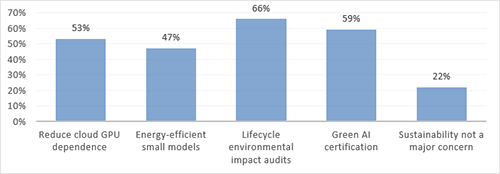
Finally, experts were asked about the environmental sustainability of AI systems (see Figure 6). Most participants emphasised the need to conduct environmental impact assessments (66%), to use small, energy efficient AI models (47%) and to establish standardised certifications for environmentally responsible AI infrastructure (59%). These priorities indicate a growing recognition of the environmental costs of large scale AI, alongside a commitment to sustainable practices in intelligent urban development.
Figure 6Enhancing the Environmental Sustainability of AI Systems
Source: author’s own work.
The responses indicate that practitioners combine technological expertise with critical judgement. Participants recognised the transformative potential of agentic environments, particularly for enhancing urban intelligence, but consistently stressed that ethical, social and environmental considerations must underpin responsible innovation. To probe these issues further, researchers at dr2.ai ran an additional online focus group in February 2025 with eight participants and members of the dr2.ai research team. The session examined practical use cases and concerns not fully covered by the survey, especially those relating to learning environments and AI supported education. It highlighted the need for agentic systems to personalise learning pathways while remaining adaptable, inclusive and transparent in lifelong learning contexts.
The Agentic Environments focus group generated both visionary and actionable insights, centred on agent collaboration and governance mechanisms to steer the development of intelligent, sustainable ecosystems. Findings underscored that modularity, personalisation, ethical governance and cross domain integration are essential to realising the potential of agentic environments across personal, professional and urban domains. The group also examined collaboration models for complex cross domain systems. Participants strongly favoured co operative agent teams and hierarchical structures, and expressed particular interest in hybrid approaches that can be tailored to specific contexts. Such models enable agents to switch between independent operation and team based co ordination as environmental demands change.
Urban infrastructure can be orchestrated by distributed, swarm like agents that control local traffic lights, while supervisory agents analyse city wide traffic patterns to optimise overall flow. Building resilient, real time adaptive environments depends on this dynamic, layered system of co ordination. Experts noted that such agentic systems achieve seamless interaction across domains through composite AI architectures that include multimodal LLMs. A personal AI assistant might combine professional calendars with urban mobility data to plan energy efficient commutes and collaborate with healthcare agents to monitor wellbeing and adjust work schedules. These collaborative systems overcome traditional silos to deliver highly contextual, cross domain support for individuals and communities. The need for edge computing as a foundation for privacy preserving personalisation emerged as a recurring theme in the responses. The analysis identified three interconnected spheres that intersect and influence one another while maintaining clear boundaries for security, privacy and user comfort:
- Personal sphere: human centred optimisation. The personal sphere sits at the core of the agentic environment, encompassing everyday settings and devices such as homes, vehicles and personal assistants. AI agents aim to enhance comfort, health and convenience through adaptive systems that safeguard user privacy. By analysing user behaviour, personalised agents co ordinate device actions to automate routines, support wellbeing and reduce energy use. Edge computing keeps data within local systems, while intelligent agents learn and adapt through federated learning and contextual interaction.
- In the professional sphere – covering work, learning and lifelong development – AI agents already boost productivity through tools such as GitHub Copilot, Microsoft 365 Copilot and Atlassian Rovo. In an agentic environment, this becomes a context aware, integrated knowledge system that is central to academic learning and ongoing skills development. LLM powered agents can deliver immediate, multimodal tutoring and rapid data retrieval for students and researchers; support educators and professionals with curriculum planning, research synthesis and grant writing; and enable continuous learning via goal based routines that recommend courses and adapt content to a user’s cognitive capacity and available time. They also tailor their operation to organisational workflows and individual development goals by drawing on personal signals – such as energy levels and concentration patterns – to enhance performance and wellbeing.
- Finally, the urban hub addresses infrastructure and systemic intelligence across buildings and public services. Multi agent systems co ordinate complex operations including energy grid management, traffic control and emergency response. AI agents optimise resource use, cut emissions and strengthen city resilience. Crucially, agents in this sphere can interact with the personal and professional domains: a workplace agent might share commute information with urban systems to trigger adaptive traffic light timing; a home system can use grid price forecasts to decide whether to pre heat or pre cool; and educational institutions can adjust digital learning environments in response to city level disruptions such as extreme weather.
LLM based multi agent systems weave these three spheres together, optimising information flows, time, connectivity and environmental sustainability. They lift productivity through automation and orchestration, reduce resource use via edge computing and distributed intelligence, and improve quality of life through anticipatory, context aware personalisation. In this way, agentic environments mark a shift from isolated digital experiences to ecosystem level intelligence oriented towards a sustainable, human centred future.
Conclusions
The shift from smart to agentic environments marks a fundamental reorientation from infrastructure optimisation towards sustainable, human centred ecosystems. Established smart city and ambient intelligence frameworks now converge with compound AI, edge computing and multi agent orchestration to create a new generation of urban systems. Early implementations show practical benefits across workplaces, education, transport and public health. However, realising this potential depends on privacy first architectures, decentralised models and sustainability led design to address the ethical and environmental challenges inherent in large scale AI.
Agentic solutions point towards more liveable, resilient and inclusive urban environments, but protecting individual privacy requires robust transparency, safety and accountability. Scaling these systems depends not only on technical capability but also on regulatory frameworks, infrastructure, governance and, increasingly, social acceptance. The EU’s privacy by design stance helps to build trust but can slow experimentation, while the United States – and many Asian jurisdictions – tend to favour faster, market led deployment under lighter oversight. Accordingly, future research should look beyond technical readiness to focus on regulatory alignment and effective public oversight, so that agentic environments can progress from promising pilots to widely adopted, trustworthy urban infrastructure.
References
- Aarts, E. (2005). Ambient intelligence drives open innovation. Interactions, 12(4), 66–68. https://doi.org/10.1145/1070960.1070996
- Alam, M. R., Reaz, M. B. I., &Ali, M. A. M. (2012). A review of smart homes – past, present, and future. IEEE Transactions on Systems, Man and Cybernetics Part C: Applications and Reviews, 42(6), 1190–1203, https://doi.org/10.1109/TSMCC.2012.2189204
- Benkhalfallah, M. S., Kouah, S., & Ammi, M. (2023). Smart energy management systems. In K. Kabassi, P. Mylonas, & J. Caro (Eds), Novel &Intelligent Digital Systems: Proceedings of the 3rd International Conference (NiDS 2023), 784. Springer. https://doi.org/10.1007/978-3-031-44146-2_1
- Bibri, S. E., & Krogstie, J. (2017). Smart sustainable cities of the future: An extensive interdisciplinary literature review. Sustainable Cities and Society, 31, 183–212. https://doi.org/10.1016/j.scs.2017.02.016
- Brown, T. B., Mann, B., Ryder, N., Subbiah, M., Kaplan, J., Dhariwal, P., Neelakantan, A., Shyam, P., Sastry, G., Askell, A., Agarwal, S., Herbert-Voss, A., Krueger, G., Henighan, T., Child, R., Ramesh, A., Ziegler, D., Wu, J., Winter, C.,… & Amodei, D. (2020). Language models are few-shot learners. Cornell University. https://doi.org/10.48550/arXiv.2005.14165
- Brodowicz, D. P. (2021). Inteligentne rozwiązania w miastach w czasie pandemii - wybrane obszary, funkcje i zastosowania [Smart solutions in cities during a pandemic - selected areas, functions and applications]. e-mentor, 1(88), 55–63. https://doi.org/10.15219/em88.1504
- Burzagli, L, Emiliani, P. L., Antona, M., & Stephanidis, C. (2022). Intelligent environments for all: A path towards technology-enhanced human well-being. Universal Access in the Information Society, 21, 437–456. https://doi.org/10.1007/s10209-021-00797-0
- Ding, Y., Huang, Y., Tang, L., Qin, X., & Jia, Z. (2022). Resource allocation in V2X communications based on multi-agent reinforcement learning with attention mechanism. Mathematics, 10(19), 3415. https://doi.org/10.3390/math10193415
- Durst, S., Foli, S., & Edvardsson, I. R. (2024). A systematic literature review on knowledge management in SMEs: current trends and future directions. Management Review Quarterly, 74, 263–288. https://doi.org/10.1007/s11301-022-00299-0
- European Commission. (2020). A new circular economy action plan: For a cleaner and more competitive Europe. https://eur-lex.europa.eu/resource.html?uri=cellar%3A9903b325-6388-11ea-b735-01aa75ed71a1.0017.02/DOC_1&format=PDF
- Giffinger, R., Fertner, C., Kramar, H., Kalasek, R., Pichler-Milanovic, N., & Meijers, E. (2007). Smart cities. Ranking of European medium-sized cities. Centre of Regional Science. https://www.smart-cities.eu/download/smart_cities_final_report.pdf
- Guo, T., Chen, X., Wang, Y., Chang, Y., Pei, S., Chawla, N., Wiest, O., & Zhang, X. (2024). Large language model-based multi-agents: a survey of progress and challenges. Cornell University. https://arxiv.org/pdf/2402.01680
- IEA. (2024). Electricity 2024 – Analysis and forecast to 2026. International Energy Agency. https://iea.blob.core.windows.net/assets/6b2fd954-2017-408e-bf08-952fdd62118a/Electricity2024-Analysisandforecastto2026.pdf
- Ioplus. (2025, January 6). Amsterdam stops smart traffic lights over privacy concerns. https://ioplus.nl/en/posts/amsterdam-stops-smart-traffic-lights-over-privacy-concerns
- Keegan, M. (2019, December 2). Big Brother is watching: Chinese city with 2.6m cameras is world’s most heavily surveilled. The Guardian. https://www.theguardian.com/cities/2019/dec/02/big-brother-is-watching-chinese-city-with-26m-cameras-is-worlds-most-heavily-surveilled
- Komninos, N. (2002). Intelligent cities. Innovation, knowledge systems and digital spaces. Routledge. https://doi.org/10.4324/9780203857748
- Luccioni, A. S., Viguier, S., & Ligozat, A.-L. (2022). Estimating the Carbon Footprint of BLOOM, a 176B Parameter Language Model. Cornell University. https://doi.org/10.48550/arXiv.2211.02001
- Mischos, S., Dalagdi, E. & Vrakas, D. (2023). Intelligent energy management systems: a review. Artificial Intelligence Review, 56(17), 11635–11674. https://doi.org/10.1007/s10462-023-10441-3
- Mosaiyebzadeh, F., Pouriyeh, S., Parizi, R., Dehbozorgi, N., Dorodchi, M., & Macêdo Batista, D. (2023). Exploring the role of Chat in education: applications and challenges. In SIGITE'23, Proceedings of the 24th Annual Conference on Information Technology Education (pp. 84–89). https://doi.org/10.1145/3585059.3611445
- Pospieszny, P., & Brodowicz, D. P. (2025). The agentic environment lenses with agents’ integration across personal, professional and urban sphere [working paper]. dr2.ai.
- Rehman, A. R., Numan, M., Tahir, H., Rahman, U., Khan, M.W., & Iftikhar, M. Z. (2023). A comprehensive overview of vehicle to everything (V2X) technology for sustainable EV adoption. Journal of Energy Storage, 74, 109304. https://doi.org/10.1016/j.est.2023.109304
- Shen, Y., Shao, J., Zhang X., Lin Z., Pan H., Li, D. (2024). Large language models empowered autonomous edge AI for connected intelligence. IEEE Communications Magazine, 62(10), 140–146. https://doi.org/10.1109/MCOM.001.2300550
- Shi, W., Cao, J., Zhang, Q., Li, Y., & Xu, L. (2016). Edge computing: Vision and challenges. IEEE Internet of Things Journal, 3(5), 637-646. https://doi.org/10.1109/JIOT.2016.2579198
- Soe, R. M. (2018). Smart cities: From silos to cross-border approach. International Journal of E-Planning Research, 7(2), 70-88. https://doi.org/10.4018/IJEPR.2018040105
- Susnjak, T. (2022). ChatGPT: The end of online exam integrity? Cornell University. https://doi.org/10.48550/arXiv.2212.09292
- Tawalbeh, J. (2025). Remote and hybrid work models: Enhancing employee engagement and redefining performance management in a new era. Journal of Posthumanism, 5(3), 101–116. https://doi.org/10.63332/joph.v5i3.715
- Tiwari, R. (2025). Conceptualising the emergence of Agentic Urban AI: from automation to agency. Urban Informatics, 4(13). https://doi.org/10.1007/s44212-025-00079-7
- Weber, W., Rabaey, J. M., & Aarts, E. (Eds). (2005). Ambient intelligence. Springer. https://doi.org/10.1007/b138670
- Wolter, D., & Kirsch, A. (2017). Editorial to special issue on smart environments. Künstl Intell, 31, 227–229. https://doi.org/10.1007/s13218-017-0499-3
- Wooldridge, M., & Jennings, N. R. (1995). Intelligent agents: Theory and practice. The Knowledge Engineering Review, 10(2), 115–152. https://doi.org/10.1017/S0269888900008122
- Wrede, J. C. A., McCullagh, P., McClelland, V., & Walkden, J. A. (2010). Enhanced healthcare provision through assisted decision-making in a smart home environment. International Journal of Smart Home, 4(4), 1–16. https://www.researchgate.net/publication/228337733
 https://orcid.org/0000-0002-2070-086X