

Informacje o artykule
DOI: https://www.doi.org/10.15219/em114.1748
W wersji drukowanej czasopisma artykuł znajduje się na s. 63-74.
 Pobierz artykuł w wersji PDF
 Abstract in English
Jak cytować
Sonik, A., & Singh, J. (2026). Retaining Generation Z employees in the knowledge-intensive service organisations: the influence of organisational virtuousness and work-life balance through psychological capital. e-mentor, 2(114), 63-74. https://www.doi.org/10.15219/em114.1748
Copyright © 2026, Ashna Sonik, Jagwinder Singh


E-mentor nr 2 (114) / 2026
Spis treści artykułu
- Abstract
- Introduction
- Literature Review and Hypothesis Development
- Methodology
- Results
- Discussion
- Implications
- Limitations and Conclusion
- References
Informacje o autorze
Retaining Generation Z Employees in the Knowledge-Intensive Service Organisations: The Influence of Organisational Virtuousness and Work-Life Balance through Psychological Capital
Ashna Sonik, Jagwinder Singh
Abstract
The prominence of Generation Z in the workplace has heightened organisational concerns related to retention and employee loyalty. Despite growing interest in factors that encourage long-term commitment among young employees, limited research has examined how workplace resources influence employee loyalty. This study examines the impact of organisational virtuousness and work-life balance on employee loyalty, with psychological capital as a mediator. A quantitative cross-sectional approach was used, collecting data from 493 Gen Z respondents and analysing them using PLS-SEM. The findings indicate that virtuousness positively affects employee loyalty, whereas work-life balance does not. Furthermore, psychological capital partially mediates the relationship between virtuousness and loyalty, and fully mediates the relationship between work-life balance and loyalty. Drawing on conservation of resources theory, these results highlight the importance of personal resources in translating job resources into effective retention strategies for Gen Z employees.
Keywords: organisational virtuousness, work-life balance, psychological capital, employee loyalty, generation Z
Introduction
Failures are more likely to occur in the service sector because this sector relies on human interaction, the behaviour of the employees, as well as real-time customer experiences, which makes it challenging to make it consistent and controllable (Ma et al., 2022). Stereotyped as disengaged and disloyal, and famous for its job hopping, Generation Z can disrupt service, increasing recruitment and training expenses, eroding customer trust, and decreasing organisational performance. To gain a competitive edge, employee loyalty is crucial for retention and performance (Dutta & Dhir, 2025). Consequently, the biggest challenge for companies is to motivate and retain them and bridge the gap between industry demands and the needs of the workforce (Cherkaoui et al., 2025; Deloitte, 2025; Dolot, 2018).
Generation Z, a cohort born between 1997 and 2012, is currently 377 million in India and is the largest workforce in the world (Jain et al., 2024). 65% of the population in India is under 35, crowning India as a global talent ecosystem (India Brand Equity Foundation, 2025). Gen Z is tech-savvy, switches jobs at will, appreciates ethics, purpose, and work-life balance and is responsible for changing the workplace norms (Das & Malik, 2025). Research on Gen Z requires prudent attention, especially in transition and emerging economies (Nguyen et al., 2022). Gen Z places greater emphasis on learning, skill upgradation, psychological well-being and interpersonal relationships (Deloitte, 2025). Gen Z expectations from the workplace are different, which poses a challenge for the organisation to attract and retain the digital natives.
Although previous studies have explored employee loyalty through tangible (rewards, career opportunities, leadership) and selected intangible (organisational culture, commitment, satisfaction) job resources, the integrated association of organisational virtuousness, work-life balance, and psychological capital remains underexplored (Aboobaker et al., 2022; Cherkaoui et al., 2025; Silva et al., 2024). Financial rewards and compensation were considered primary retention drivers for earlier generations, but Generation Z demonstrates different workplace priorities (Krishna & Agrawal, 2025; Twenge et al., 2010; Wongprasurt & Lee, 2024). Generation Z varies from previous generations, values work-life balance and job security, and remains worried about staying in the same job for a long period of time, without growth in their career (Bieleń & Kubiczek, 2020; Deloitte, 2025; Silva et al., 2024). The changing expectations indicate that the central compelling factor for employee loyalty among Generation Z is driven less by material rewards and more by intangible organisational and psychological resources that enable employees to flourish, rather than by mere employee retention. Intangible resources are unique in nature and become inimitable, leading to a gained competitive advantage (Barney, 1991).
By understanding the factors that affect employees’ willingness to stay with the current organisation, employers can better assess workforce needs and foster a work environment that values individual qualities while ensuring job security (Schroth, 2019). Limited research has explored employee loyalty from the perspective of virtuousness (Chand et al., 2026). No doubt, most scholarly work focuses on employee engagement; there is a gap in the academic literature examining the combined effect of virtuousness and work-life balance on employee loyalty among Generation Z, particularly in the knowledge-intensive service industries. Based on this, the proposed research question is:
RQ1: How do intangible job resources make an impact on loyalty of Generation Z employees in the knowledge-intensive service industries?
To answer RQ1, this study explores the direct effects of organisational virtuousness and work-life balance on employee loyalty and psychological capital. Prior research has already demonstrated that organisations promoting virtuousness exhibit positive employee outcomes such as engagement, extra-role behaviour, increased job satisfaction and improved psychological state (David et al., 2024; Gogia et al., 2024; Ho et al., 2023). Similarly, work-life balance has shown its positive linkages with employee attitudes such as satisfaction, commitment, improved performance and mental health (Rahman et al., 2025; Wongprasurt & Lee, 2024; Zhang et al., 2024).
Although previous research has found that job resources can boost engagement and loyalty, this work suggests that the importance of internal psychological resources can facilitate a resource gain spiral that increases employee resiliency, optimism and engagement (Glavanits et al., 2025; Hobfoll, 1989). The mediating mechanism is particularly relevant for Generation Z as they view their experiences at work as the process of developing their intrinsic personal resources, and the internalisation of organisational resources is a significant factor in loyalty. The purpose of this research is to determine other mediators between job resources and employee loyalty. The second research question is:
RQ2: Do intangible psychological resources, such as psychological capital, act as a bridge between intangible job resources and employee loyalty among Gen Z?
To address this, RQ2 asks whether psychological capital mediates the relationship between workplace resources and employee loyalty. Supportive organisations that provide an environment of transparency, open communication, trustworthy leadership, work-life balance, and flexibility foster employees' internal psychological state, which is necessary to deal with the stress that job demands create. Psychological capital, therefore, becomes essential in translating the effect of organisational resources to employee loyalty. The following literature review presents the theoretical arguments that underlie these relations and the hypotheses of the study.
Literature Review and Hypothesis Development
Organisational Virtuousness (OV), Employee Loyalty (EL), and Psychological Capital (PC)
OV, a component of positive organisational scholarship (positive psychology), is defined as the shared endorsement of moral values such as optimism, compassion, trust, forgiveness, and integrity (Cameron et al., 2004; Kalinowska-Andrian, 2006). OV can be disseminated through the virtuous behaviour of the leader, positively influencing employee commitment and loyalty (Singh et al., 2024). A virtuous organisation makes employees feel connected towards work, increasing their tendency to exhibit loyalty (Aboobaker et al., 2022; Gogia et al., 2024). Based on the above studies, the following hypothesis can be proposed:
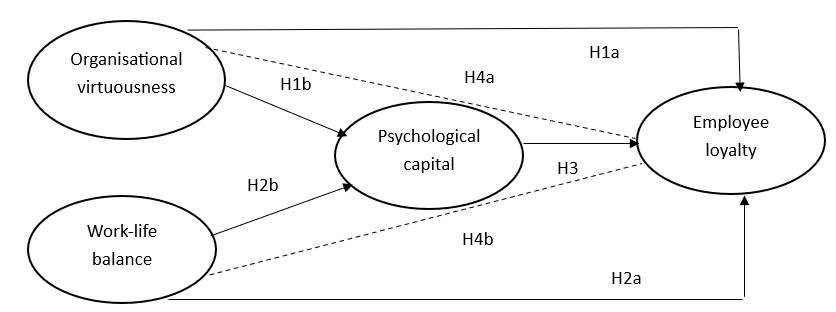
H1a: OV has a positive impact on EL.
A study has shown that perceptions of OV boost employees' psychological capital (Aubouin-Bonnaventure et al., 2023). One such study reported that a 1-unit increase in OV is associated with a 0.249-unit increase in psychological capital (Dubey et al., 2020). Psychological capital, a construct of positive organisational behaviour, is a positive developmental state characterised by hope, efficacy, resilience, and optimism. Organisational optimism fosters a positive work environment and culture, encouraging the development of individual optimism, a core construct of PC. Similarly, integrity in organisations fosters employee trust by demonstrating consistency between organisational values and actions, nurturing employees’ hope of fulfilling personal and professional goals. Therefore, OV instils resilience and agility among employees, which are necessary for survival in today’s environment (Panda & Singh, 2026). Based on these studies, the following hypothesis can be developed:
H1b: OV has a positive impact on PC.
Work-Life Balance (WLB), Employee Loyalty (EL), and Psychological Capital (PC)
Managing work with personal responsibilities to reduce conflict and satisfy one's own needs is termed work-life balance (Hayman, 2005). Generation Z pays significant attention to maintaining a balance between their professional and private life (Wójcik & Łukasiński, 2024). This generation uses flexible working hours to manage this balance (Łukasiński & Romański, 2025). One such study conducted among start-up employees in India found that promoting flexible work policies increases employee commitment (Rahman et al., 2025). Despite work on WLB, few studies have examined its psychological mechanisms and long-term outcomes. Therefore, the proposed hypothesis is:
H2a: WLB has a positive impact on EL.
A study demonstrated that WLB acts as a mediator, showing a positive relationship between PC and job attitudes (Parray et al., 2022). Studies also mention the role of WLB in enhancing PC and job satisfaction, by allowing employees to fulfil both professional and personal responsibilities, thereby improving their mental health by reducing stress and emotional exhaustion (Samroodh et al., 2023; Zhang et al., 2024). Employees with higher PC perform better at work and enjoy a healthy work-life balance. Therefore, it is hypothesised that:
H2b: WLB has a positive impact on PC.
Psychological Capital (PC) and Employee Loyalty (EL)
Employees with strong PC skills are positively associated with career commitment and employee engagement (Singh et al., 2023). Enhancement of PC fosters employees to engage in extra-role behaviour, which can further impact their loyalty (Dai et al., 2022). Facilitating job resources helps build positive emotions among employees, leading to increased trust and reduced negative effects of undesirable outcomes. Hence, it is assumed that enhancing psychological capital can increase employee loyalty. So, the following hypothesis is proposed:
H3: PC is positively related to EL.
Psychological Capital as a Mediator (PC)
A mediation is said to exist if the relationships between the input variable and the mediator, and between the mediator and the endogenous variable, are significant (Miles & Shevlin, 2001). Conservation of Resources theory posits that while employees strive to maintain their personal resources, the work environment can enhance or hinder them, creating a spiral (Arshad et al., 2025; Aubouin-Bonnaventure et al., 2023). A study found that PC served as a mediator in the relationship between OV and job satisfaction (Zaheer et al., 2022). Another study mentioned its mediating role between authentic leadership and thriving (Shahid & Muchiri, 2019). Organisational support and job autonomy show a positive association with employees’ intention to stay (Samroodh et al., 2023).
Organisations that provide employees with policies for maintaining WLB help build psychological resources, which, in turn, encourages improved mental health (Zhang et al., 2024). A study revealed that WLB and job satisfaction positively impact EL among Gen Z in Jakarta (Olii et al., 2024). Future research could investigate whether PC is predictive of employee behaviours when physical, emotional and job insecurities are high (Chen et al., 2018). Based on the above studies, it is hypothesised:
H4a: PC mediates the relationship between OV and EL.
H4b: PC mediates the relationship between WLB and EL.
The model's theoretical framework is presented in Figure 1.
Figure 1Conceptual Model
Methodology
Data Collection Phase
Data were collected through a structured questionnaire distributed to 1,020 Gen Z employees working in the knowledge-intensive service industries. Informed consent was obtained from the respondents prior to data collection. Ethical considerations, including confidentiality, informed consent, anonymity, and voluntary participation, were strictly maintained in this study, in accordance with the Institutional Ethical Clearance Certificate (NITJ/DRC/1924). A 5-point Likert scale with 29 indicators was used to measure the four study variables. Following a pilot test with 60 respondents, minor wording revisions were made for clarity and reliability. Data collection was conducted between November 2025 and March 2026. After removing outliers and unengaged responses, 493 valid responses were retained (response rate: 48.33%). Non-response bias was assessed using an independent-samples t-test comparing the first and last 50 responses, which revealed no significant differences. Ethical standards of confidentiality, anonymity, and institutional approval were maintained throughout the study.
Measurement Scale
The scales were adapted from the previous literature. The original scales consisted of a large number of items; a reduced set was adopted while retaining the original meaning of the construct. Negatively worded items were reverse-coded prior to analysis to ensure consistent interpretation. Principal component analysis with varimax rotation was employed to refine the indicators. The KMO (Kaiser-Meyer-Olkin) value of 0.958 exhibited excellent sample adequacy. Bartlett’s test of sphericity was significant, indicating the suitability for factor analysis. Table 1 provides an overview of the variables included in the model, along with their items adapted from sources.
Table 1Overview of Variables
Variable code |
Variable name |
Adapted from |
| OV | Organisational virtuousness | Cameron et al. (2004) |
| WLB | Work-life balance | Hayman (2005) |
| PC | Psychological capital | Luthans et al. (2007) |
| EL | Employee loyalty | Dutta and Dhir (2025) |
The demographic profile of the respondents, including their gender, years of experience, and mode of working, is mentioned in Table 2. The sample was taken from private-sector organisations (84.58%), with the largest percentage of participants employed in the IT (36.71%), and Banking and Financial Services (25.35%), followed by education, consulting and infrastructure engineering. Infrastructure engineering sector participants were considered because of their employment in project management, engineering consultancy work and technical service provision that specifically provided knowledge-intensive professional services rather than merely dealing in construction or manufacturing activities. Most participants were in their early-career stage and had work experience of between one and three years (58.01%). The findings should be interpreted specifically, in the context of early-career Generation Z employees working in knowledge-intensive and professional service industries. While responses from multiple industries were collected, differences across service industries may correspond to varied perceptions of workplace resources.
Table 2Respondents’ Demographic Profile (N = 493)
Categorical constructs |
Categories |
Frequency |
(%) |
| Gender | Male | 282 | 57.21 |
| Female | 211 | 42.80 | |
| Sector | Public | 76 | 15.41 |
| Private | 417 | 84.58 | |
| Type of Service Industry | Infrastructure Engineering | 45 | 9.13 |
| IT | 181 | 36.71 | |
| Education | 97 | 19.67 | |
| Banking and Financial Services | 125 | 25.35 | |
| Consulting | 45 | 9.13 | |
| Years of Experience | Less than 1 year | 72 | 14.60 |
| 1-3 years | 286 | 58.01 | |
| More than 3 years | 135 | 27.38 | |
| Organisation Nationality | Indian | 412 | 83.57 |
| MNC | 81 | 16.43 | |
| Mode of Working | Offline | 286 | 58.01 |
| Hybrid | 125 | 25.35 | |
| Remote | 82 | 16.63 |
Common Method Bias (CMB)
Harman's single-factor test was used to assess CMB. The results suggested that, among all factors, the largest single factor accounted for 41.56% of the difference, which was below the threshold of 50% (Podsakoff et al., 2003). Additionally, the marker variable approach was applied, confirming that CMB did not pose a significant concern for this study.
Data Analysis
PLS-SEM was employed due to its robustness, flexibility, predictive accuracy, and suitability for exploratory research without strict assumptions about data distribution (Hair et al., 2019). As this study is among the first to examine the relationships between OV, PC, WLB, and EL among Gen Z, PLS-SEM was considered appropriate. The analysis was conducted in two stages: assessment of the measurement model for reliability and validity, followed by evaluation of the structural model to test relationships among variables.
Results
Measurement Model
Preliminary analysis assessed reliability, validity, multicollinearity, and common-method bias (Table 3). Cronbach’s alpha and composite reliability values exceeded 0.70, confirming internal consistency (Hair et al., 2019). Skewness, kurtosis, and VIF values were within acceptable limits, indicating normality and absence of multicollinearity. All outer loadings exceeded 0.708, supporting construct validity (Hair et al., 2017). Convergent validity was established by AVEs exceeding 0.50 and CRs exceeding 0.70. Discriminant validity, as shown in Table 4, was confirmed through HTMT values below 0.85 (Henseler et al., 2015). Also, the square roots of the AVEs for each construct were greater than their correlations with any other construct, providing support for discriminant validity (Fornell & Larcker, 1981).
Table 3Convergent Validity and Reliability
Construct |
Items and code |
Outer loadings |
AVE |
Cronbach Alpha |
CR |
| Organisational Virtuousness | A sense of purpose in work is important for individuals and the organisation (OV1) | .786 | .669 | .929 | .942 |
| Optimism in organisational communication is important for overall welfare (OV2) | .832 | ||||
| Courtesy and consideration need to be an essential part of the work ecosystem (OV3) | .836 | ||||
| The organisation must emphasise care and mutual support for new or struggling employees (OV4) | .826 | ||||
| I work in an organisation that promotes social harmony through inclusiveness and mutual respect (OV5) | .815 | ||||
| The well-being of individuals in an organisation is maintained through trustworthy leadership and mutual trust among followers (OV6) | .819 | ||||
| Integrity needs to be present at all levels from top to bottom (OV7) | .802 | ||||
| It is important to embrace failures and acknowledge mistakes (OV8) | .825 | ||||
| Work-life balance | I feel psychologically detached from work (WLB1) | .827 | .653 | .911 | .929 |
| I can focus on my personal needs despite work schedules (WLB2) | .790 | ||||
| I am able to balance between work and non-work activities (WLB3) | .809 | ||||
| My energy at work does not get drained due to personal life responsibilities (WLB4) | .814 | ||||
| I feel energetic at work (WLB5) | .816 | ||||
| This job gives me energy to pursue personal activities (WLB6) | .788 | ||||
| I'm in a better mood at work because of my personal life (WLB7) | .811 | ||||
| Psychological capital | I hope that my efforts will lead to the achievement of my goals and aspirations (PC1) | .765 | .629 | .916 | .931 |
| I hope that the organisation's management will continue to trust and support me in taking new initiatives (PC2) | .791 | ||||
| I am confident that I can achieve more and strive for high benchmarks with respect to my work (PC3) | .850 | ||||
| I am confident that I will be able to turn emerging challenges into value-added opportunities (PC4) | .764 | ||||
| I understand that I possess enough dynamism that I can quickly recover from setbacks (PC5) | .784 | ||||
| I dare to embrace failures (PC6) | .848 | ||||
| I am optimistic about my bright future at the workplace (PC7) | .773 | ||||
| I am optimistic about turning my dreams into reality at my workplace (PC8) | .765 | ||||
| Employee loyalty | This firm is my first choice (EL1) | .756 | .598 | .866 | .899 |
| I will continue to stay in this firm, even if I get better package offers from other competitors (EL2) | .797 | ||||
| Employee loyalty This firm is my first choice (EL1) I will continue to stay in this firm, even if I get better package offers from other competitors (EL2) I voluntarily recommend this firm to others (EL3) I look forward to another day at work (EL4) I do not feel the need to remain in touch with consultants for better work opportunities (EL5) If I could choose again, I could choose to work for the current organisation (EL6) | .791 | ||||
| I look forward to another day at work (EL4) | .778 | ||||
| I do not feel the need to remain in touch with consultants for better work opportunities (EL5) | .762 | ||||
| If I could choose again, I could choose to work for the current organisation (EL6) | .755 |
Discriminant Validity
Fornell-Larcker Criterion |
EL |
OV |
PC |
WLB |
| EL | 0.773 | |||
| OV | 0.441 | 0.818 | ||
| PC | 0.541 | 0.653 | 0.793 | |
| WLB | 0.428 | 0.569 | 0.665 | 0.808 |
| HTMT Ratio Criterion | ||||
| EL | ||||
| OV | 0.490 | |||
| PC | 0.604 | 0.706 | ||
| WLB | 0.478 | 0.618 | 0.725 | |
Structural Model Analysis
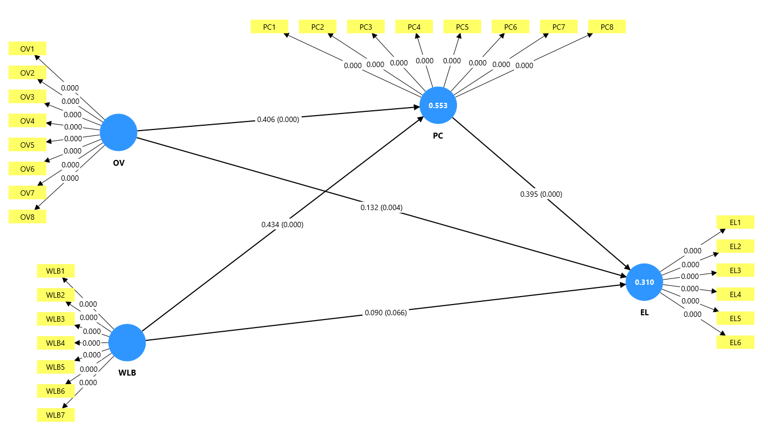
After assessing the measurement model, bias-corrected bootstrapping (10,000 subsamples, two-tailed) was performed to evaluate the structural model (Hair et al., 2019). The results for path coefficients, f2, SRMR, and NFI are presented in Table 5. SRMR (Standardised root mean square values) values below 0.08 and an NFI (Normed Fit Index) of 0.910 indicated good model fit. Effect sizes ranged from small to medium, with WLB showing the strongest effect on PC (f2 = 0.285), followed by OV on PC (f2 = 0.249), highlighting PC as a key mechanism linking OV and WLB to EL.
Direct Effects
The results support H1a, indicating a positive relationship between OV and EL (β = 0.132, p < .05), and H1b, showing a significant positive effect of OV on PC (β = 0.406, p < .001). WLB also demonstrated a significant positive effect on PC, supporting H2b (β = 0.434, p < .001). However, the relationship between WLB and EL was positive but non-significant (β = 0.090, p > .05); therefore, H2a was not supported, suggesting that WLB alone may not directly improve employee loyalty. Furthermore, PC had a significant positive effect on EL (β = 0.395, p < .001), supporting H3a.
Table 5Structural Model Evaluation
Relationships |
Std. beta |
SE |
T-value |
p-values |
BC 95% CI |
s2 |
Decision |
| H1a: OV-EL | 0.132 | 0.045 | 2.918 | .004 | [.044, .223] | 0.014 | Yes |
| H1b: OV-PC | 0.406 | 0.040 | 10.159 | .000 | [.325, .481] | 0.249 | Yes |
| H2a: WLB-EL | 0.090 | 0.049 | 1.840ns | .066 | [-.003, .188] | 0.006 | No |
| H2b: WLB-PC | 0.434 | 0.037 | 11.725 | .000 | [.361, .506] | 0.285 | Yes |
| H3a: PC-EL | 0.395 | 0.054 | 7.254 | .000 | [.288, .501] | 0.101 | Yes |
| Model fit indices | Saturated model | Estimated model | |||||
| SRMR | 0.040 | 0.040 | |||||
| NFI | 0.910 | 0.910 |
The model demonstrated satisfactory explanatory power (R2), with organisational virtuousness and work-life balance explaining 55.3% of the variance in psychological capital and predictor variables explaining 31% of the variance in employee loyalty, as shown in Table 6. Positive Q2 values further confirmed predictive relevance, with high predictive relevance for psychological capital (Q2 = 0.546) and moderate predictive relevance for employee loyalty (Q2 = 0.233). The findings of the structural model are presented in Figure 2.
Table 6Computing the Explained Variance
Construct |
R2 |
R2 adjusted |
Q2 |
| PC | .553 | .551 | .546 |
| EL | .310 | .306 | .233 |
Structural Model Results
Note. OV – organisational virtuousness, WLB – work-life balance, PC – psychological capital, EL– employee loyalty.
Mediation Analysis
Table 7 presents the direct, specific, indirect and total effects of OV and WLB on EL through the mediating role of PC. The results reveal that OV strongly impacts EL through PC (H4a: β = 0.160; t = 5.816; CI [0.109;0.216]; p < .001), highlighting the important role of psychological capital in translating virtuous organisational practices into employee loyalty, supporting H4a. This is evidenced by their variance accounted for (VAF) values ranging from 40% to 57%, indicating the crucial role of PC as a mediator.
In contrast, PC fully mediates the relationship between WLB and EL (H4b: β = 0.171; t = 5.937; CI [0.119;0.232]; p < .001). Although the VAF value falls within the conventional range of 66% associated with partial mediation, the direct effect was non-significant while the indirect effect was significant. This pattern indicates a full (indirect-only) mediation, following the guidelines of Zhao et al. (2010).
Table 7Reporting Mediation Analysis
Type of effect |
Relation |
Path coefficient |
T stats |
BC 95% CI |
Remark |
| Total effect | OV-EL WLB-EL |
0.292 0.261 |
6.761*** 5.652*** |
[0.205, 0.375] [0.169, 0.350] |
Significant total effect |
| Indirect effect | H4a: OV-PC-EL H4b: WLB-PC-EL |
0.160 0.171 |
5.816*** 5.937*** |
[0.109, 0.216] [0.119, 0.232] |
Significant indirect effect |
| Direct effect | OV-EL WLB-EL |
0.132 0.090 |
2.918** 1.840ns |
[0.044, 0.223] [-0.003, 0.188 |
Significant DE Insignificant DE |
| VAF | IE/TE H4a: OV-PC-EL H4b: WLB-PC-EL |
54.79% 65.51% |
|||
| Conclusion | PC partially mediates the relationship between OV and EL, but fully mediates the relationship between WLB and EL. | ||||
Discussion
The study aims to examine the roles of intangible organisational and psychological job resources (organisational virtuousness, work-life balance, psychological capital) in enhancing employee loyalty. The study shows that organisational virtuousness and psychological capital have a significant, positive effect, whereas work-life balance has a positive but moderate association with EL among Gen Z employees in the knowledge-intensive service industries in India. Organisations that promote virtuousness can retain a more loyal workforce during crises (Gogia et al., 2024). Likewise, certain OV indicators such as care, support and inclusiveness could be conceptually similar to organisational support. However, organisational virtuousness is a more encompassing, values- and ethics-based organisational climate, rather than just perceived support (Cameron et al., 2004). Although moderate correlations among these constructs are theoretically plausible, they represent different individual and organisation-based constructs. Also, leaders who exhibit virtuous behaviours inspire employees to exhibit loyalty and spread positive word of mouth (Shahid & Muchiri, 2019; Singh et al., 2024). For Gen Z, WLB moderately affects employee loyalty (p = .066), but millennials experience greater job satisfaction and loyalty than this cohort (Krishna & Agrawal, 2025).
However, when mediated by PC, the link between WLB and EL becomes significant (p = .000), demonstrating that WLB contributes to employee loyalty through PC. These results corroborate a study that demonstrated that work-life balance might not be the sole factor driving employee loyalty (Rahman et al., 2025). In contrast, the association of psychological capital is the highest, implying that personal resources yield positive outcomes and reduce employees’ intent to quit (Deloitte, 2025; Francis & Hoefel, 2018). The indirect effects of both OV and WLB via PC are strong and significant, suggesting that PC is a strong augmenting factor. The findings confirm that a better work-life balance boosts job satisfaction and PC among employees, thereby improving the mental health of employees (Zhang et al., 2024). The present study also demonstrates that the mediation and intervention of personal resources facilitate the outcomes of job resources.
Although the HTMT value between PC and WLB (0.725) was the highest, it was still below the proposed threshold of 0.85, indicating a good degree of discriminant validity (Henseler et al., 2015). Theoretically, there is some overlap, as better psychological resources are likely to be associated with better work-life balance. However, the constructs are still separated conceptually. Work-life balance indicates perceptions of balance between work and personal life, while psychological capital is a state of positive psychology that is defined by hope, efficacy, resilience and optimism.
In addition to statistical significance, the effect size analysis provides a deeper understanding of the proposed relationships. The direct impact of OV and WLB on employee loyalty was small, but both constructs demonstrated a comparatively strong impact on PC. This pattern indicates that employees’ psychological capital helps in translating the effects of organisational resources, serving as a mediator.
The model has a moderate level of explanatory power in behavioural research, accounting for about 31% of the variance in employee loyalty, but almost two-thirds of the variance remains unexplained. This indicates that employee loyalty, being a complex behavioural construct, is influenced by other factors such as leadership style, organisational commitment, compensation, career development opportunities, organisational justice, and employee experience; therefore, these should be explored in further studies. While tangible workplace resources, such as salary and rewards, provide a baseline for employees to survive, intangible workplace resources enable them to thrive by fostering the development of internal personal resources, such as psychological capital. Owing to their unique and inimitable nature, these resources play a significant role in strengthening employee loyalty.
Implications
Theoretical Implications
The study extends the positive psychology literature by combining the elements of positive organisational behaviour (PC) and positive organisational scholarship (OV) and empirically demonstrating that PC serves as a key catalyst through which OV and WLB correspond to employee loyalty among Gen Z. The study refines Conservation of Resources theory by showing that not all organisational resources work in the same manner. Organisational virtuousness had a direct impact on employee loyalty (β = 0.132) and an indirect impact on psychological capital (β = 0.160), suggesting that organisations promoting virtuous climates act as a catalyst for developing employee’s psychological personal resources.
While WLB did not show a direct association with employee loyalty (β = 0.090; p < .05), it demonstrated an indirect relationship through PC (β = 0.171). This asymmetry indicates different organisational resources elicit different resource gain processes. This indirect-only mediation indicates that WLB contributes to employee loyalty primarily through PC. The results refine the Conservation of Resources theory by demonstrating that some resources facilitate employee loyalty through direct/indirect pathways, whereas some translate their effect through internal resources.
Furthermore, the path coefficients from OV (β = 0.406) and WLB (β = 0.434) to PC, as compared with their direct relationships with employee loyalty, highlight PC as a key resource in the Conservation of Resources theory. The results mention the importance of personal resources through which supportive organisational practices correspond to positive attitudes among Gen Z employees.
The effect size estimates add to the theoretical interpretation of findings. OV had a moderate direct influence on employee loyalty, but exerted a higher direct impact on PC, indicating that the main impact of OV is the development of employees’ PC. Similarly, WLB demonstrated a strong impact on employee loyalty via PC, supporting the proposition that personal resources are important bridges connecting organisational resources to employee outcomes.
Managerial Implications
The study findings suggest that not all workplace resources influence employee loyalty in the same manner. OV shows a direct and an indirect relationship with employee loyalty, indicating that organisations fostering virtuousness through moral correctness, human welfare, supportive leadership, and inclusiveness can strengthen employee loyalty even beyond psychological capital. Consequently, it is the duty of managers and leaders to create a workplace environment where employees feel respected, safe and supported.
In contrast, WLB did not demonstrate a significant direct relationship with employee loyalty but had an indirect association through psychological capital. The findings reveal that flexible arrangements and work-life balance programmes alone may be insufficient to sustain Gen Z employees unless they are supported by fostering employees’ psychological capital. Organisations, therefore, must enhance flexible working and employ the right interventions to develop optimism, resilience, confidence and hope through coaching, mentoring, strengths-based leadership and developmental feedback. Such an integrated method is likely to yield more effective results than providing WLB in isolation.
Limitations and Conclusion
Workplace resources result in engagement among Gen Z, but they only work when designed to address Gen Z’s personal needs for meaning, mental health, and work-life balance. They require a relational connection to stay truly engaged, where they feel their individual growth is supported and personal contributions are valued. This study is limited to the Generation Z workforce, but it acknowledges the broader discussion on generational cohort research. Variations between generations have been suggested to be partly due to age, career stage or larger socio-economic factors, instead of generational features. The findings, therefore, should be interpreted as specific to this sample of Generation Z employees, rather than implying homogeneous characteristics across the entire generation. Future research could involve an intergenerational comparison to better understand these differences. The involvement of HR managers can further facilitate this process. Demographic data on gender, mode of working, industry type and public/private sector were gathered, but not included in inferential analysis. The sample was concentrated mainly in the IT and banking and financial services sectors, thereby limiting its applicability to knowledge-intensive service organisations rather than other service sectors like healthcare, tourism, hospitality, etc. Further research may explore their direct, moderating or comparative effects to provide a richer understanding of the proposed relationships in a variety of organisational and workforce settings. Future researchers can use qualitative methods to complement quantitative results.
Conflict of Interest: The authors declare that they have no known competing financial interests or personal relationships that could influence the work reported in this paper.
Ethical Approval: This study has been conducted in accordance with the guidelines and ethical research principles laid down by the Institutional Ethical Research Advisory Committee, ensuring confidentiality, anonymity, and voluntary participation (NITJ/DRC/1924).
References
- Aboobaker, N., Edward, M., & Zakkariya, K. A. (2022). Workplace spirituality, well-being at work and employee loyalty in a gig economy: multi-group analysis across temporary vs permanent employment status. Personnel Review, 51(9), 2162–2180. https://doi.org/10.1108/PR-01-2021-0002
- Arshad, B., Hassan, H., & Azam, A. (2025). The impact of perceived organizational virtuousness on employees’ innovative behavior. International Journal of Ethics and Systems, 41(4), 867–885. https://doi.org/10.1108/IJOES-11-2023-0261
- Aubouin-Bonnaventure, J., Fouquereau, E., Coillot, H., Lahiani, F. J., & Chevalier, S. (2023). A new gain spiral at work: relationships between virtuous organizational practices, psychological capital, and well-being of workers. International Journal of Environmental Research and Public Health, 20(3), 1823. https://doi.org/10.3390/ijerph20031823
- Barney, J. (1991). Firm resources and sustained competitive advantage. Journal of Management, 17(1), 99-120. https://doi.org/10.1177/014920639101700108
- Bieleń, M., & Kubiczek, J. (2020). Response of the labor market to the needs and expectations of Generation Z. e-mentor, 4(86), 87–94. https://www.doi.org/10.15219/em86.1486
- Cameron, K. S., Bright, D., & Caza, A. (2004). Exploring the relationships between organizational virtuousness and performance. American Behavioral Scientist, 47(6), 766–790. https://doi.org/10.1177/0002764203260209
- Chand, P. K., Tandon, U., & Mishra, N. (2026). Get cold feet: job hopping a conundrum in the stable employment of Gen Z employees at Industry 5.0. Kybernetes, 55(2), 1037–1058. https://doi.org/10.1108/K-04-2024-0943
- Chen, S. L., Shih, C. T., & Chi, N. W. (2018). A multilevel job demands–resources model of work engagement: Antecedents, consequences, and boundary conditions. Human Performance, 31(5), 282–304. https://doi.org/10.1080/08959285.2018.1531867
- Cherkaoui, S., Daidai, F., Alami, S., Cappelletti, L., & Marghich, A. (2025). The emergence of new determinants of employee loyalty for generation Z in Morocco: the mediating role of commitment. International Journal of Organizational Analysis. https://doi.org/10.1108/IJOA-11-2024-4980
- Dai, Y., Tang, Y. M., Chen, W., & Hou, J. (2022). How organizational trust impacts organizational citizenship behavior: Organizational identification and employee loyalty as mediators. Frontiers in Psychology, 13 (996962). https://doi.org/10.3389/fpsyg.2022.996962
- Das, A. K., & Malik, P. (2025). Ascertaining factors inducing engagement and stay intention among Gen Z: a qualitative study in the Indian context. International Journal of Organizational Analysis, 33(1), 163-184. https://doi.org/10.1108/IJOA-09-2023-3994
- David, R., Singh, S., Mikkilineni, S., & Ribeiro, N. (2024). A positive psychological approach for improving the well-being and performance of employees. International Journal of Productivity and Performance Management, 73(9), 2883-2900.
- Deloitte. (2025). 2025 Gen Z and Millennial Survey. https://www.deloitte.com/content/dam/assets-shared/docs/campaigns/2025/2025-genz-millennial-survey.pdf
- Dolot, A. (2018). The characteristic of Generation Z. e-mentor, 2(74), 44–51. https://www.doi.org/10.15219/em74.1351
- Dubey, S., Ruparel, N., & Choubisa, R. (2020). Does organizational virtuousness and psychological capital impact employee performance: evidence from the banking sector. Development and Learning in Organizations: An International Journal, 34(5), 17–19. https://doi.org/10.1108/DLO-08-2019-0190
- Dutta, T., & Dhir, S. (2025). Employee loyalty: measurement and validation. Global Business Review, 26(2), 346–363. https://doi.org/10.1177/0972150921990809
- Fornell, C., & Larcker, D. F. (1981). Structural equation models with unobservable variables and measurement error: algebra and statistics. Journal of Marketing Research, 18(3), 382. https://doi.org/10.1177/002224378101800313
- Francis, T., & Hoefel, F. (2018). True Gen’: Generation Z and its implications for companies. McKinsey and Company.
- Glavanits, J., Hengl, K., & Benyák, A. (2025). Psychological capital, workplace stress, and mobbing in the context of workers’ mental health. Societies, 15(9), 244. https://doi.org/10.3390/soc15090244
- Gogia, E. H., Shao, Z., Khan, K., Rehman, M. Z., Haddad, H., & Al-Ramahi, N. M. (2024). "Exploring the relationship of organizational virtuousness, citizenship behavior, job performance, and combatting ostracism” through structural equational modeling. BMC Psychology, 12(1), 384. https://doi.org/10.1186/s40359-024-01873-9
- Hair, J. F., Matthews, L. M., Matthews, R. L., & Sarstedt, M. (2017). PLS-SEM or CB-SEM: updated guidelines on which method to use. International Journal of Multivariate Data Analysis, 1(2), 107–123. https://doi.org/10.1504/IJMDA.2017.087624
- Hair, J. F., Risher, J. J., Sarstedt, M., & Ringle, C. M. (2019). When to use and how to report the results of PLS-SEM. European Business Review, 31(1), 2–24. https://doi.org/10.1108/EBR-11-2018-0203
- Hayman, J. (2005). Psychometric assessment of an instrument designed to measure work life balance. Research and Practice in Human Resource Management, 13(1), 85–91.
- Henseler, J., Ringle, C. M., & Sarstedt, M. (2015). A new criterion for assessing discriminant validity in variance-based structural equation modeling. Journal of the Academy of Marketing Science, 43(1), 115–135. https://doi.org/10.1007/s11747-014-0403-8
- Ho, H. C., Hou, W. K., Poon, K. T., Leung, A. N., & Kwan, J. L. (2023). Being virtuous together: a one-year prospective study on organizational virtuousness, well-being, and organizational commitment. Applied Research in Quality of Life, 18(1), 521-542. https://doi.org/10.1007/s11482-022-10094-4
- Hobfoll, S. E. (1989). Conservation of resources: a new attempt at conceptualizing stress. American Psychologist, 44(3), 513–524. https://doi.org/10.1037/0003-066X.44.3.513
- India Brand Equity Foundation. (2025). IT & BPM industry in India. https://www.ibef.org/industry/information-technology-india
- Jain, N., Sanghi, K., Singhal, A., Chawla, I., Kanekar, V., Trivedi, P., Jha Saurabh, S., Chaubey, A., & Nikam, P. (2024). The $2 trillion opportunity: How Gen Z is shaping the New India. Boston Consulting Group. https://www.bcg.com/publications/2024/india-the-2-trillion-opportunity-how-gen-z-is-shaping-the-new-india
- Kalinowska-Andrian, K. (2006). Positive Organizational Scholarship – a new trend in management science. e-mentor, 1(13), 9-13.https://www.e-mentor.edu.pl/artykul/index/numer/13/id/235
- Krishna, S. M., & Agrawal, S. (2025). Creative performance of Millennials and Generation Z: What matters more, intrinsic or extrinsic rewards? Administrative Sciences, 15(1), 11. https://doi.org/10.3390/admsci15010011
- Luthans, F., Avolio, B. J., Avey, J. B., & Norman, S. M. (2007). Positive psychological capital: Measurement and relationship with performance and satisfaction. Personnel Psychology, 60(3), 541–572. https://doi.org/10.1111/j.1744-6570.2007.00083.x
- Łukasiński, W., & Romański, P. (2025). Employee competencies from the perspective of Generation Z representatives. e-mentor, 5(112), 35–46. https://www.doi.org/10.15219/em112.1732
- Ma, D., Wajid, N., Anser, M. K., Anjum, Z. U. Z., & Jia, X. (2022). The effect of ethical leadership on service recovery performance: A moderated mediation model of organizational virtuousness and trait mindfulness. Frontiers in Psychology, 13(1036099). https://doi.org/10.3389/fpsyg.2022.1036099
- Miles, J., & Shevlin, M. (2001). Applying regression and correlation: A guide for students and researchers. Sage Publications.
- Nguyen Ngoc, T., Viet Dung, M., Rowley, C., & Pejić Bach, M. (2022). Generation Z job seekers’ expectations and their job pursuit intention: Evidence from transition and emerging economy. International Journal of Engineering Business Management, 14, 18479790221112548. https://doi.org/10.1177/18479790221112548
- Olii, C. F. R., Suwarno, H. L., & Hadianto, B. (2024). Work-life balance, job satisfaction, and employee loyalty. Journal of Economics and Business, 7(3), 262–272. https://doi.org/10.31014/aior.1992.07.03.610
- Panda, & Singh, P. (2026). Perceived organizational virtuousness and employee’s subjective well-being: examining the role of resilience, agility and collectivism. Management Decision, 64(5), 1940-1959. https://doi.org/10.1108/MD-01-2024-0076
- Parray, Z. A., Shah, T. A., & Islam, S. U. (2022). Psychological capital and employee job attitudes: the critical significance of work-life balance. Evidence-Based HRM: A Global Forum for Empirical Scholarship Emerald Publishing Limited., 11(3), 483–500. https://doi.org/10.1108/EBHRM-07-2022-0160
- Podsakoff, N. P., MacKenzie, S. B., Lee, J. Y., & Podsakoff, N. P. (2003). Common method biases in behavioral research: a critical review of the literature and recommended remedies. Journal of Applied Psychology, 88(5), 879–903. https://doi.org/10.1037/0021-9010.88.5.879
- Rahman, H. M., Malarvizhi, C. A. N., & Khan, N. (2025). Decoding turnover intention in Malaysia’s ICT industry: the mediating role of employee loyalty in the nexus between exploring the recruitment and selection, training and development, and work-life balance. Cogent Business & Management, 12(1), 2536672. https://doi.org/10.1080/23311975.2025.2536672
- Samroodh, M., Anwar, I., Ahmad, A., Akhtar, S., Bino, E., & Ali, M. A. (2023). The indirect effect of job resources on employees’ intention to stay: A serial mediation model with psychological capital and work–life balance as the mediators. Sustainability, 15(1), 551. https://doi.org/10.3390/su15010551
- Schroth, H. (2019). Are you ready for gen Z in the workplace? California Management Review, 61(3), 5-18. https://doi.org/10.1177/0008125619841006
- Shahid, S., & Muchiri, M. K. (2019). Positivity at the workplace: conceptualising the relationships between authentic leadership, psychological capital, organisational virtuousness, thriving and job performance. International Journal of Organizational Analysis, 27(3), 494–523. https://doi.org/10.1108/IJOA-05-2017-1167
- Silva, I., Dias, Á., & F. Pereira, L. (2024). Determinants of employee intention to stay: a generational multigroup analysis. International Journal of Organizational Analysis, 32(8), 1389-1418. https://doi.org/10.1108/IJOA-06-2023-3796
- Singh, R., Chaudhury, S., Sihag, P., & Shuck, B. (2023). Unpacking generation Y’s engagement using employee experience as the lens: an integrative literature review. Human Resource Development International, 26(5), 548–576. https://doi.org/10.1080/13678868.2023.2170210
- Singh, S., Subramani, A. K., David, R., & Jan, N. A. (2024). Workplace ostracism influencing turnover intentions: Moderating roles of perceptions of organizational virtuousness and authentic leadership. Acta Psychologica, 243, 104136.
- Twenge, J. M., Campbell, S. M., Hoffman, B. J., & Lance, C. E. (2010). Generational differences in work values: Leisure and extrinsic values increasing, social and intrinsic values decreasing. Journal of Management, 36(5), 1117-1142. https://doi.org/10.1177/0149206309352246
- Wongprasurt, S., & Lee, W. S. (2024). The comparison of factors affecting employee loyalty of Generations X, Y and Z in Bangkok’s hotel and restaurant industries. ASEAN Journal on Hospitality and Tourism, 22(3), 310-325. https://doi.org/10.5614/ajht.2024.22.3.05
- Wójcik, M., & Łukasiński, W. (2024). Identifying the disadvantages of remote working as a source of loss of employee satisfaction- the perspective of Generation Z in Poland. e-mentor, 1(103), 25–34. https://doi.org/10.15219/em103.1649
- Zaheer, A., Rauf, N. K., & Wazir, V. (2022). Organizational virtuousness and job satisfaction among employees with visual impairment: role of psychological capital. British Journal of Visual Impairment, 42(2). https://doi.org/10.1177/02646196221135009
- Zhang, J., Rehman, S., Addas, A., & Ahmad, J. (2024). Influence of work-life balance on mental health among nurses: The mediating role of psychological capital and job satisfaction. Psychology Research and Behavior Management, 17, 4249–4262. https://doi.org/10.2147/PRBM.S497305
- Zhao, X., Lynch Jr, J. G., & Chen, Q. (2010). Reconsidering Baron and Kenny: Myths and truths about mediation analysis. Journal of Consumer Research, 37(2), 197–206. https://doi.org/10.1086/651257
 https://orcid.org/0009-0006-1744-7716