

Informacje o artykule
DOI: https://www.doi.org/10.15219/em114.1747
W wersji drukowanej czasopisma artykuł znajduje się na s. 41-53.
 Pobierz artykuł w wersji PDF
 Abstract in English
Jak cytować
Amzai, A. (2026). Exploring the impact of economic freedom on entrepreneurial innovation and business growth: The case of North Macedonia. e-mentor, 2(114), 41-53. https://www.doi.org/10.15219/em114.1747
Copyright © 2026, Arjeta Amzai


E-mentor nr 2 (114) / 2026
Spis treści artykułu
- Abstract
- Introduction
- Literature Review
- Methodology
- Analysis and Interpretation of Research Data
- Qualitative Research
- Qualitative research: Government Perspectives on Entrepreneurship and Economic Freedom in North Macedonia
- Conclusion and Recommendations
- Limitations and Future Improvements
- References
Informacje o autorze
Exploring the Impact of Economic Freedom on Entrepreneurial Innovation and Business Growth: The Case of North Macedonia
Arjeta Amzai
Abstract
This study examines the relationship between economic freedom, entrepreneurial innovation, and business growth in North Macedonia. Despite the country’s notable economic changes, the entrepreneurial landscape remains shaped by institutional-quality challenges and regulatory impediments. Policymakers and business actors can benefit from understanding how perceptions of economic freedom affect business outcomes, thereby supporting sustainable growth. This study explores whether higher perceived economic freedom correlates with greater innovation and business growth among entrepreneurs in North Macedonia. Using a mixed-methods design, this study examines the opportunities and challenges faced by entrepreneurs by combining qualitative thematic analysis with quantitative survey data. An online survey with Likert-scale items and open-ended questions was used to gather data from 150 participants, including analysts, experts, and entrepreneurs from a variety of industries. Descriptive statistics and correlation analysis in SPSS were used to assess the quantitative component, while thematic coding was used to identify recurring themes and insights in the qualitative responses. Limited access to finance and regulatory complexity hinder innovation despite some improvements in property rights. The findings indicate that encouraging entrepreneurial innovation and long-term business growth in North Macedonia requires streamlining regulatory frameworks and increasing access to funding. Increased economic freedom boosts competitiveness and lowers barriers to starting new businesses, allowing start-ups to flourish and supporting overall economic growth. By comparing the results with previous research on the Western Balkans, the study offers insights that can inform a more strategic approach to entrepreneurial policy in North Macedonia.
Keywords: economic freedom, innovation, entrepreneurship, North Macedonia, business growth
Introduction
Over the past thirty years, North Macedonia has moved from the constraints of a centrally planned system towards the institutions of a market economy. This transition has been accompanied by membership in international organisations and a wave of structural reforms, yet many entrepreneurs still describe the business environment as difficult. They most often point to complicated regulations, limited financing channels, and recurring political uncertainty.
In this setting, the idea of economic freedom offers a useful way to understand how rules and institutions shape the chances for new firms to innovate and expand. By economic freedom, we mean the extent to which people and businesses can make their own choices without excessive state involvement, with key dimensions including secure property rights, clear regulations, and open markets. An empirical study by Estrin et al. (2013) provide strong evidence that inadequate property rights protection create institutional barriers, reducing entrepreneurs development.
The study explores how perceptions of economic freedom relate to entrepreneurial outcomes in North Macedonia. We ask whether higher levels of perceived freedom go hand in hand with stronger innovation and business growth. To answer this, we combined a statistical analysis of survey data with insights from entrepreneurs’ own written accounts. This mix of quantitative and qualitative evidence allows us not only to identify general patterns but also to highlight the lived experiences behind those numbers. Unlike many previous studies that focus exclusively on entrepreneurs’ perceptions, this study integrates both entrepreneurial and institutional perspectives to explain how economic freedom, institutional trust, and governance structures interact to shape innovation and business growth in North Macedonia. The study further contributes by examining the emerging risks of entrepreneurial brain drain within the context of future European integration. In doing so, we aim to contribute to the still-limited discussion of how economic freedom shapes entrepreneurship in transitional economies of the Western Balkans.
Literature Review
The theoretical foundations for linking economic freedom and entrepreneurship trace back to Schumpeter’s (1942) idea of creative destruction, which positions the entrepreneur as a disruptive innovator in the marketplace. North (1990) later highlighted that such innovation cannot thrive without supportive institutions – clear property rights, predictable legal frameworks, and enforceable contracts. Building on this tradition, Acemoglu and Robinson (2012) argued that inclusive institutions nurture innovation and long-term growth, while extractive systems suppress entrepreneurial activity. Together, these perspectives underscore that entrepreneurship is as much a product of institutional design as of individual creativity. According to Bowen & De Clercq (2008) entrepreneurs engage improve business growth.
Empirical studies have reinforced this view. Cross-country analyses, such as Berggren’s (2003), show that higher levels of economic freedom often align with faster growth and more competitive business environments. An empirical study about economic freedom and economic growth in Southeast European countries over the period 2000-2019 found that economic growth has a positive and statistically significant impact on economic growth (Emini, 2021). More recent evidence using the Heritage Foundation’s Index of Economic Freedom and the Fraser Institute’s Economic Freedom of the World index finds positive correlations between freedom scores and outcomes such as firm creation, productivity, and innovation capacity (Miller & Kim, 2023). According to Gwartney et al. (2021), higher levels of economic freedom are associated with stronger business performance. Yet, these benefits are uneven. In transitional economies, weak institutions frequently undermine the potential gains from liberalisation. Džafić (2014) documents how SMEs in the Western Balkans struggle with bureaucracy, corruption, and inconsistent regulatory enforcement, while Bitzenis and Nito (2005) observed similar barriers in Albania. These challenges resonate strongly in North Macedonia, where entrepreneurs continue to report limited access to credit, fragile property rights, and uneven market competition.
Despite such obstacles, incremental improvements in economic freedom can have tangible effects. Bartlett and Prica (2017), for example, note how closer integration with the European Union has created opportunities for Western Balkan firms. The World Bank’s (2020) Doing Business report likewise shows that targeted reforms – such as simplifying registration or streamlining taxation – can lower entry barriers. Still, these reforms are often fragile, especially when political instability erodes predictability.
According to Bowen & De Clercq (2008) entrepreneurs engage improve innovation and business growth. However, as stated by Smallbone & Welter (2008) institutional and political environment that enables development is essential for entrepreneurial growth and economic development. Institutional quality is also central to fostering entrepreneurial innovation. Entrepreneurs in emerging economies typically face a dual challenge: scarce venture financing and burdensome administrative procedures. In North Macedonia, regulatory compliance costs, licensing delays, and restricted funding opportunities remain key barriers. Yet perception matters too. Research suggests that entrepreneurs who feel greater autonomy are more inclined to take risks and adopt new technologies, pointing to a psychological dimension of economic freedom that complements formal reforms. The relationship between entrepreneurship and institutional support can also be understood through the Triple Helix framework proposed by Etzkowitz and Leydesdorff (2000), which emphasises the interaction between universities, industry, and government in fostering innovation ecosystems. In transitional economies, the effectiveness of entrepreneurial development depends not only on market liberalisation but also on the quality of cooperation among these institutional actors. Weak coordination among academia, public institutions, and private industry may significantly limit the capacity for innovation and long-term business growth.
Comparative evidence from neighbouring countries highlights similar dynamics. Serbian entrepreneurs cite finance and regulation as persistent hurdles, while in Albania, reforms have improved economic freedom rankings without fully resolving informality and weak enforcement. These parallels suggest that North Macedonia’s constraints are not isolated but reflect broader structural issues in the Western Balkans.
Taken together, the literature reveals a consistent pattern: economic freedom supports entrepreneurship, but the magnitude of this effect depends heavily on institutional quality and access to finance. In North Macedonia, progress in property rights and regulatory reforms has created some momentum, yet innovation and firm growth remain constrained. Closing this gap will require not only stronger legal and financial institutions but also efforts to build entrepreneurs’ confidence in their autonomy and opportunities.
Figure 1Conceptual Framework of the Relationship Between Economic Freedom, Institutional Trust, Innovation Capacity, and Business Growth in North Macedonia
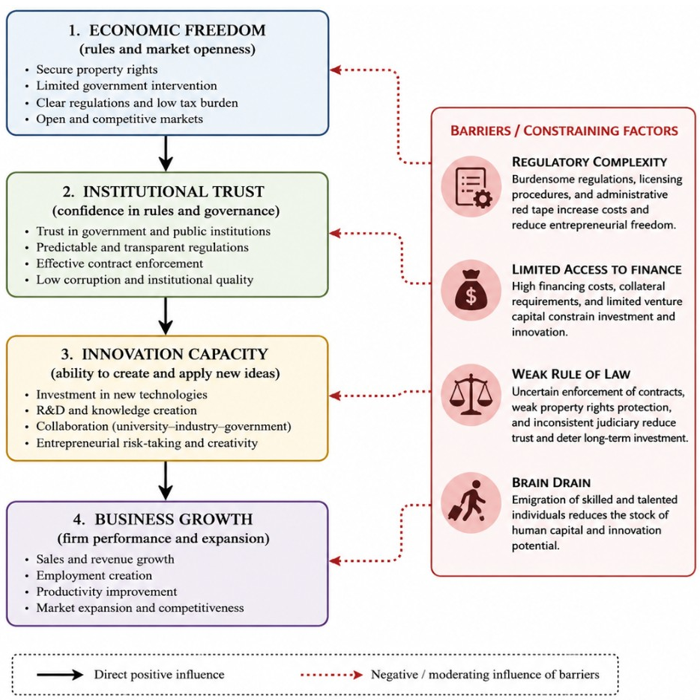
Note. The model proposes that economic freedom enhances institutional trust, which in turn builds innovation capacity and contributes to business growth. However, regulatory complexity, limited access to finance, weak rule of law, and brain drain can weaken this process.
Figure 1 presents the study’s conceptual framework, illustrating the relationships among economic freedom, institutional trust, innovation capacity, and business growth, as well as the main institutional barriers constraining entrepreneurial development in North Macedonia.
Methodology
A mixed-methods design was employed, combining survey data with qualitative insights from entrepreneurs. This approach was chosen to capture both the statistical relationships between perceptions of economic freedom and business outcomes and the personal perspectives of entrepreneurs on institutional challenges in North Macedonia. To deepen the study’s interpretative dimension, an additional qualitative empirical phase was conducted through semi-structured interviews with 10 government representatives and institutional stakeholders involved in entrepreneurship and innovation policy in North Macedonia. The integration of institutional perspectives enabled triangulation between entrepreneurs’ perceptions and policy-level interpretations of the entrepreneurial ecosystem.
The study focused on entrepreneurs, business analysts, and sector experts across North Macedonia, with attention to the predominance of small and medium-sized enterprises. Purposive sampling was applied, and 150 questionnaires were distributed online. A subset of responses was used for pilot testing and preliminary feedback. In parallel, semi-structured interviews were conducted with representatives from institutions associated with SME development, innovation support, economic policy, and entrepreneurial governance, including public agencies, innovation funds, chambers of commerce, and university innovation centres.
The sample reflects the structure of the national entrepreneurial landscape. Most respondents were between 25 and 44 years old, an age group often driving new business initiatives. Male participants predominated, reflecting regional gender disparities in entrepreneurship. While IT and technology firms made up a large portion of the sample, respondents also came from trade, services, and other sectors. The majority managed micro and small firms (1–20 employees), underscoring the centrality of SMEs in the national economy.
Data Collection and Analysis
The main hypothesis of the research study is the following: “Perceptions of greater economic freedom (fair competition, secure property rights, and predictable institutions) have a positive impact on firms’ innovation capacity and growth in North Macedonia, while limited access to finance, complex regulations, and weak institutional enforcement constrain these effects.”
Data were collected via an online questionnaire comprising three sections. The first captured demographic details (age, gender, sector, firm size). The second measured perceptions of economic freedom, including taxation, regulation, property rights, competition, and finance. The third section assessed entrepreneurial outcomes such as innovation, R&D investment, expansion, and revenue growth.
Likert-scale (1–5) items provided quantitative data, while open-ended questions encouraged participants to describe their personal experience.
Quantitative analysis was carried out using SPSS. Descriptive statistics were calculated first, followed by Pearson correlations to explore relationships between economic freedom indicators and entrepreneurial outcomes. Ordinary Least Squares (OLS) regression was then applied to test predictive effects on innovation capacity and revenue growth.
Qualitative responses were analysed thematically, with recurring issues identified around regulatory complexity, financing constraints, and institutional trust.
Reliability was ensured through internal consistency checks (Cronbach’s alpha). Validity was supported by aligning survey items with established indices of economic freedom (Heritage Foundation, Fraser Institute) and tailoring them to the North Macedonian context. Triangulation of quantitative and qualitative evidence strengthened the robustness of findings.
Ethical Considerations
Informed consent was obtained from all participants. Data were collected anonymously, and no identifying information was published. The study followed ethical standards for social science research, ensuring confidentiality and voluntary participation.
Demographic Data
Table 1 summarises the main demographic characteristics of the respondents, covering age, gender, sector of activity, and firm size. The distribution reflects the composition of the entrepreneurial landscape in North Macedonia, where younger cohorts, male ownership, and small enterprises dominate the business environment. This profile provides important context for interpreting subsequent findings, as patterns of perception and performance are often shaped by such structural factors.
Table 1Demographic Landscape of the Research Data
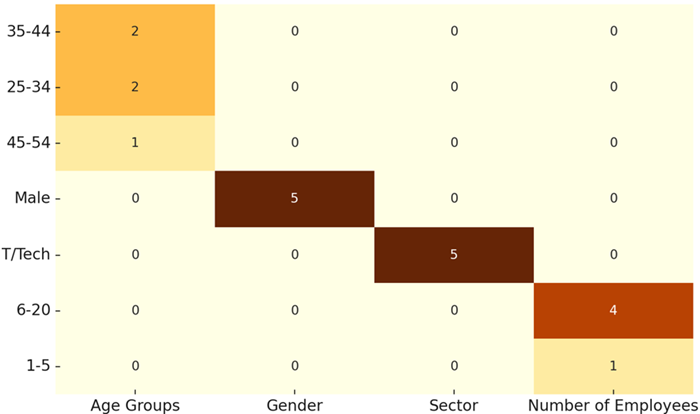
Table 1 outlines the demographic profile of the respondents. The majority fall within the 25–44 age range, indicating a strong presence of young and mid-career entrepreneurs in North Macedonia’s business landscape. This pattern is consistent with regional developments in the Western Balkans, where younger cohorts tend to be more engaged in entrepreneurship due to their adaptability and greater exposure to international markets.
The gender distribution shows a predominance of male respondents, reflecting the persistent gender imbalance in entrepreneurial participation. Such disparities are well documented in studies of transition economies, where cultural expectations and structural barriers often limit women’s involvement in business ownership.
In terms of sectoral representation, the IT/Tech industry dominates the sample. This outcome aligns with broader global trends, in which digital enterprises benefit from lower entry barriers and stronger prospects for innovation. By contrast, the weaker presence of traditional sectors such as manufacturing and agriculture suggests that entrepreneurial activity in North Macedonia remains concentrated in newer, high-growth industries rather than widely spread across the economy.
Firm size further illustrates this concentration. Most respondents operate small enterprises employing between 1 and 20 workers, underscoring the central role of SMEs in the national economy. These firms are particularly vulnerable to institutional conditions such as regulatory requirements and access to finance – two barriers that feature prominently in the later analysis.
Taken together, the demographic profile depicts a sample representative of North Macedonia’s entrepreneurial core: younger, male-led SMEs concentrated in the technology sector. This context is important when considering the findings on economic freedom and innovation presented in the subsequent sections.
Analysis and Interpretation of Research Data
Quantitative Research
This section reports the findings from the quantitative analysis of the survey data. The presentation begins with descriptive statistics to provide an overview of the sample’s key characteristics, followed by correlations that explore associations between perceptions of economic freedom and entrepreneurial outcomes. Finally, regression models are introduced to examine whether variations in perceived economic freedom help explain differences in innovation and firm growth among entrepreneurs in North Macedonia.
Table 2Descriptive Statistics of Key Variables
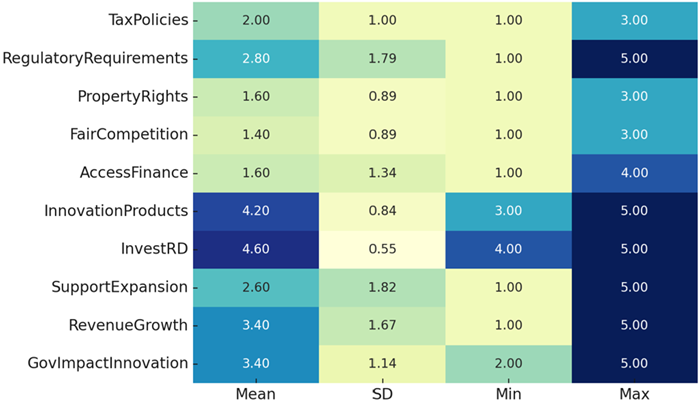
Table 2 summarises the measures of central tendency and dispersion for the main survey items. The results show particularly low ratings for tax policies and access to finance, both averaging below 2 on the Likert scale. These responses indicate widespread dissatisfaction with fiscal and financial frameworks, areas consistently cited as barriers to entrepreneurship in transitional economies.
By contrast, the highest scores were recorded for innovation capacity and investment in research and development. This pattern suggests that, even in the face of regulatory and financial constraints, firms in North Macedonia display notable resilience and a commitment to pursuing innovation. The findings resonate with the broader literature, which identifies institutional barriers as critical obstacles while also emphasising SMEs’ ability to sustain innovative practices despite adverse conditions.
Table 3Correlation Matrix of Economic Freedom and Outcomes
| Variable | 1 | 2 | 3 | 4 | 5 | 6 | 7 | 8 | 9 | 10 | |
| 1. | Tax Policies | 1.00 | |||||||||
| 2. | Regulatory Requirements | -.42 | 1.00 | ||||||||
| 3. | Property Rights | -.28 | .25 | 1.00 | |||||||
| 4. | Fair Competition | .56 | .38 | .25 | 1.00 | ||||||
| 5. | Access to Finance | .56 | .37 | .25 | 1.00 | 1.00 | |||||
| 6. | Innovation Products | .00 | -.63 | .47 | -.13 | -.13 | 1.00 | ||||
| 7. | Investment in R&D | -.91 | .15 | .10 | -.61 | -.61 | .22 | 1.00 | |||
| 8. | Support for Expansion | .55 | -.88 | -.58 | -.18 | -.18 | .39 | -.20 | 1.00 | ||
| 9. | Revenue Growth | .00 | -.63 | .47 | -.13 | -.13 | 1.00 | .22 | .39 | 1.00 | |
| 10. | Government Impact on Innovation | .00 | -.69 | .20 | -.20 | -.20 | .94 | .32 | .58 | .94 | 1.00 |
The correlation matrix presented in Table 3 reveals several noteworthy relationships between institutional factors and entrepreneurial performance. Strong negative correlations were observed between regulatory requirements and both innovation (r = –.63) and revenue growth (r = –.63), suggesting that excessive bureaucracy places a significant burden on firms and constrains their ability to expand or introduce new ideas.
In contrast, property rights and perceptions of government support were positively associated with both growth and innovation. These results underscore the importance of secure ownership frameworks and predictable institutional backing in creating an environment where businesses can thrive.
Taken together, the findings echo regional evidence from the Western Balkans, where institutions often play a dual role – serving either as barriers that stifle entrepreneurship or as enablers that provide the stability and confidence required for innovation.
Figure 2aRegression Coefficients Predicting Innovation
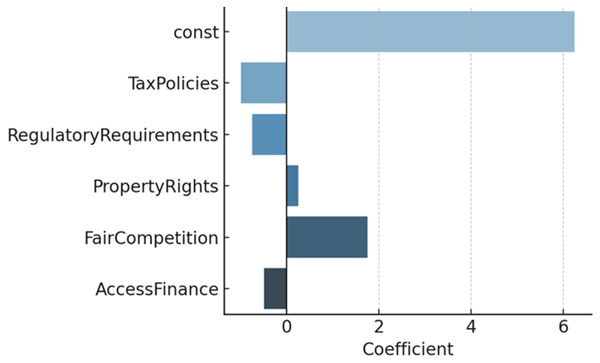
The regression results presented in Figure 2a indicate that perceptions of fair competition (+1.75) and secure property rights (+0.25) have a positive effect on innovation outcomes. In contrast, unfavourable tax policies (–1.00) and heavy regulatory requirements (–0.75) exert a negative influence. These findings suggest that innovation is more likely to emerge in contexts where entrepreneurs view markets as open and ownership as protected, whereas fiscal pressures and bureaucratic obstacles reduce firms’ willingness or capacity to pursue new initiatives.
The direction of the coefficients corresponds with theoretical expectations and with previous empirical research on transition economies, where institutional incentives often determine whether entrepreneurs invest in innovation or retreat to less risky activities.
Figure 2bRegression Coefficients Predicting Revenue Growth
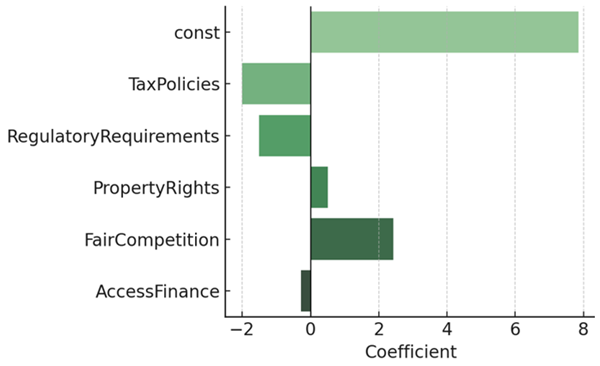
Figure 2b shows a comparable pattern for revenue growth. Fair competition (+2.43) and secure property rights (+0.50) emerge as positive predictors of firm expansion, whereas unfavourable tax policies (–2.00) and burdensome regulatory requirements (–1.50) exert negative effects. These findings indicate that the institutional environment directly shapes entrepreneurial performance: supportive frameworks encourage growth, while restrictive policies constrain potential. Although the sample size is relatively modest, the results align with cross-country evidence underscoring the role of market-friendly institutions in fostering sustainable business development.
Taken together, the analysis highlights two parallel dynamics in North Macedonia. On the one hand, regulatory complexity and limited access to finance continue to pose significant barriers to entrepreneurial growth. On the other hand, secure property rights and perceptions of fair competition provide essential incentives for both innovation and expansion. These findings reinforce the view that institutional reforms should prioritise reducing bureaucratic burdens and improving access to finance, while at the same time safeguarding competitive markets as a foundation for long-term development.
Qualitative Research
Although the survey relied mainly on structured items, space was also provided for open-ended feedback. These qualitative inputs were thematically coded and subsequently quantified to identify recurring patterns across respondents. This section summarises the open-ended responses (Questions 16–20), presenting the main themes together with their percentage frequencies. Visualisations are included to illustrate the relative prevalence of each theme among respondents.
Figure 3Question 16: Barriers to Entrepreneurship
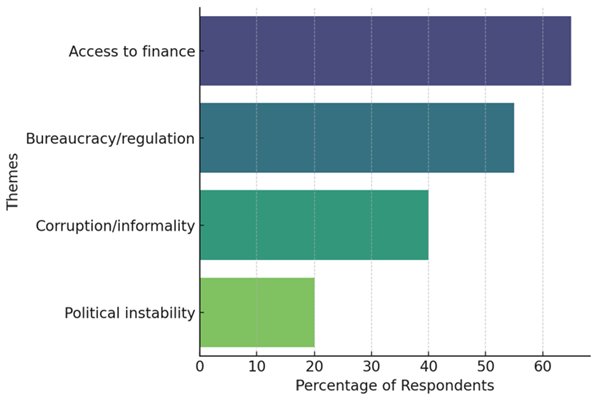
Access to finance (65%) and regulatory burdens (55%) emerged as the most frequently reported barriers to entrepreneurship in North Macedonia. Respondents described difficulties in securing loans or venture capital, as well as frustrations with lengthy procedures and excessive documentation. Corruption and informal practices were also highlighted by 40% of participants, often linked to perceptions of favouritism and the absence of fair competition. Political instability was mentioned less frequently (20%) but was seen as a source of uncertainty that discourages long-term investment decisions.
Taken together, these responses confirm that financial constraints and regulatory inefficiency remain the most pressing challenges for entrepreneurs. The qualitative insights therefore reinforce the patterns observed in the quantitative analysis, underlining the systemic nature of institutional barriers in the Macedonian business environment.
Figure 4Question 17: Government Policies and Innovation
Half of the respondents reported that government policies tend to hinder innovation, largely due to excessive complexity. Another 35% emphasised the absence of meaningful incentives for research and development (R&D), citing a lack of tax relief or subsidies to stimulate investment in new technologies. At the same time, a quarter of the sample acknowledged positive reforms, particularly in the areas of digitalisation and business registration, which were perceived as steps in the right direction.
Overall, the responses suggest that, although certain reforms have been welcomed, many entrepreneurs continue to view regulations as restrictive rather than supportive. This perception is especially pronounced in R&D-intensive sectors, where the absence of policy incentives further discourages innovative activity.
Figure 5Question 18: Policy Changes to Improve Ecosystem
The majority of respondents recommended simplifying tax and regulatory frameworks (60%), arguing that streamlined procedures would remove many of the bottlenecks that currently discourage entrepreneurship. Improved access to credit and venture funding was the second-most-frequent suggestion (50%), reflecting widespread concern about financing constraints. In addition, 30% of participants emphasised the need for stronger enforcement of property rights and contractual obligations, while 25% highlighted the value of education and training programmes aimed at developing entrepreneurial skills.
Together, these responses point to systemic challenges in the entrepreneurial ecosystem. Calls for regulatory simplification and better financing opportunities appear most urgent, while issues of legal protection and capacity building are also recognised as important areas for reform.
Figure 6Question 19: Examples of Economic Freedom Impact
Respondents illustrated the impact of economic freedom on business growth and innovation through several concrete examples. The most common reference was to restrictions in obtaining permits (35%), which were seen as a direct obstacle to expansion. Limited access to bank credit was the second most frequently mentioned issue (30%), often linked to difficulties in financing new product development. At the same time, 20% of participants pointed to positive outcomes from European Union integration, particularly in reducing trade barriers and opening new markets. Finally, 15% emphasised the burden of high taxation, which they felt limited reinvestment in innovation.
These examples highlight the dual nature of economic freedom: its absence creates tangible barriers to growth, while its presence can generate new opportunities. The narratives underscore how institutional conditions shape entrepreneurial strategies, particularly decisions about expansion and innovation.
Figure 7Question 20: Advice to Policymakers
Entrepreneurs offered several recommendations for improving economic freedom in North Macedonia. More than half (55%) advised policymakers to streamline administrative procedures, arguing that simpler processes would reduce unnecessary delays and costs. Nearly half (45%) stressed the need to increase transparency and curb corruption, identifying these issues as central to building institutional trust. Targeted financial support, including loans, grants, and tax reliefs, was proposed by 40% of respondents, while 25% emphasised the importance of a stable and predictable policy environment to encourage long-term investment.
Taken together, this advice reflects a consistent call for systemic reforms to improve efficiency, transparency, and access to resources. The responses suggest that entrepreneurs place equal value on reducing everyday barriers and on creating a trustworthy environment in which business initiatives can grow.
Qualitative research: Government Perspectives on Entrepreneurship and Economic Freedom in North Macedonia
An additional qualitative empirical research phase was conducted involving 10 government representatives and institutional stakeholders responsible for entrepreneurship, innovation policy, SME development, and economic governance in North Macedonia. The purpose of this qualitative component was to compare institutional perspectives with the experiences and perceptions of entrepreneurs and business actors expressed in the study’s survey component.
The qualitative phase was framed through the Triple Helix model developed by Etzkowitz and Leydesdorff (2000), emphasising the interaction between universities, industry, and government as a central mechanism for innovation and entrepreneurial ecosystem development. The integration of institutional perspectives provides deeper interpretative insight into the mechanisms shaping entrepreneurial innovation and business growth in North Macedonia. A qualitative empirical approach based on semi-structured interviews was employed. Ten government representatives were purposively selected from institutions directly involved in entrepreneurship policy and innovation governance, including the Ministry of Economy, the Fund for Innovation and Technological Development (FITD), municipal economic development offices, chambers of commerce, university innovation centres, and SME support agencies.
Each interview lasted 40–60 minutes and was conducted in March and April 2026. The interview protocol focused on perceptions of the entrepreneurial climate in North Macedonia; government support for innovation and SMEs; institutional barriers affecting entrepreneurship; the rule of law and contract enforcement; financing opportunities for start-ups; the impact of European integration and brain drain; and cooperation among universities, businesses, and government institutions.
All interviews were anonymised to ensure confidentiality and encourage open discussion. Data were analysed through thematic coding, allowing recurring institutional narratives and explanatory mechanisms to emerge systematically from the interview material.
Table 4Profile of Government Representatives
Institution |
Position |
Participants |
Ministry of Economy |
Policy Advisors | 2 |
FITD |
Innovation Officers | 2 |
Municipal Development Offices |
Economic Coordinators | 2 |
Chambers of Commerce |
SME Representatives | 2 |
University Innovation Centres |
Innovation Coordinators | 2 |
The interviews revealed strong convergence between entrepreneurs and government representatives regarding the major institutional barriers affecting innovation and business growth. Regulatory complexity and administrative inefficiency emerged as the most frequently discussed challenges. More than 80% of interviewees acknowledged that entrepreneurs continue to face excessive bureaucratic procedures, licensing delays, fragmented administration, and inconsistent regulatory implementation.
One government representative stated: “Digitalisation has improved some procedures, but institutional fragmentation still creates inefficiencies for entrepreneurs.”
Another respondent emphasised that legal reforms often remain formal rather than operational: “We have modern laws on paper, but implementation capacity remains weak at the administrative level.” The qualitative evidence suggests that bureaucracy reduces entrepreneurial flexibility, increases operational uncertainty, and discourages long-term investment decisions. The issue of the rule of law and contract enforcement also emerged as a dominant theme. Approximately 75% of government representatives acknowledged that weak judicial efficiency and inconsistent enforcement mechanisms reduce entrepreneurial trust in institutions. Several interviewees argued that investors and entrepreneurs are more willing to pursue innovation when property rights and contractual agreements are protected through predictable legal systems.
One participant explained: “Entrepreneurs are willing to take risks only when they believe institutions will protect their investments fairly.”
Weak legal predictability reduces risk-taking capacity and discourages innovation-oriented business strategies.
Brain drain and concerns about EU integration were discussed extensively by the interviewees. Around 70% of respondents expressed concern that North Macedonia may experience significant migration of highly skilled entrepreneurs and innovators following deeper European integration, similar to the experiences of Bulgaria, Romania, and Hungary after EU accession.
One interviewee noted: “The challenge is not only creating entrepreneurs, but creating reasons for them to stay.”
Government representatives repeatedly emphasised that improving economic freedom alone is insufficient without stronger institutional quality, transparent governance, and long-term innovation support systems. Access to finance was identified as another critical challenge. Nearly 90% of respondents acknowledged that start-ups and SMEs continue to face difficulties obtaining venture capital, seed funding, and commercialisation support. Although programmes implemented through FITD and public innovation grants were evaluated positively, participants admitted that traditional financial institutions remain risk-averse towards innovative start-ups.
The interviews also strongly reinforced the relevance of the Triple Helix framework. Approximately 65% of respondents argued that cooperation between universities, industry, and government institutions remains fragmented and underdeveloped. Participants highlighted weak commercialisation of academic research, limited technology transfer infrastructure, and insufficient collaboration between public institutions and private enterprises.
One respondent summarised: “Universities produce knowledge, businesses need innovation, and government creates policy, but coordination between these actors is still underdeveloped.”
The findings demonstrate that entrepreneurial growth depends not only on market liberalisation but also on institutional coordination mechanisms and innovation governance structures.
The qualitative findings reinforce the broader empirical results of the study. Both entrepreneurs and institutional representatives recognise that North Macedonia possesses considerable entrepreneurial potential, particularly among younger and innovation-oriented firms. However, this potential remains constrained by institutional weaknesses, financing limitations, regulatory burdens, and insufficient coordination among innovation actors.
The findings suggest that economic freedom influences entrepreneurship not only directly through deregulation and market openness, but also indirectly through institutional trust, legal predictability, innovation governance, and Triple Helix cooperation mechanisms. Consequently, future reforms should prioritise stronger contract enforcement, improved access to finance, transparent governance, and stronger cooperation between universities, industry, and government institutions.
By integrating the perspectives of both entrepreneurs and government representatives, the study provides a more process-oriented explanation of how institutional environments shape entrepreneurial innovation and business growth in transitional economies such as North Macedonia.
***
The qualitative evidence reinforces and substantially deepens the patterns identified in the quantitative analysis. Limited access to finance, burdensome regulation, weak institutional enforcement, and low institutional trust emerge as the most persistent obstacles to entrepreneurship and innovation in North Macedonia. Across responses, entrepreneurs repeatedly called for reforms to simplify administrative procedures, strengthen property rights protection, improve contract enforcement, and expand financial support mechanisms for start-ups and SMEs.
The additional interviews with government representatives further confirmed these findings, revealing a strong convergence between institutional actors and entrepreneurs regarding the structural weaknesses of the entrepreneurial ecosystem. Government representatives acknowledged that bureaucratic fragmentation, inconsistent regulatory implementation, and insufficient coordination among public institutions continue to undermine entrepreneurial confidence and limit long-term investment decisions. At the same time, concerns about brain drain and the potential migration of highly skilled entrepreneurs following deeper European integration were identified as emerging strategic challenges to the country’s long-term innovation capacity.
The findings also highlight the importance of institutional cooperation within the Triple Helix framework. Weak coordination between universities, industry, and government institutions was identified as a significant limitation for the commercialisation of innovation and the development of sustainable entrepreneurial ecosystems. This suggests that entrepreneurial growth depends not only on market liberalisation and economic freedom, but also on the quality of institutional governance, legal predictability, and innovation-oriented public support structures.
Taken together, the quantitative and qualitative findings confirm the general hypothesis: “Perceptions of greater economic freedom (fair competition, secure property rights, and predictable institutions) have a positive impact on firms’ innovation capacity and growth in North Macedonia, while limited access to finance, complex regulations, and weak institutional enforcement constrain these effects”, demonstrating that higher perceptions of economic freedom are indeed associated with stronger innovation and business growth in North Macedonia.
Importantly, the integrated findings move the analysis beyond descriptive observation by identifying the institutional mechanisms through which economic freedom influences entrepreneurial behaviour. The results suggest that entrepreneurs are more willing to innovate, invest, and expand when institutions are perceived as transparent, predictable, and supportive of fair competition. These insights therefore add significant interpretative depth to the statistical results by grounding them in the lived experiences of both entrepreneurs and institutional representatives. As such, they provide policymakers with concrete, experience-based recommendations to improve the entrepreneurial environment, strengthen institutional trust, and foster sustainable, innovation-driven growth in North Macedonia.
Conclusion and Recommendations
The findings of this study point to several targeted reforms that could strengthen the entrepreneurial ecosystem in North Macedonia. Simplifying regulatory frameworks remains a top priority. Streamlined procedures for registration, licensing, and taxation, supported by one-stop digital platforms, would reduce compliance burdens and allow entrepreneurs to devote more energy to innovation and growth. The qualitative findings further suggest that reducing administrative fragmentation and improving institutional coordination would significantly enhance entrepreneurial trust in public institutions and create a more predictable business environment.
Improving access to finance is equally critical. Expanded credit guarantee schemes, along with alternative funding channels such as venture capital and crowdfunding, could provide new opportunities for small firms. Tailored financial instruments for innovative start-ups, particularly in high-growth sectors such as information technology and renewable energy, would further stimulate investment. Government representatives also emphasised the need for stronger public–private investment partnerships capable of supporting commercialisation and scaling of innovative business models.
A more predictable and efficient system of property rights and contract enforcement would help to build trust among entrepreneurs and investors. Transparent judicial processes are essential for resolving disputes fairly, while clear enforcement of ownership rights can attract both domestic and foreign capital. The interviews demonstrated that institutional trust and legal predictability directly influence entrepreneurial willingness to invest, innovate, and expand operations.
Promoting fair competition and tackling corruption are also necessary steps. Stronger oversight of public procurement, open data initiatives, and greater transparency in government–business interactions would reduce favouritism and increase accountability. In parallel, policies that directly support innovation and research – such as R&D tax credits, innovation vouchers, and partnerships between universities, research institutes, and the private sector – would encourage firms to invest in new ideas. These findings strongly reinforce the importance of the Triple Helix framework, in which sustainable entrepreneurial development depends on effective cooperation among government, academia, and industry.
Finally, entrepreneurial education and skills development should not be overlooked. Training programmes, business incubators, accelerators, and mentoring initiatives can enhance managerial capacity and expand networking opportunities, especially for younger entrepreneurs who represent the most dynamic segment of the business community. Additional attention should also be given to retaining highly skilled entrepreneurial talent and reducing the long-term risks associated with brain drain and outward migration following future EU integration processes.
Taken together, these recommendations address the main barriers identified through both quantitative and qualitative analysis: limited access to finance, regulatory complexity, weak institutional enforcement, and insufficient institutional coordination. At the same time, they build on the strengths revealed in the study – the resilience of small firms, a strong culture of innovation, and the positive effects of fair competition and secure property rights.
Overall, the evidence suggests that enhancing economic freedom in North Macedonia requires more than institutional reform alone. Sustainable entrepreneurial growth also depends on strengthening institutional trust, improving governance quality, and creating an innovation ecosystem in which entrepreneurs perceive opportunities as accessible, transparent, and supported by stable institutions. The findings demonstrate that economic freedom yields stronger entrepreneurial outcomes when accompanied by an effective rule-of-law framework, coordinated innovation governance, and stronger cooperation among universities, businesses, and public institutions. By addressing financial and regulatory bottlenecks while reinforcing transparency, institutional stability, and innovation support structures, North Macedonia can unlock its entrepreneurial potential, stimulate sustainable business growth, reduce the risks of entrepreneurial migration, and contribute more effectively to long-term economic development across the Western Balkans.
Limitations and Future Improvements
While this study offers important insights into the relationship among economic freedom, entrepreneurial innovation, and business growth in North Macedonia, several limitations warrant acknowledgement. The sample, although based on 150 distributed questionnaires, represents a relatively small subset and is skewed towards male respondents in the IT/Tech sector. This imbalance limits the generalisability of the findings across industries and reduces the visibility of female entrepreneurship and rural business initiatives, which may face different institutional and financial barriers compared to urban technology-oriented firms.
The cross-sectional design presents another limitation, as it captures perceptions at a single point in time. Institutional reforms, political developments, and entrepreneurial behaviour are dynamic processes that evolve continuously in transitional economies. Consequently, a longitudinal approach would provide stronger evidence regarding how changes in economic freedom, governance quality, and regulatory reforms shape entrepreneurial outcomes over time.
A further constraint concerns reliance on self-reported perceptions. While perceptions are valuable indicators of the entrepreneurial climate and institutional trust, they are also subject to bias influenced by optimism, pessimism, media narratives, or short-term political developments. The absence of objective indicators such as profit margins, export performance, firm survival rates, investment intensity, or employment growth limits the robustness of the findings and reduces the ability to establish stronger causal relationships between economic freedom and business performance.
Although the study was strengthened through the inclusion of semi-structured interviews with government representatives, the qualitative component still remains limited in scope. A larger number of interviews with entrepreneurs, investors, policymakers, and innovation stakeholders could provide deeper insight into the institutional mechanisms that shape entrepreneurial behaviour. In addition, focus groups and longitudinal case studies would enable future researchers to capture more nuanced experiences of innovation processes, institutional trust, and business adaptation strategies.
Another limitation concerns the institutional context itself. North Macedonia represents a transitional economy with unique political, historical, and socio-economic characteristics. While this provides valuable country-specific insights, it also restricts the ability to distinguish localised challenges from broader regional patterns. The Western Balkans share many structural similarities, including post-socialist institutional transformation, EU integration pressures, and persistent governance challenges. However, differences in reform trajectories, political stability, and market development may significantly influence entrepreneurial ecosystems across countries.
Furthermore, the study did not directly examine informal institutions such as political networks, cultural norms, social trust, and informal business practices, despite their significant influence within transitional economies. Future research could benefit from integrating institutional sociology and political economy perspectives to better understand how formal and informal institutional dynamics interact in shaping entrepreneurship.
Future research can address these limitations in several ways. Expanding the sample to include more diverse sectors, greater regional representation, and greater inclusion of female-led enterprises would improve generalisability and inclusiveness. Longitudinal research designs could capture the evolving impact of institutional reforms and EU integration processes on entrepreneurship over time. A mixed-methods approach combining perceptual data with objective financial, legal, and institutional indicators would further strengthen analytical validity and explanatory depth.
Future studies could also explore the role of brain drain, diaspora entrepreneurship, and return migration in shaping entrepreneurial ecosystems in the Western Balkans. Comparative studies involving neighbouring countries such as Serbia, Albania, Kosovo, Bulgaria, and Romania would help situate North Macedonia’s experience within a broader regional and European framework. In addition, further research grounded in the Triple Helix framework could examine how cooperation between universities, government institutions, and private industry influences innovation capacity, technology transfer, and long-term entrepreneurial sustainability in transitional economies.
References
- Acemoglu, D., & Robinson, J. (2012). Why nations fail: The origins of power, prosperity, and poverty. Crown Business.
- Bartlett, W., & Prica, I. (2017). Interdependence between core and peripheries of the European economy: Secular stagnation and growth in the Western Balkans. European Journal of Comparative Economics, 14(1), 25–46.
- Berggren, N. (2003). The benefits of economic freedom: A survey. The Independent Review, 8(2), 193–211.
- Bitzenis, A., & Nito, E. (2005). Obstacles to entrepreneurship in a transition business environment: The case of Albania. Journal of Small Business and Enterprise Development, 12(4), 564–578.
- Bowen, H. P., & De Clercq, D. (2008). Institutional context and the allocation of entrepreneurial effort. Journal of International Business Studies, 39(4), 747–767.
- Džafić, Z. (2014). Business environment and entrepreneurship in transitional economies: Evidence from the Western Balkans. Economic Research-Ekonomska Istraživanja, 27(1), 546–560.
- Emini, E. (2021). The impact of economic freedom on growth prospects of Southeast European countries. ECONOMIC VISION-International Scientific Journal in Economics, Finance, Business, Marketing, Management and Tourism, 8(15-16), 51-59.
- Estrin, S., Korosteleva, J., & Mickiewicz, T. (2013). Which institutions encourage entrepreneurial growth aspirations? Journal of Business Venturing, 28(4), 564–580. https://doi.org/10.1016/j.jbusvent.2012.05.001
- Etzkowitz, H., & Leydesdorff, L. (2000). The dynamics of innovation: from National Systems and “Mode 2” to a Triple Helix of university–industry–government relations. Research Policy, 29(2), 109–123. https://doi.org/10.1016/S0048-7333(99)00055-4
- Gwartney, J., Lawson, R., Hall, J., & Murphy, R. (2022). Economic freedom of the world: 2022 annual report. Fraser Institute.
- Miller, T., & Kim, A. B. (2023). 2023 Index of Economic Freedom. Heritage Foundation.
- North, D. C. (1990). Institutions, institutional change and economic performance. Cambridge University Press.
- Schumpeter, J. A. (1942). Capitalism, socialism, and democracy. Harper & Brothers Publishers.
- Smallbone, D., & Welter, F. (2009). Entrepreneurship and small business development in post-socialist economies. Routledge. https://doi.org/10.4324/9780203892565
- World Bank. (2020). Doing Business 2020: Comparing business regulation in 190 economies. World Bank Publications.
 https://orcid.org/0009-0003-7248-2061