

Informacje o artykule
DOI: https://www.doi.org/10.15219/em113.1739
W wersji drukowanej czasopisma artykuł znajduje się na s. 44-53.
 Pobierz artykuł w wersji PDF
 Abstract in English
Jak cytować
Miglani, M., Bhatnagar, M., Taneja, S., Johri, A., & Shamsuddin, Z. (2026). Examining the adoption of natural language processing in HR practice: An Empirical Investigation Using TAM. e-mentor, 1(113), 44-53. https://www.doi.org/10.15219/em113.1739
Copyright © 2026, Mehul Miglani, Mukul Bhatnagar, Sanjay Taneja, Amar Johri, Zelhuda Shamsuddin


E-mentor nr 1 (113) / 2026
Spis treści artykułu
Informacje o autorze
Examining the Adoption of Natural Language Processing in HR Practice: An Empirical Investigation Using TAM
Mehul Miglani, Mukul Bhatnagar, Sanjay Taneja, Amar Johri, Zelhuda Shamsuddin
Abstract
This paper discusses how employees respond to and embrace the idea of using chatbots to perform their human resources tasks and roles. This paper aims to investigate the Technology Adoption Model (TAM) constructs and two external factors to identify employees’ attitudes toward and acceptance of chatbots for HR functions. A closed-ended questionnaire with a 7-point Likert scale was developed with a clear structure to collect data from a diverse group of professionals, including HR managers, administrative staff, and other employees who interact with HR functions in their organisations from various sectors within the Delhi-NCR region, including the IT, finance, and manufacturing industries. The cross-sectional data collected from 237 respondents for this study were analysed through Partial Least Squares Structural Equation Modelling (PLS-SEM). The results of the study revealed a significant positive influence of PEOU and TE on PU. However, PU alone was not a significant determinant of employees’ attitudes towards chatbot adoption.
Keywords: TAM, chatbots, Technology Adoption Model, Technology enthusiasm, HR functions, perception
Introduction
Over the years, numerous advances have attained a stage where technology has been blended with Human Resource Management (HRM) and related terminologies of HRM Systems (HRIS), Digital HRM (DHRM), Automated HR (AHR), Enterprise Resource Planning (ERP), Internet of Things (IoT) and data mining (Bondarouk, 2017; Nawaz & Gomes, 2017; Stone, 2015). Regarding AI potential, it is crucial to underscore that AI chatbots, especially ChatGPT, are considered versatile software for HR automation and enhancing the candidate experience (Allal-Chérif et al., 2021; Kshetri, 2021). Using Machine Learning (ML) techniques and Natural Language Processing (NLP), these chatbots reply to the conversation in a way that is close to the human interaction, and they can be widely used in different fields of HR functions, including recruitment, onboarding and engagement of the employees (Merlin & Jayam, 2018). The vigour of information technology innovations in business has become increasingly evident. As these technologies advance, they are poised to bring about more drastic changes to the natural world of human resource management within organisations, enhancing work efficiency, staff morale, and organisational performance (Anitha & Shanthi, 2021; Jitgosol et al., 2019).
In recent years, there has been growing research and discussion on the use of chatbots in organisations, especially those serving as support for internal operations and HRM (Carter & Knol, 2019; Dutta et al., 2023). These are the AI-based chatbots he added, designed to make HR processes less time-consuming, employees happier, and organisations work more efficiently (Taule et al., 2022). With the use of NLP and other machine learning techniques, chatbots can perform various functions, including answering general employee queries and even handling most recruitment processes, freeing HR professionals to undertake more strategic tasks (Dodda et al., 2025). The proposed application of conversational AI and HR Chatbots for international human resource development (IHRD) offers opportunities to increase productivity and excellent prospects for efficiency in the process (Andreas, 2024).
The existence of a gap in the theoretical understanding of the need to identify the essence of moving AI-powered chatbots into HR functions allows us to conclude that the discussed research is highly justified. Although the Technology Acceptance Model has been widely used in previous studies to generalise to technological tools, its predictive ability remains lower in new, human-interactive AI contexts, such as HR chatbots, where the essence of emotional, behavioural, and sustainability-related variables can be critical. Current models pay little attention to the roles of employee mindset, technological enthusiasm, and environmental awareness in adoption decisions within the organisational context. This paper helps narrow that gap by building on TAM by incorporating context-relevant constructs and empirically showing that conventional predictors, such as perceived usefulness, might not be sufficient to explain user attitudes toward HR applications. Given the growing use of AI in recruitment, onboarding, and employee engagement, it is important and well-timed to develop a more sophisticated, humanistic theoretical framework; thus, the present research can be a valuable input to the literature on technology adoption.
Despite the great potential chatbots might have for improving and automating various processes in the Human Resources department, many factors remain unclear about their use by employees and human resources managers. Chatbots are still at the stage of exploration in organisations whereby they are only beginning to apply them and this comes with many challenges some which are; usability, reliability, privacy issues all of which may impact the acceptance of use of chatbot among users and thus there is potential for the future development and usage of chatbots (Jaiswal et al., 2025; Rahmani & Kamberaj, 2021; Sakib, 2024). Therefore, understanding the factors that shape employees' perceptions of using and embracing chatbots in a given context is significant. Since this concern was the research focus, the current study sought to understand employees' acceptance of chatbots and the critical factors driving it within the technological context, particularly in the execution of Human Resource activities. The study will also seek to establish the factors that make this a new research topic that has been explored minimally. From this study, developers of chatbots and organisations can benefit by understanding key antecedents of an HR-based chatbot model for employees.
Recent scholarship on algorithmic management highlights how AI systems reshape employee autonomy and monitoring (Sharma & Sengupta, 2024), while research on digital employee experience emphasises the role of chatbots in shaping perceptions of fairness and support (Strohmeier, 2022). Additionally, prior studies have examined TAM in general technology adoption; few have examined how enthusiasm for technology and environmental concern shape acceptance of HR chatbots. This study addresses that gap by extending TAM to include these variables to explain employee attitudes toward HR practice.
Historical Background
To provide conceptual clarity, the literature review is structured into four themes: (1) AI & Chatbots in HRM, technology adoption model and determinants of AI acceptance, extending the framework with Technology Enthusiasm (TE) and Environmental Concern (EC) to ensure a logical flow from general developments in HR technology to the specific constructs examined in this study.
AI & Chatbots in HRM
In the present, rapidly evolving global environment, deploying AI in HRM is considered one of the most critical and rapidly evolving trends replacing popular strategies for managing workforces (Alkhalailah & Mjlae, 2023). Organisations are shifting towards greater reliance on AI, aided by the emerging phenomenon of chatbots, which mimic user engagement by using NLP and ML algorithms to replicate human-like conversations with users (Majumder & Mondal, 2021). AI-powered tool chatbots provide organisations with suitable and well-organised interfaces to facts and facilities for internal matters and administrative purposes (Brandtzaeg & Folstad, 2017). This conversational software provides facilities for a range of HR functions, including application sorting, interview scheduling, responding to frequently requested inquiries, and supporting onboarding and employee engagement (DiRomualdo et al., 2018; Majumder & Mondal, 2021). Chatbots are also seen as a reputation symbol for the organisations as they are the cause of a good image of the company in the market, establishing it as an organisation actively implementing innovative solutions, and showcasing the company's commitment to its employees as a key priority to help attract talented workers and ensure high levels of their engagement (Majumder & Mondal, 2021). Technology Enthusiasm reflects employees' proactive attitudes toward innovation, which has been shown to accelerate the adoption of AI tools in HR contexts (Berner et al., 2023). Environmental Concern, meanwhile, aligns with sustainability-driven HR practices, where digital tools reduce resource use and support eco-friendly operations (Aberg, 2017).
Technology Acceptance Model (TAM)
The TAM model proposed by Davis (1985) is widely cited in various literatures as an ideal model for explaining individuals' acceptance behaviour towards technology. It is an established theory for understanding user approval and their acceptance of technology. Originally, the TAM model was founded on two of the well-known theories from the social psychology domain, namely the 'Theory of Planned Behaviour' and the 'Theory of Reasoned Action', which were then developed by Ajzen and Fishbein in 1980 based on their earlier research work (Fishbein & Ajzen, 1975). TAM has been refined and included repeatedly by other analysts, and it postulates that users' perceptions and attitudes towards technology are very important for their actual use of the technology (Venkatesh & Bala, 2008; Venkatesh & Davis, 2000).
In the context of TAM, two key components, PU and PEOU, are particularly helpful in determining technology acceptance, as they are the significant variables in the model (Davis, 1989, Marangunić & Granić, 2015). The Technology Acceptance Model focuses on four internal factors, consisting of PEOU, PU, ATU, and BI, regarding the actual utilisation of new technologies. The external factors considered as part of the decision-making procedure help formulate the intent to adopt any technology. At the same time, the two outcome variables incorporated are usage and behavioural intention, as posited by Venkatesh et al. (2003). BI measures actual usage and, at the same time, serves as the dependent variable in the PU and PEOU models. TAM was then refined to TAM2 in a 2000 study by Venkatesh and Davis, and subsequently to TAM3, incorporating additional variables, by Venkatesh and Bala in 2008. It is widely accepted across domains due to its flexibility and the inclusion of external variables. The TAM has been dynamic and provides a robust theoretical foundation for the acceptance of technology by extant and expected users across diverse domains and environments. About 40-50% of people's readiness to embrace technology may be accounted for by ATU, PU, and PEOU, which collectively form the core TAM variables (Park, 2009).
Attitude Towards Usage (ATU)
In TAM, 'Attitude Towards Usage (ATU)' is the sum of the user's beliefs regarding the positive or negative disposition they hold towards a specific technology that might affect their likelihood of using that technology (Davis, 1989; Liébana-Cabanillaset al., 2014). ATU refers to the user's personal preference and subjective evaluations about a particular technology, which is a complex concept. Previous research also revealed a favourable, significant association between individual attitude and ultimate behaviour (Bhatt & Shiva, 2020; Yang, 2012).
H1: Attitude Towards Usage (ATU) has a positive influence on employees' Behavioural Intention (BI) towards chatbots.
Behavioural Intention (BI)
Since Behavioural Intention (BI) forecasts a person's future behaviour, this construct serves as a key component of TAM (Davis, 1989). One of the two main concepts in the 'TAM' is behavioural intention, which describes a person's goal to utilise a specific technology or system (Davis, 1989). Intention is the likelihood of the intended behaviour wherein an individual will perform a given behaviour (Fishbein & Ajzen, 1975). While various factors, including attitudes towards a new technology and external stimuli, can influence behavioural intention, TAM, which is based in the cognitive response area of human psychology, primarily focuses on two major constructs: PU and PEOU (Hampshire, 2016). The hypothesis, as mentioned below, has been tested in various studies and has consistently been found to yield an absolute positive, significant correlation between a person's behaviour and attitude (Bhatt & Shiva, 2020; Yang, 2012).
H2: Behavioural Intention (BI) has a positive influence on the Actual Usage (AU) of chatbots by employees.
Environmental Concern (EC)
Attitudes, awareness and responses to environmental issues include the kinds of interactions users can exhibit toward new technology or software in terms of their environmental concern. Prior studies have shown that people with higher Levels of environmental concern exhibit more positive environmental attitudes and behaviours (Bhatt & Shiva, 2020; Yoon, 2018). Environmental concerns primarily focus on their ability to add value to the sustainability process. Chatbots have the potential to free people from physical facilities and material resources, thereby positively impacting energy conservation and reducing CO2 emissions (Aberg, 2017).
H3: Environmental Concern (EC) has a positive influence on Attitude Towards Usage (ATU) of chatbots.
Technology Enthusiasm (TE)
Technology anxiety and technology enthusiasm are widely accepted as constructs that help to describe how people perceive and interact with technology (Anderberg et. al., 2019). Technology integration that is appropriate for users, development, and implementation is a significant step towards widespread acceptance. Berner et al. (2023) emphasise that all these attitudes are important in the development of a person's relationship with technology. Not only do they mention the application or the interaction with the specific technology, but they also impact the extent and type of usage or adoption of new technological procedures. Technology acceptance, usage and interest have also been associated with the personality (Berner et al., 2023). Hence, the given hypotheses have been constructed based on the literature review.
H4: Technology Enthusiasm (TE) has a positive influence on the Perceived Ease of Use (PEOU) of chatbots.
H5: Technology Enthusiasm (TE) has a positive influence on the Perceived Usefulness (PU) of chatbots.
Perceived Ease of Use (PEOU)
Perceived Ease of Use '(PEOU)', being a sub-factor of TAM, refers to the amount of effort that a user anticipates in order to operate any technology or IT application (Davis et al., 1989). 'PEOU' significantly and positively impacts the ATU and BI (Park et al., 2015), as the technology that is easy to use is often perceived as useful by the users (Davis et al., 1989). Users' perceptions of chatbots were strongly shaped by their perceived usefulness and user-friendliness (Kasilingam, 2020). The literature found that it is convenient for customers to obtain product or service information through chatbots and to engage in customer interactions, due to constructs such as PU and PEOU (Pillai & Sivathanu, 2020; Selamat & Windasari, 2021). Chatbot technology has been anticipated to be easy to use, influencing PU in various other ways, such as shopping and education (Al-Abdullatif, 2023; Kasilingam, 2020).
H6: Perceived Ease of Use (PEOU) has a positive influence on employees' Attitude Towards Usage (ATU) of chatbots.
H7: Perceived Ease of Use (PEOU) has a positive influence on the Perceived Usefulness (PU) of chatbots.
Perceived Usefulness (PU)
Perceived Usefulness PU is stated as one's belief that a particular application or technology would likely increase one's performance and efficiency to perform their job (Davis et al., 1989). Some researchers have highlighted that information systems have the potential to generate content that enhances Perceived Usefulness (Huang & Chueh, 2021; Lee & Lehto, 2013). The researchers have further posited that PU is a significant factor influencing the adoption of a particular technology (Elmorshidy et al., 2015; Selamat & Windasari, 2021). PU also affects user attitudes and behaviours, as prior research has shown that PU is consequential for user attitudes and behaviour towards the use of chatbots (Elmorshidy et al., 2015; Gümüş & Çark, 2021; Murtarelli et al., 2023).
H8: Perceived Usefulness (PU) has a positive influence on employees' Attitude Towards Usage (ATU) of chatbots.
Figure 1Conceptual Model
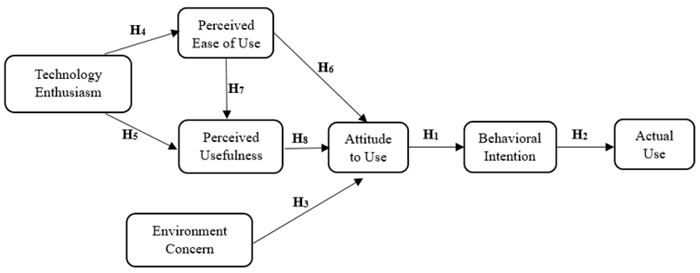
Note: Figure shows the conceptual framework of the study. The model builds on TAM and UTAUT, linking Perceived Ease of Use and Perceived Usefulness to Attitude Towards Usage, which in turn influences Behavioral Intention and Actual Usage. It shows how different factors are connected through hypotheses (H1-H8).
Research Methodology
Research Design
This study employs a multi-indicator model that incorporates many reflective components to evaluate various latent variables in the technology acceptance model of chatbots in human resource management. The data was collected from a diverse group of professionals, including HR managers, administrative staff, and employees from support functions like payroll staff, training coordinators, and IT support personnel who regularly interact with HR systems. Their inclusion ensured a broader perspective on chatbot adoption beyond HR specialists. who interact with HR functions in their organisations from various sectors within the Delhi-NCR region, including the IT, finance, and manufacturing industries. These sectors were deliberately chosen because they represent industries with high levels of HR automation, diverse workforce structures, and varying degrees of exposure to digital HR practices, making them suitable for testing chatbot adoption across different organisational contexts. The collected data are cross-sectional. The study was conducted from January, 2024 to May, 2024. This study follows a descriptive research design.
Measurement Scales
To elicit first-hand information from the target respondents, a 7-point Likert-scale closed-ended questionnaire with a clear structure was developed, as shown in the appendix. The questionnaire had two parts: Section I was a demographic section that asked respondents about themselves, and Section II comprised test questions presented on a range of scales. All used scales were standardised, but a few modifications were made to align with the study's research objective. A panel of three HR academics and two industry practitioners reviewed the items to ensure contextual relevance. In addition to the survey, a post-survey focus group discussion (FGD) was conducted with HR managers, employees, and academic experts.
Sampling & Data Collection
The current study used a snowball sampling technique, which enabled access to a diverse range of respondents, initially reaching out to 400 potential respondents via online platforms such as WhatsApp groups and email. Only those respondents who answered affirmatively to the screening question confirming prior use of HR chatbots were allowed to proceed with the survey. Of these 400, 256 responded, and after data cleaning, 237 responses were retained for analysis, exceeding the suggested number of respondents by G*Power. Therefore, the final sample size of 237 was considered to be sufficient and adequate for this study.
Data Analysis
The normal distribution was missing among the data collected for this study. Nevertheless, when the data are not normally distributed, PLS-SEM is deemed appropriate (Henseler, 2010). Therefore, based on the data and the level of the conceptual model, the researchers adopted SmartPLS software (Ringle et al., 2024) to assess construct validity and reliability and analyse the data to test the above-stipulated hypotheses.
Demographics of Respondents
The present study encompassed respondents aged twenty and older, with 64.55% men and 35.45% women. Additionally, 40.5% of respondents reported an income between five lakh and ten lakh, 32.9% reported an income below five lakhs, and the remainder reported an income above 10 lakhs. These demographics suggest a diverse range of chatbot users, each with varying understandings and behavioural intentions regarding chatbot usage (as depicted in Table 1 given below).
Table 1Respondents' Demographic Profile
| Characteristics | Frequency (N = 237) |
Percentage | |
| Gender | Male Female |
153 84 |
64.55 35.45 |
| Age | 20-30 years 30-40 years Above 40 years |
103 91 43 |
43.46 38.40 18.14 |
| Annual Income (Rs.) | Less than 5 lacs 5-10 lacs Above 10 lacs |
78 96 63 |
32.91 40.50 26.59 |
Measurement Model Assessment
This study employed the recommendations provided by Hair et al. (2019) and Hair et al. (2020) to assess the model results. The first step while assessing the measurement model is to check for construct validity. To retain any item within the model, its loading should be above 0.708 (Hair et al., 2020). As shown in Table 2 given below, each item's loading score is above the threshold limit.
Table 2Discriminant Validity - Heterotrait Monotrait Ratio (HTMT)
| Construct | Coding | Indicator Loading | Cronbach's Alpha | Composite Reliability (rho_a) | AVE |
| Attitude Towards Usage | ATU1 ATU2 ATU3 ATU4 |
0.887 0.935 0.927 0.939 |
0.941 | 0.951 | 0.85 |
| Actual Usage | AU1 AU2 AU3 |
0.959 0.957 0.962 |
0.957 | 0.957 | 0.92 |
| Behavioural Intention | BI1 BI2 BI3 |
0.937 0.931 0.901 |
0.913 | 0.913 | 0.852 |
| Environmental Concern | EC1 EC2 EC3 |
0.895 0.932 0.921 |
0.904 | 0.908 | 0.839 |
| Technology Enthusiasm | TE1 TE2 TE3 TE4 |
0.9 0.937 0.919 0.909 |
0.936 | 0.939 | 0.84 |
| Behavioural Intention | PEOU1 PEOU2 PEOU3 PEOU4 PEOU5 |
0.875 0.903 0.868 0.888 0.868 |
0.928 | 0.931 | 0.775 |
| Perceived Usefulness | PU1 PU2 PU3 PU4 PU5 |
0.836 0.923 0.906 0.932 0.866 |
0.936 | 0.939 | 0.798 |
Subsequently, we evaluated internal consistency reliability by computing the Composite Reliability and Cronbach's alpha for each construct. Thus, all constructs exceeded the mandatory threshold of 0.70 (Hair et al., 2020; Henseler et al., 2009). Subsequently, construct convergence was assessed by calculating the AVE for all constructs, which exceeded the suggested limit of 0.5 (Hair et al., 2019; Hair et al., 2020). This shows us that each of the constructs studied accounts for at least 50 per cent of the variance between the items. Also, discriminant validity is tested through HTMT in Table 3.
Table 3Discriminant Validity - Heterotrait Monotrait Ratio (HTMT)
| AU | ATU | BI | EC | TE | PEOU | PU | |
| AU | |||||||
| ATU | 0.384 | ||||||
| BI | 0.611 | 0.382 | |||||
| EC | 0.443 | 0.551 | 0.513 | ||||
| TE | 0.378 | 0.308 | 0.285 | 0.494 | |||
| PEOU | 0.689 | 0.331 | 0.423 | 0.312 | 0.455 | ||
| PU | 0.38 | 0.389 | 0.353 | 0.437 | 0.345 | 0.347 |
Note. AU: Actual use; ATU: Attitude Towards Use; BI: Behavioural Intention; EC: Environment Concern; TE: Technology Enthusiasm; PEOU: Perceived Ease of Use; PU: Perceived Usefulness.
Structural Model Assessment
After measuring the model, the path coefficients were tested to assess the hypothesised relationships linking employees' BI to their use of chatbots. Also, to verify the concluding theoretical and empirical implications of the suggested model, Q2 Stone-Geisser's value of the main constructs of the study was estimated. It was discovered that the Q2 values were greater than zero, which confirms that the given model performs fairly well in predicting the above-said constructs (Henseler et al., 2009). The coefficient of determination, R2, indicated that the explanatory variables explained a substantial amount of variance in the endogenous constructs, reflecting the model's in-sample predictive or explanatory capacity (Hair et al., 2019). The minimum acceptable R2 threshold depends on the study context, and even lower values can be considered acceptable within the scope of PLS-SEM analysis.
To test the proposed hypotheses, bootstrapping with 5,000 subsamples was performed, and in Table 5, all path coefficients were significant at p < 0.05, except for one coefficient, with the values of f2. Among the eight hypotheses in this study, six appear significant at the 1% level, while one appears significant at the 5% level (Table 4).
Table 4Hypothesis Testing and Relationship With Variables
| β | T statistics | CI 0.95 | Significance | VIF Inner | R2 | Q2 | f2 | ||
| H1 | ATU → BI | 0.358 | 5.969*** | [0.238-0.474] | Yes | 1 | 0.316 | 0.251 | 0.147 |
| H2 | BI → AU | 0.572 | 11.699*** | [0.475-0.664] | Yes | 1 | 0.128 | 0.127 | 0.487 |
| H3 | EC → ATU | 0.408 | 4.994*** | [0.25-0.571] | Yes | 1.245 | - | - | 0.196 |
| H4 | TE → PEOU | 0.428 | 6.376*** | [0.293-0.56] | Yes | 1 | - | - | 0.225 |
| H5 | TE → PU | 0.228 | 2.878*** | [0.068-0.377] | Yes | 1.225 | - | - | 0.05 |
| H6 | PEOU → ATU | 0.142 | 1.996** | [0.001-0.281] | Yes | 1.157 | 0.184 | 0.173 | 0.025 |
| H7 | PEOU → PU | 0.227 | 3.091*** | [0.079-0.373] | Yes | 1.225 | - | - | 0.049 |
| H8 | PU → ATU | 0.162 | 1.918 | [-0.009-0.316] | No | 1.273 | 0.148 | 0.093 | 0.03 |
Note. *** significant at 1%; ** significant at 5%; AU: Actual use; ATU: Attitude Towards Use; BI: Behavioural Intention; EC: Environment Concern; TE: Technology Enthusiasm; PEOU: Perceived Ease of Use; PU: Perceived Usefulness.
TE significantly and positively impacts PEOU (β = 0.428, p < 0.01) and PU (β = 0.228, p < 0.01). So, H4 and H5 hypotheses were duly supported by the result. The PEOU in Hypothesis H6 (β = 0.142, p < 0.05) has a positive and significant influence on employees' ATU of chatbots, as it assists them with various tasks, such as HR, IT support and other organisational issues. Thus, it suggests that chatbots, which employees perceive as easy to use, will lead them to adopt a positive attitude towards them. Similarly, Hypothesis H7 is accepted at the 1% significance level, indicating that PEOU has a significant and positive impact on PU (β = 0.227, p < 0.01). At last, PU also has a positive impact on ATU but failed to be accepted (β = 0.162, p = 0.055), thus H8 was rejected.
Figure 2Testing the Structural Equation Model
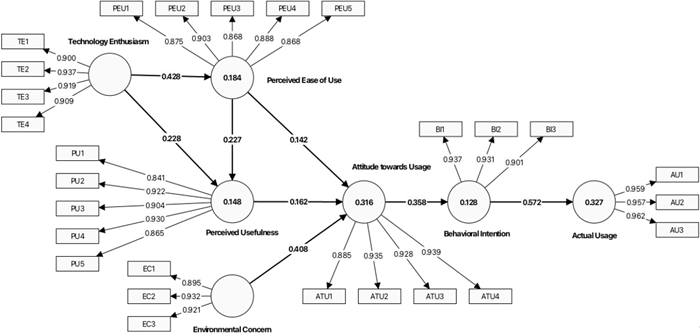
Note: Figure represents the hypothesized pathways among the constructs of the structural equation model depicting the directional relationships specified in the study.
Discussion
This study extends the Technology Acceptance Model (TAM) to examine chatbot adoption in HRM, enriching domains such as AHR, HRIS, ERP, DHRM, IoT, and data mining, and confirms TAM's effectiveness in predicting user attitudes toward AI-based HR tools by integrating perceived usefulness, ease of use, environmental concern, and technology enthusiasm as key determinants (Bai et al., 2022; Hmoud & Várallyai, 2020; Khan et al., 2024; Yoo et al., 2018). In fact, environmental concern compels HR managers and the organisation to adopt this technology, such that Chatbots are also considered a reputation icon for organisations because they aim to enhance the firm's favourable image, especially in the eyes of the public (Majumder & Mondal, 2021).
This research expands the classical Technology Acceptance Model by presenting a contextualisation aligned with AI-based HR practices, thereby enhancing the theoretical impact. In contrast to traditional TAM applications, which place the most significant focus on perceived usefulness and ease of use, the current study incorporates Technology Enthusiasm and Environmental Concern as important boundary conditions that influence employee cognition and intentions to adopt chatbots. This result adds to the theory by suggesting the transition of performance-focused to experience-focused adoption of technology in organisations. Additionally, the research offers a subtle insight into the functioning of AI-based tools in the socio-organisational context, thereby taking TAM a step further toward humanisation and sustainability-focused design. The empirically tested extensions provided by the research enable the development of a theoretically enriched model that can serve as a framework for further research investigating the adoption of AI in HRM, as well as other areas of service in this field.
In this research study, PEOU has been established as one of the key constructs of the TAM model that positively affects employees' attitudes, which is in line with the findings of Nemukula (2023), and subsequently influences employees' behavioural intention towards chatbot usage. A smooth user experience and interface can substantially contribute to the two perceived factors: ease of use and usefulness. Chatbot features that PU has improved the sample participants' attitudes towards the implementation of chatbots, with employees reporting a more positive attitude towards the application of chatbots. The employees' BI positively influences the AU of NLP-based chatbots. For HR practice, this means that managers should focus on building employees' behavioural intention through training, communication, and trust-building initiatives, as these directly translate into actual chatbot use in daily HR tasks such as recruitment, onboarding, and employee query handling. This study showed that enthusiasm for technology significantly and positively impacts PEOU and PU. It assists in closing the existing literature gap on chatbots, with a specific focus on the concept's applicability in the enterprise environment, particularly for the implementation of selected elements of HRM processes.
This study contributes to refining technology adoption models by showing that ease of use and enthusiasm are stronger drivers of chatbot adoption than perceived usefulness alone. By adding Technology Enthusiasm and Environmental Concern, the model is extended to HR-specific practices. This highlights how proactive attitudes and sustainability concerns shape employees' acceptance of digital HR tools.
Theoretical Implications and Practical Implications
The current study advances existing knowledge regarding factors affecting the perceived efficiency of chatbots in the workplace, drawing on TAM and an amended UTAUT model that incorporates attitudinal and perceptual factors. Hence, this study employs various constructs such as AU, ATU, BI, EC, TE, PEOU and PU to provide a comprehensive view of co-integration relationships. In addition, to make our conceptual model more precise, they incorporated the variable known as Technology Enthusiasm to expand the knowledge concerning these relationships. The inclusion of TE adds a significant layer to the existing theory by highlighting employees' proactive attitudes towards technological innovations. From an HR perspective, fostering enthusiasm for technology can be achieved by integrating chatbot demonstrations into orientation programs, encouraging peer-to-peer support, and positioning chatbots as tools that reduce administrative burden, thereby allowing HR staff to focus on strategic functions.
Overall, the findings highlight that ease of use and enthusiasm are stronger drivers of chatbot adoption than perceived usefulness alone. HR managers should prioritise intuitive chatbot design, emphasise sustainability benefits to appeal to employees' environmental concerns, and ensure ethical data handling to build trust. These measures will help organisations achieve smoother adoption and maximise the efficiency gains of chatbot integration in HR practice.
Study Limitations and Its Future Scope
The present study did not use any qualitative research methodology; it used only the quantitative method. As PLS-SEM is a quantitative research approach, it is always beneficial to complement it with qualitative data collected from interviews or focus groups to understand the nature of the problem, user attitudes and experiences interacting with chatbots. Therefore, it would be useful for the subsequent research in the same field to use qualitative or, correspondingly, mixed research methods to avoid some of the shortcomings of the quantitative approach discovered in this work. Although the model focuses on TAM with two external variables, future research should incorporate constructs such as trust in AI, privacy concerns, perceived risk, and organisational support to capture the full complexity of HR chatbot adoption. Another limitation of this study was that only 237 respondents participated. Future research based on these constructs should consider increasing the sample size, which will help improve external validity and total internal validity according to the most desirable statistical metrics.

References
- Åberg, J. (2017). Chatbots as a mean to motivate behavior change: How to inspire pro-environmental attitude with chatbot interfaces. https://www.diva-portal.org/smash/get/diva2:1106358/FULLTEXT01.pdf
- Al-Abdullatif, A. M. (2023). Modeling students' perceptions of chatbots in learning: Integrating technology acceptance with the value-based adoption model. Education Sciences, 13(11), 1151. https://doi.org/10.3390/educsci13111151
- Alkhalailah, R., & Mjlae, S. (2023). The influence of human resource management practices on employee performance: A case study of Al-Balqa Applied University. Problems and Perspectives in Management, 21(1), 279. http://dx.doi.org/10.21511/ppm.21(1).2023.24
- Allal-Chérif, O., Simón-Moya, V., & Ballester, A. C. C. (2021). Intelligent purchasing: How artificial intelligence can redefine the purchasing function. Journal of Business Research, 124, 69-76. https://doi.org/10.1016/j.jbusres.2020.11.050
- Anderberg, P., Eivazzadeh, S., & Berglund, J. S. (2019). A novel instrument for measuring older people's attitudes toward technology (TechPH): Development and validation. Journal of Medical Internet Research, 21(5), e13951. https://doi.org/10.2196/13951
- Andreas, N. B. (2024). Ethics in international HRD: examining conversational AI and HR chatbots. Strategic HR Review, 23(3), 121-125. https://doi.org/10.1108/SHR-03-2024-0018
- Anitha, K., & Shanthi, V. (2021). A study on intervention of chatbots in recruitment. In P. K. Singh, Z. Polkowski, S. Tanwar, S. K. Pandey, G. Matei, & D. Pirvu (Eds.), Innovations in Information and Communication Technologies (IICT-2020) (pp. 67-74). Springer. https://doi.org/10.1007/978-3-030-66218-9_8
- Bai, G., Wang, W., & Wang, X. (2022). Research on the influence of technological innovation enthusiasm on innovation performance from the perspective of nonlinearity-empirical evidence from Chinese listed firms. Sustainability, 14(16), 10154. https://doi.org/10.3390/su141610154
- Berner, J., Dallora, A. L., Palm, B., Sanmartin Berglund, J., & Anderberg, P. (2023). Five-factor model, technology enthusiasm and technology anxiety. Digital Health, 9. https://doi.org/10.1177/20552076231203602
- Bhatt, S., & Shiva, A. (2020). Empirical examination of the adoption of Zoom software during COVID-19 pandemic: Zoom TAM. Journal of Content, Community and Communication, 12(6), 70-88.
- Bondarouk, T., Parry, E., & Furtmueller, E. (2017). Electronic HRM: four decades of research on adoption and consequences. The International Journal of Human Resource Management, 28(1), 98-131. https://doi.org/10.1080/09585192.2016.1245672
- Brandtzaeg, P. B., & Følstad, A. (2017). Why people use chatbots. In I. Kompatsiaris, J. Cave, A. Satsiou, G. Carle, A. Passani, E. Kontopoulos, S. Diplaris, & D. McMillan (Eds.), Internet Science: 4th International Conference, INSCI 2017 (pp. 377-392). Springer. https://doi.org/10.1007/978-3-319-70284-1_30
- Carter, E., & Knol, C. (2019). Chatbots - an organization's friend or foe? Research in Hospitality Management, 9(2), 113-116. https://doi.org/10.1080/22243534.2019.1689700
- Davis, F. D. (1985). A technology acceptance model for empirically testing new end-user information systems. Massachusetts Institute of Technology, Cambrige. https://dspace.mit.edu/handle/1721.1/15192
- Davis, F. D. (1989). Perceived usefulness, perceived ease of use, and user acceptance of information technology. MIS Quaterly, 13(3), 319-340. https://doi.org/10.2307/249008
- Davis, F. D., Bagozzi, R. P., & Warshaw, P. R. (1989). User acceptance of computer technology: A comparison of two theoretical models. Management Science, 35(8), 982-1003. http://dx.doi.org/10.1287/mnsc.35.8.982
- DiRomualdo, A., El-Khoury, D., & Girimonte, F. (2018). HR in the digital age: how digital technology will change HR's organization structure, processes and roles. Strategic HR Review, 17(5), 234-242. https://doi.org/10.1108/SHR-08-2018-0074
- Dodda, S., Volikatla, H., & Vummadi, J. R. (2025). Exploring the role of AI-enhanced chatbots in automating recruitment processes in human capital management systems. International Journal of Emerging Trends in Computer Science and Information Technology, 6(3), 28-36. https://doi.org/10.63282/3050-9246.IJETCSIT-V6I3P104
- Dutta, D., Mishra, S. K., & Tyagi, D. (2023). Augmented employee voice and employee engagement using artificial intelligence-enabled chatbots: a field study. The International Journal of Human Resource Management, 34(12), 2451-2480. https://doi.org/10.1080/09585192.2022.2085525
- Elmorshidy, A., Mostafa, M. M., El-Moughrabi, I., & Al-Mezen, H. (2015). Factors influencing live customer support chat services: An empirical investigation in Kuwait. Journal of Theoretical and Applied Electronic Commerce Research, 10(3), 63-76. https://doi.org/10.4067/S0718-18762015000300006
- Fishbein, M., & Ajzen, I. (1975). Belief, attitude, intention, and behavior: An introduction to theory and research. Addison-Wesley Publishing Company.
- Gümüş, N., & Çark, Ö. (2021). The effect of customers' attitudes towards chatbots on their experience and behavioral intention in Turkey. Interdisciplinary Description of Complex Systems: INDECS, 19(3), 420-436. https://doi.org/10.7906/indecs.19.3.6
- Hair, J. F., Howard, M. C., & Nitzl, C. (2020). Assessing measurement model quality in PLS-SEM using confirmatory composite analysis. Journal of Business Research, 109, 101-110. https://doi.org/10.1016/J.JBUSRES.2019.11.069
- Hair, J. F., Risher, J. J., Sarstedt, M., & Ringle, C. M. (2019). When to use and how to report the results of PLS-SEM. European Business Review, 31(1), 2-24. https://doi.org/10.1108/EBR-11-2018-0203
- Hampshire, C. (2016). Exploring UK consumer perceptions of mobile payments using smart phones and contactless consumer devices through an extended technology adoption model. [Doctoral dissertation]. University of Chester. https://chesterrep.openrepository.com/server/api/core/bitstreams/3ccb0e4c-7a26-4859-a3fc-6eec55115e90/content
- Henseler, J. (2010). On the convergence of the partial least squares path modeling algorithm. Computational Statistics, 25, 107-120. https://doi.org/10.1007/s00180-009-0164-x
- Henseler, J., Ringle, C. M., & Sinkovics, R. R. (2009). The use of partial least squares path modeling in international marketing. New Challenges to International Marketing, 20, 277-319. Emerald Group Publishing Limited. https://doi.org/10.1108/S1474-7979(2009)0000020014
- Hmoud, B. I., & Várallyai, L. (2020). Artificial intelligence in human resources information systems: Investigating its trust and adoption determinants. International Journal of Engineering and Management Sciences, 5(1), 749-765. https://doi.org/10.21791/IJEMS.2020.1.65
- Huang, D. H., & Chueh, H. E. (2021). Chatbot usage intention analysis: Veterinary consultation. Journal of Innovation & Knowledge, 6(3), 135-144. https://doi.org/10.1016/j.jik.2020.09.002
- Jaiswal, R., Dixit, A. K., Saxena, T., Yadav, A. S., Verma, N., & Singh, R. (2025). The challenges and role of AI in HRM: Opportunities and ethical challenges on HR digitalization. Advances in Consumer Research, 2(4).
- Jitgosol, Y., Kasemvilas, S., & Boonchai, P. (2019, December). Designing an HR chatbot to support human resource management. In Proceeding of the 5th SUIC International Conference.
- Kasilingam, D. L. (2020). Understanding the attitude and intention to use smartphone chatbots for shopping. Technology in Society, 62, 101280. https://doi.org/10.1016/j.techsoc.2020.101280
- Khan, F. A., Khan, N. A., & Aslam, A. (2024). Adoption of Artificial Intelligence in Human Resource Management: An application of TOE-TAM model. Research and Review: Human Resource and Labour Management, 5(1), 22-36.
- Kshetri, N. (2021). Evolving uses of artificial intelligence in human resource management in emerging economies in the global South: some preliminary evidence. Management Research Review, 44(7), 970-990. https://doi.org/10.1108/MRR-03-2020-0168
- Lee, D. Y., & Lehto, M. R. (2013). User acceptance of YouTube for procedural learning: An extension of the Technology Acceptance Model. Computers & Education, 61, 193-208. https://doi.org/10.1016/j.compedu.2012.10.001
- Liébana-Cabanillas, F., Sánchez-Fernández, J., & Muñoz-Leiva, F. (2014). Antecedents of the adoption of the new mobile payment systems: The moderating effect of age. Computers in Human Behavior, 35, 464-478. https://doi.org/10.1016/j.chb.2014.03.022
- Majumder, S., & Mondal, A. (2021). Are chatbots really useful for human resource management? International Journal of Speech Technology, 24(4), 969-977. https://doi.org/10.1007/s10772-021-09834-y
- Marangunić, N., & Granić, A. (2015). Technology acceptance model: A literature review from 1986 to 2013. Universal Access in the Information Society, 14(1), 81-95. https://doi.org/10.1007/s10209-014-0348-1
- Merlin, P. R., & Jayam, R. (2018). Artificial intelligence in human resource management. International Journal of Pure and Applied Mathematics, 119(17), 1891-1895. https://doi.org/10.57240/DUJMBK04
- Murtarelli, G., Collina, C., & Romenti, S. (2023). "Hi! How can I help you today?": investigating the quality of chatbots-millennials relationship within the fashion industry. The TQM Journal, 35(3), 719-733. https://doi.org/10.1108/TQM-01-2022-0010
- Nawaz, N., & Gomes, A. M. (2017). Human resource information system: a review of previous studies. Journal of Management Research, 9(3), 92-120. https://doi.org/10.5296/jmr.v9i3.11488
- Nemukula, L. L. (2023). Chatbots in a corporate business: Improving managers' experience [Master's thesis]. University of Johannesburg (South Africa).
- Park, S. Y. (2009). An analysis of the technology acceptance model in understanding university students' behavioral intention to use e-learning. Journal of Educational Technology & Society, 12(3), 150-162. http://www.jstor.org/stable/jeductechsoci.12.3.150
- Park, E., Kim, H., & Ohm, J. Y. (2015). Understanding of driver adoption of Car navigation systems using the extended technology acceptance model. Behavior and Information Technology, 34(7), 741-751. https://doi.org/10.1080/0144929X.2014.963672
- Pillai, R., & Sivathanu, B. (2020). Adoption of AI-based chatbots for hospitality and tourism. International Journal of Contemporary Hospitality Management, 32(10), 3199-3226. https://doi.org/10.1108/IJCHM-04-2020-0259
- Rahmani, D., & Kamberaj, H. (2021, May). Implementation and usage of artificial intelligence powered chatbots in human resources management systems. In Conference: International Conference on Social and Applied Sciences at: University of New York Tirana.
- Ringle, C. M., Wende, S., & Becker, J.-M. (2024). SmartPLS 4. SmartPLS. https://www.smartpls.com
- Sakib, M. N., Salehin, M., Younus, M., Al-Omari, M. A., Sahabuddin, M., & Tabash, M. I. (2024). The ChatGPT and the future of HR: A critical review on the benefits and challenges of Al chatbots in human resource management. Multidisciplinary Reviews, 7(8), 2024136. https://doi.org/10.31893/multirev.2024136
- Selamat, M. A., & Windasari, N. A. (2021). Chatbot for SMEs: Integrating customer and business owner perspectives. Technology in Society, 66, 101685. https://doi.org/10.1016/j.techsoc.2021.101685
- Sharma, S., & Sengupta, S. (2024). AI-Driven HR Practices: Recent trends in digital HR tools and their perceived benefits. In Z. Illés, C. Verma, P. J. S. Gonçalves, & P. K. Singh (Eds.), Proceedings of International Conference on Recent Innovations in Computing. ICRIC 2023 (pp. 219-231). Springer. https://doi.org/10.1007/978-981-97-3442-9_15
- Stone, D. L., Deadrick, D. L., Lukaszewski, K. M., & Johnson, R. (2015). The influence of technology on the future of human resource management. Human Resource Management Review, 25(2), 216-231. https://doi.org/10.1016/j.hrmr.2015.01.002
- Strohmeier, S. (2022). Artificial intelligence in human resources-an introduction. In Handbook of Research on Artificial Intelligence in Human Resource Management (pp. 1-22). Edward Elgar Publishing.
- Taule, T., Følstad, A., & Fostervold, K. I. (2022). How can a Chatbot support Human Resource Management? Exploring the operational interplay. In A. Følstad,T. Araujo,S. Papadopoulos,E. L.-C. Law, E. Luger, M. Goodwin, & P. B. Brandtzaeg (Eds.), Chatbot Research and Design: 5th International Workshop, CONVERSATIONS 2021, Virtual Event, November 23-24, 2021, Revised Selected Papers (pp. 73-89). Springer. https://doi.org/10.1007/978-3-030-94890-0_5
- Venkatesh, V., & Bala, H. (2008). Technology Acceptance Model 3 and a research agenda on interventions. Journal of Information Technology, 39(2), 273-315. https://doi.org/10.1111/j.1540-5915.2008.00192.x
- Venkatesh, V. & Davis, F. D. (2000). A theoretical extension of the Technology Acceptance Model: Four longitudinal field studies. Management Science, 46(2), 186-204. https://doi.org/10.1287/mnsc.46.2.186.11926
- Venkatesh, V., Morris, M. G., Davis, F. D. & Davis, G. B. (2003). User acceptance of information technology: Toward a unified view. MIS Quarterly, 27(3), 425-478. https://doi.org/10.2307/30036540
- Yang, K. (2012). Consumer technology traits in determining mobile shopping adoption: An application of the extended theory of planned behavior. Journal of Retailing and Consumer Services, 19(5), 484-491. https://doi.org/10.1016/j.jretconser.2012.06.003
- Yoo, W., Yu, E., & Jung, J. (2018). Drone delivery: Factors affecting the public's attitude and intention to adopt. Telematics and Informatics, 35(6), 1687-1700. https://doi.org/10.1016/j.tele.2018.04.014
- Yoon, C. (2018). Extending the TAM for Green IT: A normative perspective. Computers in Human Behavior, 83, 129-139. https://doi.org/10.1016/j.chb.2018.01.032
 https://orcid.org/0000-0001-8996-3388