

Informacje o artykule
DOI: https://www.doi.org/10.15219/em112.1732
W wersji drukowanej czasopisma artykuł znajduje się na s. 35-46.
 Pobierz artykuł w wersji PDF
 Abstract in English
Jak cytować
Łukasiński, W., & Romański, P. (2025). Employee competencies from the perspective of Generation Z representatives. e-mentor, 5(112), 35-46. https://www.doi.org/10.15219/em112.1732
E-mentor nr 5 (112) / 2025
Spis treści artykułu
- Abstract
- Introduction
- Modern Technologies and Competencies in the Era of the Digital Economy
- Generation Z in the Labour Market
- Research Method
- Results
- Discussion
- Conclusions
- Limitations
- Future Research
- References
Informacje o autorze
Employee Competencies from the Perspective of Generation Z Representatives
Wiesław Łukasiński, Piotr Romański
Abstract
This article aims to identify key competencies for employees from the perspective of Generation Z. The study sought to answer the following questions: which competencies will be crucial for employees in organisations in the coming years, how they are perceived by representatives of Generation Z, and what forms of developing these competencies are preferred. The article discusses the concept and role of employee competencies in the changing labour market, from the perspective of Generation Z. The development of employee competencies increases the likelihood that organisations gain a competitive advantage in a dynamic, complex environment.
The article presents the results of a literature review and a survey in which respondents identified key competencies that determine professional success amid rapid technological development. Based on the findings, the following competencies were highlighted: technological curiosity and openness to innovation, flexibility and adaptability to change, technological skills, and foreign language proficiency. Representatives of Generation Z prefer the following forms of competency development: online training, mentoring, internships, and study visits. The results contribute to the design of work environments that foster employee competencies and enable organisations to adapt effectively to the modern demands of the labour market.
Keywords: employee competencies, Generation Z, competency development methods, labour market transformation, future skills
Introduction
Modern organisations operate in an environment dominated by volatility and complexity. In such conditions, employee competencies have become a key determinant of organisational success, serving not only as a source of value but also as the foundation of competitive advantage (Moczydłowska, 2021, p. 3; Sony & Naik, 2020, pp. 2213–2232). With the development of technology and ongoing digitalisation, employees are expected to possess not only advanced technical and technological competencies, but also the ability to work effectively in virtual environments (Albano et al., 2020, pp. 20–22; Grześ, 2022, p. 157).
Generation Z, currently entering the labour market, has new opportunities but also new expectations. Growing up in the digital era has shaped their approach to technology (Dewicka, 2013, pp. 19–20). They perceive competencies as an element linking employees’ individual abilities with the needs of the business environment (Chomątowska & Żarczyńska-Dobiesz, 2016).
Despite growing interest in employee competencies, a research gap persists in the literature regarding the developmental needs of Generation Z. Existing analyses primarily focus on general trends such as digitalisation, automation, and the development of soft skills, while relatively few studies consider the perspectives of Generation Z representatives themselves. There is also a lack of empirical studies that combine a literature review with an examination of young employees’ opinions on key competencies and preferred forms of developing them. Filling this gap enables a better understanding of Generation Z’s needs and supports the design of work environments and development programs that align with their expectations and labour market requirements.
This article aims to identify the competencies that are crucial for employees from the perspective of Generation Z. The study seeks to answer the following research questions: Which competencies are essential for employees in organisations in the context of rapid technological change, and how are they perceived by representatives of Generation Z? It is also important to determine the preferred forms of developing these competencies.
The achievement of this aim and the answers to the research questions are made possible through a literature review, a questionnaire survey, and the interpretation of the obtained results.
Modern Technologies and Competencies in the Era of the Digital Economy
Competencies are among the key factors determining employees’ effectiveness and professional success, forming the foundation for achieving organisational goals and completing professional tasks. Competence is a broad concept that has been defined in multiple ways in the literature, depending on the context in which it is used. Initially, it was associated with the formal scope of an employee’s authority and responsibility. Today, however, it is defined as a combination of knowledge, experience, abilities, and attitudes that determine the effective performance of professional tasks (Bombiak, 2014, pp. 174–175). Competencies include knowledge, diverse skills, behaviours, and attitudes that enable tasks to be carried out at an appropriate level (Filipowicz, 2016, pp. 186–187).
In this article, the term ‘competence’ is understood as a combination of knowledge, skills, attitudes, and personal traits that condition work effectiveness and adaptability to changing organisational and technological conditions. This understanding draws from the behavioural approach, which focuses on individual traits and behaviours, as well as the functional approach, which refers to work outcomes and job requirements (van der Klink & Boon, 2002; Vazirani, 2010). In contrast, the concept of skills is defined as a learned ability to achieve specific results with a high level of effectiveness and efficiency (Knapp, 1963). Skills include both practical and professional competencies developed through experience and training, as well as the ability to perform tasks in an automated way, without excessive engagement of cognitive processes (Dreyfus & Dreyfus, 1986). Thus, skills result from combining knowledge, practice, and experience, enabling individuals to act effectively in diverse and often demanding conditions (Breivik, 2016).
A breakthrough in global research on competencies came with McClelland’s 1973 publication, which demonstrated that traditional intelligence tests or academic assessments are not reliable predictors of professional success. Instead, competencies – understood as enduring behaviour patterns – better predict work effectiveness (McClelland, 1998). Boyatzis further developed this concept, pointing out that competencies are fundamental characteristics of an individual, causally related to high job performance, and can be developed throughout life (Boyatzis, 2008). Similarly, Spencer and Spencer emphasised that competencies include motivations, personality traits, values, knowledge, and measurable skills that distinguish top performers from average ones (Spencer & Spencer, 1993).
Parry highlighted that competencies are a set of interrelated knowledge, skills, and attitudes that can be assessed against clearly defined standards and subsequently developed through training and practice (Parry, 1996). From another perspective, Athey and Orth (1999) argued that competencies take the form of observable dimensions of individual and organisational behaviours linked to high performance and competitive advantage (Athey & Orth, 1999). Draganidis and Mentzas (2006) likewise stressed that competencies encompass both direct skills and indirect behaviours that enable effective task performance (Draganidis & Mentzas, 2006). Page, Wilson and Kolb (1994) added that competencies include both explicit aspects (knowledge, skills) and implicit ones (attitudes, personality traits) (Page et al., 1994).
In practice, competencies can be divided into core competencies, comprising the knowledge and skills necessary for the proper execution of a given job, and distinguishing competencies, which separate the most effective employees from the rest (Pocztowski, 2005, p. 245; Sojda & Lepiarska, 2019, p. 124). Competencies cover all employee attributes used in the work process to achieve specific results aligned with organisational goals (Łukasiński et al., 2021, pp. 57–58; Rostkowski, 2004, pp. 69–71). These are not only knowledge and skills, but also attitudes, motivations, and personality traits that influence the way tasks are performed (Oleksyn, 2006, pp. 43–44; Strzelczyk-Łucka, 2019, p. 64). They represent fundamental human characteristics that are causally related to work effectiveness, measured by defined criteria and reflected in above-average results achieved during task execution (Wiśniewska, 2021, p. 16).
Competencies are therefore perceived as dynamic attributes integrating knowledge, skills, attitudes, and abilities, enabling effective performance in a given professional context. They combine the knowledge necessary for proper job execution with soft skills that determine how tasks are carried out (Armstrong, 2007; Łukasiński et al., 2021, p. 52). Competencies shape both cognitive and emotional development, making them a key element in self-development and adaptation to the evolving work environment (Łukasiński et al., 2021, p. 52; Rieckman, 2018).
Competencies can also be considered in behavioural terms, where they represent the ability to perform specific patterns of behaviour that integrate knowledge, skills, and responsibilities, adjusted to the requirements of a given position (Podgórska, 2018, p. 69). This approach highlights the dynamic nature of competencies, which are developed and modified in response to changing organisational and technological demands.
In today’s rapidly changing world, employees are expected to develop both technical and interpersonal competencies that enable effective collaboration and adaptation to the evolving work environment. The modern labour market requires far more than theoretical knowledge or industry-specific skills. Increasingly, what matters is how employees approach their work, deal with challenges, communicate within teams, and navigate dynamic environments (Karbownik, 2017; Moczydłowska, 2023, pp. 97–98). Key attributes include adaptability, continuous learning, and the evolution of competencies (Jastrzębowska, 2020, p. 14).
In the context of today’s socio-economic transformations, green competencies are also gaining importance. They combine knowledge, skills, and attitudes to minimise the negative environmental impact of professional activities and support sustainable development principles (Gadomska-Lila et al., 2024; Kozar & Sulich, 2023). These include both hard green skills, such as installing and operating renewable energy technologies or implementing resource-saving processes, and soft ones, such as ecological awareness, responsible attitudes, and pro-environmental communication (ILO, 2019). Green competencies are gaining importance as Generation Z, which, upon entering the labour market, expects organisations to act in accordance with the principles of sustainable development. In response to these needs, the GreenComp document was developed as the European sustainability competence framework. This framework defines a set of knowledge, skills, and attitudes necessary to act responsibly and empathetically toward the environment, regardless of age or level of education, and it can be applied in formal, non-formal, and informal learning. GreenComp comprises 12 competencies organised into four areas: embodying sustainability values, embracing complexity in sustainability issues, envisioning sustainable futures, and acting for sustainability (European Commission, 2022). For Generation Z, these competencies represent an essential element of preparation for work in modern organisations, as they integrate values, systems thinking, critical and futures thinking, as well as the ability to initiate pro-environmental actions.
The modern labour market, with its demands for flexibility, mobility, and digitalisation, poses new challenges for employees. It is a dynamic space characterised by rapid technological development, globalisation, and evolving organisational expectations of employees. A key feature of this market is the need for a multidimensional approach to employment, where traditional, stable career models are being replaced by flexible forms of work, such as project-based work, remote work, or freelancing (Vadie & Lipták, 2023). Today’s labour market is also marked by increasing process automation and the intensive use of artificial intelligence and digital tools. This creates a need for not only specialised technical competencies but also soft skills such as the ability to collaborate in interdisciplinary teams, creative thinking, and effective communication (Cichy et al., 2024, pp. 3–4).
In this context, it is worth referring to the European Commission’s Digital Competence Framework for Citizens (DigComp). This framework serves as a tool to support the development of digital skills, enabling the assessment of the level of knowledge, skills, and attitudes necessary for the effective, safe, and critical use of digital technologies. DigComp encompasses five main areas of competence: information and data literacy, communication and collaboration, digital content creation, digital safety, and problem-solving in digital environments. This tool allows individuals, educational institutions, and employers to assess and develop digital competencies, supporting lifelong learning and preparation for work in a digital economy (Vuorikari et al., 2022). Including DigComp in the analysis of contemporary labour market requirements underscores that Generation Z needs digital competencies not only in a technical sense but also in critical thinking, collaboration within digital networks, and adaptation to rapidly changing technologies.
In parallel with green and digital competencies, it is useful to refer to the OECD publication The Future of Education and Skills: Education 2030. This framework presents a vision of future education that focuses on preparing learners for life in a dynamic, uncertain, and complex world. The OECD emphasises that modern education should develop not only knowledge and skills but also attitudes, values, and the capacity to make responsible decisions (learner agency). The document identifies three main transformative competencies: creating new value, reconciling tensions and dilemmas, and taking responsibility. These competencies require the mobilisation of knowledge, skills, attitudes, and values in action, supported by reflection, anticipating consequences, and taking informed action. The framework also highlights the importance of systems thinking, intercultural collaboration, creativity, critical thinking, digital development, and ecological awareness, forming a coherent model of competencies necessary for active and responsible functioning in a complex world (OECD, 2018). Incorporating the OECD framework into the analysis of the labour market and education allows consideration of a broader perspective on future competencies, encompassing not only professional qualifications but also adaptive, social, and ethical skills that are crucial for Generation Z.
Another important feature of today’s labour market is generational diversity. In one work environment, employees from different generations coexist – from Baby Boomers to Generation Z – which requires flexible management approaches, as well as adjustments in communication styles and expectations (Ławińska & Korombel, 2023, p. 14). As a result, employees can no longer rely on one-time qualification acquisition. Career development depends on lifelong learning, experimenting with new technologies, and quickly adapting to changing conditions. Particularly valuable are the competencies acquired directly through performing work tasks (Taradejna, 2014, p. 23).
Generation Z in the Labour Market
Generation Z, defined as individuals born after 1995 (Czerwińska & Bojar, 2021; Grabiwoda, 2019, p. 51; Messyasz, 2021; Tomaszuk & Wasiluk, 2023, p. 84) or 1998 (Tapscot, 2008, p. 16), is a generation that differs significantly from previous ones in its approach to work, communication style, and perception of professional success. As the first generation to grow up fully integrated with modern technologies, its representatives do not need to learn how to use digital tools, as they have been exposed to them since early childhood. They demonstrate a high level of digital competency, encompassing not only effective online navigation and the use of digital work tools but also advanced skills in data analysis, programming, and operating various communication platforms. From the labour market perspective, technological competencies have become indispensable in many industries, particularly in IT, digital marketing, e-commerce, and project management, where remote work tools and virtual workspaces have become the standard (Stankiewicz-Mróz, 2020, pp. 53–54).
Generation Z representatives prefer remote work, flexible working hours, and integration with cloud systems, introducing a modern approach to organising daily tasks. They are capable of working effectively from different locations, self-organising their tasks, and adjusting their work both to organisational requirements and to their own needs, which allows them to maintain a balance between professional and personal life (Muster, 2020, pp. 133–134). They are adept at adopting new technologies, and using the latest digital tools is not only an obligation but also a source of satisfaction. They also understand the importance of critical thinking, information management, problem-solving using digital tools, and effective team communication, especially in remote environments (Żarczyńska-Dobiesz & Chomątowska, 2016, pp. 198–199).
As the first generation raised in full integration with technology, Generation Z must adjust its skills to the realities of a rapidly changing labour market marked by the constant emergence of new tools and methods of work. To meet these challenges, employees must not only maintain baseline competencies but also continually update their skills to keep pace with evolving trends (Świerkosz-Hołysz, 2016, pp. 442–443). In this context, digital skills represent only one part of the broad skillset required for professional success. Personal and social competencies (e.g., interpersonal and emotional skills) are equally important. While online communication is natural for Generation Z, this can result in difficulties with face-to-face interactions, where more advanced interpersonal skills are needed (Ławińska & Korombel, 2023, pp. 17–18).
Adapting to traditional, physical workspaces may also pose a challenge. Thus, developing skills in emotional management, assertiveness, teamwork, and conflict resolution is essential. Furthermore, adjusting work styles to different organisational roles requires a high degree of flexibility and openness to change (Kukla & Nowacka, 2019, pp. 125–126). For Generation Z, this often means working in flexible conditions that encourage self-organisation, creativity, and the use of individual predispositions. They expect their work environment to allow experimentation, testing new solutions, and the rapid implementation of innovations (Całek, 2021, pp. 106–107).
Generation Z particularly values autonomy at work, the ability to achieve goals independently, but under the guidance of leaders who provide support and motivation. Therefore, organisations seeking to effectively develop employee competencies must create environments that foster independent development, provide opportunities for experimentation, and allow flexible working hours. Flexibility and openness to modern work approaches are key to maintaining the engagement and motivation of Generation Z. Organisations that understand these needs gain loyal employees who not only contribute their skills but also become ambassadors of organisational values in their wider environment (Muster, 2020, pp. 143–144). Generation Z appreciates individualism and flexibility, requiring leaders who can manage projects while supporting personal growth. Leaders should act as guides, inspiring development, offering constructive feedback, and assisting in problem-solving. This approach fosters teamwork skills, enhances communication efficiency, and improves adaptability to changing work conditions. The modern leader is not only a supervisor but also a mentor, providing both emotional and substantive support (Moczydłowska, 2023, pp. 155–157).
Generation Z is aware that competency development requires continuous adaptation to changing professional and technological realities. They place great importance on self-improvement, actively seeking new methods of learning and self-development. This generation uses a wide range of tools, including online educational platforms and interactive workshops, to acquire new skills in ways that suit their preferences. Time and project management skills are also crucial, enabling them to effectively organise their work despite increasingly complex and demanding tasks (Żarczyńska-Dobiesz & Chomątowska, 2016, pp. 203–204). Competencies are the foundation of professional success and the key to efficiency and job satisfaction. Success depends not only on the ability to apply existing competencies in practice but also on their continuous development and adaptation to evolving work conditions. Generation Z is fully aware of the ever-changing labour market, which requires readiness for lifelong learning, adaptation, and shifting approaches to work (Kukla, Nowacka, 2019, pp. 128–129).
In this context, competency development is achieved through a variety of methods that enable the acquisition of new skills and the improvement of existing qualifications. These include participation in training and courses (both onsite and online), mentoring programs, and involvement in international projects that facilitate experience-sharing, as well as practical learning during internships or project-based work. Technological progress has also enabled new forms of learning, such as webinars, e-learning platforms, and microlearning, which align with the digital habits of Generation Z and allow flexible adaptation of learning to their lifestyle. Access to diverse online knowledge resources (e.g., podcasts, expert blogs) further supports self-directed learning (Bendkowski, 2018).
Having grown up in an era of rapid technological change, Generation Z is particularly aware of the role of digital skills in fostering innovation and adapting to new work conditions. However, social and emotional competencies are equally important, as they enable not only integration within organisations but also effective management of professional relationships and the building of trust-based, collaborative teams (Moczydłowska, 2023, pp. 105–106).
Research Method
To better understand the developmental needs of Generation Z and how they perceive labour market-relevant competencies, a survey was conducted. For the study, Generation Z was defined as individuals born after 1995. The survey was carried out online between October and December 2024, using the CAWI (Computer-Assisted Web Interview) technique. The questionnaire was distributed through internal communication channels of Polish higher education institutions (e.g., mailing systems, student platforms). The questionnaire used in the study was an original instrument developed by the authors, tailored to the topic’s specificity and the research objectives.
The sampling was non-random and purposive – respondents had to meet two criteria: be members of Generation Z and hold student status in economics-related fields of study at Polish universities. Although the non-stratified selection limits the ability to generalise the findings to the entire Polish Generation Z population, the sample represents a group of young people who are educated or actively engaged in both education and work.
The study included 315 individuals meeting the age criteria: 185 men (58.7%), 128 women (40.6%), and 2 respondents (0.6%) who chose not to disclose their gender. In terms of educational and professional activity, 134 respondents (42.5%) were students, 177 (56.2%) combined study with work, and 4 (1.3%) focused exclusively on professional activity.
The questionnaire included single- and multiple-choice questions developed based on a literature review of employee professional competencies. The design of the survey questions was grounded in a theoretical model of professional competencies derived from the review, which encompassed both hard and soft skills considered essential in the context of a dynamically changing labour market and the digital economy era (Industry 4.0). The literature review identified competencies critical from both technological and social perspectives, including digital skills, programming, adaptability, creativity, communication, and language skills. These competencies were then selected for inclusion in the survey instrument.
To ensure data quality, a filtering mechanism was applied – only fully completed questionnaires were included in the analysis, with incomplete responses excluded. The data analysis was conducted in Microsoft Excel (version 2016), using statistical functions and tools to visualise the results (tables and figures). While the data were not deposited in a public repository, they may be made available for further scientific research upon request.
Results
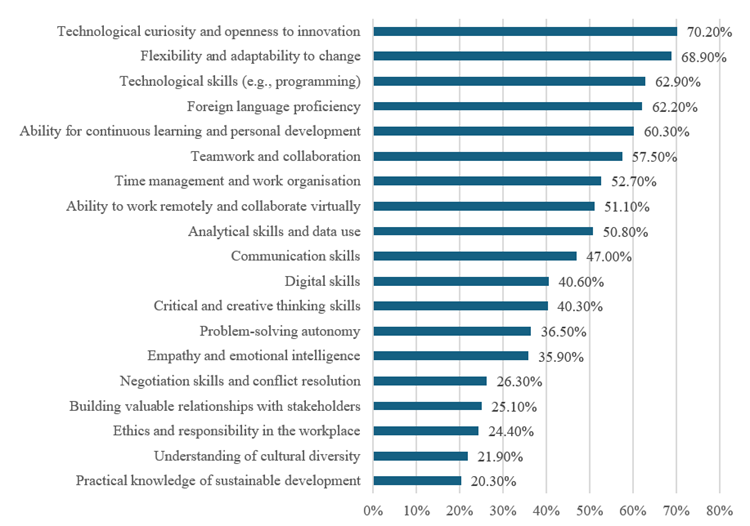
In the study, respondents were asked to select, from a given set, the 10 key employee competencies considered important for the development of their professional careers (Figure 1).
Figure 1Key Competencies for Future Employees According to Respondents
Source: authors’ own work based on survey research conducted in October–December 2024.
The study results indicate that the most frequently selected competency (70.2%) was technological curiosity and openness to innovation. This finding highlights a strong interest in technological advancements and a readiness to implement innovations among Generation Z representatives. The result reflects the growing significance of technology and digitalisation in all professional domains. The second most frequently indicated competency was flexibility and adaptability to change (68.9%), emphasising the importance of adjusting to rapidly evolving work environments and technologies. These skills have become particularly crucial in the face of challenges such as the pandemic and the swift transition of organisations to remote work.
Technological skills (62.9%) and foreign language proficiency (62.2%) were also highly valued, indicating a demand for professionals prepared to work in a global, digital environment. Equally important were competencies related to continuous learning and personal development (60.3%) and teamwork (57.5%), which are indispensable for collaboration in dispersed teams and amid increasing automation.
Among the less frequently chosen competencies, empathy and emotional intelligence (35.9%), as well as negotiation skills and conflict resolution (26.3%), stood out as crucial for building relationships and effective communication in organisations. Competencies such as practical knowledge of sustainable development (20.3%) and cultural diversity awareness (21.9%) were considered important but ranked lower, likely due to respondents prioritising technological and practical aspects.
As part of the study, respondents were also asked to assess the impact of identified employee competencies on their career development. They rated the influence of each competency on a scale from 1 to 5, where 1 meant ‘minimal’ and 5 signified ‘crucial.’ The average ratings and variability coefficients for each competency provide valuable insights into the professional priorities of Generation Z representatives.
Table 1Assessment of the Impact of Employee Competencies on Career Development from Respondents’ Perspectives
| Competency | Mean Score | Variability Coefficient |
| Communication skills | 4.30 | 18.15% |
| Foreign language proficiency | 4.25 | 23.31% |
| Flexibility and adaptability to change | 4.23 | 18.36% |
| Continuous learning and personal development | 4.20 | 20.26% |
| Technological curiosity and openness to innovation | 4.17 | 20.17% |
| Time management and work organisation | 4.08 | 21.51% |
| Technological skills (e.g., programming) | 4.03 | 22.46% |
| Digital skills | 4.00 | 22.83% |
| Teamwork | 3.98 | 21.55% |
| Creative and critical thinking skills | 3.92 | 22.35% |
| Analytical skills and data utilisation | 3.90 | 23.41% |
| Remote work and virtual collaboration | 3.86 | 25.66% |
| Building valuable relationships with stakeholders | 3.85 | 22.76% |
| Independence in problem-solving | 3.77 | 24.34% |
| Negotiation skills and conflict resolution | 3.73 | 24.12% |
| Work ethics and responsibility | 3.71 | 24.98% |
| Practical knowledge of sustainable development | 3.54 | 26.43% |
| Empathy and emotional intelligence | 3.50 | 28.97% |
| Cultural diversity awareness | 3.28 | 34.27% |
Source: authors’ own work based on survey research conducted in October–December 2024.
Based on the study results, several competencies emerge as particularly important for career development, as perceived by the respondents. The highest-rated competencies are communication skills, foreign language proficiency, and flexibility and adaptability to change, which respondents perceive as fundamental for effective functioning in a dynamic and globalised work environment. The relatively low variability coefficients for these competencies indicate a high level of consensus regarding their importance.
High importance was also attributed to competencies related to continuous learning, technological curiosity, and openness to innovation, reflecting the growing significance of adaptability and lifelong learning in the context of rapid technological change. Similarly, time management, work organisation, and digital and technological skills were assessed as important, confirming the increasing role of digitalisation and automation across professions.
Moderately rated competencies include teamwork, creative and critical thinking, analytical skills, and remote work capabilities, which support collaboration and problem-solving in modern organisational settings. Competencies related to relationship-building, negotiation, responsibility, and independent problem-solving, although valued, were perceived as less critical compared to technology-oriented skills.
The lowest ratings were assigned to empathy and emotional intelligence, sustainable development knowledge, and cultural diversity awareness. Higher variability coefficients in these areas suggest greater diversity of opinions among respondents regarding their relevance to future career development.
Analysing the survey results also makes it possible to group competencies into thematic clusters, which helps to better understand Generation Z’s professional priorities as well as the relationships between specific skills. Based on functional similarity and significance for career development, four main groups of competencies can be distinguished.
The first cluster consists of technological and digital competencies, including technological curiosity and openness to innovation, technological skills such as programming, and digital skills. These competencies highlight young employees’ strong orientation toward growth in the area of modern technologies and the digitalisation of professional processes.
The second cluster comprises adaptive and developmental competencies, which include flexibility and adaptability to change, the ability to engage in continuous learning and personal development, and independence in problem-solving. These emphasise the importance of adjusting to a dynamic work environment and taking initiative in self-development.
The third cluster covers social and communication competencies, including communication skills, teamwork, negotiation and conflict-resolution abilities, empathy, and emotional intelligence. These reflect the need for effective interpersonal interaction and relationship-building in the workplace.
The fourth cluster consists of global and value-based competencies, such as foreign language proficiency, understanding cultural diversity, and practical knowledge of sustainable development and work ethics. These competencies reflect the growing importance of operating in a global environment and of addressing social responsibility, both of which are becoming increasingly relevant in the context of international cooperation and global challenges.
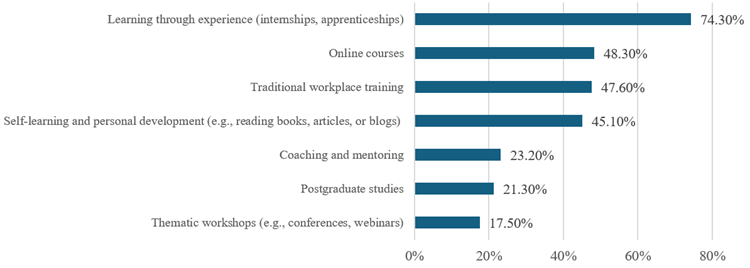
In response to the question about preferred forms of education for developing professional competencies, survey participants indicated a variety of methods they believe can support their career development (Figure 2). These findings are significant both for organisations seeking to effectively support employee development and for individuals looking to take an active role in shaping their careers.
Figure 2Preferences of Generation Z for Educational Forms in Professional Competency Development
Source: authors’ own work based on survey research conducted in October–December 2024.
The highest percentage of respondents indicated learning through experience (internships, apprenticeships), with 74.3% (234 respondents) choosing this option. This result clearly highlights that for Generation Z, gaining practical skills in real work environments is a key factor in professional development. Experience acquired through internships or apprenticeships allows for the direct application of theory in practice and a better understanding of the specifics of various industries. Additionally, this form of education fosters professional relationships that support career growth.
In second place were traditional workplace training programs, selected by 47.6% of respondents (150 respondents). This result confirms that education conducted directly within an organisation still plays an important role in professional skill development. Such training enables employees to gain knowledge relevant to their job tasks.
Online courses were chosen by 48.3% of respondents (152 respondents), indicating their growing popularity, particularly among Generation Z. Online courses offer flexibility in learning, allowing individuals to adjust the pace and schedule to their personal needs. Furthermore, their accessibility and the ability to earn certifications make them particularly attractive to those who prefer digital forms of education.
Self-learning and personal development (e.g., reading books, articles, or blogs) were indicated by 45.1% of respondents (142 respondents). This result highlights Generation Z’s independence in acquiring knowledge. Self-learning provides the opportunity to explore topics tailored to individual interests and needs, which is especially valued by those with strong internal motivation for growth.
Coaching and mentoring, as forms of skill development, were recognised by 23.2% of respondents (73 respondents). This method emphasises the importance of relationships with experienced professionals who can support the development of younger employees by sharing their knowledge and experience.
Postgraduate studies were chosen by 21.3% of respondents (67 respondents), indicating that formal academic education continues to be perceived as a valuable means of gaining knowledge. However, compared to more flexible methods such as online courses or practical training, traditional studies are selected less frequently.
The least popular form of education was thematic workshops (e.g., conferences, webinars), chosen by only 17.5% of respondents (55 respondents). This result may stem from the perception that such events are less interactive and more time-limited compared to more comprehensive and practical forms of learning. Nevertheless, workshops remain an important source of knowledge regarding industry trends and networking opportunities.
Based on the study, a competency framework can be identified that synthesises the most important skills influencing career development, as reported by Generation Z representatives. This framework comprises four main categories of competencies. The first group consists of technological and digital competencies, which encompass technological curiosity and openness to innovation, technological skills such as programming, and digital skills. These competencies indicate a clear orientation of Generation Z toward development in the area of modern technologies and the digitalisation of professional processes.
The second category comprises adaptive and developmental competencies, which include flexibility and the ability to adapt to change, the capacity for continuous learning and personal development, and independence in problem-solving. These competencies highlight the importance of adjusting to a dynamic work environment and taking initiative in one’s professional development.
The third group consists of social and communication competencies, including communication skills, teamwork, negotiation and conflict-resolution skills, as well as empathy and emotional intelligence. These competencies are essential for effective collaboration, building interpersonal relationships, and engaging in successful interactions within teams, including virtual environments.
The fourth category includes competencies related to foreign language proficiency, understanding cultural diversity, practical knowledge of sustainable development, and ethics and responsibility in the workplace. These competencies reflect global challenges, the importance of working in international environments, and the growing role of social responsibility in career development.
The presented structure provides a coherent foundation for planning professional development strategies by both organisations and employees, enabling the conscious shaping of career paths in line with current labour market requirements.
Discussion
The study results indicate the key competencies that Generation Z considers the most significant for the future job market. Their analysis, compared with subject literature and international reports such as The Future of Jobs Report 2023 (WEF, 2023) and Future of Skills: Employment in 2030 (Bakhshi et al., 2020), allows for several important conclusions regarding directions for professional development amid changing technological and global conditions.
One of the most notable findings is that technological curiosity and openness to innovation (75.30%) are recognised as the most crucial future competency. This result aligns with the increasing role of technology in professional life, which is confirmed in academic literature, where skills related to technology utilisation, design, and programming are listed as essential (WEF, 2023, pp. 256–286). Similar conclusions emerge from employer expectations, where advanced digital skills (69%), such as proficiency in programming, graphic software, accounting software, or digital content creation, are deemed equally important (Karpińska & Owczarczuk, 2024, p. 80). This underscores the need to combine technological curiosity with practical application skills, which Generation Z should consider in their education and career development.
Second in the ranking is flexibility and adaptability to change (71.40%), reflecting the growing demand for resilience and the ability to respond quickly to global challenges, such as the COVID-19 pandemic and rapid automation of work processes. Similarly, employers emphasise the importance of analytical skills (52%), which support effective decision-making and adaptation in a rapidly changing professional environment. Modern organisations require employees to navigate dynamic workplaces and analyse and interpret data – an essential aspect of efficient change management (Karpińska & Owczarczuk, 2024, p. 80).
Foreign language proficiency (66.20%) is another highly rated skill among Generation Z, reflecting the growing significance of globalisation and working in international environments. Employers also stress the necessity of this competency, highlighting that fluency at at least B2 level (57%) is crucial for communication and international collaboration (Karpińska & Owczarczuk, 2024, p. 80). This is further confirmed by a survey conducted by Pracuj.pl, where 46% of Generation Z respondents indicated foreign language proficiency as a key skill for career development (Pracuj.pl, 2024).
The study findings align with the conclusions of Bartkowski and Pytlak, who, based on their research, recognised that Generation Z entering the labour market in the Pruszków district brings valuable competencies, particularly appreciated in today’s job market. These include advanced knowledge of digital technology and fluency in foreign languages, which are valuable assets in the era of globalisation and ongoing digitalisation. These skills equip Generation Z to significantly impact the labour market in this region, introducing innovative approaches to tasks and problem-solving in a rapidly evolving environment (Bartkowski & Pytlak, 2024, p. 16).
These abilities, combined with advanced digital competencies, form the foundation for successful navigation in the globalised job market. The Future of Skills report emphasises the importance of communication and collaboration, which can be interpreted as complementary to foreign language proficiency and technological skills. However, as the report highlights, communication skills – while fundamental – do not dominate young respondents’ perceptions as strongly as technological competencies. This may stem from the belief in their universal nature (Bakhshi et al., 2020, pp. 93–100). The new generation of employees recognises that effective communication remains crucial in the professional world. In a study for Pracuj.pl, 49% of young respondents identified soft skills, such as communication, as key to career growth (Pracuj.pl, 2024).
Another essential aspect of the study results is the ability to engage in continuous learning and personal development (60.80%), which is highly valued by both respondents and employers. Academic literature (Marszałek, 2011; Minta, 2012) emphasises that in an evolving work environment, learning ability is the foundation for long-term career development. Employers also confirm the importance of basic digital skills (38%) and teamwork skills (77%), further reinforcing the need for flexibility and readiness to grow in various areas (Karpińska & Owczarczuk, 2024, p. 80).
At the same time, it is worth noting the relatively low rating of competencies related to cultural diversity (25.70%) and sustainable development (23.40%). These results suggest that both young professionals and employers primarily focus on technical and practical skills that directly impact professional productivity.
The study also highlights the significance of soft skills, such as teamwork (59.80%) and time management and work organisation, which align with employer expectations. In particular, teamwork (77%) is a crucial aspect of modern organisations. However, while these skills are important, young professionals tend to view them as more universal and naturally developed over the course of their careers, whereas technological competencies require more specific preparation in education.
The study results reveal that both Generation Z and employers focus on technology, innovation, and adaptability as key pillars of the future job market. However, some discrepancies exist, including lower perceived importance of social competencies, cultural diversity, and sustainable development. Looking ahead, it will be important to integrate technological skills with social abilities to meet the increasingly complex challenges of the job market (WEF, 2023).
The results of the study on preferred learning methods among Generation Z representatives and on employer practices indicate numerous similarities (Karpińska & Owczarczuk, 2024, pp. 83–84). The largest percentage of respondents (76.5%) indicated learning through experience, such as internships and apprenticeships, highlighting the importance of acquiring practical skills in real-world settings. This aligns with the popularity of development support methods used in small and micro-enterprises, such as on-the-job training and job shadowing. Despite their simplicity and low cost, these methods are valued for their effectiveness and adaptability to employees’ real needs (Pracuj.pl, 2024).
In contrast, traditional internal training, chosen by 49.8% of Generation Z respondents, and online courses (48.2%) reflect the strategies of larger enterprises, which more frequently organise both internal and external courses and training. In large organisations, courses and training dominate as the primary means of supporting employee development due to their greater financial and organisational capabilities. As a result, young employees in larger companies have access to a richer educational offering, including more specialised and costly support forms, such as postgraduate studies or study visits (PARP, 2019).
It is also worth noting that self-education, chosen by 46.3% of Generation Z respondents, is an integral part of employee development practices. This is particularly evident in smaller organisations, where employers encourage employees to independently enhance their qualifications, often due to budget constraints. Meanwhile, less popular forms of education among young people, such as conferences, seminars, and workshops (21.9%), are relatively more frequently used by large enterprises as a way to develop specialised competencies and establish industry contacts (PARP, 2019).
A report by Ernst & Young confirms these observations, indicating that Generation Z respondents consider professional internships the most effective way to develop their skills – 59% of respondents rated them as the most important. In contrast, only 12% of Generation Z respondents preferred traditional education methods such as training sessions or lectures (Sawyer, 2021).
Conclusions
The conducted research has led to important conclusions regarding the educational preferences and key professional competencies of Generation Z in the context of the future labour market. The findings suggest that young employees primarily value practical experience gained in real work environments, such as internships and apprenticeships, recognising them as the most effective forms of learning and professional development. At the same time, the popularity of online courses and self-directed learning underscores the significance of flexibility and accessibility in education, which play a crucial role in an ever-evolving work environment.
There is also a noticeable increase in the value of technological competencies, such as programming, design, and advanced use of digital tools, which are considered fundamental in the modern labour market. In the context of globalisation, language skills and the ability to work in an international environment are particularly valued. Simultaneously, flexibility and adaptability to change are key in addressing challenges such as process automation and global crises.
Although teamwork and time management remain essential for both employees and employers, the research findings suggest that the younger generation perceives these skills as more universal and naturally developed throughout their careers. Meanwhile, relatively low interest in competencies related to cultural diversity and sustainable development highlights the need to raise awareness in these areas, as they are expected to gain increasing importance in response to global challenges.
The research results emphasise that the effective professional development of Generation Z requires integrating technological skills, social competencies, and learning flexibility. Organisations that aim to attract and develop young employees should create opportunities for practical learning, invest in modern education methods, and support adaptability in a changing professional environment. Looking ahead, it is essential to strive for a balanced approach that combines advanced technical skills with social responsibility and openness to diversity.
The study results provide important guidance for human resource management practitioners and educational institutions in preparing young employees for the requirements of the modern labour market. First, for HR professionals, the findings highlight the need for systematic development of technological and digital competencies among Generation Z employees. This means implementing training programs that cover both information technologies and digital tools used in daily work, as well as encouraging an innovative approach and experimentation with new solutions. At the same time, adaptive competencies – such as flexibility, the ability to work in changing conditions, and the capacity for self-development – should be strengthened through change management training, mentoring, and programs that support experiential learning.
In the area of social and communication competencies, the study results indicate a need to develop interpersonal skills, including effective communication, teamwork, negotiation, and emotional intelligence. HR should implement practical workshops, coaching programs, and mentoring initiatives that enable employees to gain experience in conflict resolution and relationship-building in professional environments, including remote and hybrid settings.
For higher education institutions, it is crucial to adapt curricula to the needs of Generation Z, with particular emphasis on experiential learning, internships, placements, and online courses that combine theoretical knowledge with practical application. Universities should also develop programs supporting soft and global competencies, such as foreign language proficiency, understanding cultural diversity, work ethics, and social responsibility, to prepare students for work in an international and diverse professional environment.
Implementing these actions will not only increase the attractiveness of organisations for Generation Z but also strengthen employees’ competitiveness in the labour market. For educational institutions and HR departments, this means the need for systematically monitoring competency requirements and designing development programs based on research findings and current market trends, thereby enabling effective preparation of young employees for the demands of the contemporary economy.
Limitations
The conducted study has certain limitations that should be taken into account when interpreting the results. The research sample was purposive and included only representatives of Generation Z – students of economics-related fields at higher education institutions in Poland. The use of non-stratified sampling limits the possibility of fully generalising the conclusions to the entire population of young employees. Additionally, the study was based solely on closed-ended questions, both single-choice and multiple-choice, which may have restricted respondents’ ability to fully express their opinions and may have led to the loss of important nuances in the perception of professional competencies.
Future Research
Therefore, future research should include broader generational groups, such as Millennials, Generation Y, or Baby Boomers, which would allow for comparing attitudes toward professional competencies across different generations. It would also be valuable to include representatives of various fields of study and industries in order to better capture the diversity of competency needs. The use of qualitative methods, such as in-depth interviews or focus groups, would allow for a deeper understanding of the motivations and expectations of young employees.
An additional direction for future studies could be panel research, which would enable analysis of changes over time and capture the dynamics of the evolving competency needs of Generation Z amid ongoing labour market transformations. Incorporating these perspectives would enable not only a more precise understanding of current preferences among young employees but also monitoring the processes shaping the future labour market and the resulting competency requirements.

References
- Albano, R., Curzi, Y., & Fabbri, T. (2020). System, actor, and process. Keywords in organization studies. Routledge.
- Armstrong, M. (2007). Zarządzanie zasobami ludzkimi [Human resource management]. Wolters Kluwer.
- Athey, T., & Orth, M. (1999). Emerging comptency methods for the future. Human Resource Management, 38(3), 215–226. https://doi.org/10.1002/(SICI)1099-050X(199923)38:3<215::AID-HRM4>3.0.CO;2-W
- Bakhshi, H., Downing, J. M., Osborne, M. A., & Schneider, P. (2020). Future of Skills. Employment in 2030. https://media.nesta.org.uk/documents/the_future_of_skills_employment_in_2030_0.pdf
- Bartkowski, M., & Pytlak, M. (2024). Pracownicy „Pokolenia Z”. Czy zmienią lokalny rynek pracy? Czy rynek zmieni ich? [Employees of "Generation Z". Will they change the local labor market? Will the market change them?]. Zeszyty Naukowe ANS im. Haliny Konopackiej, 2, 1-39. https://www.wskfit.pl/PDF/artykuly/20/2-1.2024.pdf
- Bendkowski, J. (2018). Rozwój kompetencji pracowników w gospodarce wirtualnej [Developing employees competencies in virtual economy]. Zeszyty Naukowe Politechniki Śląskiej, 121, 11-24.
- Bombiak, E. (2014). Kompetencje pracownicze – istota, pomiar i sprawozdawczość [Employee competence – the essence, the measurement and reporting]. Management and Administration Journal, 30(103), 173–191.
- Boyatzis, R. E. (2008). Competencies in the 21st century. Journal of Management Development, 27(1), s. 5–12. https://doi.org/10.1108/02621710810840730
- Breivik, G. (2016). The role of skill in sport. Sport, Ethics and Philosophy, 10(3), 222-236. https://doi.org/10.1080/17511321.2016.1217917
- Całek, A. (2021). Pokolenie Z – próba diagnozy [Generation Z - an attempt at diagnosis]. Zeszyty Prasoznawcze, 1(245), 105-108.
- Chomątowska, B., & Żarczyńska-Dobiesz, A. (2016). DNA lidera według przedstawicieli pokolenia „Z” [DNA of a leader in the view of generation "Z"]. Prace Naukowe Uniwersytetu Ekonomicznego we Wrocławiu, 430, 58-68.
- Cichy, H., Czapluk, M., Kiebzak, W., & Kieroński, A. (2024). Rynek pracy a rewolucja cyfrowa. Wpływ AI i nowych technologii [The labor market and the digital revolution: The impact of AI and new technologies]. Polityka Insight. https://www.politykainsight.pl/_resource/multimedium/20360905360905
- Czerwińska, M., & Bojar, E. (2021). Model akceptacji internetowych informacji zdrowotnych przez przedstawicieli pokolenia Z. Wyniki badań pilotażowych [Model of internet health information acceptance by representatives of generation Z - Results of pilot studies]. Przegląd Organizacji, 4, 31–40. https://doi.org/10.33141/po.2021.04.04
- Dewicka, A. (2013). Unikatowe kompetencje pracowników determinantą innowacyjności przedsiębiorstwa [Unique skills of workers as determinants of business innovation]. Zeszyty Naukowe Politechniki Poznańskiej, 61, 19-27.
- Draganidis, F., & Mentzas, G. (2006). Competency based management: A review of systems and approaches. Information and Computer Security, 14(1), 51-64. https://doi.org/10.1108/09685220610648373
- Dreyfus, H. L., & Dreyfus, S. E. (1986). Mind over machine: The power of human intuition and expertise in the era of the computer. Free Press.
- European Commission. (2022). GreenComp The European sustainability competency framework. https://publications.jrc.ec.europa.eu/repository/handle/JRC128040
- Filipowicz, G. (2016). Zarządzanie kompetencjami. Perspektywa firmowa i osobista [Competency management: A corporate and personal perspective]. Wolters Kluwer.
- Gadomska-Lila, K., Sudolska, A., & Lapinska, J. (2024). The importance of green competencies in advancing orga-nizational sustainability: The empirical perspective. Sustainable Development, 32(1), 1152-1169. https://doi.org/10.1002/sd.2729
- Grabiwoda, B. (2019). E-konsumenci jutra. Pokolenie Z i technologie mobilne [E-consumers of tomorrow: Generation Z and mobile technologies]. Wydawnictwo Nieoczywiste.
- Grześ, B. R. (2022). Kluczowe kompetencje liderów XXI wieku [The key competences of leaders in organizations in 21st Century]. Management and Quality, 4(4), 155-171.
- ILO. (2019). Skills for a greener future: A global view. Based on 32 country studies. International Labour Organization. https://www.ilo.org/sites/default/files/wcmsp5/groups/public/%40ed_emp/documents/publication/wcms_732214.pdf
- Jastrzębowska, A. (2020). Dopasowanie kompetencyjne człowieka do pracy [Competency fit between an individual and a job]. Wydawnictwo Naukowe SCHOLAR.
- Karbownik, A. (2017). Zarządzanie projektami w przedsiębiorstwie [Project management in an enterprise]. Wydawnictwo Politechniki Śląskiej.
- Karpińska, K., & Owczarczuk, M. (2024). Inwestycje w rozwój kompetencji pracowników jako determinanta zmian technologicznych w dobie rewolucji cyfrowej – wyniki badań własnych [Investments in employee development as a determinant of technological changes in the era of the digital revolution – results of own research]. Optimum. Economic Studies, 4(118), 70-87. https://doi.org/10.15290/oes.2024.04.118.05
- Klink, M., van der, & Boon, J. (2002). The investigation of competencies within professional domains. Human Resource Development International, 5(4), 411-424. https://doi.org/10.1080/13678860110059384
- Knapp, B. (1963). Skill in sport: the attainment of proficiency. Routledge.
- Kozar, L., & Sulich, A. (2023). The development of employees’ green competencies through sustainable business practices. Forum Scientiae Oeconomia, 11(3), 127-143. https://doi.org/10.23762/FSO_VOL11_NO3_7
- Kukla, D., & Nowacka, M. (2019). Charakterystyka podejścia do pracy przedstawicieli pokolenia Z – praca w systemie wartości młodych. Cz. 1 [Characteristics of the approach to work of representatives of the generation Z – work in the system of young values. Part 1]. Edukacja Ustawiczna Dorosłych, 3, 120-130. https://doi.org/10.34866/j3z5-5633
- Ławińska, O., & Korombel, A. (2023). Pokolenie Z jako wyzwanie współczesnego zarządzania przedsiębiorstwem. Relacje, media społecznościowe i crowdsourcing [Generation Z as a challenge for modern business management: Relationships, social media, and crowdsourcing]. Wydawnictwo Politechniki Częstochowskiej.
- Łukasiński, W., Bińczycki, B., & Dorocki, S. (2021). Kluczowe kompetencje organizacji XXI wieku [Key competencies of 21st century organizations]. Oficyna Wydawnicza Arboretum.
- Marszałek, A. (2011). Doskonalenie kluczowych kompetencji jako wymóg współczesnego rynku pracy [Enhancing key competencies as a requirement of the modern labor market]. e-mentor, 3(40), 67–73.
- McClelland, D. C. (1998). Identifying competencies with behavioral-event interviews. Psychological Science, 9(5), 331–339. https://doi.org/10.1111/1467-9280.00065
- Messyasz, K. (2021). Pokolenie Z na rynku pracy – strukturalne uwarunkowania i oczekiwania [Generation Z on the labour market – structural conditions and expectations]. Acta Universitatis Lodziensis. Folia Sociologica, 76, 97-114. https://doi.org/10.18778/0208-600X.76.06
- Minta, J. (2012). Od aktora do autora. Wspieranie młodzieży w konstruowaniu własnej kariery [From actor to author: Supporting youth in shaping their own careers]. Krajowy Ośrodek Wspierania Edukacji Zawodowej i Ustawicznej.
- Moczydłowska, J. M. (2021). Kluczowe kompetencje zmieniających się organizacji – nowe wyzwania na rynku pracy [Key competences of changing organizations – new challenges on the labour market]. Marketing i Rynek, 1, 3-10. https://doi.org/10.33226/1231-7853.2021.1.1
- Moczydłowska, J. M. (2023). Przemysł 4.0 (?) Ludzie i technologie [Industry 4.0 (?) People and technologies]. Difin.
- Muster, R. (2020). Pokolenie „Z” na współczesnym rynku pracy w opiniach pracodawców [Generation "Z" on the contemporary labor market in the opinions of employers]. Humanizacja Pracy, 1, 131–146.
- OECD. (2018). The future of education and skills. Education 2030. https://www.oecd.org/content/dam/oecd/en/publications/reports/2018/06/the-future-of-education-and-skills_5424dd26/54ac7020-en.pdf
- Oleksyn, T. (2006). Zarządzanie kompetencjami. Teoria i praktyka [Competency management: Theory and practice]. Oficyna Ekonomiczna.
- Page, C., Wilson, M., & Kolb, D. (1994). Management competencies in New Zealand. On the inside looking in? Wellington.
- Parry, S. B. (1996). The quest for competencies. Training, 33(7), 48–54.
- Pocztowski, A. (2005). Zarządzanie zasobami ludzkimi [Human resource management]. Polskie Wydawnictwo Ekonomiczne.
- Podgórska, M. (2018). Kompetencje przywódcze kierownika projektu jako krytyczny czynnik sukcesu w zarządzaniu projektami [Leadership competencies of a project manager as a critical success factor in project management]. Wydawnictwo Politechniki Śląskiej.
- PARP. (2019). Aktywność zawodowa i edukacyjna dorosłych Polaków wobec wyzwań współ czesnej gospodarki. Raport podsumowujący VI edycję badania BKL w latach 2017–2018 [Professional and educational activity of adult Poles in the face of contemporary economic challenges: Summary report of the 6th edition of the BKL study, 2017–2018]. Polska Agencja Rozwoju Przedsiębiorczości [Polish Agency for Enterprise Development].
- Pracuj.pl. (2024, June 7). Pokolenie Z: kluczowe kompetencje i benefity. Badanie Pracuj.pl [Generation Z: Key competencies and benefits. Pracuj.pl study]. https://media.pracuj.pl/324282-pokolenie-z-kluczowe-kompetencje-i-benefity-badanie-pracujpl
- Rieckman, M. (2018). Key themes in education for sustainable development. In A. Leicht, J. Heiss, & W. J. Byun (Eds.), Issues and trends in Education for Sustainable Development (pp. 61-84). UNESCO Publishing. https://unesdoc.unesco.org/ark:/48223/pf0000261803
- Rostkowski, T. (2004). Nowoczesne metody zarządzania zasobami ludzkimi [Modern methods of human resource management]. Difin.
- Sawyer, A. (2021, April 19). How business and education can help Gen Z reframe the future. https://www.ey.com/en_gl/about-us/corporate-responsibility/how-business-and-education-can-help-gen-z-reframe-the-future
- Sojda, P., & Lepiarska, E. (2019). Zarządzanie kompetencjami pracowników w przedsiębiorstwie usługowym [Employee competency management in a service enterprise]. Zeszyty Naukowe Politechniki Częstochowskiej, 34, 123-134. https://doi.org/10.17512/znpcz.2019.2.11
- Sony, M., & Naik, S. (2020). Key ingredients for evaluating Industry 4.0 readiness for organizations: a literature review. Benchmarking: An International Journal, 27(7), 2213-2232. https://doi.org/10.1108/BIJ-09-2018-0284
- Spencer, L. M., & Spencer, S. M. (1993). Competence at work: Models for superior performance. John Wiley & Sons, Inc.
- Stankiewicz-Mróz, A. (2020). Percepcja elastyczności pracy studentów jako reprezentantów pokolenia Z oraz pracodawców z sektora MŚP [Perception of work flexibility among students as representatives of Generation Z and employers from the SME sector]. Zarządzanie Zasobami Ludzkimi, 132(1), 49-63. https://doi.org/10.5604/01.3001.0013.8778
- Strzelczyk-Łucka, J. (2019). Kompetencje przyszłości w świetle wyników badań [Competences of the future – based on research results]. In A. Sobczyk-Kolbuch (Ed.), Współczesna gospodarka – szanse i perspektywy – wybrane problemy (pp. 61-78). Wydawnictwo Arterior.
- Świerkosz-Hołysz, M. (2016). Pokolenie Z wkracza na rynek pracy [Generation Z enters the labor market]. Społeczeństwo i Edukacja. Międzynarodowe Studia Humanistyczne, 2(21), 439-447.
- Tapscot, D. (2008). Grown up digital: How the generation is changing your world. McGraw Hill Professional.
- Taradejna, B. (2014). Rola kompetencji zawodowych na współczesnym rynku pracy [The role of professional competencies in the modern labor market]. Bezpieczeństwo Pracy, 8, 22-26.
- Tomaszuk, A., & Wasiluk, A. (2023). Pokolenie Z – perspektywa zaufania do przełożonych i współpracowników [Generation Z - the perspective of trust in superior and co-workers]. Przegląd Organizacji, 2, 83–93. https://doi.org/10.33141/po.2023.02.09
- Vadie, A., & Lipták, K. (2023). Industry 4.0: New challenges for the labor market and working conditions as a result of emergence of robots and automation. Economic and Regional Studies, 16(3), 434-445. https://doi.org/10.2478/ers-2023-0028
- Vazirani, N. (2010). Competencies and competency model – A brief overview of its development and application. SIES Journal of Management, 7(1), 121–131.
- Vuorikari, R., Kluzer, S., & Punie, Y. (2022). DigComp 2.2: The digital competence framework for citizens. Publications Office of the European Union. https://data.europa.eu/doi/10.2760/115376
- WEF. (2023). Future of jobs report 2023. World Economic Forum. https://www3.weforum.org/docs/WEF_Future_of_Jobs_2023.pdf
- Wiśniewska, S. (2021). Kompetencje pracowników – wyzwania przyszłości [Employee competencies – challenges of the future]. In M. Tyrańska (Ed.), Wybrane zagadnienia zarządzania kompetencjami pracowników w organizacji (pp. 15–33). Wydawnictwo C.H. Beck.
- Żarczyńska-Dobiesz, A., & Chomątowska, B. (2016). Zarządzanie pracownikami z pokolenia paradoksów [Managing the workforce from the full of paradoxes generation]. Nauki o Zarządzaniu, 2(27), 196–206.http://dx.doi.org/10.15611/noz.2016.2.16
 https://orcid.org/0000-0002-8757-0190