

Informacje o artykule
DOI: https://www.doi.org/10.15219/em112.1729
W wersji drukowanej czasopisma artykuł znajduje się na s. 15-24.
 Pobierz artykuł w wersji PDF
 Abstract in English
Jak cytować
Knapik, I. (2025). Digitising administrative processes in siloed structures – lessons learned from the university. e-mentor, 5(112), 15-24. https://www.doi.org/10.15219/em112.1729
E-mentor nr 5 (112) / 2025
Spis treści artykułu
- Abstract
- Introduction
- Methodology
- Case Characteristics
- Digitalisation Steps in the Context of BPM
- Empirical Outcomes of Digitalisation
- Challenges and Recommendations
- Conclusions
- References
Informacje o autorze
Digitising Administrative Processes in Siloed Structures - Lessons Learned from the University
Ida Knapik
Abstract
The digitalisation of administrative processes in higher education institutions offers significant potential for improving efficiency, yet it remains challenging in organisations characterised by siloed structures and low process maturity. This article presents a qualitative case study of a digitalisation initiative implemented at a large public university, focusing on the digital support of a selected administrative process. The results show measurable benefits, including reduced paper usage, improved transparency, and shorter processing times. However, the study also demonstrates that digitalisation alone does not increase overall process maturity when formal process governance and standardised management practices are absent. The initiative succeeded mainly due to the practical application of BPM lifecycle principles by experienced staff, despite the lack of a formally adopted BPM framework. The findings highlight the importance of governance, people, and organisational culture as key enablers of an early-stage digital transformation and show how small-scale initiatives can serve as a starting point for broader process-oriented change in higher education.
Keywords: Business Process Management (BPM), digital transformation, higher education administration, process maturity, process digitalisation
Introduction
Universities are a distinct type of organisation characterised by a long-standing institutional tradition, substantial professional autonomy, and governance structures rooted in collegiality rather than hierarchical managerial control. The classical Humboldtian model of the university emphasises academic freedom, the unity of teaching and research, and a high degree of institutional autonomy - values that continue to shape the functioning of contemporary public universities (Dziedziczak-Foltyn, 2018).
Universities often combine elements of bureaucratic administration with decentralised decision-making structures, in which authority is distributed across faculties, departments, and collegial bodies rather than concentrated in a single managerial hierarchy (Clark, 1986; Paradeise et al., 2009). In many European higher education systems, including Poland, the Rector holds a central formal position as the institution's head and issues internal regulations, ordinances, and administrative decisions. The practical implementation of these decisions relies on numerous semi-autonomous organisational units. This dispersion of authority reinforces organisational fragmentation and limits direct managerial control over administrative processes.
While institutional autonomy and collegial governance are fundamental to academic values, they also contribute to organisational inertia and complicate the implementation of large-scale administrative and technological change (Kezar, 2014). These structural characteristics have direct consequences for the management of administrative processes within universities. Fragmented authority, firm disciplinary boundaries, and the coexistence of academic and administrative logics frequently result in siloed organisational structures, limited cross-unit coordination, and slow decision-making. In such an environment, processes are often poorly documented, informally executed, and highly dependent on individual knowledge and personal relationships, which hampers transparency and organisational learning (Rosemann & de Bruin, 2005).
In response to these structural and governance-related challenges, digitalisation has emerged as a key approach to improving the efficiency and coordination of administrative processes in universities. Business Process Management (BPM) is a systematic approach to designing, executing, monitoring, and continuously improving organisational processes to achieve strategic objectives and enhance operational efficiency (Davenport, 1993; Harmon, 2019). Closely related, Business Process Orientation (BPO) denotes the adoption of a process-focused mindset across the organisation, emphasising clear process ownership, alignment of processes with organisational goals, and the integration of process governance into managerial practices (Rosemann & de Bruin, 2005). These concepts provide a foundation for understanding how digitalisation initiatives can be effectively implemented in higher education institutions.
Digitalisation entails the end-to-end redesign of workflows by adopting digital systems to automate processes and enable platform integration. Rather than merely converting information into digital form, this approach aims to improve operational efficiency and foster collaboration through technology (Parviainen et al., 2017). The digitalisation of administrative processes in higher education, including the implementation of Enterprise Resource Planning (ERP) systems, Business Process Management (BPM), workflow automation, and document management solutions, is well established.
Prior research consistently reports measurable efficiency gains from such initiatives and increasingly highlights frameworks and technologies specifically tailored to higher education contexts (Chaushi et al., 2017; Galimberti et al., 2022; Zenak et al., 2025). However, universities often struggle to implement digitalisation in a coherent, organisation-wide manner. While some administrative areas, such as dean’s offices, are frequently partially digitised, for example, through student information systems such as USOS (Afeltowicz, 2011), these solutions tend to remain isolated and insufficiently coordinated within a broader institutional framework.
Studies on process maturity in educational institutions further indicate that many universities remain at the initial levels of process maturity, as described in models such as the Business Process Maturity Model (BPMM) (Duarte & Martins, 2014; Hrabala et al., 2017). At this stage, organisations typically prioritise the digitalisation of existing processes, often suboptimal and poorly structured, over their systematic organisation and improvement (Rosemann & de Bruin, 2005). This limited process maturity is closely linked to structural and governance-related barriers. The absence of clearly defined process owners, overlapping authority structures, and the widespread presence of ad-hoc or shadow processes are repeatedly identified as significant obstacles to effective BPM implementation in higher education institutions (Abdelnabi et al., 2023; Hrabala et al., 2017). In addition, universities frequently encounter resistance to change stemming from dispersed responsibility, legal constraints, and a deeply embedded organisational culture that prioritises academic autonomy over managerial efficiency (Kezar, 2014).
Consequently, digitalisation initiatives are often reduced to the introduction of new technological tools, with insufficient attention paid to the structure and governance of the underlying processes. The literature nevertheless acknowledges that even partial digitalisation can yield short-term benefits, such as reduced paperwork, increased transparency, and shorter document processing times (Davenport & Short, 1990; Vom Brocke & Mendling, 2018). Without comprehensive process governance and the development of a process-oriented organisational culture, these benefits are difficult to sustain in the long term. As emphasised by Gabryelczyk (2020), digitising poorly governed processes rarely leads to lasting improvements in organisational efficiency.
The article contributes to the literature by presenting an in-depth case study of the digitalisation of a selected administrative process in a large public university characterised by low process maturity and siloed organisational structures. Unlike many studies that focus on process optimisation prior to digitalisation, the case deliberately examines the digital support of an existing process without prior redesign, reflecting common practice in higher education organisations. By analysing the implementation steps, encountered challenges, and achieved outcomes, the study highlights the critical role of Business Process Orientation (BPO) and formal process governance as prerequisites for lasting process-oriented digital change in universities.
Methodology
This study adopts a qualitative descriptive case study approach (Yin, 2003), which describes the university's digitalisation efforts from an insider perspective, following the logic of a BPM lifecycle that has not been formally institutionalised. The process lifecycle serves as a schematic representation of how processes are implemented and managed within an organisation, providing a map for the core steps of process management (Szelągowski, 2018). According to this lifecycle, effective process transformation involves identification, modelling, analysis, design, implementation, and monitoring of processes (Dumas et al., 2013). Digitalisation projects often expose shortcomings in existing process governance and can, by necessity, accelerate the adoption of BPM principles (Cruz et al., 2021). The subject matter is one of ten Polish higher education institutions designated as research universities. As of 31st December 2024, the university serves nearly 20,000 students and employs over 2,000 academic staff as well as more than 2,000 non-academic employees, including administrative and engineering-technical personnel across 18 faculties (AGH, 2024). From a technological perspective, the university is characterised by a well-developed IT infrastructure. Core administrative and academic functions are supported by integrated information systems (e.g., human resources system). The institution has established formal data management policies governing data quality, access, security, and compliance with legal and regulatory requirements (https://www.agh.edu.pl/o-agh/dokumenty).
Case Characteristics
In the case analysed, the university undertook digitalisation efforts to streamline administrative processes and transition from paper-based workflows to digital environments. These initiatives were conducted as pilot projects in selected areas. Prior to digitalisation, processes were carefully mapped, analysed, and documented, providing a foundation for subsequent technological implementation. The initiative aligns with the university’s strategic goals of becoming an efficiently managed institution and implementing the digital university concept (6th strategic goal and 3rd operational goal) (AGH, 2022). The organisation exhibited characteristics of level 1 (Initial) in the Business Process Maturity Model (BPMM), where processes are informal, poorly documented, and highly dependent on individual knowledge (Object Management Group, 2008). To empirically justify this, criteria such as process documentation, standardisation, repeatability, and governance mechanisms were assessed.
Well-known, established project management frameworks, such as PRINCE2 or PMBOK, cannot be directly operationalised in higher education without adaptation, due to unique governance structures, professional autonomy, and collegial decision-making (Coghlan & Brannick, 2014). Their principles served as reference points for evaluating the organisation’s maturity. Despite intuitive adherence to some good practices and an agile approach to implementation, processes remained largely siloed and dependent on individual actors. This low maturity reflects both the Humboldtian structure of the university and entrenched discipline-specific administrative traditions. Consequently, many activities were performed on an ad hoc basis, relying heavily on tacit knowledge, which increases vulnerability to personnel changes (Rosemann & de Bruin, 2005). The implemented changes primarily focused on digitising existing processes through pilot projects. This approach enabled structured digitalisation aligned with BPM principles while also providing insights necessary for future optimisation and standardisation.
Digitalisation Steps in the Context of BPM
The project followed the subsequent stages:
- The management of job vacancy leaflets was selected as one of the first processes for optimisation within the faculty. Prioritisation was jointly decided by the Dean of the Faculty and the Project Manager. During this stage, all stakeholders involved in the process were identified, ensuring that responsibilities, inputs, and outputs were clearly mapped. This phase corresponds to the process identification stage of the BPM lifecycle.
- The second phase involved AS IS process modelling for the management of job vacancy leaflets. The case was intentionally selected to represent a typical faculty within the university, enabling an in-depth understanding of current practices in a real-world operational context. The study included administrative staff from both the faculty (four recruiters and three HR employees) and the central HR department (four staff members), all of whom were directly involved in the preparation, verification, or publication of job vacancy leaflets as a part of their daily responsibilities. Data were collected over approximately six months, with the researcher participating as an internal observer, gaining hands-on insight into the process. Empirical material was documented in the form of systematic handwritten notes, digitally recorded by the researcher throughout the observation and interview phases.
The modelling consisted of two main parts:
- Documentation analysis - archival documents containing job vacancy leaflets were gathered, organised, and indexed by faculty and date. A thorough content analysis was performed to identify key elements, document structure, recurring patterns, and commonly used terminology. Each leaflet typically included mandatory elements, such as announcement number, faculty, position type, number of vacancies, requirements, and necessary documents (e.g., CV, consent for data processing, or cover letter). Optional elements included detailed job descriptions, personal qualities, and scope of duties. Conclusions and discussion questions for stakeholders were prepared based on this analysis.
- Interviews with stakeholders - semi-structured, face-to-face interviews were conducted with faculty and central staff. An initial set of questions was prepared as a kick-off guide. Examples of the prepared questions included:
- What is the process flow from submitting a demand for a new employee to publishing the leaflet on the website?
- Who is authorised to submit a demand for a new employee?
- Which information is provided by the faculty, and which is completed by the HR department?
- On average, how many leaflets are published each month?
Further questions arose dynamically during the conversations, often in an ad hoc manner depending on respondents' flow and real-time reactions. Limited participant availability extended the interview phase over several weeks.
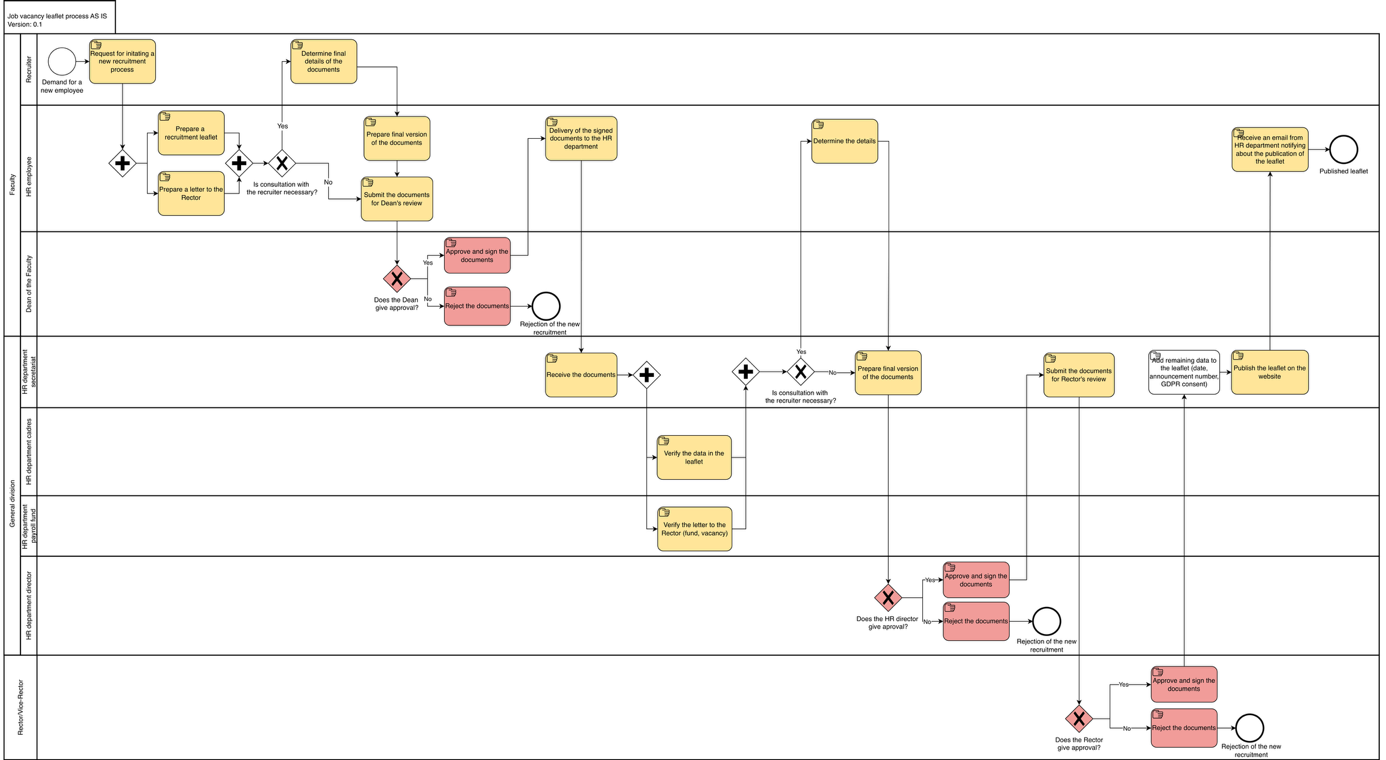
The analysis of the AS IS process revealed several bottlenecks (marked in red) and weaknesses (marked in yellow), as shown in Figure 1.
In particular: - Approval stages at the faculty, HR department and Rector levels constitute major bottlenecks, as decisions depend on individual availability and are not supported by standardised timeframes.
- Verification and correction actions between faculty and HR units introduce delays due to non-standardised content and repeated manual checks.
- Strong dependence on tacit knowledge is visible in several steps, where task execution relies on individual experience rather than formalised procedures (e.g., leaflet preparation or document verification).
- Manual data handling and document transfers increase the risk of errors and prolong the overall process duration.
- In the next step, the documented process was subjected to qualitative analysis using an inductive approach. Given the limited scope of the case and the exploratory nature of the study, the analysis focused on understanding process logic, recurring issues, and opportunities for improvement rather than on theory-building or large-scale qualitative generalisation. The analysis proceeded in four stages. First, a descriptive phase was conducted, involving repeated readings of the collected empirical material, including interview notes and internal documents. This stage aimed to familiarise the researcher with the process logic, terminology used by participants, and recurring problem areas. Second, the material was segmented into smaller analytical units, such as sentences and short thematic fragments. During this stage, frequently recurring expressions and topics were identified. The most common references concerned:
- Submission and circulation of the job vacancy leaflet, e.g., “the leaflet and letter are sent to the HR department” (Interview 1, 2024).
- Verification of documents by the HR department, e.g., “the HR department verifies the documents” (Interview 3, 2024).
- Roles and responsibilities of process participants, e.g., “roles and permissions must be clearly defined” (Interview 1, 2024).
- Approval by Dean and Rector, e.g., “documents must be signed by the Dean, then they go to the Rector” (Interview 1, 2024).
- Document requirements and formal correctness, e.g., “the leaflet must contain all mandatory elements, otherwise it is returned for correction” (Interview 2, 2024).
- Requirement process (demand for a new employee, prepare the leaflet and letter, approvals, publish the leaflet, inform the unit).
- Documents and content (leaflet description, necessary documents, document templates, with mandatory and optional sections).
- Roles and actors (recruiter, HR employee, Dean, Rector, HR department staff).
- Issues and needs (roles and access rights, duplicate actions, alerts and reminders).
- Proposed system functionalities (colour-coded forms, notifications, automated publishing).
- extensive manual handling of information,
- frequent corrections and delays,
- limited process transparency,
- lack of status tracking mechanisms,
- strong dependence on informal communication,
- and growing frustration among process participants.
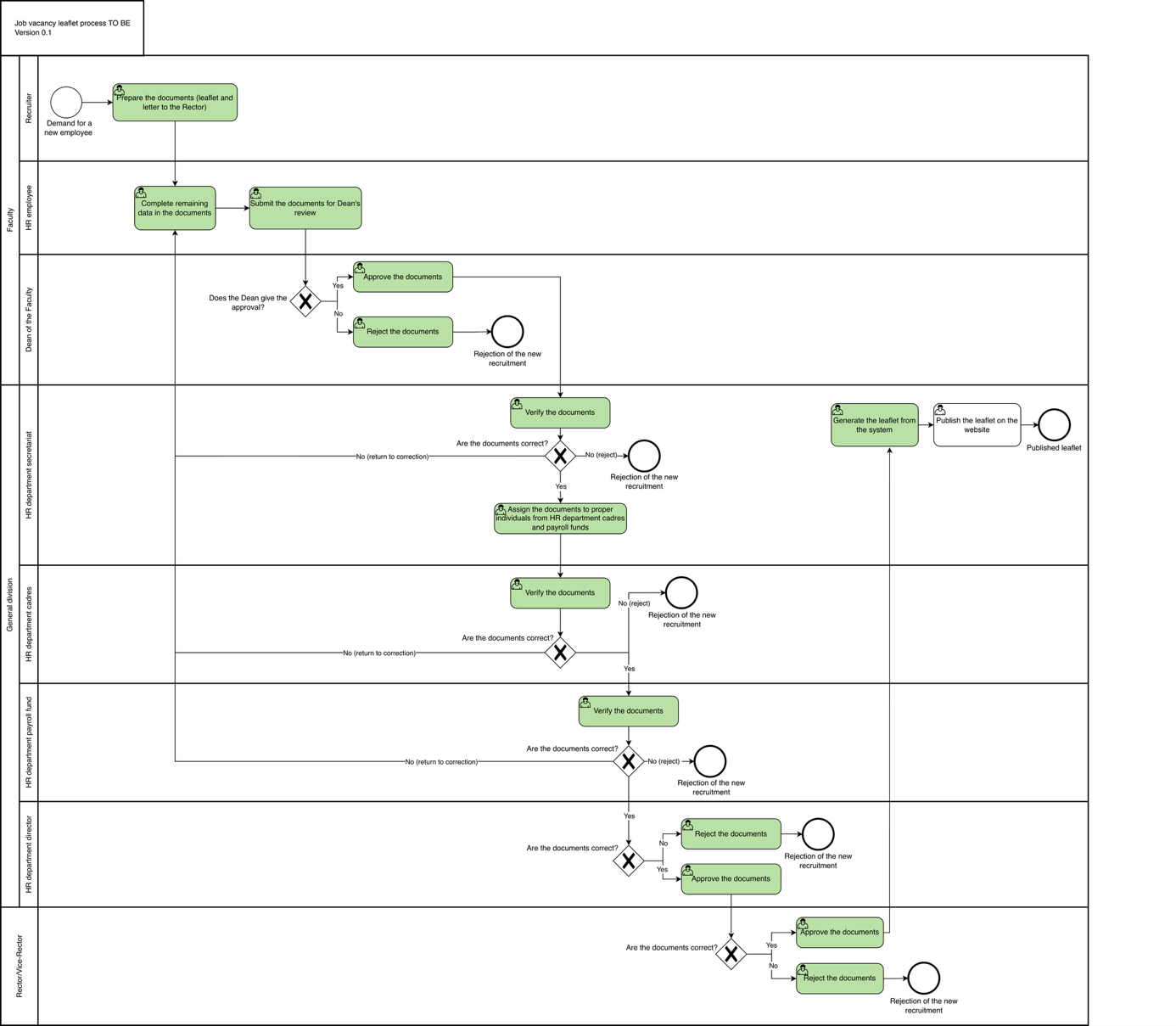
- Based on the identified requirements, observed process weaknesses, and stakeholder input, a TO BE process model was developed using BPMN notation. The design phase focused on translating analytical findings into feasible process improvements while considering the technical capabilities of the target system. BPMN modelling was supported by draw.io and Figma tools, which were used to prepare both process diagrams and interface mock-ups. The outcome of this phase was a pre-implementation analysis document, including AS IS and TO BE process models, detailed descriptions of redesigned process steps, and visual mock-ups of the planned system interface. The TO BE model (Figure 2) introduces several key improvements compared to the existing process (marked in green):
- Automation of requests, enabling automatic forwarding of tasks to the next responsible actor without manual intervention.
- Built-in data validation, ensuring completeness and correctness of submitted forms before further processing.
- Full digital handling of documents, eliminating paper-based steps and reducing the risk of errors.
- Real-time process tracking, allowing participants to monitor the status of requests.
- Centralised data and document management, ensuring consistent access to up-to-date information.
- Improved communication between stakeholders, supported by system-based notifications and clearly defined responsibilities.
- As a part of the implementation phase, the redesigned process was digitalised using the nAxiom low-code platform (https://naxiom.com/en/platform/about-platform). The tool was selected through a formal public procurement procedure, in accordance with regulations applicable to public higher education institutions. It was made available for process automation at the organisational level. nAxiom is a low-code platform supporting process modelling, electronic forms, rule-based validation, automated task routing, and role-based access control. These functionalities enabled the implementation of the redesigned process while maintaining compliance with institutional and legal requirements. The platform was particularly well-suited to supporting structured workflows and enhancing process transparency without requiring extensive custom development. The implementation was constrained by the system's technical capabilities and the need to preserve the existing business logic. Consistent with observations by Scheithauer and Wirtz (2008), the digitalisation focused on improving execution and control rather than on radically redesigning the process. The final phase of the project corresponded to the process monitoring and control stage and was conducted using an agile-oriented User Acceptance Testing (UAT) approach. In agile methodologies, UAT constitutes a critical validation phase in which end users assess whether the implemented solution adequately supports business processes and operational requirements prior to production deployment (https://scrumguides.org/index.html).
- In the case analysed, UAT was conducted iteratively, with key stakeholders directly involved in the job-vacancy process. The testing phase combined hands-on system use with structured feedback collection and was conducted over 2 cycles. This approach enabled the identification of functional issues, usability problems, and inconsistencies between the designed process and actual work practices. The results of UAT led to several refinements to the implemented solution, including adjustments to form structure, validation mechanisms, and system improvements. Following the incorporation of these changes, the system was approved for initial deployment. The pilot implementation was launched at the Faculty of Computer Science and subsequently extended to three additional organisational units cooperating at the executive level. The solution is currently in operational use and is supported through ongoing maintenance and incremental improvements based on user feedback.
The identified bottlenecks correspond to activities characterised by low formalisation and high reliance on individual expertise, consistent with level 1 (Initial) of process maturity.
Figure 1AS IS Flow for the Analysed Process (Job Vacancy Leaflet Management)
Source: author’s own work.
The purpose of this step was not to quantify word frequency but to identify recurrent process-related issues and decision points, which served as indicators of structurally significant elements within the process. Third, an open coding procedure was applied. Codes were assigned to recurring themes and grouped into broader analytical categories:
Given the study's limited scale and the narrowly defined process scope, coding was conducted by a single researcher. The empirical material was relatively small and homogeneous, and the objective of the analysis was to understand processes rather than to generate theory. For this reason, formal inter-coder reliability procedures were not applied, as they would not have added analytical value in this context. Instead, consistency was ensured through repeated iterations of coding and continuous comparison between data segments and emerging categories. In the final step, the codes were consolidated into higher-level thematic categories (primary, secondary, expected and unexpected). Table 1 presents the results of this analytical process, along with illustrative quotations from the empirical material.
Table 1Summary of Closed Coding Results with Categorised Themes and Illustrative Quotations
| Theme category | Codes | Illustrative quotations |
| Primary | Recruitment process, documents, roles and actors | “Step 1 is a demand for a new employee” (Interview 3, 2024). “The application should include a CV” (Interview 2, 2024). |
| Secondary | Process issues | “There are many duplicative actions and substantial paper use” (Interview 2, 2024). |
| Expected | Automated workflow, document management, role clarity and permissions | “HR department employees must be able to edit the leaflet” (Interview 1, 2024). “Note that person XYZ is responsible for this document to prevent duplicates” (Interview 3, 2024). |
| Unexpected | Duplicated actions, lack of centralised communication | “The HR department communicates by phone/email with the relevant HR employee” (Interview 1, 2024). |
Source: author’s own work.
The analysis revealed several major issues (narrative summary), including:
These changes directly address the bottlenecks and inefficiencies identified in the AS IS analysis. The TO BE process represents a structured approach to process improvement, aimed at increasing efficiency, traceability, and reliability while laying the foundation for further process standardisation and digital maturity.
Figure 2TO BE Flow for the Analysed Process (Job Vacancy Leaflet Management)
Source: author’s own work.
Empirical Outcomes of Digitalisation
The effects of this digitalisation became visible shortly after deployment and could be directly linked to previously identified bottlenecks in the AS IS process. The effects of digitalisation were assessed using a set of process-oriented Key Performance Indicators (KPIs), which are summarised in Table 2. The most significant improvement concerned the elimination of paper-based documentation. Prior to implementation, each case required printing and manual circulation of multiple documents, typically up to 10 pages per 1 leaflet. Following digitalisation, the process became fully electronic, resulting in a 100% reduction in paper use for the analysed workflow. A second significant improvement concerns process throughput time, particularly at the approval stages. In the AS IS process, document circulation depended on the physical availability of decision-makers, which frequently caused delays. After implementation, approvals were processed electronically and asynchronously with proper reminders, reducing the average processing time from approximately 10-14 days to 3-5 days, depending on case complexity. The digital solution also improved process transparency and control. Users gained real-time access to request status, which significantly reduced informal inquiries and repeated follow-ups. User feedback collected during and after UAT confirmed these effects. One participant noted that “The status of each request is now immediately visible, which eliminates uncertainty and unnecessary communication.” At the same time, another emphasised that “The system enforces a clear structure and reduces the risk of errors.” Concurrently, the implementation revealed challenges in adapting established work practices. Some users required additional time to adapt to the new workflow, underscoring that digital transformation in academic organisations must be accompanied by gradual learning and support mechanisms. The system remains under continuous evaluation, with performance indicators monitored to guide further optimisation.
Table 2KPIs before and after Digitalisation
| KPI | AS IS | TO BE | Observed effects |
| Process duration | 10-14 days | 3-5 days | Approx. 60-70% reduction |
| Paper usage | Up to 10 pages per 1 leaflet | 0 pages | 100% elimination |
| Approval dependency | Physical presence required | Electronic approval | Bottleneck removed |
| Level of automation | Fully manual process | Partially automated, system-supported | Significant reduction of manual work |
| Process transparency | Low | High (real-time tracking) | Fewer status inquiries |
Source: author’s own work.
Challenges and Recommendations
Although the digitalisation initiative delivered measurable operational improvements, it is important to emphasise that the presented results stem from the implementation of a single administrative process; therefore, they should be interpreted within the limitations of a qualitative case study. The findings do not permit direct generalisation to the entire organisation. They provide empirically grounded insights into the typical challenges associated with process digitalisation in large, decentralised universities.
The case demonstrates that digitalisation, when implemented without a broader organisational framework for process management, tends to focus on the technical layer rather than on structural or governance-related transformation. In the analysed project, the primary effort was directed toward mapping and digitising an existing process. In contrast, issues such as process ownership, cross-unit coordination, and long-term process governance remained only partially addressed. This confirms earlier observations that digital tools alone do not guarantee process maturity and may even reinforce existing inefficiencies if organisational conditions are not adequately addressed.
The findings of this study should not be interpreted as exceptional or isolated. On the contrary, they reflect challenges widely reported in the literature on Business Process Management in Central and Eastern European (CEE) countries. As noted by researchers analysing BPM adoption in this region, there is often an apparent discrepancy between the theoretical maturity of BPM concepts and their practical implementation. While process-oriented management is well described in academic literature, its application in public organisations remains fragmented, incremental, and frequently limited to local initiatives rather than organisation-wide transformation (Gabryelczyk et al., 2022).
From this perspective, the value of the presented case lies precisely in its practical realism. The study illustrates how digitalisation efforts unfold under real organisational constraints, including limited formal process governance, siloed structures, and a strong dependence on individual engagement. Rather than representing an idealised BPM implementation, the case highlights the everyday conditions under which digitalisation initiatives are typically carried out in public universities.
The analysis also indicates that while the strongest emphasis was placed on information technology, methods, and strategic alignment, the project simultaneously initiated gradual development in the remaining BPM core elements - governance, people, and culture (Rosemann & vom Brocke, 2014) (Figure 3). Although no formal process governance framework was introduced, the agile, iterative implementation approach led to the gradual emergence of responsibility and decision-making structures within the digitised process.
Similarly, while BPM was not formally adopted, the project fostered increased process awareness among participants and encouraged more structured thinking about workflows and responsibilities. The observed user adaptation challenges underline that digital transformation is not merely a technical change but a social and organizational one. Resistance to new tools, reliance on established work habits, and the need for learning time are common in organisations characterised by low process maturity. These findings support earlier research indicating that successful wide digital transformation requires not only technological investment but also sustained efforts in training, communication, and cultural change (Sánchez, 2020).
Based on the case analysis, several recommendations can be formulated, not as universal prescriptions, but as practice-oriented indicators for similar organisations:
- Digital initiatives should be accompanied by the gradual development of process governance structures, even if implemented initially on a limited scale.
- Process ownership and accountability should be explicitly defined to avoid fragmentation and local optimisation.
- Employee competencies in the process lifecycle and digital tools should be systematically developed.
- Cultural change toward process orientation should be supported through incremental, well-communicated initiatives rather than top-down enforcement.
The presented case does not claim to provide a comprehensive model for digital transformation in higher education. Instead, it offers empirical evidence that even a single well-executed digitalisation initiative can reveal structural weaknesses, stimulate organisational learning, and catalyse broader process-oriented thinking. Addressing such issues openly, rather than assuming that digital tools alone will resolve them, remains a critical challenge for universities pursuing digital transformation.
Figure 3BPM Core Elements
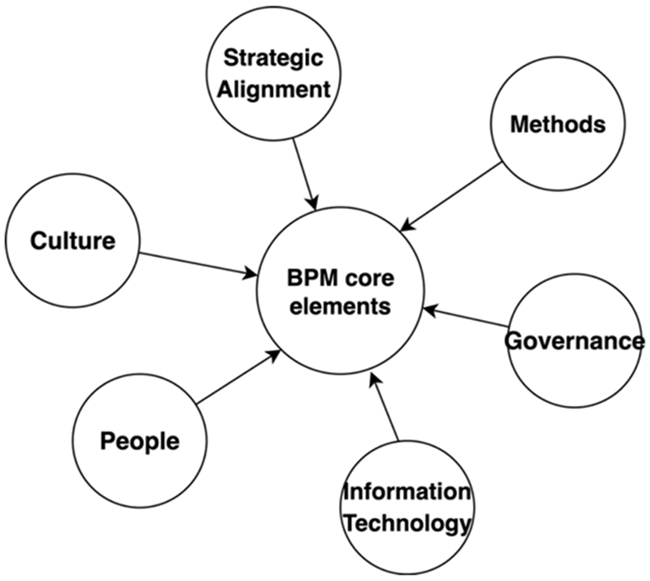
Source: own work based on M. Rosemann & J. vom Brocke, “The six core elements of business process management”. In J. vom Brocke, & M. Rosemann (Eds.), Handbook on business process management 1: introduction, methods, and information systems (p. 111). Springer (https://doi.org/10.1007/978-3-642-45100-3_5).
Conclusions
The presented case demonstrates that even in highly siloed higher education institutions, digitalisation can yield tangible operational improvements when supported by process-oriented thinking. The implementation confirmed that BPM principles, although not formally adopted, enabled the identification of bottlenecks, improved transparency, and increased efficiency of the analysed process. The study clearly shows that digitalization alone does not increase overall process maturity. While the project improved the execution of a single administrative process, it did not produce systemic change at the organisational level. This is why technological solutions must be accompanied by the development of process governance, clearly defined responsibilities, and organisational capabilities related to process management.
The study contributes to the BPM literature by empirically demonstrating how low process maturity and the absence of governance mechanisms shape the trajectory of digitalisation. Under such conditions, efficiency gains remain confined to local process improvements, while organisation-wide process transformation is systematically constrained. The presented case concerns a single, relatively small administrative process implemented as a pilot initiative; therefore, its results cannot be generalised directly to the entire university. However, the study provides valuable empirical insight into how digitalisation unfolds in practice and highlights the typical challenges faced by higher education institutions at the early stages of process maturity. Future research and implementation efforts should extend this approach to a broader set of processes to assess scalability and long-term organisational impact. Meaningful digital transformation in higher education does not begin with technology itself, but with the willingness to rethink processes, responsibilities, and collaboration, making process awareness the actual driver of change.
References
- Abdelnabi, E. A., Fadel, M. A., Erhoma, L. A., & Elbarghathi, L. A. (2003). Application of Business Process Management in the Libyan International Medical University: History and development. 2023 IEEE 3rd International Maghreb Meeting of the Conference on Sciences and Techniques of Automatic Control and Computer Engineering (MI-STA) (pp. 348-352). IEEE. https://doi.org/10.1109/MI-STA57575.2023.10169815
- Afeltowicz, Ł. (2011). Od automatycznych systemów diagnostycznych do USOS/USOSweb: informatyczne systemy wspomagania pracy a reorganizacja praktyk społecznych, wzorców działania i procesów poznawczych [From automated diagnostic systems to USOS/USOSweb: information technology systems supporting work and the reorganization of social practices, patterns of action, and cognitive processes]. In M. Jeziński (Ed.), Nowe media w systemie komunikowania: edukacja, cyfryzacja (pp. 95-105). Wydawnictwo Adam Marszałek.
- AGH. (2022). Strategia Akademii Górniczo-Hutniczej im. Stanisława Staszica w Krakowie [The strategy of the AGH University]. https://www.agh.edu.pl/home/ckim/dokumenty/inne/Strategia_AGH_30.11.2022.pdf
- AGH. (2024). Fakty i liczby [Facts and figures]. https://www.agh.edu.pl/o-agh/fakty-i-liczby
- Chaushi, B. A., Dika, Z., & Chaushi, A. (2017). Improving institutional services through university ERP: a study of the academic planning module development at SEEU. SEEU Review, 12(2), 62-81. https://doi.org/10.1515/seeur-2017-0018
- Clark, B. R. (1986). The higher education system: Academic organization in cross-national perspective. University of California Press.
- Coghlan, D., & Brannick, T. (2014). Doing action research in your own organization (4th ed.). SAGE Publications Ltd. https://doi.org/10.4135/9781529682861
- Cruz, L., Basto, M., Silva, J., & Lopes, N. (2021). Business Process Management as a driver for Digital Transformation: A case study in a higher education institution. In 16th Iberian Conference on Information Systems and Technologies (CISTI) (pp. 1-6). IEEE. https://doi.org/10.23919/CISTI52073.2021.9476422
- Davenport, T. H. (1993). Process innovation: reengineering work through information technology. Harvard Business Press.
- Davenport, T. H., & Short, J. E. (1990). The new industrial engineering: information technology and business process redesign. MIT Sloan Management Review. https://sloanreview.mit.edu/article/the-new-industrial-engineering-information-technology-and-business-process-redesign/
- Duarte, D., & Martins, P. V. (2014). Higher education business process improvement: Achieving BPMM level 3. In 2014 9th International Conference on the Quality of Information and Communications Technology (pp. 18-27). IEEE. https://doi.org/10.1109/QUATIC.2014.10
- Dumas, M., La Rosa, M., Mendling, J., & Reijers, H. A. (2013). Fundamentals of Business Process Management (2nd ed.). Springer.
- Dziedziczak-Foltyn, A. (2018). Uniwersytet socjalistyczny i jego współczesne neoliberalne analogie [The socialist university and its contemporary neoliberal configurations]. Kultura i Społeczeństwo, 62(1). https://doi.org/10.35757/KiS.2018.62.1.13
- Gabryelczyk, R. (2020). Has COVID-19 accelerated digital transformation? Initial lessons learned for public administrations. Information Systems Management, 37(4), 303–309. https://doi.org/10.1080/10580530.2020.1820633
- Gabryelczyk, R., Brzychczy, E., Gdowska, K., & Kluza, K. (2022). Business process management in CEE countries: A literature-based research landscape. In A. Marella, R. Matulevičius, R. Gabryelczyk, B. Axmann, V. B. Vukšić, W. Gaaloul, M. I. Štemberger, A. Kő, & Q. Lu (Eds.), Business Process Management: Blockchain, Robotic Process Automation, and Central and Eastern Europe Forum. BPM 2022. Lecture Notes in Business Information Processing, 459, 279-294. Springer. https://doi.org/10.1007/978-3-031-16168-1_18
- Galimberti, M. F., Hauck, J. R., De Lucca, J. E., & Peters, S. (2022, July). Towards a Business Process Automation Office Model: Action research in higher education institution. In Workshop de Computação Aplicada em Governo Eletrônico (WCGE) (pp. 204-214). SBC.
- Harmon, P. (2019). Business process change: a business process management guide for managers and process professionals (4th ed.). Morgan Kaufmann.
- Hrabala, M., Opletalova, M., & Tuček, D. (2017). Business process management in Czech higher education. Journal of Applied Engineering Science, 15(1), 35-44. https://doi.org/10.5937/jaes15-12171
- Kezar, A. (2014). How colleges change: Understanding, leading, and enacting change. Routledge.
- Object Management Group. (2008). Business Process Maturity Model (BPMM). http://www.omg.org/spec/BPMM/1.0/PDF
- Paradeise, C., Reale, E., Bleiklie, I., & Ferlie, E. (Eds.). (2009). University governance. Springer.
- Parviainen, P., Tihinen, M., Kääriäinen, J., & Teppola, S. (2017). Tackling the digitalization challenge: how to benefit from digitalization in practice. International Journal of Information Systems and Project Management, 5(1), 63-77. https://doi.org/10.12821/ijispm050104
- Rosemann, M., & de Bruin, T. (2005). Towards a Business Process Management Maturity Model. ECIS 2005 Proceedings, 37. https://aisel.aisnet.org/ecis2005/37
- Rosemann, M., & vom Brocke, J. (2015). The six core elements of business process management. In J. vom Brocke, & M. Rosemann (Eds.), Handbook on Business Process Management 1: Introduction, methods, and information systems (pp. 105-122). Springer. https://doi.org/10.1007/978-3-642-45100-3_5
- Sánchez, M. A. (2020). University e-readiness for the digital transformation: the case of Universidad Nacional del Sur. Revista Gestão & Tecnologia, 20(2), 75–97. https://doi.org/10.20397/2177-6652/2020.v20i2.1848
- Scheithauer, G., & Wirtz, G. (2008). Applying business process management systems: a case study. Bamberger Beitrage zur Wirtschaftsinformatik und Angewandten Informatik, 76. http://fis.uni-bamberg.de/bitstreams/2275f429-225b-446f-8cd4-57b120575c10/download
- Szelągowski, M. (2018). Evolution of the BPM Lifecycle. In M. Ganzha, L. Maciaszek, & M. Paprzycki (Eds.), Communication Papers of the 2018 Federated Conference on Computer Science and Information Systems (pp. 205-211). https://doi.org/10.15439/2018f46
- Vom Brocke, J., & Mendling, J. (Eds.). (2018). Business Process Management cases. Digital innovation and business transformation in practice. Springer.
- Zenak, F. & Bendoukha, H. & Himri, F. (2025). Digitalization and Optimization of University Business Processes through BPM and KPI Integration. Journal of Information Systems Engineering and Management, 10(4), 753-768. https://doi.org/10.52783/jisem.v10i4.9891
- Yin, R. K. (2003). Case study research: Design and methods (3th ed.). Sage Publications.
 https://orcid.org/0009-0007-9347-5978