

About the article
DOI: https://www.doi.org/10.15219/em112.1730
The article is in the printed version on pages 47-56.
 Download the article in PDF version
How to cite
Mijač, T. (2025). Rethinking information system success: Generative AI in the hands of future business managers. e-mentor, 5(112), 47-56. https://www.doi.org/10.15219/em112.1730
E-mentor number 5 (112) / 2025
Table of contents
- Introduction
- Literature Review
- Research Model Development
- Methodology
- Results
- Discussion
- Conclusion
- References
About the author
Rethinking Information System Success: Generative AI in the Hands of Future Business Managers
Tea Mijač
Abstract
Artificial Intelligence (AI) has rapidly evolved over recent decades, transforming various sectors. At the forefront of AI advancements is Generative Pre-trained Transformer technology, exemplified by ChatGPT, which demonstrates significant capabilities in generating human-like conversational responses.
This study examines the perceived success factors of ChatGPT among Gen Z business students using the DeLone and McLean Information System Success Model. Utilising a qualitative methodology with a sample of 410 participants, the research assesses all six core dimensions while accounting for multidimensionality.
The findings reveal that, while ChatGPT is widely adopted in academic contexts, higher-order construct analysis indicates that some traditionally validated dimensions did not achieve statistical significance in this specific setting. Notably, the research did not confirm that the quantity dimension is significantly related to intention to use, nor that intention to use significantly affects perceived net benefits, suggesting potential limitations of the model when applied to generative AI. This study highlights the need for updated or adapted theoretical models that better capture the unique characteristics and user interactions associated with modern AI tools such as ChatGPT. As these students transition into the workforce, their attitudes and experiences offer a valuable preview of how future employees may engage with AI in professional environments.
Keywords: generative AI, future business workforce, IS success, Gen Z, DeLone and McLean Model
Introduction
Artificial intelligence (AI) has become a transformative force in both business and society, reshaping how organisations operate and how individuals interact with digital services. Recent research has extensively examined the adoption and application of AI across a wide range of industries and domains, highlighting its growing strategic importance. The ability of organisations to successfully adopt and integrate technological innovations has become a critical determinant of competitive advantage (Ikhsan et al., 2025). Beyond technical implementation, this integration requires a clear understanding of how AI can be leveraged to generate economic value and organisational benefits. Consequently, defining effective governance mechanisms and strategic approaches to harness AI’s economic potential has emerged as a key challenge for contemporary organisations (Chhillar & Aguilera, 2022). Different providers now depend on AI models to deliver personalised assistance and advice (Söllner et al., 2025). As a result, individuals and organisations now rely on AI-driven systems daily, often without fully recognising the extent of this dependence.
Although AI was introduced in the 1950s, widespread adoption did not occur until the launch of ChatGPT in November 2022. Why? Because it became available to the public, unlike previously, when AI was limited to highly educated individuals, because its use required expert knowledge. AI advancements include Generative Pre-trained Transformer (GPT) models, exemplified by ChatGPT (Dwivedi et al., 2023), which demonstrate significant capabilities for generating human-like conversational responses. Although generative AI (GenAI) represents only one segment of AI, it is currently among the most widely known and used tools, with ChatGPT increasingly recognised for its potential to enhance economic productivity (Turkes et al., 2024).
In today’s labour market, there are Gen Z, millennials, Gen X, and boomers, and regardless of the industry in which these generations work, efficiency has always been and will continue to be one of the main goals, as it is well known that efficiency can increase revenue and, therefore, profit. Millennials, born between 1981 and 1996, grew up with rapid advances in IT, so this tech-savvy generation often adopts digital innovations early (Ikhsan et al., 2025). However, the new generation, known as Gen Z, is regarded as significantly more technologically proficient (Arkhipova et al., 2019) and currently constitutes a substantial share of the population in many countries (Abed, 2024).
Drawing on the Theory of Reasoned Action (TRA) and the Technology Acceptance Model (TAM), end users’ perception of technology’s usefulness is expected to increase their intention to use it and their actual usage. Additionally, to assess the overall success of an IS or digital service (regardless of whether it is based on AI or not), the DeLone and McLean Information System Success Model provides a well-established theoretical framework. Their model, referred to as the D&M IS success model, assesses system success across six dimensions: system quality, information quality, service quality, user satisfaction, intention to use/usage, and perceived net benefits.
The motivation for this empirical research stems from prior studies validating the IS success model or attempting to determine additional dimensions and relationships, so far studies focusing on AI based technologies success did not include all success dimension in their models (Minseong et al., 2025), or results were not consistent with the theory (Chen et al., 2024; Yoon & Kim, 2023). Additionally, the perceived net benefits of using GenAI in business remain under-researched (Chu, 2023). GenAI is highly interdisciplinary; thus, it is important to identify success factors (Söllner et al., 2025). In general, IS research and practice can benefit considerably from improved understanding of IS success (Jeyaraj, 2020).
The goal of this paper is to investigate whether the D&M IS success model, including all its core dimensions and considering their multidimensionality, adequately captures the success of GenAI tools such as ChatGPT when applied by Gen Z business students.
This paper is divided into seven sections. The first section examines relevant phenomena and identifies research gaps foundational to this study. The second section outlines the literature review, while the third establishes the framework and hypotheses. The fourth section outlines the research strategy and summarises the methodology. In the fifth section, the research findings are presented. The sixth section offers a theoretical and practical discussion of these findings. Finally, the last section concludes with a discussion of research limitations and suggests directions for future research.
Literature Review
Adoption of GenAI in the Business Context
The scientific landscape of AI research has flooded scientific databases. This is expected, given that the benefits of AI-based technologies are unquestionable across industries. Several studies have examined the usage of AI in the work environment, for example, in the field of project management (Vegar & Mijač, 2024), in a smart city environment (Ferreira dos Santos et al., 2025), energy efficiency (Fontoura et al., 2025), marketing (Gupta et al., 2025), banking sector (Ikhsan et al., 2025), etc.
Recent findings corroborate that AI and machine learning (ML) significantly impact firm performance and logistics efficiency, underscoring their essential role in companies’ success (Garg et al., 2025). Recent studies have shown that adopting AI is also crucial for SMEs to realise both immediate operational improvements and long-term sustainability goals (Soomro et al., 2025). Evidence indicates that organisations using ChatGPT can experience improved creativity and innovation, increased work efficiency, and enhanced employee skills and competencies, thereby increasing employees’ awareness of their organisation’s sustainability commitments (Vrontis et al., 2023). However, another piece of empirical evidence on GenAI indicated that increased employee efficiency was rated lower than expected (3.05 out of 5). In contrast, cost savings were perceived as a more important benefit (3.41 out of 5) (Vegar & Mijač, 2024).
Despite the growing necessity of integrating AI into business, significant barriers to adoption remain. Although generative AI has rapidly become mainstream, resistance persists, highlighting a digital divide that extends into the workplace. A recent study found that managers perceive greater risk and are less willing to invest in AI applications for human resources than in finance and marketing. Furthermore, findings indicate that acceptance of this technology diminishes when its functionality exceeds a critical threshold, allowing AI to make decisions without human oversight (Gieselmann et al., 2025).
A recent study revealed that individuals who strongly embrace the idea of technosolutionism – believing that technology can solve problems – tend to favour robots over humans for job roles and prefer AI over human managers for decision-making in the workplace. This is significant because most studies indicate that people generally dislike the notion of being replaced or overseen by technology. However, those who are enthusiastic about technology solutions are more likely to adopt them (Nagpal et al., 2024). In addition, empirical research on project managers revealed a notable trend of limited adoption, with 56.5% of respondents reporting no use of AI (Vegar & Mijač, 2024). By contrast, research focused solely on employees of IT companies found that 69% of respondents held a positive view of ChatGPT’s future development (Jakopec et al., 2023). These findings reveal disparities across industries, with the IT sector favoured. A recent study also examined ChatGPT and unequal adoption among Swedish workers, indicating that younger and less experienced workers are more likely to use ChatGPT (Humlum & Vestergaard, 2025). Additionally, the same analysis highlighted a significant gender gap in adoption, showing that women tend to be much less likely to use ChatGPT.
These findings suggest a gender and industry divide in AI adoption. Some possible reasons for low AI adoption in business environments (excluding the IT industry, which clearly has a high adoption rate) include limited awareness of the availability of AI tools and insufficient skills for their use (Vegar & Mijač, 2024).
TAM, UTAUT and D&M IS Success Model
The use, adoption, and success of technology have been a focus of research for more than four decades. It began in 1989, when Davis introduced the TAM, focusing on the antecedents of usage: perceived ease of use and perceived usefulness. TAM was extended into the Unified Theory of Acceptance and Use of Technology (UTAUT). In contrast, the D&M IS success model adopts a more comprehensive perspective while also accounting for usage and intention to use. The D&M model considers objective measures of systems that undoubtedly impact success (Delone & McLean, 2003). Unlike TAM and UTAUT, which are more oriented toward individuals’ characteristics, the IS success model tends to examine success factors for achieving organisational and individual net benefits. TAM and UTAUT have been criticised for reaching a plateau in knowledge contribution due to their extensive use in research (Shachak et al., 2019). Similarly, some authors criticise the IS success model for oversimplifying the complex nature of ISs and for failing to fully capture the dynamic and contextual factors that influence success.
Some scholars have suggested integrating theoretical models or frameworks with specific ISs to better understand AI adoption (Abed, 2024). Given that IS success is a complex, multidimensional construct, with each dimension serving as a potential indicator of success (Mijač et al., 2024), this study applies the D&M IS success model to measure the success of ChatGPT among Gen Z. Additionally, previous research has shown that this model can be applied to AI chatbot adoption in the tourism sector (Abed, 2024), as ChatGPT exhibits characteristics typical of an IS (Chu, 2023).
Regarding the IS success model, a recent meta-study and review paper identified limitations that should be addressed: studies reported inconsistent use of indicators and results that were not aligned with the theoretical IS success model (Jeyaraj, 2020; Mijač et al., 2024). This inconsistency in the empirical results has also been noted in AI-related research. For example, user satisfaction with ChatGPT has not been confirmed to influence the intention to use ChatGPT (Minseong et al., 2025). Notably, recent research has not found a significant effect of information quality on satisfaction (Yoon & Kim, 2023). Additionally, research on ChatGPT has not found a significant impact of system quality on user satisfaction (Chen et al., 2024). In particular, the literature review indicates that empirical tests of the IS success model are often partial. For example, recent research on ChatGPT assessed success factors; however, it did not include service quality and information quality in its conceptual model (Marjanovic et al., 2024). In addition, a recent study that validated the IS success model on ChatGPT (Chen et al., 2024) did not include the net benefits construct, whereas Chu (2023) did not observe an intention to use/usage of ChatGPT; none of these empirical papers employed higher-order constructs in their conceptual models.
When discussing the quality subdimension, information quality is paramount in the context of GenAI, as the primary purpose of this digital service is to generate content. Thus, testing all quality aspects significantly contributes to overall success. Research focusing on information quality indicates that students are aware of ChatGPT’s potential inaccuracies and perceive its answers as lacking accuracy or specificity, underscoring the need for caution (Tlili et al., 2023).
The authors confirmed the importance of information quality by examining its subdimensions and impact on user satisfaction with information quality (Fu et al., 2024). End users recognise that information quality can be questionable; however, only 32% of IT employees surveyed in a recent study reported that inaccuracies and ambiguities in responses are the main drawbacks (Jakopec et al., 2023).
The rationale for applying this theoretical model in this study lies in the study’s business context, where measuring the success of ISs through the benefits they deliver is particularly important. After all, without tangible benefits, the implementation of AI technologies would lack clear justification. Nevertheless, all quality dimensions should be incorporated into the assessment of the success of GenAI digital services.
Research Model Development
ChatGPT exhibits features of a standard IS, aligning well with the academically validated IS success model (Chu, 2023); thus, the study’s research model is grounded in the original dimensions of that model. The multidimensionality of the construct has been considered, as digital service quality is often conceptualised as a higher-order construct (HOC) in research (Aldholay et al., 2018; Ho et al., 2010; Isaac et al., 2017). The quality dimensions of the IS D&M success model refer to system quality, information quality, and service quality (Delone & McLean, 2003). Thus, ChatGPT quality in this paper is conceptualised as a multidimensional construct (Mijač et al., 2023), comprising system quality, service quality, and information quality as its subdimensions. Additionally, each of these three dimensions has been treated as a third-order multidimensional construct.
Most system quality indicators focus on engineering performance, particularly relating to program code quality and the development phase (DeLone & McLean, 1992; Semeon et al., 2010). Additionally, system quality can be defined as the capability of an IS to be used easily and correctly while continuously providing all functionalities specified in user requirements (Martins et al., 2019). In this research, system quality reflects the reliability, availability, security, functionality, response rate and usability for measuring system quality (Chu, 2023; Mijač et al., 2025).
Information quality refers to the desirable characteristics of an IS’s outputs, such as reports or digital content (Petter et al., 2008). Essentially, it represents the perceived value of system outputs from the perspective of end users (Semeon et al., 2010). Several empirical studies have shown that information quality statistically influences higher system usage and overall user satisfaction (Chu, 2023). A recent paper confirmed a significant positive impact of information completeness, precision, timeliness, and convenience on user satisfaction with ChatGPT, whereas accuracy and reliability were not significant (Fu et al., 2024). This research used indicators: up-to-dateness, reliability, accuracy, completeness, timeliness, understandability and relevancy to measure information quality.
Enhancements in service quality, such as improved functionality, reliability, and support, are anticipated to boost user satisfaction (Al-Emran et al., 2025). Service quality has shifted from face-to-face to online modes, as the growing popularity of web-based environments has often replaced personal interactions with system interfaces (Chen & Chengalur-Smith, 2015). Regardless of the support channel used, standard measures of service quality include response time, accuracy, reliability, technical competence, staff empathy, and user guidelines (Chen & Chengalur-Smith, 2015; Petter et al., 2008). Service quality has very often been identified as a significant determinant of user satisfaction (Chu, 2023) and intention to use (Mijač et al., 2024).
Past studies have confirmed the impact of IS quality subdimensions on intention to use and user satisfaction; for example, in a recent study on Fintech payments, system, service, and information quality were directly associated with user satisfaction (Abed & Alkadi, 2025). Additionally, research involving 360 industry and academic experts confirmed the importance of all quality subdimensions for organisational performance (Al-Qerem et al., 2025). Recent research has confirmed that the system and service quality of AI-based speakers positively affect user satisfaction, and that user satisfaction significantly influences net benefits (Yoon & Kim, 2023). Similarly, user satisfaction with fintech payment apps has been found to positively influence users’ intention to continue using them (Abed & Alkadi, 2025). The elevated satisfaction is expected to foster users’ adoption of GenAI, prompting them to explore its capabilities further and integrate these tools more deeply into their activities (Al-Emran et al., 2025).
Recent research on ChatGPT has also confirmed the significant and positive impact of information and service quality on user satisfaction, as well as the impact of user satisfaction on intention to use ChatGPT (Chen et al., 2024). Empirical research on ChatGPT also confirmed that all quality subdimensions have a significant and positive impact on user satisfaction (Chu, 2023).
The primary criterion for evaluating IS success is its benefits, which entail assessing the advantages derived from the system’s utilisation (Delone & McLean, 2003). A benefit is defined as a quantifiable improvement arising from a particular achievement and is observable to all stakeholders (Andrade et al., 2016). Based on the SLR, the most commonly used indicators for measuring perceived net benefits are: enhanced end-user performance, usefulness, time savings, and cost savings (Mijač et al., 2024). These benefits have also been applied to AI-related technologies, notably reduced costs (Yoon & Kim, 2023) and time savings (Marjanovic et al., 2024; Yoon & Kim, 2023). Recent research confirmed that ChatGPT increased worker productivity (Retkowsky et al., 2024). It is self-explanatory that without the utilisation of AI-based technologies, no benefits are provided. To truly achieve benefits, individuals must employ AI-based technologies.
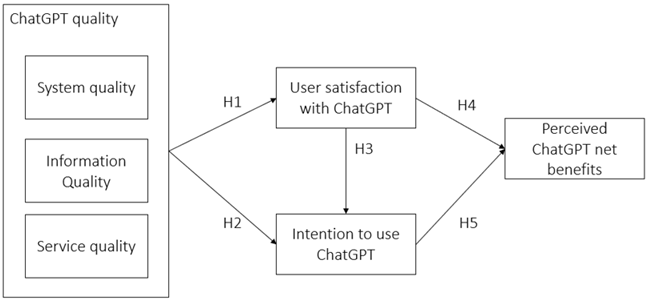
Based on the literature review, the posed hypotheses are:
H1 ChatGPT quality positively influences user satisfaction with ChatGPT.
H2 ChatGPT quality positively influences the intention to use ChatGPT.
H3 User satisfaction with ChatGPT positively influences the intention to use ChatGPT.
H4 User satisfaction with ChatGPT positively influences the perceived net benefits of ChatGPT.
H5 Intention to use ChatGPT positively influences the perceived net benefits of ChatGPT.
The developed hypotheses are presented in the conceptual model (Figure 1).
Figure 1Conceptual Model
Source: author’s own work.
Methodology
The research focused on undergraduate and graduate students in business economics. An anonymous survey was administered in Croatia during the 2023/2024 academic year. In total, 410 surveys were completed. The minimum sample size of 300, meeting the study’s requirements, was achieved (Hair et al., 2017a).
The instrument used in this study was adapted from a previous study (Mijač et al., 2023) and contextualised. Precisely, the final list consisted of 98 items rated on a five-point Likert scale.
Once the data was gathered, multivariate statistical methods were utilised. Data analysis was executed using IBM SPSS Statistics and IBM SPSS Amos for structural equation modelling (SEM).
Results
The collected data revealed that the sample consisted predominantly of female participants (approximately 67%), consistent with publicly available sex distribution data for economics and business students in Croatian higher education institutions. Additionally, more than 80% of participants reported having extensive experience with ChatGPT.
Descriptive analysis of constructs indicates that system quality received the highest overall evaluation (3.86), followed by service quality (3.49), whereas information quality received the lowest rating (3.39). Within system quality, availability and usability were the most positively evaluated attributes, whereas information quality indicators related to content currency and completeness were rated less favourably.
The intention to use ChatGPT was rated relatively high (3.84), with no significant gender differences. User satisfaction averaged 3.59 and perceived net benefits were rated at 3.76.
Multivariate Analysis
In covariance-based SEM, variables need to follow a normal distribution (Hair et al., 2017a). Consequently, skewness and kurtosis were computed, leading to the exclusion of all manifest variables that fell outside the acceptable range of [−2; +2] (George & Mallery, 2010). The theoretical framework suggests the possible multidimensionality of observed constructs, particularly HOCs (Awang et al., 2017; Hair et al., 2017b). Here, manifest variables are associated with first-order latent variables, which in turn are associated with second-order latent variables. First-order constructs are regarded as indicators of the HOC (Hair et al., 2017b).
A second-order construct may embody (sub)dimensions of third-order constructs, provided there is a conceptual and theoretical framework (Khan et al., 2019). Utilising HOCs enhances each dimension, rather than associating all manifest variables with a single first-order construct, especially when this approach could leave the construct’s explanation insufficient.
The conceptual model features one HOC, one being the third-order construct of ChatGPT Quality (CQ), alongside three first-order constructs: User satisfaction (US), Intention to use ChatGPT (INT), and Perceived net benefits (NB). Additionally, CQ comprises two second-order constructs (System quality and Information quality) and one first-order construct (Service quality).
The evaluation of models that include HOCs follows the same approach as that for models with first-order constructs (Awang et al., 2017). To determine construct validity, Factor Loading (FL), Average Variance Extracted (AVE) and Composite Reliability (CR) were calculated. The findings demonstrate that all indicators conform to the reference values set by Hair et al. (2014; 2017a). Detailed results are reported in Appendix Table 1a.
Subsequently, for the second- and third-order constructs, FL, CR, and AVE were computed, and all results met established reference standards (Appendix Tables 2a and 3a).
The overall model fit was evaluated using several indices, following the methodology of Hair et al. (2014) and Marsh and Hocevar (1985). The Root Mean Square Error of Approximation (RMSEA) was 0.055, indicating a good fit to the data. The ratio of chi-square to degrees of freedom (CMIN/df) was 2.24, which falls within the acceptable range of less than 3. The Comparative Fit Index (CFI) was 0.88, slightly below the commonly recommended threshold of 0.90. However, values above 0.85 are sometimes considered acceptable in complex models or those with smaller samples (Bentler, 1990). Taken together, the indices suggest that the model demonstrates an adequate fit, particularly with respect to theoretical coherence and model parsimony.
After confirming construct validity, the next step was to assess discriminant validity. This research applied the Fornell-Larcker criterion (Afthanorhan et al., 2021). However, the results indicated that discriminant validity was not established, suggesting substantial construct overlap (Table 1). Specifically, the correlation between US and both INT and NB exceeded the square root of the AVE for the US. Similarly, the correlation between INT and NB was greater than the square root of the AVE for INT.
Table 1Discriminant Validity Results
| CQ | US | INT | NB | |
| CQ | 0.887 | |||
| US | 0.85 | 0.7649 | ||
| INT | 0.67 | 0.768 | 0.825727 | |
| NB | 0.754 | 0.83 | 0.87 | 0.761534 |
Source: author’s own work.
According to the methodology, the proposed construct should be removed from the initial conceptual model. Thus, the construct NB has been removed.
After the construct was removed, the same procedure was followed to assess reliability and validity indicators. However, this time the NB construct was excluded from the model. Results indicate that discriminant validity has now been achieved (Table 2).
Table 2Discriminant Validity Results after Removing the NB Construct
| CQ | US | INT | |
| CQ | 0.887 | ||
| US | 0.847 | 0.765 | |
| INT | 0.664 | 0.757 | 0.826 |
Source: author’s own work.
Model fit was again evaluated using multiple indices as before. The CMIN/df was 2,318, indicating an acceptable level of fit. The RMSEA was 0.059, indicating a good fit with the data (Browne & Cudeck, 1992). The CFI was 0.88, slightly below the conventional cutoff of 0.90. However, values above 0.85 may still be considered adequate in complex models or those with smaller sample sizes (Bentler, 1990). RMSEA and CMIN/df support the conclusion that the model demonstrates a reasonable overall fit, especially when considered alongside theoretical justification and model parsimony.
Of the eight hypotheses tested in the study, six were supported (Table 3).
Table 3Hypotheses Testing
| Hypotheses | β | p-value | Result |
| H1 ChatGPT quality -> user satisfaction with ChatGPT | 0.845 | 0.000 | supported |
| H2 ChatGPT quality -> intention to use ChatGPT | 0.064 | 0.595 | Not supported |
| H3 User satisfaction with ChatGPT -> intention to use ChatGPT | 0.709 | 0.000 | supported |
| H4 intention to use ChatGPT-> net benefits | NA | ||
| H5 User satisfaction with ChatGPT -> net benefits | NA |
Source: author’s own work.
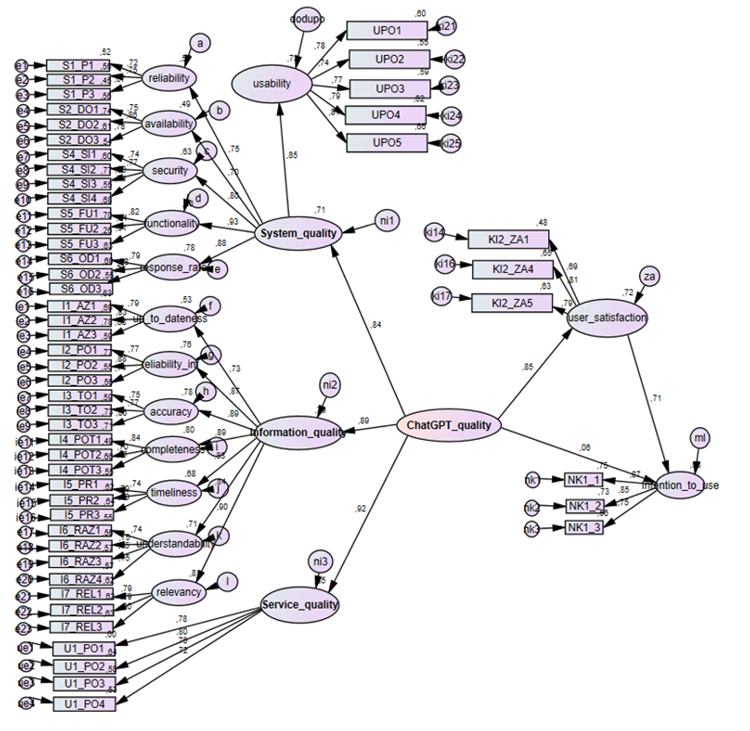
The results of the structural model are visually presented in Figure 2.
Figure 2Structural Model Results
Source: author’s own work.
Discussion
ChatGPT is an AI-powered digital service, and its utilisation is increasingly integral to daily life and business operations. Rather than conducting internet searches, users are increasingly relying on ChatGPT for information, despite the explicit disclaimer that all data should be independently verified. The goal of this paper was to explore future managers’ perceptions of GenAI and to investigate whether the D&M IS success model adequately captures the success of GenAI tools such as ChatGPT. The participants in this study were business economics students from Generation Z, a cohort that plays a crucial role in fostering innovation and whose engagement is central to realising the full potential of technology-driven business transformation (Truncale, 2025).
Previous research has shown that managers are increasingly reluctant to invest in AI, particularly for autonomous decision-making. However, previous studies also highlight differences in gender and domain. This study found that the future workforce demonstrates a firm intention to use AI technologies [3.8 out of 5], indicating a high openness to integrating such tools into their professional routines. Also, as the gender composition of correspondents favours female students, the intention is very high in both genders, and there is no statistically significant difference, unlike previously reported (Humlum & Vestergaard, 2025).
One of the theoretical contributions of this research lies in its treatment of ChatGPT quality as a multidimensional construct, which it inherently is. This approach enables a more comprehensive examination of ChatGPT quality. It provides a multidimensional perspective on this construct, rather than linking all items to a single first-order construct, which can lead to an incomplete explanation of the construct. Despite this, quality was often modelled as a first-order construct, and not all its dimensions are consistently included. The results of this research confirmed the indicators for each quality subdimension. ChatGPT system quality is manifested through reliability, availability, security, functionality, response rate and usability. In addition, ChatGPT information quality is measured using the following indicators: up-to-dateness, reliability, accuracy, completeness, timeliness, understandability, and relevance. These results are partially consistent with recent research indicating that indicators such as completeness, convenience, format, precision, and timeliness are now more indicative of user satisfaction in the context of ChatGPT than the traditional emphasis on accuracy and reliability (Fu et al., 2024). ChatGPT service quality is treated as a first-order construct, measured by four manifest variables.
Another theoretical contribution is regarding the net benefits of using ChatGPT. The statistical analysis revealed that discriminant validity was not achieved in validating the original D&M IS success model, particularly due to high correlations between perceived net benefits and intention to use. This research followed rigorous statistical methodology and applied the Fornell-Larcker criterion. In related studies examining the IS success of AI speakers, alternative criteria have been used to evaluate discriminant validity, reflecting ongoing methodological diversity in this research stream (Yoon & Kim, 2023).
The results indicating a strong correlation among perceived benefits, user satisfaction, and intention to use can be explained by the theoretical interdependence among these constructs. According to the Expectation-Confirmation Theory (Oliver, 1980), users form their satisfaction based on perceived benefits, which in turn leads to the intention to use. Additionally, according to TAM (Davis, 1989), perceived usability (which may be closely related to perceived net benefits) has been shown to affect intention to use, thereby explaining the high correlation. Another possible explanation is common method variance, given that all data were collected using the same questionnaire. This may have led respondents to rate related variables similarly.
While the success of GenAI and its economic implications, including productivity, efficiency and time reductions, were rated moderately high (3.87, 3.70 and 3.89 respectively), this construct could not be examined within the proposed IS success model. Despite existing research on the net benefits of using ChatGPT in business (Chu, 2023), this gap persists due to the lack of discriminant validity. Future research could consider separating the measurement over time or incorporating objective business indicators. This research gap should not be neglected. This opens new avenues for future research, especially in refining construct measurement and exploring deeper conceptual overlaps.
For hypothesis testing, only three hypotheses remained after removing the construct perceived net benefits from the model. Results showed that ChatGPT quality, consisting of its subdimensions, has a significant and positive impact on user satisfaction (H1) (b = 0.845; p = 0.00). Results from Marjanovic et al. (2018) partially align with those of this study. By contrast, authors who did not apply HOC did not find a significant impact of information quality on user satisfaction (Yoon & Kim, 2023) or of ChatGPT’s usability on user satisfaction (Minseong et al., 2025).
Regarding the H2, ChatGPT quality has a significant and positive impact on intention to use; however, this finding was not supported. This suggests that ChatGPT quality, whether low or high, does not influence whether end users use it more. Even if users do not perceive ChatGPT as highly accurate or of high quality, they might continue to use it. This may mean that users already expect some degree of inaccuracy and are willing to work around it. These results are inconsistent with prior studies that found that perceived ease of use has a positive and significant impact on behavioural intention to use ChatGPT (Turkes et al., 2024).
The H3 was confirmed, indicating that user satisfaction with ChatGPT influenced the intention to use it (b = 0.709; p = 0.00). User satisfaction will influence their intention to continue using ChatGPT. If users are satisfied with their overall experience, regardless of its accuracy, they are more likely to continue using ChatGPT. Satisfaction, or emotional connection and a sense of being helped, can outweigh minor inaccuracies.
The intention-to-use construct impacts perceived net benefits (H4), and H5, which refers to User satisfaction and Net benefits, has not been tested. However, future research should investigate how user satisfaction with ChatGPT impacts net benefits and organisational performance and profitability.
Given that students of business economics will soon occupy decision-making roles in corporations, their experiences and evaluations of AI technologies like ChatGPT directly inform future corporate strategies regarding AI adoption, ethics, stakeholder engagement, and corporate social responsibility. Understanding their current attitudes toward AI can guide educators and policymakers in fostering ethically responsible, stakeholder-oriented approaches to AI integration in business.
The findings of this study, which highlight students’ firm intention to use and continue using GenAI despite recognising the potential for information inaccuracies, should be carefully considered by the business sector. One crucial implication is that organisations should prioritise employee training programs to foster awareness of AI-related risks, inaccuracies, and potential negative consequences. Ensuring the competent, responsible, and ethically aware use of AI technology can significantly enhance a company’s ability to manage stakeholder expectations, strengthen consumer trust, and enhance corporate reputation. Companies should be aware of the critical side effects of their GenAI adoption and advise managers to experiment with ChatGPT to understand its potential and limitations, thereby informing dynamic policies on its use.
Conclusion
The D&M model remains a highly relevant and widely used framework for evaluating IS success. This study provided a valuable lens for assessing the economic and organisational implications of GenAI, particularly ChatGPT. By connecting theoretical constructs and applying HOCs, the model contributes to the evaluation of AI’s evolving role in the business and tech economy.
Findings suggest that Gen Z, tomorrow’s managers and decision-makers, are already incorporating GenAI tools like ChatGPT into their daily academic and professional routines. While current managerial attitudes toward AI investments may still be marked by hesitation, the free and widespread availability of tools such as ChatGPT could lead to a gradual, even unnoticed, integration of AI-supported decision-making into organisational workflows.
As future business leaders, the respondents of this study will influence corporate policies on AI use, shaping governance, transparency, and ethical standards. Their early experiences with generative AI will therefore play a pivotal role in shaping how these technologies affect society over the long term. The way today’s business students perceive and engage with AI is likely to echo in their future strategic, operational, and ethical decisions.
Despite awareness of the limitations and risks, particularly around accuracy and reliability, Gen Z continues to make extensive use of AI tools. This behaviour is expected to carry over into the professional sphere, underscoring the need for organisations to prepare for AI integration not only technologically but also culturally and ethically.
Rather than resisting AI, businesses must recognise its growing influence and adapt their operations accordingly. Responsible adoption will require clear frameworks addressing ethics, privacy, and governance.
This study is subject to several limitations. The use of a Gen Z student sample may limit the generalisability of the findings to other populations. At the same time, reliance on self-reported cross-sectional data limits causal interpretation and may introduce common-method bias. In addition, the inability to establish discriminant validity among specific constructs necessitated modifications to the original IS Success Model, suggesting that existing measurement approaches may require refinement for generative AI contexts.
Future research should also focus on quantifying economic benefits by using data from businesses that have adopted ChatGPT to calculate tangible outcomes, such as time savings, increased sales, or improved customer support performance.
A final, open question remains: can the DeLone and McLean model be effectively extended to measure the success of generative AI tools such as ChatGPT? While this study offers early insights, further research is essential to fully understand the model’s applicability in this rapidly evolving domain.

References
- Abed, S. S. (2024). Acceptance and use of Artificial Intelligence in online tourism services by Generation Z in Saudi Arabia. IEEE, 12, 164533–164542. https://doi.org/10.1109/ACCESS.2024.3492001
- Abed, S. S., & Alkadi, R. S. (2025). Consumer continuous use of and satisfaction with Fintech payment applications in Saudi Arabia: towards an integrated model. Journal of Financial Reporting and Accounting, 23(2), 496–517. https://doi.org/10.1108/JFRA-12-2023-0759
- Afthanorhan, A., Ghazali, P. L., & Rashid, N. (2021). Discriminant validity: A comparison of CBSEM and consistent PLS using Fornell & Larcker and HTMT approaches. Journal of Physics: Conference Series, 1874(1), 012085. https://doi.org/10.1088/1742-6596/1874/1/012085
- Aldholay, A., Isaac, O., Abdullah, Z., Abdulsalam, R., & Al-Shibami, A. H. (2018). An extension of Delone and McLean IS success model with self-efficacy. The International Journal of Information and Learning Technology, 35(4), 285–304. https://doi.org/10.1108/IJILT-11-2017-0116
- Al-Emran, M., Abu-Hijleh, B., & Alsewari, A. R. A. (2025). Examining the impact of Generative AI on social sustainability by integrating the information system success model and technology-environmental, economic, and social sustainability theory. Education and Information Technologies, 30, 9405-9426. https://doi.org/10.1007/s10639-024-13201-0
- Al-Qerem, A., Mohd Ali, A., Nabot, A., Jebreen, I., Alauthman, M., Someah, A., Abrub, F., & Aldweesh, A. (2025). Enhancing organizational performance: synergy of cyber-physical systems, cloud services, and crowdsensing. International Journal of Crowd Science, 9(1), 44–55. https://doi.org/10.26599/ijcs.2023.9100033
- Andrade, R., Fernandes, G., & Tereso, A. (2016). Benefits management in university-industry R&D collaborative projects: A review on benefits and success factors. Procedia Computer Science, 100, 921–927. https://doi.org/10.1016/j.procs.2016.09.249
- Arkhipova, M. V., Belova, E., Gavrikova, Y. A., Pleskanyuk, T. N., & Arkhipov, A. N. A. (2019). Reaching Generation Z. Attitude toward technology among the newest generation of school students. In E. Popkova, V., Ostrovskaya (Eds.), Perspectives on the use of new Information and Communication Technology (ICT) in the modern economy. ISC 2017. Advances in intelligent systems and computing, vol .726 (pp. 1026–1032). Springer. https://doi.org/10.1007/978-3-319-90835-9_114
- Awang, Z., Afthanorhan, A., Mamat, M., & Aimran, N. (2017). Modeling structural model for Higher Order Constructs (HOC) using marketing model. World Applied Sciences Journal, 35(8), 1434–1444.
- Bentler, P. M. (1990). Comparative fit indexes in structural models. Psychological Bulletin, 107(2), 234–246. https://doi.org/10.1037/0033-2909.107.2.238
- Browne, M. W., & Cudeck, R. (1992). Alternative ways of assessing model fit. Sociological Methods & Research, 21(2), 230–258. https://doi.org/10.1177/0049124192021002005
- Chen, H.-J., Chang, S.-T., Chou, P.-Y., Tsai, Y.-S., Chu, C., Hsieh, F.-C., & Tseng, G. (2024). Exploring users’ continuous use intention of ChatGPT based on the IS Success Model and technology readiness. International Journal of Management Studies and Social Science Research, 6(1), 366–377. https://doi.org/10.56293/ijmsssr.2024.4833
- Chen, Y. H., & Chengalur-Smith, I. (2015). Factors influencing students’ use of a library Web portal: Applying course-integrated information literacy instruction as an intervention. Internet and Higher Education, 26, 42–55. https://doi.org/10.1016/j.iheduc.2015.04.005
- Chhillar, D., & Aguilera, R. V. (2022). An eye for Artificial Intelligence: insights into the governance of Artificial Intelligence and vision for future research. Business & Society, 61(5), 1197–1241. https://doi.org/10.1177/00076503221080959
- Chu, M. N. (2023). Assessing the benefits of ChatGPT for business: An empirical study on organizational performance. IEEE Access, 11, 76427–76436. https://doi.org/10.1109/ACCESS.2023.3297447
- Davis, F. D. (1989). Perceived usefulness, perceived ease of use, and user acceptance of information technology. MIS Quarterly, 13(3), 319–340. https://doi.org/10.2307/249008
- Delone, W. H., & McLean, E. R. (2003). The DeLone and McLean model of information systems success: A ten-year update. Journal of Management Information Systems, 19(4), 9–30. https://doi.org/10.1080/07421222.2003.11045748
- Dwivedi, Y. K., Kshetri, N., Hughes, L., Slade, E. L., Jeyaraj, A., Kar, A. K., Baabdullah, A. M., Koohang, A., Raghavan, V., Ahuja, M., Albanna, H., Albashrawi, M. A., Al-Busaidi, A. S., Balakrishnan, J., Barlette, Y., Basu, S., Bose, I., Brooks, L., Buhalis, D., … Wright, R. (2023). “So what if ChatGPT wrote it?” Multidisciplinary perspectives on opportunities, challenges and implications of generative conversational AI for research, practice and policy. International Journal of Information Management, 71, 102642. https://doi.org/10.1016/j.ijinfomgt.2023.102642
- Ferreira dos Santos, J. P., de Matos, C. A., & Groznik, A. (2025). The role of artificial intelligence in smart city systems usage: drivers, barriers, and behavioural outcomes. Technology in Society, 81, 102867. https://doi.org/10.1016/j.techsoc.2025.102867
- Fontoura, L., Luiz de Mattos Nascimento, D., Neto, J. V., & Gusmão Caiado, R. G. (2025). Energy Gen-AI technology framework: A perspective of energy efficiency and business ethics in operation management. Technology in Society, 81, 102847. https://doi.org/10.1016/j.techsoc.2025.102847
- Fu, C. J., Silalahi, A. D. K., Shih, I. T., Phuong, D. T. T., Eunike, I. J., & Jargalsaikhan, S. (2024). Assessing ChatGPT’s information quality through the lens of user information satisfaction and information quality theory in higher education. Human Behavior and Emerging Technologies, 2024(1), 114315. https://doi.org/10.1155/2024/8114315
- Garg, V., Gabaldon, J., Niranjan, S., & Hawkins, T. G. (2025). Impact of strategic performance measures on performance: The role of artificial intelligence and machine learning. Transportation Research Part E: Logistics and Transportation Review, 198, 104073. https://doi.org/10.1016/j.tre.2025.104073
- George, D., & Mallery, M. (2010). SPSS for Windows step by step: A simple guide and reference, 17.0 update (10th ed.). Pearson.
- Gieselmann, M., Erdsiek, D., Rost, V., & Sassenberg, K. (2025). Do managers accept artificial intelligence? Journal of Economic Psychology, 108, 102804. https://doi.org/10.1016/j.joep.2025.102804
- Gupta, S., Wang, Y., Patel, P., & Czinkota, M. (2025). Navigating the future of AI in marketing: AI integration across borders, ethical considerations, and policy implications. International Journal of Information Management, 82, 102871. https://doi.org/10.1016/j.ijinfomgt.2025.102871
- Hair, J. F., Babin, B. J., & Krey, N. (2017a). Covariance-based structural equation modeling in the Journal of Advertising: Review and recommendations. Journal of Advertising, 46(1), 163–177. https://doi.org/10.1080/00913367.2017.1281777
- Hair, J. F., Gabriel, M. L. D. da S., & Patel, V. K. (2014). Amos Covariance-Based Structural Equation Modeling (CB-SEM): Guidelines on its application as a marketing research tool. Brazilian Journal of Marketing - BJM, 13(2), 44–55. https://doi.org/10.5585/remark.v13i2.2718
- Hair, J. F., Hult, G. T. M., Ringle, C. M., & Sarstedt, M. (2017b). A primer on Partial Least Squares Structural Equation Modeling (PLS-SEM) (2nd ed.). SAGE Publications.
- Ho, L. A., Kuo, T. H., & Lin, B. (2010). Influence of online learning skills in cyberspace. Internet Research, 20(1), 55–71. https://doi.org/10.1108/10662241011020833
- Humlum, A., & Vestergaard, E. (2025). The unequal adoption of ChatGPT exacerbates existing inequalities among workers. Proceedings of the National Academy of Sciences, 122(1), e2414972121. https://doi.org/10.1073/pnas.2414972121
- Ikhsan, R. B., Fernando, Y., Prabowo, H., Yuniarty, Gui, A., & Kuncoro, E. A. (2025). An empirical study on the use of artificial intelligence in the banking sector of Indonesia by extending the TAM model and the moderating effect of perceived trust. Digital Business, 5(1), 100103. https://doi.org/10.1016/j.digbus.2024.100103
- Isaac, O., Abdullah, Z., Ramayah, T., & Mutahar, A. M. (2017). Examining the relationship between overall quality, user satisfaction and internet usage: An integrated individual, technological, organizational and social perspective. Asian Journal of Information Technology, 16(1), 100–124.
- Jakopec, T., Selthofer, J., & Szombathelyi, D. (2023). The impact of using ChatGPT on employees of Croatian IT Companies. Central European Conference on Information and Intelligent Systems, 473–480.
- Jeyaraj, A. (2020). DeLone & McLean models of information system success: Critical meta-review and research directions. International Journal of Information Management, 54, 102139. https://doi.org/10.1016/j.ijinfomgt.2020.102139
- Khan, A., Masrek, M. N., & Mahmood, K. (2019). The relationship of personal innovativeness, quality of digital resources and generic usability with users’ satisfaction: A Pakistani perspective. Digital Library Perspectives, 35(1), 15–30. https://doi.org/10.1108/DLP-12-2017-0046
- Marjanovic, U., Mester, G., & Marjanovic, B. M. (2024). Assessing the success of artificial intelligence tools: an evaluation of ChatGPT using the information system success model. Interdisciplinary Description of Complex Systems, 22(3), 266–275. https://doi.org/10.7906/indecs.22.3.3
- Marjanovic, U., Simeunovic, N., Delić, M., Bojanic, Z., & Lalic, B. (2018). Assessing the success of university social networking sites: Engineering students’ perspective. International Journal of Engineering Education, 34(4), 1363–1375.
- Marsh, H. W., & Hocevar, D. (1985). Application of confirmatory factor analysis to the study of self-concept: First- and higher order factor models and their invariance across groups. Psychological Bulletin, 97(3), 562–582. https://doi.org/10.1037/0033-2909.97.3.562
- Martins, J., Branco, F., Gonçalves, R., Au-Yong-Oliveira, M., Oliveira, T., Naranjo-Zolotov, M., & Cruz-Jesus, F. (2019). Assessing the success behind the use of education management information systems in higher education. Telematics and Informatics, 38, 182–193. https://doi.org/10.1016/j.tele.2018.10.001
- Mijač, T., Jadrić, M., & Ćukušić, M. (2023). The role of user experience and co-creation in measuring the success of digital services in higher education. Behaviour and Information Technology, 43(6), 1219–1240. https://doi.org/10.1080/0144929X.2023.2206924
- Mijač, T., Jadrić, M., & Ćukušić, M. (2024). Measuring the success of information systems in higher education – a systematic review. Education and Information Technologies, 29, 18323–18360. https://doi.org/10.1007/s10639-024-12564-8
- Mijač, T., Jadrić, M., & Ćukušić, M. (2025). The great debate: UX vs. usability. Which indicators are relevant to measure the success of information systems in higher education? International Journal of Technology Enhanced Learning, 17(2), 137–157. https://doi.org/10.1504/IJTEL.2025.145314
- Minseong, K., Kim, J., Knotts, T. L., & Albers, N. D. (2025). AI for academic success: investigating the role of usability, enjoyment, and responsiveness in ChatGPT adoption. Education and Information Technologies, 30(10), 14393–13414. https://doi.org/https://doi.org/10.1007/s10639-025-13398-8
- Nagpal, M., De Cremer, D., & Van Hiel, A. (2024). Is technology uniquely placed to solve our problems? An examination into technosolutionism, what it entails and what it predicts. Business & Society, 64(5), 933–967. https://doi.org/10.1177/00076503241271298
- Oliver, R. L. (1980). A cognitive model of the antecedents and consequences of satisfaction decisions. Journal of Marketing Research, 17(4), 460–469. https://doi.org/10.2307/3150499
- Petter, S., DeLone, W., & McLean, E. (2008). Measuring information systems success: models, dimensions, measures, and interrelationships. European Journal of Information Systems, 17, 236–263. https://link.springer.com/content/pdf/10.1057/ejis.2008.15.pdf
- Retkowsky, J., Hafermalz, E., & Huysman, M. (2024). Managing a ChatGPT-empowered workforce: Understanding its affordances and side effects. Business Horizons, 67(5), 511–523. https://doi.org/10.1016/j.bushor.2024.04.009
- Semeon, G., Negash, S., & Musa, P. (2010). The success of student information management system: The case of higher education institution in Ethiopia. 16th Americas Conference on Information Systems 2010, AMCIS 2010, 6, 4522–4532.
- Shachak, A., Kuziemsky, C., & Petersen, C. (2019). Beyond TAM and UTAUT: Future directions for HIT implementation research. Journal of Biomedical Informatics, 100, 103315. https://doi.org/10.1016/j.jbi.2019.103315
- Soomro, R. B., Al-Rahmi, W. M., Dahri, N. A., Almuqren, L., Al-mogren, A. S., & Aldaijy, A. (2025). A SEM–ANN analysis to examine impact of artificial intelligence technologies on sustainable performance of SMEs. Scientific Reports, 15(1), 5438. https://doi.org/10.1038/s41598-025-86464-3
- Söllner, M., Arnold, T., Benlian, A., Bretschneider, U., Knight, C., Ohly, S., Rudkowski, L., Schreiber, G., & Wendt, D. (2025). ChatGPT and beyond: Exploring the responsible use of generative ai in the workplace. An interdisciplinary perspective. Business and Information Systems Engineering, 67(2), 289–303. https://doi.org/10.1007/s12599-025-00932-8
- Tlili, A., Shehata, B., Adarkwah, M. A., Bozkurt, A., Hickey, D. T., Huang, R., & Agyemang, B. (2023). What if the devil is my guardian angel: ChatGPT as a case study of using chatbots in education. Smart Learning Environments, 10(1), 15. https://doi.org/10.1186/s40561-023-00237-x
- Turkes, M. C., Stancioiu, A.-F., & Banacu, C.-S. (2024). The intention to use ChatGPT in office work in Romania. Amfiteatru Economic, 26(67), 783-800. https://doi.org/10.24818/ea/2024/67/783
- Vegar, B., & Mijač, T. (2024). Artificial Intelligence in project management: Insights from Croatia. In 2024 47th ICT and Electronics Convention, MIPRO 2024 – Proceedings (pp. 1766–1771). https://doi.org/10.1109/MIPRO60963.2024.10569357
- Vrontis, D., Chaudhuri, R., & Chatterjee, S. (2023). Role of ChatGPT and skilled workers for business sustainability. Sustainability, 15(16), 12196. https://doi.org/10.3390/su151612196
- Yoon, S. J., & Kim, M. Y. (2023). A study on the improvement direction of artificial intelligence speakers applying DeLone and McLean’s Information System Success Model. Human Behavior and Emerging Technologies, 1. https://doi.org/10.1155/2023/2683458
 https://orcid.org/0000-0001-5695-2105