

About the article
DOI: https://www.doi.org/10.15219/em114.1751
The article is in the printed version on pages 30-40.
 Download the article in PDF version
How to cite
Ameti, V., Emini-Deari, E., & Maksuti, A. (2026). Increasing workforce productivity through workplace design: empirical evidence. e-mentor, 2(114), 30-40. https://www.doi.org/10.15219/em114.1751
Copyright © 2026, Valon Ameti, Edrina Emini-Deari, Atixhe Maksuti


E-mentor number 2 (114) / 2026
Table of contents
- Introduction
- Research Objectives
- Literature Review
- Methodology and Model Specification
- Results
- Discussion
- Conclusion and Recommendations
- Limitations and Future Research
- References
About the author
Footnotes
1 The findings of this study should be interpreted as evidence of statistical associations rather than causal relationships. Given the cross-sectional design and the limitations inherent in observational survey data, the estimated coefficients should not be interpreted as establishing causality.
Increasing Workforce Productivity through Workplace Design: Empirical Evidence
Valon Ameti, Edrina Emini-Deari, Atixhe Maksuti
Abstract
This research analyses how workplace design facilitates workforce productivity by considering various aspects, including the physical work environment, ergonomic working conditions, employee autonomy, job rotation, and social interaction. Applying concepts from the Job Characteristics Model and the Socio-Technical Systems Approach, a theoretical model of workplace design as a predictor of employee productivity is developed and empirically tested through five dimensions: the physical work environment, ergonomics, job autonomy, job rotation, and social interaction. To carry out the study, a quantitative research design based on a questionnaire, supported by a comprehensive literature review, was adopted. The sample consisted of 350 employees working in organisations in the Republic of North Macedonia. The empirical findings show that all workplace design dimensions have a positive and statistically significant relationship with productivity. The regression model is statistically significant at the 0.01 level, with an explanatory power of 61% for workforce productivity (R² = .61; adj. R² = .59; p < .001), where the social interaction dimension has the largest standardised coefficient, followed by ergonomics and the physical work environment.
Keywords: workplace design, workforce productivity, ergonomics, autonomy, job rotation, social interaction, organisational performance
Introduction
Workplace design has increasingly become an important topic in Human Resource Management, Organisational Behaviour, and Strategic Management. In current organisations, productivity is not only about the use of technology and task allocation; it is also a consequence of the quality of the workplace environment, employees' autonomy, role significance, and socio-political circumstances that allow cooperation and involvement.
Historically, job and workplace design have been rooted in classic economic theory and management theory. For instance, Smith (1776) discussed productivity in terms of the importance of specialisation and division of labour, whereas Babbage (1832) argued for the productivity implications of specialisation through mechanisation and cost-efficiency. Finally, Taylor's scientific management (1911) included standardised task performance and vertical division of labour. Even though these concepts were instrumental in boosting productivity, they were also associated with dangers such as monotony and employee alienation when used exclusively.
Subsequent theories expanded the scope from simplifying tasks to designing work around humans. Herzberg et al. (1959) discussed the importance of intrinsic work characteristics in terms of motivation, while Hackman and Oldham's (1976) Job Characteristics Model highlighted five critical factors – skill variety, task identity, task significance, autonomy, and feedback – that make a job meaningful and engaging. At the same time, the Socio-Technical Systems theory highlighted the interconnectedness between technical structure and social relations within organisations (Trist & Bamforth, 1951).
In today's organisations, workplace design decisions are not limited to job structure. Factors such as the work environment, ergonomics, employee autonomy, job rotation, flexibility, and social interaction are all relevant. Such variables affect fatigue, motivation, communication, learning, and performance at work. Hence, it is important to view workplace design as a multifaceted organisational process rather than an administrative issue.
The COVID-19 pandemic has transformed the way organisations perceive workplace design. Remote and hybrid working have expanded the concept of workplace design beyond the physical office space (Nediari et al., 2021). These changes increasingly require organisations to create spaces that support both physical and virtual collaboration (Gocer et al., 2026). Although the current study focuses primarily on traditional workplace environments, these changes underscore the importance of workplace design in increasing employee productivity.
Although research on workplace design is growing, most existing studies have investigated individual dimensions of workplace design. For example, several studies have investigated social interaction (Mittal & Rani, 2022; Oktavia & Permana, 2025), ergonomic workplace conditions (Miska & Azzahra, 2025), employee autonomy (Jaafar & Rahim, 2022; Johannsen & Zak, 2020), job rotation (Eriksson & Ortega, 2006; Sunday & Gabriel, 2024), and the physical work environment (Hamed et al., 2023; Zhenjing et al., 2022) as specific dimensions of employee performance and productivity. Empirical research that includes multiple dimensions of workplace design in relation to productivity remains largely limited (Mosquera et al., 2025), particularly in developing and transition economies, where evidence on the relationship between workplace design and workforce productivity is still scarce (Shamusideen & Ukpomwan, 2014). For example, Čizmić et al. (2022), in a study of public and private sector organisations in Bosnia and Herzegovina, highlighted the importance of workplace design dimensions for improving employee satisfaction and effectiveness. However, empirical evidence integrating multiple workplace design dimensions and workforce productivity in developing countries remains limited.
Addressing this gap, the current research aims to explore the connection between workplace design and workforce productivity in organisations located in the Republic of North Macedonia. The proposed paper seeks to contribute to existing research by integrating work design theories with information on workplace design practices in organisations today and their impact on workforce productivity.
This study contributes by extending the existing literature in three ways. First, the study incorporates five dimensions of workplace design into a regression equation with employee productivity. Second, it provides empirical evidence from a developing country such as the Republic of North Macedonia, where studies in this area are notably lacking. Third, the study findings provide practical implications for managers to improve workforce productivity.
Research Objectives
The main objective of this study is to examine the influence of workplace design on workforce productivity. Specifically, this research aims to explore which dimensions of workplace design have the greatest correlation with productivity and determine whether the empirical findings confirm the existence of a multidimensional workplace design model.
The objectives of this study include:
- Exploring the theoretical basis for job and workplace design in terms of their effects on productivity.
- Evaluating employees' views of different aspects of workplace design.
- Examining the relationship between workplace design and workforce productivity.
- Formulating recommendations aimed at enhancing organisational productivity by means of human-centred workplace design.
Literature Review
Work entails not only economic transactions where labour and payment are exchanged but also social, psychological, and organisational processes wherein people help achieve common objectives, acquire skills, and construct their occupational selves. Work is defined in management studies as a process involving activities performed to accomplish organisational ends (Schermerhorn, 1993).
Job design is defined as the arrangement of task content, methods, responsibilities, and relationships to meet the requirements of technology, organisations, society, and individuals (Davis, 1966). It encompasses the design of both the technical and social elements of the work activity (Umstot et al., 1976). Workplace design is more inclusive than job design since it covers both job content and other factors related to the physical environment in which work occurs.
Effective workplace design requires balancing the objectives of organisations, including productivity, efficiency, and quality, with those of employees, which include autonomy, competence, safety, and meaningfulness of work. According to Armstrong & Taylor (2014), there should be consistency between roles, organisational structure, and employees' abilities. Likewise, Mathis et al. (2017) suggest that job design could be modified to improve production results and job satisfaction.
In today's business environment, employee well-being is increasingly recognised as a key factor in enhancing productivity. Recent studies on workplace design suggest that it extends beyond the physical work environment and encompasses psychological and social dimensions that significantly influence employee performance and organisational outcomes (Mosquera et al., 2025; Voordt & Jensen, 2023). Furthermore, Hamed et al. (2023), in a study conducted in Malaysia among employees from different organisational sectors, found that physical work environment positively affects employee motivation, satisfaction, and productivity. Supporting this view, Zhenjing et al. (2022), in an empirical study involving 314 academic staff and using PLS-SEM analysis, found that a positive workplace environment significantly improves employee performance, which in turn contributes to higher productivity.
However, the relationship between workplace design and employee outcomes is not always positive. Some workplace design practices can also have negative consequences, depending on the nature of the work and individual employee preferences. For example, although open-plan office layouts create opportunities for communication and collaboration, they sometimes lead to increased noise, frequent interruptions and even decreased concentration, thereby reducing employee productivity (Bernstein & Turban, 2018; Gerlitz & Hülsbeck, 2024). Therefore, it is very important that workplace design adapts to the characteristics and nature of the work rather than being applied uniformly.
Ergonomics is concerned with designing workplaces, tools, and processes according to human abilities and limitations. Through ergonomics, one eliminates superfluous effort and ensures that workers do their jobs in a safer and more comfortable environment. When applied in office and knowledge-related environments, ergonomics addresses matters such as seating, desk arrangements, monitor positioning, movement, lighting, and minimising repetitive strain injury.
Recent studies emphasise the importance of ergonomic factors in the workplace in improving employee performance and productivity. A study applying a systematic literature review conducted between 2020 and 2025 found that ergonomic elements of the workplace, including lighting, ventilation, workspace organisation, and ergonomic furniture, increase productivity by improving focus and physical comfort (Miska & Azzahra, 2025).
Autonomy is one of the main dimensions of Hackman & Oldham's (1976) Job Characteristics Model, increasing employees' responsibility for their work. Autonomy denotes the level of control employees exercise over how and when to carry out their duties. Autonomy is important in the Job Characteristics Model because it enhances employees' sense of responsibility and ownership over their work.
Employee autonomy has been widely studied in relation to employee motivation (Hackman & Oldham, 1976; Karasek, 1979; Matei & Veith, 2023), employee commitment (Fernet et al., 2012; Gebregiorgis & Xuefeng, 2021), and job satisfaction (Jing et al., 2021; Rizwan et al., 2014; Soegiarto et al., 2024; Zychová et al., 2024;). However, empirical studies that directly examine the relationship between employee autonomy and workforce productivity remain relatively limited. Johannsen and Zak (2020) conducted an experimental study at Claremont Graduate University involving 100 participants, primarily undergraduate and graduate students, as well as members of the local community. The study found that increased perceived autonomy significantly improved both individual and group productivity, significantly increasing employee well-being. Another empirical study further supports the importance of employee autonomy in increasing productivity. With a sample of 155 telecommuting employees, the study found through the PLS-SEM model that autonomy positively affects employee productivity by giving employees greater responsibility over time management and work tasks (Jaafar & Rahim, 2022).
Nevertheless, autonomy must be coupled with proper communication from managers, appropriate training and performance management systems. Otherwise, lack of clear objectives and necessary feedback may become problematic. In other words, autonomy should become part of organisational processes.
Job rotation is understood as reassignment of an individual from one task, job or department to another. Job rotation can help eliminate boredom, promote skill diversity, add flexibility and increase employees' awareness of related tasks. It is especially effective in cases where companies aim to develop versatile and less specialised employees.
There are multiple reasons behind the significance of job rotation as cited in the literature: employees will have greater access to information, the employer will have a clearer understanding of their staff's skills, and motivation levels will improve due to the lack of monotony (Eriksson & Ortega, 2006). Furthermore, job rotation can promote organisational commitment by enhancing employees' understanding of how their tasks fit into the bigger picture of organisational functioning. Empirical studies in recent years also support the positive role of job rotation in increasing employee performance and productivity. A study conducted by Sunday and Gabriel (2024) among 134 employees in manufacturing firms in Rivers State, Nigeria, found a strong positive relationship between job rotation and productivity, suggesting that job rotation contributes to improved employee performance and organisational outcomes.
Nonetheless, job rotation is not equally suitable for all jobs. In the case of a very specialised job position, constant rotations will lead to higher training costs and decreased efficiency when staff members need much time to learn and master the required skills (Hsieh & Chao, 2004). Therefore, job rotation should be implemented by adapting to the nature of the work, taking into account the complexity of the work, employee competencies, and organisational needs, rather than being implemented as a universal workplace design practice.
The physical work environment entails factors such as lighting, noise, temperature, spatial layout, accessibility, and general comfort in the workplace setting. These factors affect employees' concentration, communication opportunities, and performance throughout the workday (Hamed et al., 2023; Vischer, 2007; Voordt & Jensen, 2023).
Another important aspect in design is social interaction. Workplaces that encourage teamwork, communication, and trust can enhance the coordination of information exchange among workers. This is consistent with socio-technical systems theory, which is well-suited to the topic at hand. Recent empirical studies support the positive relationship between social interactions and productivity. Mittal and Rani (2022), in a study of independent professionals working in coworking spaces in Chandigarh and Mohali, India, found a significant positive relationship between workplace social interactions and productivity. Similarly, Oktavia and Permana (2025), in a study conducted among 115 employees at HP Care Tangerang, Indonesia, using the PLS-SEM method, reported that social interactions significantly improve employee productivity.
Although previous empirical studies support the importance of workplace design dimensions, such as physical work environment, ergonomics, autonomy, job rotation, and social interactions, these factors have generally been examined separately. Studies investigating these dimensions simultaneously within a single model remain limited. This is even more evident in developing countries, where empirical evidence on workplace design and workforce productivity is still scarce (Shamusideen & Ukpomwan, 2014). For example, Čizmić et al. (2022) highlight the importance of job design on employee productivity for developing countries by analysing the impact of workplace design dimensions on employee satisfaction and effectiveness in a sample of 125 respondents from public and private sector organisations in Bosnia and Herzegovina. Therefore, this study aims to contribute to the literature by examining these dimensions simultaneously within a single empirical model.
Conceptual Framework and Hypotheses
This theoretical model involves both the structural aspects and human aspects of work design. According to the Job Characteristics Model, an analysis can be done in relation to how task characteristics affect performance and motivation (Hackman & Oldham, 1976). The Socio-Technical Systems theory stresses that there must be a match between the technical system and social interaction (Trist & Bamforth, 1951).
The workplace design model in this research is based on five components.
Table 1Theoretical Foundations of Workplace Design Dimensions and Expected Productivity Outcomes
| Workplace design inputs | Theoretical basis | Max. Expected outcome |
| Physical environment and ergonomics | Biological and perceptual-motor job design; ergonomics | Reduced fatigue, better comfort, and improved performance |
| Autonomy and job rotation | Job Characteristics Model; motivational job design | Higher motivation, learning, responsibility, and adaptability |
| Social interaction | Socio-Technical Systems approach | Stronger cooperation, communication, and collective productivity |
Note. Author's compilation based on “Motivation through the design of work: Test of a theory “ J. R. Hackman and G. R. Oldham, 1976, Organizational Behavior and Human Performance, 16(2), pp. 250–279 (https://doi.org/10.1016/0030-5073(76)90016-7) and “Some social and psychological consequences of the longwall method of coal-getting” E. L. Trist and K. W. Bamforth, 1951, Human Relations, 4(1), pp. 3–38 (https://doi.org/10.1177/001872675100400101), and the ergonomics literature.
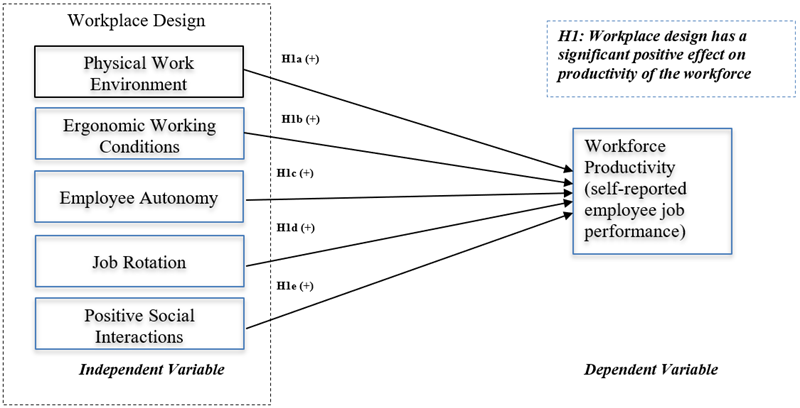
Based on these theoretical foundations, Figure 1 presents the proposed conceptual framework and hypothesised relationships between workplace design dimensions and workforce productivity.
Figure 1Proposed Conceptual Model of Workplace Design and Workforce Productivity
Research Hypotheses
Based on the theoretical models presented in Table 1 and supported by the findings of recent empirical studies discussed in the literature review, this study proposes the following hypotheses regarding the relationship between workplace design dimensions and workforce productivity.
Overall hypothesis
Workplace design is positively associated with workforce productivity.
Sub-hypotheses
H1a: The physical work environment is positively associated with workforce productivity.
H1b: Ergonomic working conditions are positively associated with workforce productivity.
H1c: Employee autonomy is positively associated with workforce productivity.
H1d: Job rotation is positively associated with workforce productivity.
H1e: Positive social interaction is positively associated with workforce productivity
Methodology and Model Specification
Research Design
This study adopted a quantitative research design supported by a comprehensive literature review. Quantitative data were collected through a survey administered to employees working in private sector organisations in the Republic of North Macedonia. The study targeted respondents from three organisational levels, namely operational staff, middle-level management, and top-level management, in order to obtain diverse perspectives on workplace design and workforce productivity.
The research design was both descriptive and explanatory. The descriptive component reviewed current perspectives on workplace design, whereas the explanatory component examined the influence of workplace design dimensions on workforce productivity.
Sample and Data Collection
Primary data were collected using structured questionnaires distributed among a sample of 350 respondents comprising operational personnel, middle-level management, and top-level management. These respondents came from diverse organisational backgrounds. The questionnaire comprised closed-ended Likert-scale statements measuring work environment features and productivity perceptions.
Secondary data were collected from books and journal articles concerning human resources management, job design, ergonomics, and organisational behaviour. The original questionnaire consisted of 72 items covering several dimensions of human resource management and organisational practices. For the purpose of this study, only the items corresponding to the six constructs investigated in this research (physical work environment, ergonomic working conditions, employee autonomy, job rotation, positive social interaction, and workforce productivity) were retained for statistical analysis. In this study, workforce productivity refers to employees' perceived ability to perform their jobs effectively, achieve work objectives, and maintain a high level of performance at work. Workforce productivity was measured using self-reported attitudes or perceptions from employees collected through multiple Likert-scale questions included in the questionnaire. The measurement items were adapted from established studies in the workplace design and organisational behaviour literature and were modified to fit the organisational context of North Macedonia. All construct items were measured using a five-point Likert scale ranging from 1 (strongly disagree) to 5 (strongly agree), where higher scores indicate more favourable perceptions of workplace design and higher perceived workforce productivity. So, the data were collected through a structured questionnaire administered to employees working in private sector organisations in North Macedonia. The study targeted employees at three organisational levels, operational staff, middle-level management, and top-level management, to obtain diverse perspectives on workplace design and workforce productivity. A total of 400 questionnaires were distributed to eligible respondents; of these, 350 were returned and deemed complete and suitable for statistical analysis, yielding a response rate of 87.5%. The study employed a convenience sampling technique, whereby respondents were selected based on their accessibility and willingness to participate. This non-probability sampling approach was considered appropriate because it enabled data collection from employees across various private-sector organisations within the available time and resource constraints.
Variables and Regression Model
The dependent variable is workforce productivity (WP). The independent variables are physical environment (PE), ergonomics (ER), autonomy (AU), job rotation (JR), and social interaction (SI). Gender (GEN) was included as a control variable to account for potential demographic differences in workforce productivity.
WP = β0+ β1PE + β2ER + β3AU + β4JR + β5SI + β6GEN + ε1
In this model, β0 represents the constant term, β1 through β5 represent the regression coefficients of the independent variables, β6 represents the regression coefficient for the control variable (gender) and ε represents the error term. The hypotheses were tested at a 95% confidence level using regression coefficients and significance values.
Results
Descriptive Statistics
The descriptive statistics in Table 2 indicate that all variables recorded relatively high mean values, ranging from 3.61 to 4.05, suggesting positive perceptions among respondents regarding the physical work environment, ergonomic conditions, employee autonomy, job rotation, social interaction, and workforce productivity. The standard deviation values (0.63–0.82) demonstrate moderate variability in respondents' answers. The minimum and maximum values indicate that all constructs covered the full range of the measurement scale. Furthermore, skewness values ranged from -0.61 to -0.28, while kurtosis values ranged from -0.52 to 0.25, indicating that the data distribution does not significantly deviate from normality, as the values remain within the commonly accepted range of ±2.
Table 2Descriptive Statistics for Study Variables
| Variable | Mean | Std. Dev. |
Minimum | Maximum | Skewness | Kurtosis |
| Physical Work Environment | 3.82 | 0.71 | 1.5 | 5 | -0.42 | -0.31 |
| Ergonomic Working Conditions | 3.95 | 0.68 | 1.8 | 5 | -0.55 | 0.12 |
| Employee Autonomy | 3.74 | 0.76 | 1.6 | 5 | -0.36 | -0.45 |
| Job Rotation | 3.61 | 0.82 | 1.4 | 5 | -0.28 | -0.25 |
| Positive Social Interaction | 4.05 | 0.63 | 2 | 5 | -0.61 | 0.25 |
| Workforce Productivity | 3.88 | 0.7 | 1.7 | 5 | -0.47 | -0.18 |
Note. Author's compilation based on “Motivation through the design of work: Test of a theory “ J. R. Hackman and G. R. Oldham, 1976, Organizational Behavior and Human Performance, 16(2), pp. 250–279 (https://doi.org/10.1016/0030-5073(76)90016-7) and “Some social and psychological consequences of the longwall method of coal-getting” E. L. Trist and K. W. Bamforth, 1951, Human Relations, 4(1), pp. 3–38 (https://doi.org/10.1177/001872675100400101), and the ergonomics literature.
Reliability and Validity
To assess the internal consistency and reliability of the measurement scales, Cronbach's Alpha coefficient is calculated for each construct included in the study. Cronbach's Alpha values above .70 are generally considered acceptable, indicating satisfactory internal consistency among the items measuring each construct. The results presented in Table 3 demonstrate that all constructs achieved acceptable reliability levels, with Cronbach's Alpha coefficients ranging from .78 to .89. The highest reliability value was observed for positive social interaction (α = .89), followed by Ergonomic Working conditions (α = .86) and workforce productivity (α = .85). The lowest alpha value was recorded for Job rotation (α = .78), which still exceeds the recommended threshold of .70. These findings confirm that the measurement instruments used in this study demonstrate good internal consistency and are reliable for further statistical analysis.
Table 3Reliability Analysis of Study Constructs
| Construct | Number of Items | Cronbach's Alpha (α) | Interpretation |
| Physical Work Environment | 5 | .82 | Good reliability |
| Ergonomic Working Conditions | 5 | .86 | Good reliability |
| Employee Autonomy | 4 | .81 | Good reliability |
| Job Rotation | 4 | .78 | Acceptable reliability |
| Positive Social Interaction | 5 | .89 | Very good reliability |
| Workforce Productivity | 5 | .85 | Good reliability |
Variance Inflation Factor (VIF) and Tolerance statistics were calculated to assess potential multicollinearity among the independent variables. The VIF values ranged from 1.24 to 1.56, while tolerance values ranged from .64 to .81. Since all VIF values are well below the commonly accepted threshold of 5.0 (and considerably below the more conservative threshold of 3.0), and all tolerance values exceed 0.20, multicollinearity is not considered a concern. These findings indicate that each workplace design dimension contributes unique explanatory information to the regression model and that the estimated regression coefficients are stable and reliable.
Table 4Multicollinearity Diagnostics
| Predictor | Tolerance | VIF |
| Gender (Control Variable) | .56 | 1.08 |
| Physical Work Environment | .69 | 1.45 |
| Ergonomic Working Conditions | .66 | 1.52 |
| Employee Autonomy | .73 | 1.37 |
| Job Rotation | .81 | 1.24 |
| Positive Social Interaction | .64 | 1.56 |
As shown in Table 4, Variance Inflation Factor (VIF) and Tolerance statistics were calculated to assess potential multicollinearity among the independent variables. The VIF values ranged from 1.24 to 1.56, while tolerance values ranged from .64 to .81. Since all VIF values are well below the commonly accepted threshold of 5.0 (and considerably below the more conservative threshold of 3.0), and all tolerance values exceed .20, multicollinearity is not considered a concern. These findings indicate that each workplace design dimension contributes unique explanatory information to the regression model and that the estimated regression coefficients are stable and reliable.
Common Method Bias Assessment
Since the data for all variables were collected through a self-administered questionnaire from the same respondents, the possibility of common method bias (CMB) was considered. Common method bias may occur when the measurement method rather than the actual relationships among constructs influences the observed correlations. Therefore, Harman's single-factor test was conducted to assess whether a single factor accounted for the majority of the covariance among the study variables. All measurement items representing the independent variables (physical work environment, ergonomic working conditions, employee autonomy, job rotation, and positive social interaction) and the dependent variable (workforce productivity) were entered into an exploratory factor analysis without rotation. The results indicated that six factors with eigenvalues greater than 1 were extracted, and the first factor accounted for 32.47% of the total variance, which is below the recommended threshold of 50%. Therefore, no single factor dominated the variance explained by the measurement items, suggesting that common method bias is unlikely to represent a serious concern in the present study.
Table 5Harman's Single Factor Test Results
| Test | Result |
| Number of factors extracted (Eigenvalue > 1) | 6 |
| Variance explained by the first factor | 32.47% |
| Recommended threshold | <50% |
| Conclusion | No significant common method bias detected |
Correlation Analysis
A correlation analysis was performed to determine the extent to which each of the workplace designs correlates positively or negatively with workforce productivity. The statistical significance of the correlation coefficients was assessed using Pearson's correlation test (two-tailed) at the 95% confidence level. All correlations are positive and statistically significant. The highest correlation coefficient belongs to social interactions, where r = .64, ergonomics, where r = .62, and the physical environment, where r = .58. The lowest correlation coefficient is r = .41, which belongs to job rotation.
Table 6Correlations between Workplace Design Factors and Workforce Productivity
| Relationship | Correlation (r) | Interpretation |
| Physical environment and productivity | .58 | Positive, significant |
| Ergonomics and productivity | .62 | Positive, significant |
| Autonomy and productivity | .55 | Positive, significant |
| Job rotation and productivity | .41 | Positive, significant |
| Social interaction and productivity | .64 | Positive, significant |
The multiple regression approach was adopted to establish the extent of influence of each factor on the productivity of the labour force
As shown in Table 7, the regression model is statistically significant (F(5,194) = 61.32, p < .001), indicating that the set of workplace design predictors significantly explains variations in workforce productivity. The coefficient of determination (R2 = .61) indicates that approximately 61% of the variance in workforce productivity can be explained by the five workplace design dimensions included in the model. The adjusted coefficient of determination (Adjusted R2 = .59) further confirms the robustness of the model after accounting for the number of predictors. The results presented in Table 8 demonstrate that all five workplace design factors show statistically significant positive relationships with workforce productivity. Among the predictors, positive social interaction emerged as the strongest predictor (β = 0.27, p < .001), followed by ergonomic working conditions (β = 0.24, p < .001) and the physical work environment (β = 0.21, p = .002). Employee autonomy also had a significant positive contribution (β = 0.19, p = .014), while job rotation showed the smallest but still statistically significant effect (β = 0.12, p = .032). These findings suggest that workplace design elements, particularly social interaction and ergonomic conditions, play an important role in enhancing workforce productivity. Gender was included as a control variable in the regression analysis. The results indicate that gender was statistically significant (β = 0.34, p <.01). However, the inclusion of the control variable did not materially alter the relationships between the workplace design dimensions and workforce productivity.
Table 7Model Summary
| Model Statistics | Value |
| R | .781 |
| R2 | .61 |
| Adjusted R2 | .59 |
| F-statistic | 61.32 |
| Degrees of freedom | F(5,194) |
| Model significance (p-value) | <.001 |
Regression analysis
| Predictor | Standardised β | Standard Error (SE) | t-value | p-value | Interpretation |
| Gender (Control Variable) | 0.34 | 0.06 | 5.67 | .001 | Significant control variable |
| Physical work environment | 0.21 | 0.07 | 3.12 | .002 | Positive and significant |
| Ergonomic working conditions | 0.24 | 0.06 | 4.01 | .001 | Positive and significant |
| Employee autonomy | 0.19 | 0.08 | 2.47 | .014 | Positive and significant |
| Job rotation | 0.12 | 0.06 | 2.16 | .032 | Positive and significant |
| Positive social interaction | 0.27 | 0.07 | 4.36 | .001 | Positive and significant |
Hypothesis Testing
Table 9Summary of Hypothesis-Testing Results
| Hypothesis | Description | Result |
| General research hypothesis | Workplace design is positively associated with workforce productivity. | Supported |
| H1a | The physical work environment is positively associated with workforce productivity. | Supported |
| H1b | Ergonomic working conditions are positively associated with workforce productivity. | Supported |
| H1c | Employee autonomy is positively associated with workforce productivity. | Supported |
| H1d | Job rotation is positively associated with workforce productivity. | Supported |
| H1e | Positive social interaction is positively associated with workforce productivity. | Supported |
Discussion
The findings of this study are consistent with the theoretical assumptions of the Job Characteristics Model (Hackman & Oldham, 1976) and the Socio-Technical Systems Theory (Trist & Bamforth, 1951), emphasising that workplace design is a multidimensional construct related to employee productivity.
Based on the results of the study, we found positive and statistically significant relationships between all construct variables that determine workplace design and employee productivity. The positive and significant correlations between all variables indicate that productivity is affected not only by individual efforts but also by factors such as workspaces, work itself, autonomy, and social relations in the workplace.
In terms of statistical significance, social interaction (β = 0.27, p < .01) is the strongest predictor among the factors analysed. These findings are consistent with studies by Mittal and Rani (2022) and Oktavia and Permana (2025), which found that workplace social interaction significantly increases employee productivity. This may be explained by the fact that effective communication, knowledge sharing, and interpersonal trust create conditions for coordination and collaboration, thus improving employee performance and increasing productivity.
Another important factor is ergonomics, for which, based on the results (β = 0.24, p < .01), we confirm hypothesis H1b. This finding is consistent with Miska and Azzahra (2025), who concluded that workplace ergonomics, including space organisation, ventilation, ergonomic furniture, and lighting, positively affect employee performance by reducing physical strain and increasing concentration. Based on the study's findings and previous research, organisations should create comfortable workspaces with appropriate lighting, reduced noise levels, an adequate workspace layout, and ergonomic furniture, as these factors are likely to increase employee productivity.
The physical work environment was also found to be a significant factor in workforce productivity (β = 0.21, p < .01). These findings are consistent with the results of the study by Zhenjing et al. (2022), who demonstrated that a good work environment increases employee performance, as well as Hamed et al. (2023), according to which a well-designed physical workspace increases employee motivation, satisfaction and productivity.
Autonomy, as another dimension of workplace design, was positively associated with workforce productivity (β = 0.19, p < .05), suggesting that the greater the autonomy provided to employees in carrying out their tasks, the more productive they will be. These findings are also consistent with the study by Johannsen and Zak (2020), which, based on an experiment, found that autonomy plays an important role in both individual and team contexts. The study by Jaafar and Rahim (2022) also supports these findings, indicating that autonomy positively affects employee productivity by giving employees greater responsibility for time management and work tasks.
Job rotation was also found to have a positive and statistically significant relationship with workforce productivity (β = 0.12, p < .05), although in terms of magnitude of impact it had the smallest effect compared to other dimensions of workplace design. This finding is consistent with the study by Sunday and Gabriel (2024), which found that job rotation contributes positively to employee performance in manufacturing firms in Rivers State, Nigeria. The smaller effect of job rotation on workforce productivity can be explained by the nature of the job and the organisational context. For example, Hsieh and Chao (2004) found that job rotation is less effective in highly specialised positions, where task rotation requires additional training and at the same time longer periods to adapt. Another study on the impact of job rotation on workforce productivity and the mediating effects of HR strategy and training in the petrochemical industry found that job rotation had a negative effect on productivity (Alizadeh Majd et al., 2024). This study also found that HR strategy and training moderated the positive effect between rotation and workforce productivity. Therefore, organisations should consider task complexity and employee competencies and implement practices to adapt employees before implementing workforce rotation.
Conclusion and Recommendations
This study concludes that workplace design plays a very important role in ensuring employee productivity. From the results of this research, it becomes clear that physical environment, ergonomics, autonomy, job rotation, and social interaction all play a vital role in determining worker performance. Based on the results of the study, social interaction showed the strongest positive association with workforce productivity. These findings suggest practical implications for organisations, which suggest investing in communication and teamwork; the other dimension with the greatest impact was the ergonomic and physical environment dimension, where the findings suggest that organisations should pay attention to ergonomic factors and create good working conditions to improve productivity,
Autonomy should also be evaluated when delegating tasks, as the study's findings suggest that the more autonomy employees are given in performing their tasks, the more productive they will be. While job rotation had a smaller effect, it should therefore be used selectively, and the nature and complexity of the tasks as well as the skills and competencies of the employees should be taken into account.
According to this research, work is no mere economic activity. Rather, work is an organised social process shaped by task design, worker autonomy, the physical environment, and interpersonal relationships.
From these findings, organisations should take into account the following recommendations:
- Ensure that the workplace allows for concentration as well as interactions between employees.
- Purchase ergonomically designed furniture along with appropriate lighting and noise reduction devices, as well as space division to ensure comfort and reduce fatigue.
- Provide employees with an appropriate level of autonomy by allowing greater discretion in task execution and decision-making.
- Use job rotation selectively, where employee skills and competencies allow.
- Employee managers should be trained on how to provide support for autonomy and communication between employees.
- Use valid measures of performance and productivity when evaluating workplace design initiatives.
Limitations and Future Research
While this study offers some empirical evidence, there are a number of limitations that should be considered. Firstly, this study relies on self-reported data collected from surveys, which might be influenced by participants' perceptions rather than their actual productivity levels. Secondly, this study is limited to the organisations operating in the Republic of North Macedonia, which might affect its generalisability to other organisations in different environments. Thirdly, this research was based on a cross-sectional survey design, and the findings should be interpreted as correlations rather than causal relationships. Future research could use longitudinal or experimental designs to investigate the causal relationships between workplace design and workforce productivity.
In the future, the scope of this study could be broadened to include samples of organisations from various industries and countries, include objective measures of productivity, and apply longitudinal designs to investigate whether changes in workplace design have a long-lasting effect on employee productivity. Furthermore, although gender was included as a control variable in the regression analysis, the model did not include other potentially relevant demographic, organisational, and contextual variables (e.g., age, organisational position, leadership quality, compensation, and sector-specific characteristics) that may also influence workforce productivity. Future studies could incorporate these variables to provide a more comprehensive explanation of workforce productivity and could also draw on multiple data sources to further reduce the potential for common method bias.
References
- Alizadeh Majd, A., Bell, R., Ali, S. A., Davoodi, A., & Nasirifar, A. (2024). The effect of job rotation on employee performance: the mediating role of HR strategy and training in the petrochemical industry. Industrial and Commercial Training, 56(2), 93-105. https://doi.org/10.1108/ICT-10-2023-0074
- Armstrong, M., & Taylor, S. (2014). Armstrong’s handbook of human resource management practice (13th ed.). Kogan Page.
- Babbage, C. (1832). On the economy of machinery and manufactures. Charles Knight.
- Bernstein, E. S., & Turban, S. (2018). The impact of the ‘open’ workspace on human collaboration. Philosophical Transactions of the Royal Society B: Biological Sciences, 373(1753), 20170239. https://doi.org/10.1098/rstb.2017.0239
- Čizmić, E., Rahimić, Z., Šestić, M., & Ahmić, A. (2022, May). The impact of job design parameters on employee satisfaction and effectiveness in developing countries within digitization context. In I. Karabegović, A. Kovačević, & S. Mandžuka (Eds.), New Technologies, Development and Application V (pp. 1076-1082). Springer.
- Davis, K. (1966). Human behavior at work: Organizational behavior. McGraw-Hill.
- Eriksson, T., & Ortega, J. (2006). The adoption of job rotation: Testing the theories. ILR Review, 59(4), 653–666. https://doi.org/10.1177/001979390605900407
- Fernet, C., Austin, S., & Vallerand, R. J. (2012). The effects of work motivation on employee exhaustion and commitment: An extension of the JD-R model. Work & Stress, 26(3), 213-229. https://doi.org/10.1080/02678373.2012.713202
- Gebregiorgis, A. K., & Xuefeng, Z. (2021). Exploring the relationship between Job autonomy and employee engagement in turbulent times: The role of autonomous motivation. International Journal of Research in Business and Social Science, 10(2), 134-152. https://doi.org/10.20525/ijrbs.v10i2.1074
- Gerlitz, A., & Hülsbeck, M. (2024). The productivity tax of new office concepts: a comparative review of open-plan offices, activity-based working, and single-office concepts. Management Review Quarterly, 74(2), 745-775. https://doi.org/10.1007/s11301-022-00316-2
- Gocer, O., Ergöz Karahan, E., Parkinson, T., Gocer, K., & de Dear, R. (2026). Shifting work patterns and workplace perceptions post-COVID-19. Architectural Science Review, 69(2), 240-252. https://doi.org/10.1080/00038628.2025.2493819
- Hackman, J. R., & Oldham, G. R. (1976). Motivation through the design of work: Test of a theory. Organizational Behavior and Human Performance, 16(2), 250–279. https://doi.org/10.1016/0030-5073(76)90016-7
- Hamed, S. A., Hussain, M. R. M., Jani, H. H. M., Sabri, S. S. S., & Rusli, N. (2023). The impacts of physical workplace environment (PWE) on employees productivity. International Journal of Business and Technology Management, 5(4), 369-376.
- Herzberg, F., Mausner, B., & Snyderman, B. B. (1959). The motivation to work (2nd ed.). John Wiley & Sons.
- Hsieh, A. T., & Chao, H. Y. (2004). A reassessment of the relationship between job specialization, job rotation and job burnout: Example of Taiwan’s high-technology industry. The International Journal of Human Resource Management, 15(6), 1108–1123. https://doi.org/10.1080/09585190410001677331
- Jaafar, N. A., & Rahim, R. A. (2022, September). Telecommuting and employee productivity: Mediating role of work-family conflict and autonomy. Proceedings, 82(1), 84. MDPI. https://doi.org/10.3390/proceedings2022082084
- Jing, S., Li, Z., Stanley, D. M., Guo, X., & Wenjing, W. (2021). Work-family enrichment: influence of job autonomy on job satisfaction of knowledge employees. Frontiers in Psychology, 12, 726550. https://doi.org/10.3389/fpsyg.2021.726550
- Johannsen, R., & Zak, P. J. (2020). Autonomy raises productivity: An experiment measuring neurophysiology. Frontiers in Psychology, 11, 963. https://doi.org/10.3389/fpsyg.2020.00963
- Karasek, R. A. (1979). Job demands, job decision latitude, and mental strain: Implications for job redesign. Administrative Science Quarterly, 24(2), 285–308. http://dx.doi.org/10.2307/2392498
- Koontz, H. (1959). Principles of management. McGraw-Hill.
- Matei, R., & Veith, C. (2023). Empowerment and engagement: The role of autonomy and feedback in fostering employee motivation. Manager, 37(1), 7-22.
- Mathis, R. L., Jackson, J. H., Valentine, S. R., & Meglich, P. A. (2017). Human resource management (15th ed.). Cengage Learning.
- Miska, L., & Azzahra, S. (2025). An ergonomic office interior design study on improving employee performance and job satisfaction. International Journal Administration, Business & Organization, 6(3), 326-339. https://doi.org/10.61242/ijabo.25.630
- Mittal, E., & Rani, T. (2022). Do social interactions really moderate job productivity in coworking spaces? Acta Universitatis Sapientiae, Economics and Business, 10(1), 145-160. https://doi.org/10.2478/auseb-2022-0009
- Mosquera, P., T. Chagas, B., & Azevedo, A. (2025). Enhancing positive work outcomes through workplace design. Journal of Corporate Real Estate, 27(4), 261-280. https://doi.org/10.1108/JCRE-11-2024-0039
- Nediari, A., Roesli, C., & Simanjuntak, P. M. (2021, April). Preparing post Covid-19 pandemic office design as the new concept of sustainability design. IOP Conference Series: Earth and Environmental Science, 729(1), 012095. IOP Publishing. https://doi.org/10.1088/1755-1315/729/1/012095
- Oktavia, P., & Permana, D. (2025). The influence of work stress, work life balance, and quality of social interaction on employee productivity (Study at HP Care Tangerang). Business, Economics, Law, Communication, and Social Sciences, 1(2), 156-170.
- Rizwan, M., Jamil, M. I., Shahid, U., Saeedi, A., Faisal, N., Islam, Z., Qadeer, A., & Mateen, A. (2014). The impact of the job stress, job autonomy and working conditions on employee satisfaction. International Journal of Human Resource Studies, 4(2), 196-207. https://doi.org/10.5296/ijhrs.v4i2.5907
- Schermerhorn, J. R. (1993). Management for productivity (5th ed.). John Wiley & Sons.
- Shamusideen, K., & Ukpomwan, N. (2014). Industrial workplace design and physiological consideration of work in developing countries. Journal Prevention & Ergonomics, 8(1), 53-73.
- Smith, A. (1776). An inquiry into the nature and causes of the wealth of nations. W. Strahan and T. Cadell.
- Soegiarto, I., Sihite, M., & Usmany, P. (2024). The influence of training and development programs, job autonomy, and organizational culture on employee job satisfaction and performance. International Journal of Business, Law, and Education, 5(2), 1577-1583. https://doi.org/10.56442/ijble.v5i2.596
- Sunday, J. I., & Gabriel, P. D. I. (2024). Job rotation and employee performance in manufacturing companies in rivers state. World Journal of Entrepreneurial Development Studies, 9(4), 0544.
- Taylor, F. W. (1911). The principles of scientific management. Harper & Brothers.
- Trist, E. L., & Bamforth, K. W. (1951). Some social and psychological consequences of the longwall method of coal-getting. Human Relations, 4(1), 3–38. https://doi.org/10.1177/001872675100400101
- Umstot, D. D., Bell, C. H., & Mitchell, T. R. (1976). Effects of job enrichment and task goals on satisfaction and productivity: Implications for job design. Journal of Applied Psychology, 61(4), 379-394. https://doi.org/10.1037/0021-9010.61.4.379
- Vischer, J. C. (2007). The effects of the physical environment on job performance: towards a theoretical model of workspace stress. Stress and Health, 23(3), 175-184. https://doi.org/10.1002/smi.1134
- Voordt, T. V. D., & Jensen, P. A. (2023). The impact of healthy workplaces on employee satisfaction, productivity and costs. Journal of Corporate Real Estate, 25(1), 29-49. https://doi.org/10.1108/JCRE-03-2021-0012
- Zhenjing, G., Chupradit, S., Ku, K. Y., Nassani, A. A., & Haffar, M. (2022). Impact of employees' workplace environment on employees' performance: a multi-mediation model. Frontiers in Public Health, 10, 890400. https://doi.org/10.3389/fpubh.2022.890400
- Zychová, K., Fejfarová, M., & Jindrová, A. (2024). Job autonomy as a driver of job satisfaction. Central European Business Review, 13(2), 117-140. https://doi.org/10.18267/j.cebr.347
 https://orcid.org/0000-0002-2123-4397