

About the article
DOI: https://www.doi.org/10.15219/em114.1750
The article is in the printed version on pages 4-13.
 Download the article in PDF version
How to cite
Nesterak, J., & Radziszewski, P. (2026). Transformation of business process controlling education in the era of generative Artificial Intelligence: From technical modelling to critical data analysis. e-mentor, 2(114), 4-13. https://www.doi.org/10.15219/em114.1750
Copyright © 2026, Janusz Nesterak, Przemysław Radziszewski


E-mentor number 2 (114) / 2026
Table of contents
- Introduction
- Assumptions and Structure of the Traditional Curriculum (2018–2024)
- Rationale and Concept for Integrating GAI Tools into the Course
- Implementation Process and Educational Outcomes of Generative Artificial Intelligence
- Directions for the Evolution of the Curriculum in the Context of AI Technology Development
- Comparative Analysis of the Training Programme's Development Stages
- Conclusions
- References
About the author
Transformation of Business Process Controlling Education in the Era of Generative Artificial Intelligence: From Technical Modelling to Critical Data Analysis
Janusz Nesterak, Przemysław Radziszewski
Abstract
This article presents a modification of a long-standing curriculum in business process controlling, delivered at the Krakow University of Economics, developed in response to the growing importance of Generative Artificial Intelligence (GAI) tools. Drawing on a review of the literature concerning the scale and consequences of students' use of GAI in higher education, the authors discuss the original course programme implemented in 2018 as well as the changes introduced in 2025. The most important modification consisted in replacing the manual modelling of processes in BPMN 2.0 notation with the automatic generation of models using GAI tools. The educational intervention demonstrated that integrating these tools shortens task completion time, enables students to analyse a larger number of scenarios, and increases students' awareness of the importance of input data quality. The article also outlines directions for the further development of the course, encompassing the use of GAI at every stage of the work, from data acquisition, through process analysis and simulation, to the creation of interactive controlling reports. The authors argue that the conscious and proactive incorporation of GAI tools into academic programmes can constitute an appropriate response by higher education institutions to the dynamic technological changes taking place in the contemporary business environment.
Keywords: generative artificial intelligence, process controlling, management controlling, BPMN 2.0, educational programme, higher education, process management, academic teaching, process modelling, educational innovations
Introduction
The emergence in recent years of the tools referred to as Generative Artificial Intelligence (GAI) has brought about significant changes in many areas of social and economic life. The impact of these technologies is particularly visible in both enterprise operations and the education sector, including higher education. The rapid development of GAI tools and their widespread availability have led students to use them in their everyday academic work on an unprecedented scale.
In the academic community, this phenomenon was initially perceived above all as a potential threat to the teaching process and to the integrity of assessing learning outcomes. In response to these challenges, numerous studies focused on identifying the scale of students' use of GAI and the consequences arising from it. Research conducted at Chinese universities (Guo et al., 2025) showed that, in 2023–2024, more than 60% of students used GAI tools in their learning. In turn, analyses carried out in Ukraine and Lithuania (Prohorovs et al., 2026) confirmed a comparable level of use of these technologies, while also pointing to students' reluctance to disclose their use of GAI to instructors. Studies conducted in the Italian academic environment (Stöhr et al., 2024) broadened this issue by identifying differences in the way GAI is used, resulting, among other things, from respondents' demographic characteristics, including gender.
Subsequent research began to focus not only on the scale of GAI use but also on its impact on learning outcomes and academic performance (Pallant et al., 2026). Emphasis was also placed on the need to redefine existing teaching methods and to redesign some of the tasks performed by students which, in the face of GAI development, proved too formulaic and susceptible to full automation (Lindell & Stöhr, 2025).
As a result, there is an increasingly frequent call for the conscious, controlled and active incorporation of GAI tools into the teaching process as part of preparing students to function in the contemporary business environment (Ma et al., 2025). The technology offers many new possibilities for shaping new curricula, but it can also be a source of numerous risks, including the possibility of presenting false content and introducing it into teaching programmes.
It is therefore postulated that the use of GAI in higher education should be governed by clear ethical, pedagogical, and assessment-related guidelines (Kumar et al., 2024; Xia et al., 2024).
Recent systematic reviews indicate that higher education institutions increasingly redesign curricula to integrate generative AI not only as an object of study but also as a tool supporting learning activities and competency development (Batista et al., 2024; Belkina et al., 2025; Ogunleye et al., 2024). Furthermore, the integration of GAI into higher education is increasingly associated with the need to develop AI literacy competencies, including the ability to critically evaluate AI-generated outputs, understand the limitations of AI systems, and use AI responsibly in educational and professional contexts (Caspari-Sadeghi, 2026). These developments are accompanied by broader curriculum reforms that shift educational objectives from procedural task execution towards analytical, evaluative, and problem-solving competencies that are difficult to automate (Ma et al., 2025). Consequently, the role of academic education is gradually evolving from teaching students how to perform specific technical tasks towards preparing them to critically supervise, interpret, and validate the results generated by artificial intelligence systems. Similar trends have been identified in recent reviews of AI-supported education, which emphasise the transition from traditional task execution towards higher-order cognitive and evaluative competencies (Bouguettaya et al., 2025; Deroncele-Acosta et al., 2025; Salhab & Aboushi, 2025).
The authors of this article faced a similar challenge, having taught classes in business process controlling for many years at the Krakow University of Economics. The previous course model, based, among other things, on the manual modelling of business processes in BPMN 2.0 notation, required adaptation to new technological realities and to students' changing competencies.
The aim of the article is to demonstrate the benefits that a long-standing and proven curriculum can derive from the introduction of evolutionary, controlled changes, specifically, the incorporation of GAI as a tool supporting the execution of selected tasks without compromising the curriculum's established didactic objectives. Adopting a quantitative, exploratory approach based on task-completion time measurements collected against a multi-year historical baseline, the study addresses the following research questions: (RQ1) To what extent does the use of GAI tools reduce the time required to build a business process model on the basis of process-analysis data, compared to the manual modelling applied consistently in the 2018–2024 editions of the course? (RQ2) To what extent does GAI similarly reduce the time required to build a model of an improved (optimised) process? (RQ3) How do students allocate the time saved through GAI-supported modelling, and does this reallocation support the deeper analytical engagement, such as testing multiple process scenarios, that constitutes a core didactic objective of the programme?
Assumptions and Structure of the Traditional Curriculum (2018–2024)
The authors developed and implemented a curriculum aimed at equipping students of the Accounting and Controlling field of study, controlling specialisation, with competencies related to the practical use of controlling in process management. With minor modifications, this programme was delivered at the Krakow University of Economics for eight years, until 2024. During the period under analysis, the changes introduced were primarily technical in nature and served to streamline students' work while carrying out projects.
The structure of the curriculum is presented as a diagram in Figure 1.
Figure 1Diagram Of the Original Baseline Training Programme Designed to Prepare Employees to Perform Tasks Related to the Practical use of Business Process Management Mechanisms
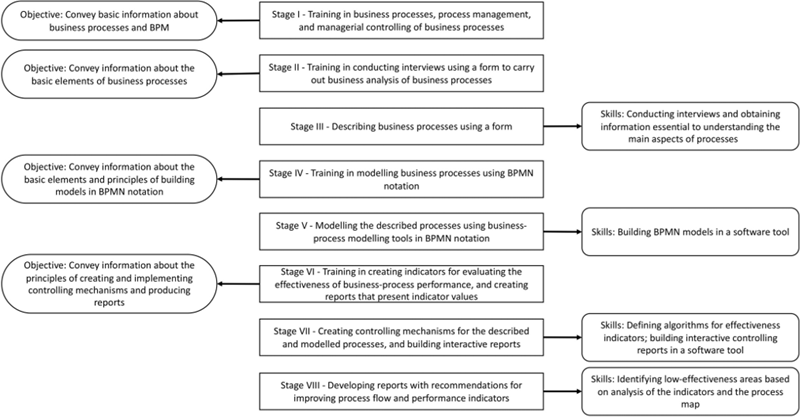
The training programme comprised eight stages, integrating a variety of teaching methods such as lectures, practical exercises and team projects carried out by students. The overarching aim of both the programme as a whole and its individual stages was to convey to participants concise, practical knowledge concerning management controlling and the process management that supports it. An important assumption of the programme was also the development of competencies related to the use of selected methods and tools serving to implement the process approach in organisations. In addition, the programme aimed to familiarise participants with the possibilities of using commercial IT tools that support the design and implementation of the process management concept in management controlling.
The first stage was delivered as a lecture devoted to the definitions of business processes and to the fundamental issues related to process management and management controlling. During the lecture, key concepts concerning business processes were discussed, including the process life cycle, process resources and business objectives. Participants were introduced to the typology of business processes and to their significance for the functioning of an enterprise. The main principles of process management were then presented, encompassing the identification, documentation, analysis, monitoring and optimisation of processes. Selected concepts and methods supporting process improvement, such as BPM (Business Process Management), Lean Management and Six Sigma, were also discussed. Attention was paid to the importance of the process approach for increasing the efficiency and flexibility of organisations operating in a dynamically changing business environment.
The remainder of the lecture focused on the role of management controlling as an integral element of process management. It presented how controlling supports managerial decision-making by providing up-to-date information on the efficiency of the processes being carried out. The basic controlling tools were discussed, including budgeting, cost analysis, management accounting and KPIs (Key Performance Indicators). The theoretical part was complemented by case studies presenting practical applications of controlling in various sectors of the economy. The interactive format of the classes, comprising discussions and case analysis, fostered active engagement and a deeper understanding of the issues discussed.
The second stage was a lecture and focused on the practical application of business analysis methods used to identify and describe the course of business processes. In the original version of the course, its aim was to provide participants with knowledge of the principles of conducting interviews within business analysis. In the modified version of the programme, this stage was extended to include the use of a dedicated questionnaire form supporting and structuring the process of conducting interviews with respondents describing the course of the processes being analysed.
The third stage comprised practical exercises consisting in describing the process under study by means of an interview supported by a specially prepared research form. The form made it possible to gather information about the course of the process systematically and to record the interviewer's observations relating to its individual elements. As part of the exercises, participants conducted interviews with people involved in carrying out the business processes being analysed in the organisations under study. This made it possible to obtain detailed information on the structure of the processes, the way they function, and potential problems and areas requiring improvement. These exercises allowed the practical application of the research methods learned earlier and the development of analytical and communication competencies.
The fourth stage comprised a lecture combined with practical exercises concerning the use of BPMN 2.0 notation and the IBM Blueworks Live tool for modelling business processes. The theoretical part presented the basic elements of BPMN 2.0 notation, such as events, activities, gateways and process flows. The practical aspects of using the IBM Blueworks Live platform to create business process models were then discussed. Participants had the opportunity to model selected processes on their own, which allowed for the practical application of the knowledge acquired. The exercises also included analysing the models developed, identifying potential improvements and optimising business processes.
The fifth stage was practical in nature and focused on the independent creation of graphical models of the business processes under analysis. Participants used the modelling methods and tools learned earlier to develop models relating to real business cases. The exercises included not only creating process diagrams but also identifying bottlenecks, analysing organisational problems and formulating improvement proposals. An important element of this stage was teamwork, which fostered the exchange of experience and a multifaceted analysis of the problems under study. The instructors acted as moderators supporting participants in solving more complex issues.
The sixth stage was delivered as a lecture with elements of practical exercises. Its aim was to provide participants with knowledge of the application of controlling mechanisms in relation to specific business processes. The classes covered both methods of defining process performance indicators and the practical use of IT tools for creating controlling reports, such as IBM Cognos Analytics. In the practical part, participants developed KPIs and learned to interpret them in the context of achieving organisational objectives. In addition, the possibilities of using IBM Cognos Analytics to create reports and analyses supporting the process of managerial decision-making were presented. These classes developed both analytical competencies and the technical skills related to the use of controlling tools.
The seventh stage comprised project exercises that resulted in the preparation of reports presenting the course of the processes under analysis from a controlling perspective. Participants used IT tools, including IBM Cognos Analytics, to create analyses incorporating key process performance indicators. These exercises helped participants develop skills in interpreting data and formulating recommendations to improve the processes under analysis. The results of the work were then presented and discussed in the group forum, which fostered the exchange of experience and a critical evaluation of the proposed solutions.
The eighth stage was delivered as exercises aimed at developing the ability to identify and formulate proposals for improving the business processes under analysis. Participants worked on real case studies, which allowed for the practical application of the knowledge and competencies acquired. During the classes, areas requiring improvement were identified, and proposals for improvement measures were developed, together with possible strategies for their implementation.
Summarising the teaching and research process presented, it should be emphasised that, despite the multifaceted nature of the activities carried out, the main aim of the programme remained unchanged. It focused on analysing the relationship between the quality and maturity of process management in an organisation and the effectiveness of management control. An important factor affecting the efficiency of process management remains the way it is implemented in the enterprise. The choice of an appropriate method for implementing the process approach therefore constitutes one of the key challenges facing the management of contemporary organisations.
Rationale and Concept for Integrating GAI Tools into the Course
The curriculum described above was intended to introduce controlling students to issues related to process management and the practical use of controlling tools. The rapid development and growing popularity of Generative Artificial Intelligence (GAI) tools, however, created new challenges that prompted the programme's authors to substantially redesign both the structure of the course and the rules governing students' project work.
The widespread use of GAI tools by students has become one of the most significant challenges facing contemporary higher education. The ability to generate texts, analyses or solutions to tasks automatically has been recognised as a factor undermining the effectiveness of traditional teaching methods and ways of verifying learning outcomes. In many academic disciplines, the development of GAI is perceived above all as a threat to existing educational models. In the case of the management sciences, and particularly controlling and process management, it nevertheless seems more justified to treat these technologies as a natural element of the contemporary work environment that should be considered in the educational process. The incorporation of GAI into curricula should be seen not as a sign of the weakening of the role of higher education, but as an expression of its capacity to adapt to the technological changes taking place in the business environment. The growing presence of GAI tools in enterprises indicates that solutions of this kind will, in the future, be a standard workplace tool. For this reason, the authors decided to modify the course programme to consider both the possibilities and the potential benefits arising from the use of GAI. It should, of course, be noted that other approaches to modifying curricula, prompted by the widespread use of GAI tools by students, are being pursued in parallel. An example is research focusing on methods (Khlaif et al., 2025) of assessing students' work that consider the possibility of task results being co-created with GAI.
The process of designing the changes began with an analysis of the individual stages of the programme in terms of their labour-intensiveness and the substantive value they brought to the projects carried out. The analysis showed that the most time-consuming stage is the analysis of the business process and the acquisition of information about its course. At the same time, this stage proved crucial for the quality of the whole project, since the reliability of the data gathered determines the correctness of subsequent analyses and studies. The next stage, consisting in modelling the process in BPMN 2.0 notation, also required considerable effort, yet the value of the result remained disproportionate to the time devoted to creating process models manually. For this reason, this area was chosen as the starting point for implementing GAI-based solutions.
The development of tools supporting the automatic generation of BPMN 2.0 models based on business process descriptions made it possible to partially automate this stage of project work. In recent years, many solutions have emerged that enable process models to be created from unstructured textual data, and the quality of the generated models has reached a level that allows them to be used in practice in the teaching process. An analysis of the relationship between the time needed to develop a model manually and the possibility of obtaining a comparable result using GAI clearly justified modifying this element of the programme.
Consequently, the authors decided to incorporate GAI tools into the programme, enabling the automatic generation of process models based on materials prepared during the analysis of the process under study. This decision stemmed from both organisational and pedagogical considerations. The use of GAI made it possible to significantly reduce the time devoted to the technical modelling of processes, while also enabling students to acquire new competencies related to the practical use of artificial intelligence tools in carrying out analytical tasks.
An important effect of the changes introduced was also drawing students' attention to the importance of input data quality in projects related to the analysis and improvement of business processes. The use of GAI allowed course participants to observe the direct relationship between the quality of the prepared process description and the quality of the generated BPMN model. Students were able to experiment on their own with modifying process descriptions and to analyse the impact of these changes on the result generated by the GAI tools. As a result, the teaching process was extended not only by an element of work automation but also by practical experience related to assessing data quality and critically analysing the results generated by artificial intelligence.
Implementation Process and Educational Outcomes of Generative Artificial Intelligence
The Impact of Generative AI on the Efficiency of Business Process Modelling in BPMN Notation
Business process modelling in BPMN notation is a key component of education in process analysis, automation, and organisational improvement design. The traditional approach to teaching BPMN focuses on manual diagram creation, which is time-consuming and cognitively demanding, especially for beginners. In recent years, tools based on Generative AI (GAI) have emerged, enabling automatic generation of models from textual descriptions. The introduction of such tools can significantly change how process analysts work and how academic instruction is structured.
The study was conducted with 42 students who performed a process modelling task both in the traditional format and using a GAI-based tool (lucid.app). The results were compared with historical data from 2018–2025, covering 50 to 100 students per year. Each student worked on an identical process description, allowing direct comparison of efficiency between the two approaches. In both cases, the instructor measured the time required to complete the task, using the point at which more than 50% of students had completed their model as the completion criterion. Additionally, the quality of final projects was assessed, including AS-IS and TO-BE models, identification of weaknesses, recommendations for improvement, automation level, metrics, and cost-benefit analysis. The average project grade was 4.3 on a scale from 2 to 5.
Research Design and Case Description
The study was designed as a case study of a pedagogical intervention implemented within a long-standing business process controlling curriculum. The analysis adopted a comparative and exploratory approach based on task-completion time measurements and historical benchmark data collected from previous editions of the course. Students first completed the task in the traditional format and then, after a short break, performed the same task using the GAI tool. This approach allowed the researchers to isolate the effect of technology while maintaining constant conditions: the same process description, instructor, and student group.
Project evaluation was based on nine criteria covering both technical correctness of BPMN models and the quality of process analysis. Table 1 below presents the full set of criteria.
Table 1Project Evaluation Criteria (100 points)
No. |
Criterion |
Max. |
What to look at when assessing |
| 1 | Process scope and description (AS-IS) | 10 | Clearly defined trigger, outcome, process boundaries, participants and their roles; no blurring of scope; a quantitative description of the current state. |
| 2 | AS-IS model in BPMN | 15 | Correct notation (pools/lanes, start/end events, gateways, flows), completeness of paths, readability, and consistency with the textual description. |
| 3 | Diagnosis of weaknesses | 15 | Specificity and connection to the process (not generalities), identifying causes rather than only symptoms, and linkage to metrics. |
| 4 | Recommendations / proposed changes | 10 | Whether each change addresses an identified weakness; feasibility; no technology for technology's sake. |
| 5 | TO-BE model in BPMN | 15 | Correct notation, consistency with AS-IS, correct representation of automation (system vs. manual tasks), and a new system/ERP lane. |
| 6 | Level of automation and maturity logic | 10 | Justification of the AS-IS -> TO-BE transition; an appropriate choice of technology (OCR, KSeF, workflow, ERP integration); removing dependence on manual work. |
| 7 | Metrics / KPIs | 10 | Measurability, relevance to the process objectives, preferably with a baseline and a target value. |
| 8 | Cost-benefit analysis | 8 | An attempt at quantification, realism, stated sources/assumptions, consideration of the scale of the organisation, and inclusion of benefits/ROI. |
| 9 | Quality of presentation, structure and language | 7 | A logical narrative, linguistic correctness, slide readability, and the visual quality of the diagrams. |
| Total | 100 | ||
Experiment Results
The most striking effect of using GAI was the dramatic reduction in task completion time. In the traditional version, students needed between 55 and 75 minutes to complete a basic BPMN model. In the GAI-assisted experiment, the same task took only 8 minutes. This represents a reduction of over 80%, constituting a breakthrough improvement in efficiency. Table 2 summarises the results.
Table 2Average Task Completion Time
| Student Group | Average Time to Complete the Task |
| Students 2018–2025 | 55–75 min |
| Students 2026 (traditional version) | 55–65 min |
| Students 2026 (GAI version) | 8 min |
The reduction in time did not result from task simplification – students worked on the same process description, and the completion criterion remained unchanged. The difference stems solely from the use of GAI technology.
Results Analysis
The introduction of GAI changed the structure of students' work. In the traditional format, much of the time was spent manually drawing BPMN elements, ensuring notation correctness, and fixing technical errors. In the GAI format, students could focus on process analysis: diagnosing weaknesses, designing improvements, defining automation logic, setting KPIs, and conducting cost-benefit analysis. This shift moves the educational focus from manual tasks to analytical reasoning, fostering the development of skills essential in business practice.
Despite the drastic reduction in time, the quality of final projects remained high. The average grade of 4.3/5 indicates that students not only completed the task faster but also delivered projects of high analytical value. GAI tools support BPMN notation accuracy, eliminating common beginner errors such as missing flows, incorrect gateways, or inconsistencies between the model and textual description.
Discussion
Integrating GAI into BPMN education enables shorter exercises, more iterations, and work on more complex processes. Students are more engaged, as removing manual work increases satisfaction and motivation. The technology promotes the development of analytical, technological, and design competencies that are crucial for process analysts.
The study has certain limitations: it involved a single group of students and one type of process. Future research should expand the experiment to include different process types, various GAI tools, and long-term analysis of skill development.
Educational Implications of the Empirical Findings
The experiment clearly demonstrates that using Generative AI in business process modelling significantly increases student efficiency, reduces task completion time by over 80%, and maintains high-quality results. The technology shifts the educational focus from manual modelling to analytical thinking, leading to deeper process understanding and more mature improvement proposals. GAI is a valuable educational and practical tool that can transform how process analysis is taught and performed.
Directions for the Evolution of the Curriculum in the Context of AI Technology Development
The results achieved during classes conducted according to the modified version of the curriculum confirmed the validity of the decision to incorporate GAI tools into the stage of creating process models in BPMN 2.0 notation. At the same time, the results obtained by students while carrying out projects became the basis for developing further directions for the programme's development.
Proposals were prepared for further modifications envisaging the extension of the use of GAI tools and of algorithms co-created by students to further areas of process analysis. The planned changes include, among other things, the use of GAI to analyse data describing business processes, identify potential improvements, design organisational changes, and support the creation of controlling mechanisms. A further area envisaged for integration with GAI tools is the simulation of the course of the designed business processes.
From the perspective of students in fields related to controlling and business analysis, the possibility of broadening their competencies in process management and process life-cycle management is of considerable practical importance. Traditional curricula, which require the simultaneous mastery of numerous IT tools and analytical techniques, considerably limit the time that can be devoted to developing skills related to interpreting results, designing improvements or formulating managerial recommendations.
The conscious use of GAI tools makes it possible to manage more effectively the time devoted to carrying out the individual stages of the course. Thanks to the automation of selected technical activities, students can analyse a larger number of process variants in a shorter time and test different organisational scenarios. This changes the way educational objectives are defined in the curricula being designed. The use of GAI makes it possible to focus the teaching process not only on acquiring technical skills but, above all, on developing analytical competencies, critical thinking and the ability to design solutions corresponding to real organisational problems.
The ability to quickly generate and analyse multiple process variants means that students gain considerably more practical experience in a relatively short time. In this situation, the role of the academic teacher partly changes and increasingly focuses on supporting students in the conscious, critical and responsible use of the knowledge obtained through GAI tools and the experience gained while carrying out teaching projects.
Comparative Analysis of the Training Programme's Development Stages
The data presented in Table 3 set out the successive stages in the development of the curriculum, considering the gradual broadening of the scope of use of Generative Artificial Intelligence tools. The first phase of modifying the programme covered two stages of the course, in which traditional, manual process modelling was replaced by GAI-based solutions. In the next phase, a considerably broader deployment of artificial intelligence tools is planned, encompassing practically all stages of the programme delivered.
Table 3Stages of the Programme Delivered in Classes Devoted to Business Process Controlling
| Stage | Original programme | Programme modification I (2026) | Programme modification II – plan (2027) |
| Stage I | Training in process management | ||
| Stage II | Training in conducting interviews | ||
| Stage III | Interviews with process stakeholders supported by a form in MS Word | No change | Conducting interviews using audio recorders, with transcription to text. Using video analysis to document production processes. |
| Stage IV | Training in business process modelling | ||
| Stage V | Creating process models in the Blueworkslive.com tool | Automatic generation of BPMN models using GAI based on documentation collected in Stage II | No change relative to the modified programme |
| Stage VI | Training in creating indicators and dashboards | ||
| Stage VII | Creating a dashboard and analyses in a BI tool (Cognos/Watson) | No change | Creating dashboards and analysing processes using GAI |
| Stage VIII | Identifying process weaknesses and proposing changes to improve efficiency | Identifying process weaknesses and proposing changes using GAI | Simulating the flow of the designed processes using GAI Preparation of interactive reports using GAI |
Ultimately, each stage of the course is to be supported by GAI-based solutions, beginning with the phase of acquiring information about the course of the business process under analysis. In addition to the widely available functions offered by GAI tools, such as the automatic transcription of audio recordings or the generation of process models from unstructured textual descriptions, the authors plan to draw on experience from earlier research (Monzon & Hays, 2025). This concerned, among other things, the use of artificial intelligence tools to analyse video recordings of processes carried out at traditional production workstations.
The stage of data analysis and of developing recommendations for improving business processes will also be modified (Xia et al., 2024). The main aim of the planned changes is to enable students to analyse multiple alternative scenarios for redesigning and optimising processes. In the previous version of the programme, due to time constraints and the need to enter changes into process models manually, students were able to develop only a single improvement variant. The use of GAI tools will make it possible to significantly broaden the range of scenarios analysed and to increase the scope for experimenting with different process configurations.
The most significant changes, however, are planned for the final stage of the curriculum. Thanks to the integration of GAI tools, students will be able not only to create controlling reports but also to develop them based on the results of business process simulations (Francis et al., 2025). The inclusion of simulation models supported by GAI will make it possible to extend the programme to include an analysis of the effects of the proposed organisational changes and an assessment of their impact on process efficiency. Such an approach will allow course participants to gain experience that closely resembles real-world process design and improvement in business organisations.
Conclusions
Modifications to a long-standing curriculum, delivered both in academic studies and in the form of business training, constitute an attempt to flexibly adapt education to the technological changes taking place in the contemporary economic environment. The main impulse for redesigning this course was the spread of generative artificial intelligence tools and their increasingly strong position in everyday professional practice. The emergence of these technologies initially provoked considerable variation in attitudes: the business world quickly saw in them an opportunity to automate routine tasks and streamline decision-making processes, whereas in higher education concerns arose about the integrity of traditional forms of verifying learning outcomes. The experience described in the article suggests, however, that the appropriate response of universities is the conscious incorporation of GAI solutions into study programmes, rather than perceiving them solely in terms of a threat. This integration makes it possible to clearly shift the focus of education – from time-consuming, repetitive technical activities towards the development of analytical skills, critical thinking and the independent design of improvements.
In an educational process shaped in this way, the role of the student evolves: students cease to be merely executors of repetitive tasks and become people who critically verify and evaluate the results of artificial intelligence. Although automation relieves course participants of the burden of drawing diagrams manually, theoretical knowledge of BPMN 2.0 notation by no means loses its importance. Its purpose changes, however, since it becomes the basis for assessing the correctness of models generated by artificial intelligence, which is crucial given the risk of errors or inaccuracies in automatically created diagrams. The significant reduction in the time devoted to technical modelling made it possible to save time that students could devote to a more thorough analysis of bottlenecks and to the search for creative optimisation solutions. This redesign redefines the educational objectives, linking the academic experience with the ability to solve real, complex organisational problems rather than with mere proficiency in operating software. Consequently, the role of the academic teacher evolves from that of a traditional lecturer to that of a mentor supporting students in the responsible and critical use of the resources provided by technology.
The findings suggest that the educational value of GAI lies not only in process automation and efficiency gains but also in supporting the development of AI literacy competencies. In the redesigned curriculum, students are required to critically evaluate AI-generated process models, identify inconsistencies, verify compliance with BPMN standards, and assess the relationship between input data quality and model outputs. As a result, the educational focus shifts from technical model construction towards the development of analytical judgement, critical thinking, and responsible interaction with AI systems. This observation is consistent with recent studies emphasising AI literacy and the critical evaluation of AI-generated content as emerging core competencies in higher education (Caspari-Sadeghi, 2026; Ma et al., 2025).
The study also provides answers to the research questions formulated in the introduction. With respect to RQ1, the findings indicate that the use of GAI tools substantially reduces the time required to build a business process model based on process-analysis data, reducing average completion time from approximately 55–75 minutes to 8 minutes. Regarding RQ2, a similar reduction was observed in activities related to developing improved process models, indicating that GAI can significantly reduce the time devoted to technical modelling tasks. Finally, in response to RQ3, the evidence suggests that the time saved through GAI-supported modelling can be reallocated to higher-value analytical activities, including diagnosing process weaknesses, evaluating alternative scenarios, defining performance indicators, and designing process improvements.
The educational intervention presented has certain limitations, arising from the fact that it covered a specific group of students of the Controlling specialisation who already possessed high analytical competencies from the outset. Bearing this in mind, the authors have outlined a perspective for the further development of the curriculum through the successive implementation of GAI tools in subsequent stages of process analysis. The planned innovations include the use of algorithms to interpret process data, to design organisational changes, and to support the construction of controlling mechanisms. A key element of the forthcoming phase of the course's development will be the implementation of AI-supported simulation models. This will allow students to run simulations and accurately assess the impact of the designed transformations on the efficiency of the entire enterprise. Such a path for the development of teaching will make it possible to equip graduates with unique market skills aligned with the realities of contemporary business, in which the collaboration of humans with artificial intelligence is becoming a standard element of an analyst's work.
It should be acknowledged that, notwithstanding the multi-year historical baseline described above, the present design does not constitute a randomised controlled experiment: no parallel control group was maintained during the 2025 implementation, cohort-level differences across the 2018–2024 period may have influenced completion times independently of GAI use, and the reported time reductions have not yet been subjected to formal statistical significance testing (e.g., the Mann–Whitney U test). Future research should investigate the relationships between the use of GAI tools and several educational outcomes, including task-completion time, project quality, analytical performance, AI literacy development, and students' ability to critically evaluate AI-generated outputs. Further studies should also examine how different levels of GAI integration influence learning outcomes and engagement, preferably using larger samples, comparison groups, and formal statistical analyses.
References
- Batista, J., Mesquita, A., & Carnaz, G. (2024). Generative AI and Higher Education: Trends, challenges, and future directions from a systematic literature review. Information, 15(11), 676. https://doi.org/10.3390/info15110676
- Belkina, M., Daniel, S., Nikolic, S., Haque, R., Lyden, S., Neal, P., Grundy, S., & Hassan, G. (2025). Implementing generative AI (GenAI) in higher education: A systematic review of case studies. Computers and Education: Artificial Intelligence, 8, 100407. https://doi.org/10.1016/j.caeai.2025.100407
- Bouguettaya, S., Pupo, F., Chen, M., & Fortino, G. (2025). A meta-survey of generative AI in education: trends, challenges, and research directions. Big Data and Cognitive Computing, 9(9), 237. https://doi.org/10.3390/bdcc9090237
- Caspari-Sadeghi, S. (2026). AI literacy for teacher educators: A holistic curriculum for capacity-building in higher education. Frontiers in Education, 11. https://doi.org/10.3389/feduc.2026.1745768
- Deroncele-Acosta, A., Sayán-Rivera, R. M. E., Mendoza-López, A. D., & Norabuena-Figueroa, E. D. (2025). Generative Artificial Intelligence and transversal competencies in higher education: A systematic review. Applied System Innovation, 8(3), 83. https://doi.org/10.3390/asi8030083
- Francis, N., Jones, S., & Smith, D. (2025). Generative AI in higher education: Balancing innovation and integrity. British Journal of Biomedical Science, 81, 14048. https://doi.org/10.3389/bjbs.2024.14048
- Guo, F., Zhang, L., Shi, T., & Coates, H. (2025). Whether and when could generative AI improve college student learning engagement? Behavioral Sciences, 15(8), 1011. https://doi.org/10.3390/bs15081011
- Khlaif, Z. N., Alkouk, W. A., Salama, N., & Abu Eideh, B. (2025). Redesigning assessments for AI-enhanced learning: A framework for educators in the generative AI era. Education Sciences, 15(2), 174. https://doi.org/10.3390/educsci15020174
- Kumar, S., Rao, P., Singhania, S., Verma, S., & Kheterpal, M. (2024). Will artificial intelligence drive the advancements in higher education? A tri-phased exploration. Technological Forecasting and Social Change, 201, 123258. https://doi.org/10.1016/j.techfore.2024.123258
- Lindell, T., & Stöhr, C. (2025). Navigating generative AI in higher education: Six near future scenarios. Learning, Media and Technology, 50(1), 1–16. https://doi.org/10.1080/17439884.2025.2562405
- Ma, X., Li, Y., Wang, Z., & Liu, H. (2025). Preparing students for an AI-driven world: Generative AI and curriculum reform in higher education. Frontiers of Digital Education, 2(30). https://doi.org/10.1007/s44366-025-0067-6
- Monzon, N., & Hays, F. A. (2025). Leveraging generative artificial intelligence to improve motivation and retrieval in higher education learners. JMIR Medical Education, 11, e59210. https://doi.org/10.2196/59210
- Ogunleye, B., Zakariyyah, K. I., Ajao, O., Olayinka, O., & Sharma, H. (2024). A systematic review of generative AI for teaching and learning practice. Education Sciences, 14(6), 636. https://doi.org/10.3390/educsci14060636
- Pallant, J. L., Blijlevens, J., Campbell, A., & Jopp, R. (2026). Mastering knowledge: The impact of generative AI on student learning outcomes. Studies in Higher Education, 51(4), 714–735. https://doi.org/10.1080/03075079.2025.2487570
- Prohorovs, A., Užule, K., & Tsaryk, O. (2026). Understanding higher education students' reluctance to adopt GenAI in learning in Latvia and Ukraine. Frontiers in Education, 10, 1676900. https://doi.org/10.3389/feduc.2025.1676900
- Salhab, R., & Aboushi, M. M. (2025). Influence of AI literacy and 21st-century skills on the acceptance of generative artificial intelligence among college students. Frontiers in Education, 10. https://doi.org/10.3389/feduc.2025.1640212
- Stöhr, C., Ou, A. W., & Malmström, H. (2024). Perceptions and usage of AI chatbots among students in higher education across genders, academic levels and fields of study. Computers and Education: Artificial Intelligence, 7, 100259. https://doi.org/10.1016/j.caeai.2024.100259
- Xia, Q., Weng, X., Ouyang, F., Tzung, J. I., & Chiu, T. K. F. (2024). A scoping review on how generative artificial intelligence transforms assessment in higher education. International Journal of Educational Technology in Higher Education, 21, 40. https://doi.org/10.1186/s41239-024-00468-z
 https://orcid.org/0000-0001-9114-4947