

About the article
E-mentor number 2 (114) / 2026
Table of contents
About the author
Thematic Analysis. A Practical Guide
Beata Tkacz
Abstract
The purpose of this article is to review the book Thematic analysis. A practical guide by Virginia Braun and Victoria Clarke is one of the most important modern studies of thematic analysis (TA). Thematic analysis is a method for analysing empirical data within a qualitative approach. This approach is one of the most popular in psychology, social sciences and health. It is a practical guide for those engaged in qualitative research. The book under review is a specialist publication, aimed both at those just beginning their journey with TA and learning this method, as well as at those teaching and supervising TA.
Keywords: qualitative research, reflective thematic analysis, coding, data analysis, reflexivity
Thematic Analysis. A Practical Guide
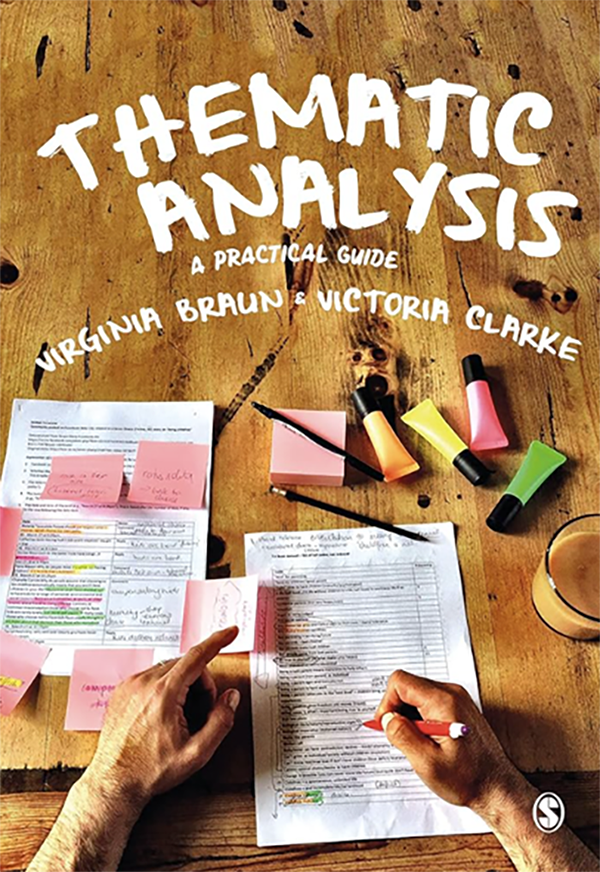
The reviewed book, Thematic analysis. A practical guide is 315 pages long and was published by Wydawnictwo Naukowe PWN SA in Warsaw in 2024. The book was translated by Dorota Przygucka. Virginia Braun is a professor in the School of Psychology at the University of Auckland in Aotearoa, New Zealand and a health psychologist. She lectures on the psychology of gender and health. Victoria Clarke is a professor in the Faculty of Social Sciences at the University of the West of England (UWE) in Bristol. She lectures on qualitative methods. The book also includes excerpts from other scholars, including Suzy Anderson, Melanie Beres, Elicia Boulton, Gina Cowie, Louise Davey, Pantea Farvid, Ally Gibson, Rachel Graham, Jade Le Grice, Nikki Hayfield, Michelle G. Ong, Matt Sillars, Gareth Terry, Lisa Trainor, and Matthew Wood.
Thematic analysis. A practical guide is a publication focusing on thematic analysis (TA). Reflective TA is a qualitative research method that involves in-depth, subjective analysis of data sets that coalesce into themes (Braun & Clarke, 2024a). TA is a popular qualitative method that can analyse large datasets and is applied within larger research groups (Nowell et al., 2017). Given the popularity of qualitative research, the transparency of the procedures used is important. Reflective TA differs from other methods in its approach to thematic development and philosophy. The authors analyse various approaches to technical analysis in TA: inductive and deductive, semantic and implicit, critical realist and constructivist. Importantly, these are not necessarily mutually exclusive. Analysis can incorporate elements of several orientations (Braun & Clarke, 2024a; 2024c). The authors repeatedly emphasise the flexibility of reflective TA and its applicability to various research paradigms.
This book is a comprehensive and reliable guide covering a six-step approach to conducting reflective TA. It describes in detail the process of coding and analysing empirical data, as well as the detailed development of themes and report writing. The book emphasises the reflexivity and contextualisation of this method. According to the authors, the researcher is aware that they are in some way influencing the analysis results and are part of the research process. The authors also emphasise that data should not be analysed out of context. During analysis, it is important to be aware of the cultural and environmental context. It is also crucial to pay attention to when and how a specific data set was created (Braun & Clarke, 2024a).
The book is written in a language that is understandable to everyone, in a very engaging and accessible style. Even those with no prior knowledge of TA will have the necessary skills to successfully conduct reflective TA after reading it. The book’s structure is clear. It includes numerous practical examples that help understand the issues discussed, as well as tables and figures, which significantly facilitate understanding of the information presented. At the end of each section, a summary is provided, along with suggested further reading (for readers who want to learn more) and useful exercises. It combines both practical and theoretical knowledge, making it a very interesting and solid resource on this topic. The book’s language is clear and easy to understand. It is recommended for anyone interested in this qualitative research method, from professionals to students. Its most important strength is demonstrating that TA is not just a mechanical process but a complex, intricate interpretive activity that requires reflection.
The book consists of two parts and nine thematic chapters. A very useful glossary of terms is included at the end. Subsequent chapters provide information on preparing and coding empirical material and a detailed process for interpreting data. The authors (Braun & Clarke, 2024a) propose a six-phase approach to conducting reflective TA (presented below), which is described in detail in each chapter:
- Familiarising yourself with the dataset. The authors recommend multiple readings of the data. In the context of familiarising yourself with the data, they discuss proximity (immersion) and distance (critical engagement). During reading, they emphasise the importance of creating logical notes, either in a classical format or by capturing potential patterns of meaning and possible questions.
- Coding. The authors describe this as identifying interesting fragments and emphasise assigning code labels. Braun and Clarke (2024a) distinguish between superficial and latent multilevel coding. They describe semantic coding and latent coding. Semantic coding involves examining the meaning of the data’s surface, and such codes remain close to participants’ language, although they are not intended to reflect their words. Latent codes, on the other hand, focus on deeper, hidden meanings, which are sometimes completely thematically detached from the content of the empirical data. It is also important to complete at least two rounds of coding.
- Generating initial themes. In this phase, the authors emphasise the importance of identifying and grouping potential or preliminary themes. The researcher should identify relevant themes and then create coding categories. This is where the concept of a candidate theme emerges.
- Developing and verifying themes. Braun and Clarke (2024a) provide a detailed description of the process of assessing the initial relevance of themes and emphasise the importance of verifying their relevance. Themes can be combined, separated, or removed entirely.
- Refining, defining, and naming themes. This section describes the process of consolidating one’s analysis and selecting themes, and the importance of writing a short summary for each theme.
- Writing. The final phase described by the authors is the formal refinement of the writing process, which informally begins in Phase 1.
The reviewed publication aims to demonstrate that TA is a fully fledged research method. The authors (Braun & Clarke, 2024a) emphasise how reflexivity compels us to examine how we make sense of data. They emphasise that the data analysis process is not mechanical, but organic. The authors also point out the importance of maintaining analytical sensitivity.
Although TA has been criticised (Saldana, 2013) for its explicit procedures, it remains a frequently used method due to its flexibility. TA has never been as appreciated as other qualitative research methods, such as grounded theory or phenomenology (Braun & Clarke, 2006; Nowell et al., 2017). Some researchers believe that because TA is often used alongside other qualitative methods, it is not a separate method but merely a subset of others (Boyatzis, 1998). However, Braun & Clarke (2006) argue that this is a flawed approach and TA should be considered a separate method. Other authors also support this position (Nowell et al., 2017).
TA offers considerable flexibility regarding research questions and data volume (Braun & Clarke, 2013). However, this flexibility can also lead to inconsistencies in data processing (Holloway & Todres, 2003). Other researchers also note drawbacks of this method, such as the relatively small body of scientific literature devoted to it, especially compared to other qualitative research methods, which can pose difficulties for inexperienced researchers (Nowell et al., 2017).
TA is widely used but rarely recognised, so the authors (Braun & Clarke, 2024a) present an accessible, understandable approach to using TA in research. TA is often misused, its superficial practices are common, and researchers have the misconception that the method lacks theoretical foundations (Braun & Clarke, 2023; 2024c). Many research errors stem from imposing universal criteria on this method (Braun & Clarke, 2020). It is important to understand that TA is not a single method, but a collection of qualitative data analysis approaches that focus on developing emerging themes (Braun & Clarke, 2024b).
This book can definitely be recommended to a wide audience. It is a book that will be understandable for both professionals and those just beginning their adventure with TA. It is a valuable source of knowledge on qualitative data analysis methods.
References
- Boyatzis, R. (1998). Transforming qualitative information: Thematic analysis and code development. Sage Publications Ltd.
- Braun, V., & Clarke, V. (2006). Using thematic analysis in psychology. Qualitative Research in Psychology, 3(2), 77-101. https://doi.org/10.1191/1478088706qp063oa
- Braun, V. & Clarke, V. (2013). Successful qualitative research: A practical guide for beginners. SAGE Publications Ltd.
- Braun, V., & Clarke, V. (2020). One size fits all? What counts as quality practice in (reflexive) thematic analysis? Qualitative Research in Psychology, 18(3), 328–352. https://doi.org/10.1080/14780887.2020.1769238
- Braun, V., & Clarke, V. (2023). Is thematic analysis used well in health psychology? A critical review of published research, with recommendations for quality practice and reporting. Health Psychology Review, 17(4), 695–718. https://doi.org/10.1080/17437199.2022.2161594
- Braun, V., & Clarke, V. (2024a). Analiza tematyczna. Praktyczny przewodnik [Thematic analysis. A practical guide]. Wydawnictwo Naukowe PWN.
- Braun, V., & Clarke, V. (2024b). Thematic analysis. University of Auckland. Reserved Retrieved March 25, 2026, from https://www.thematicanalysis.net
- Braun, V., & Clarke, V. (2024c). Supporting best practice in reflexive thematic analysis reporting in Palliative Medicine: A review of published research and introduction to the Reflexive Thematic Analysis Reporting Guidelines (RTARG). Palliative Medicine, 38(6), 608–616. https://doi.org/10.1177/02692163241234800
- Holloway, I., & Todres, L. (2003). The status of method: Flexibility, consistency and coherence. Qualitative Research, 3(3), 345–357. https://doi.org/10.1177/1468794103033004
- Nowell, L. S., Norris, J. M., White, D. E., & Moules, N. J. (2017). Thematic Analysis: Striving to Meet the Trustworthiness Criteria. The International Journal of Qualitative Methods, 16(1), 1–13. https://doi.org/10.1177/1609406917733847
- Saldana, J. (2016). The coding manual for qualitative researchers. SAGE Publications Ltd.

 https://orcid.org/0009-0000-0980-5276