

About the article
DOI: https://www.doi.org/10.15219/em113.1743
The article is in the printed version on pages 65-78.
 Download the article in PDF version
How to cite
Walentynowicz, P., Białas, S. Jendza, D., Borowska-Pietrzak, A., Kawka, T., Sliż, P. (2026). Integrating Human Capital Management and Ambidextrous Business Process Management: A conceptual review and framework. e-mentor, 1(113), 65-78. https://www.doi.org/10.15219/em113.1743
Copyright © 2026, Piotr Walentynowicz, Sylwia Białas, Dorota Jendza, Agata Borowska-Pietrzak, Tomasz Kawka, Piotr Sliż


E-mentor number 1 (113) / 2026
Table of contents
- Introduction
- Theoretical Foundations of the Human Capital–ABPM Framework
- The Method
- Navigating the Complexity: Human Resources in Ambidextrous BPM
- Generational Dynamics in ABPM
- Managing Diverse Teams in ABPM: Towards Cognitive Diversity and Flexibility
- Mental Resilience as a Pillar of Ambidextrous BPM
- Cultural Transformation: Orchestrating Change Management in ABPM
- Discussion
- Conclusion
- References
About the author
Integrating Human Capital Management and Ambidextrous Business Process Management: A Conceptual Review and Framework
Piotr Walentynowicz, Sylwia Białas, Dorota Jendza, Agata Borowska-Pietrzak, Tomasz Kawka, Piotr Sliż
Abstract
Contemporary organisations operate in an increasingly complex and volatile environment, demanding greater flexibility than traditional Business Process Management (BPM). One of the biggest challenges is balancing exploitative and explorative activities, a duality that has given rise to integrated models such as ambidextrous BPM (ABPM). Organisational success in this context depends not only on structures and technologies, but also on the strategic role of human capital and human resource management (HRM) practices. This paper aims to identify the challenges and opportunities facing HR departments in supporting ABPM. The analysis focuses on four key areas: managing multigenerational teams, fostering cognitive diversity, strengthening employees’ mental resilience, and shaping an organisational culture conducive to ambidexterity. To address these dimensions, the study draws on a literature review based on Scopus and Web of Science databases. The article concludes by proposing a conceptual framework that links HRM practices with the demands of ABPM. This integrative perspective offers an original contribution to BPM and HRM domains, emphasising the role of human capital as a key enabler of organisational ambidexterity in dynamic and uncertain environments.
Keywords: BPM, ABPM, human capital, human capital management (HCM), ambidexterity, diversity, social aspects, resilience, human resource management (HRM)
Introduction
The growing complexity and unpredictability of the organisational environment, marked by rapid technological advancement and mounting pressure for innovation, are signs of Industry 4.0/5.0 and represent a transformative shift in the way organisations are managed. This shift demands that organisations adopt strategies that enable dynamic adaptation to changing conditions (Sliż & Jackowska, 2024).
The challenge for researchers and practitioners today is to understand how human resource management can be aligned with organisational strategies while simultaneously supporting the conflicting demands of exploitation and exploration (Junni et al., 2015). This question becomes even more relevant when considering the complexity of human behaviour and the strategic importance of employees’ knowledge, engagement, and motivation.
Despite growing interest in this area, the literature still falls short in addressing the role of HR in implementing ambidextrous strategies at the process and business process management level. Current research offers limited insights into how HR can support process-level ambidexterity.
This article aims to identify the challenges and opportunities for the contemporary strategic approach of HRM (Human Resource Management) in the context of implementing and supporting ambidexterity in BPM. This approach can be thought of as human capital management (HCM).
At this point, a conceptual clarification between Human Resource Management (HRM) and Human Capital Management (HCM) is required. Although the two terms are often used interchangeably in the literature, they represent partially overlapping yet analytically distinct perspectives. HRM traditionally refers to the configuration of policies, practices, and systems aimed at managing people within organisations (Armstrong & Taylor, 2023; Boxall & Purcell, 2016), and can therefore be used synonymously with HR practices in this text. In contrast, HCM emphasises the strategic, value-creation dimension of people management, viewing employees not merely as resources to be administered but as capital assets that generate future economic and strategic returns (Becker et al., 2001; Juchnowicz, 2014).
In this article, HRM is treated as the operational and systemic domain of people-management practices, whereas HCM represents its strategic and investment-oriented logic, particularly relevant in the context of ambidextrous Business Process Management (BPM). Thus, the term HCM will be used to refer to the strategic role of human capital as a driver of the exploration–exploitation balance, while HRM will denote the organisational mechanisms and managerial practices through which this strategic intent is enacted. This distinction allows the paper to integrate both perspectives without conflating their analytical levels.
In this light, the study explores four HCM-driven areas crucial for ambidextrous BPM: multigenerational team management, cognitive diversity and flexibility workgroups, psychological resilience and Psychological Capital, and organisational culture supportive of ambidexterity.
This leads to the main research question (RQ):
RQ: What are the key challenges facing modern strategic HCM in implementing the principles of ambidexterity within BPM?
The paper is conceptual and is intended to stimulate future empirical research aimed at testing its assumptions and propositions. To explore the issue, the article employs a conceptual literature review drawing on the Web of Science and Scopus databases. It contributes to the ABPM discourse by addressing a persistent gap – namely, the relative paucity of research focusing on human capital issues in ABPM – by providing an initial conceptualisation of HCM in ABPM, identifying strategic opportunities for integrating HR with ambidextrous BPM (ABPM) in response to the complex challenges of the 21st century, and outlining directions for subsequent empirical verification.
This article adopts a conceptual review design aimed at integrating dispersed insights from the BPM, ambidexterity, and human capital literature into a coherent analytical framework. Rather than testing empirical relationships, the paper develops a theoretically grounded model that systematises the microfoundations of ambidextrous BPM and delineates directions for future empirical validation.
Theoretical Foundations of the Human Capital–ABPM Framework
HRM in Ambidextrous Business Process Management (ABPM) lies in the foundational tension between exploration and exploitation in organisational processes (March, 1991), further developed within the ambidexterity literature (O’Reilly & Tushman, 2013). In BPM settings, this duality translates into the simultaneous requirement to maintain operational reliability and efficiency while continuously adapting and reconfiguring processes (Sliż & Jackowska, 2024). Process ambidexterity should therefore not be reduced to a structural or technological design challenge. Rather, it constitutes a human capital–based capability, as employees enact and balance both logics in their day-to-day process execution (Gibson & Birkinshaw, 2004). Human Capital Management perspective shifts the analytical focus from structural separation toward the microfoundations of ambidexterity. ABPM environments redefine expectations toward employees engaged in process work (Armstrong & Taylor, 2023; Baron & Armstrong, 2007), requiring them to:
- switch between competing work logics (cognitive switching) (Hoang et al., 2025; Rosing & Zacher, 2017);
- tolerate heightened ambiguity and stress (mental resilience) (Demerouti et al., 2001; Jia et al., 2024);
- integrate diverse knowledge domains (learning and knowledge sharing) (Marin Idarraga et al., 2025; Wang et al., 2024);
- collaborate effectively within heterogeneous teams (diversity management) (Ahammad et al., 2019; Kassotaki, 2022).
These changing performance requirements provide the conceptual bridge to the theoretical lenses supporting the proposed framework. At the strategic level, the model is anchored in the Resource-Based View (RBV), which conceptualises sustainable competitive advantage as rooted in valuable, rare, and difficult-to-imitate resources (Barney, 1991). The configuration of human competencies, tacit knowledge, collaborative routines, and relational capital constitutes such a resource bundle. Ambidextrous BPM may therefore be interpreted as the outcome of a distinctive human capital configuration rather than a mere reflection of formal process architecture. Extending this reasoning, the Dynamic Capabilities perspective emphasises the organisation’s capacity to integrate and reconfigure resources in response to environmental turbulence (Teece, 2007; Teece et al., 1997). The capability to oscillate between standardisation and adaptation represents a microfoundational expression of dynamic capability at the process level. Within the proposed framework, the four HR/HCM levers operate precisely as enabling mechanisms for activating this switching capability in everyday process work.
The psychological dimension of ABPM is illuminated through the Job Demands–Resources (JD-R) model. Ambidextrous process environments generate simultaneous efficiency pressures (exploitation) and experimentation imperatives (exploration). When job and personal resources are insufficient, overload and disengagement may follow (Demerouti et al., 2001; Schaufeli & Bakker, 2004). Psychological resilience and the components of Psychological Capital (PsyCap) (Luthans et al., 2007a) thus function as critical personal resources enabling sustained performance under complexity. Recent empirical findings demonstrate that ambidextrous HR practices strengthen PsyCap, thereby enhancing creativity and performance outcomes (Zhao et al., 2022).
A central foundational element of the model is multigenerational team management (generational composition and coordination), conceptualised within the Diversity Management paradigm. Teams represent the primary locus where exploitation and exploration are reconciled. From the RBV standpoint, human capital acquires strategic value not solely at the individual level but as a configuration of complementary competencies within teams (Barney, 1991). Multigenerational teams may enhance cognitive variety by combining experiential process knowledge and stability orientation with exploratory learning and innovation capacity.
Yet diversity effects remain conditional. As established in diversity research, heterogeneity, conceptualised as ‘variety’, may enhance problem-solving quality, whereas heterogeneity, conceptualised as ‘separation’, may generate conflict and reduce cohesion (Harrison & Klein, 2007; van Knippenberg et al., 2004). Social Identity Theory explains such dynamics through processes of in-group and out-group categorisation (Hogg, 2016; Tajfel & Turner, 1979). In ABPM contexts, generational diversity does not automatically translate into ambidexterity. Rather, its value depends on deliberate orchestration through HR practices.
Properly coordinated multigenerational collaboration can generate cognitively energising, non-routine solutions often driven by younger employees, while simultaneously preserving validated quality standards grounded in the tacit knowledge of more experienced staff. Consequently, multigenerational team management is treated not as a demographic attribute but as a designed HRM mechanism encompassing role alignment, mentoring and reverse mentoring, structured knowledge transfer, managerial support, and conflict-resolution processes. From the perspective of dynamic capabilities, sustained knowledge integration enables process reconfiguration. From the JD-R perspective, effective coordination mitigates cognitive and emotional strain, thereby strengthening both operational reliability and readiness for innovation.
The final integrative dimension is organisational culture and the leadership context. Upper Echelons Theory (Hambrick & Mason, 1984) argues that strategic choices and balancing mechanisms reflect top managers’ cognitive frames (Hambrick, 2007). Ambidexterity research underscores the necessity of a context combining discipline and flexibility (O’Reilly & Tushman, 2013). A culture that legitimises both operational rigour and experimentation, therefore institutionalises the remaining HRM levers and sustains ambidextrous performance (Gibson & Birkinshaw, 2004).
Recent empirical evidence further confirms that high-performance HR practices promote organisational ambidexterity, which mediates the relationship between HR systems and innovation outcomes (Wang et al., 2024). Accordingly, the four HR/HCM levers constitute a coherent set of microfoundations of ambidextrous BPM, grounded in resource-based, adaptive, and psychological theories and integrated through culture and leadership (Varandas et al., 2024).
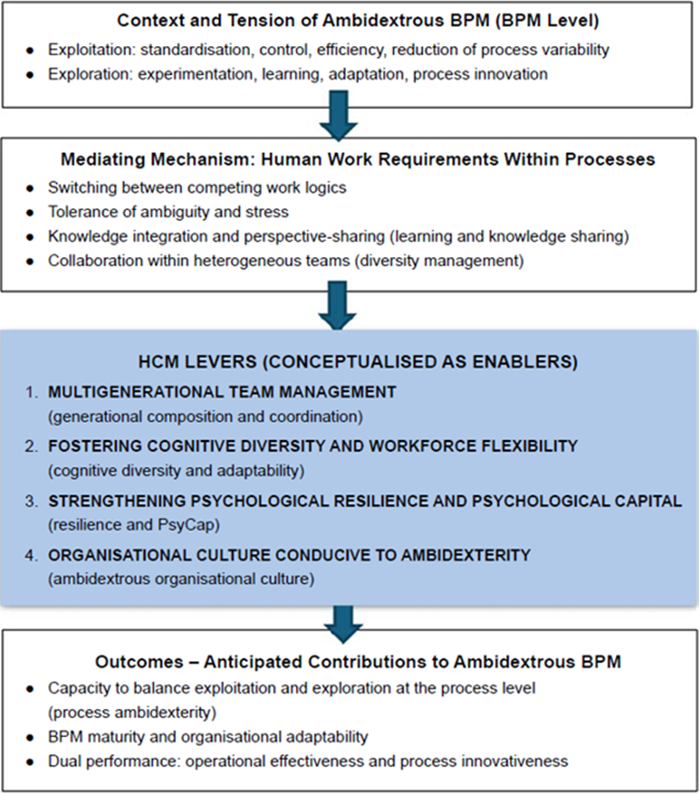
The conceptual framework (Figure 1) thus integrates ambidextrous BPM with core human capital levers. The model begins with the fundamental tension between exploitation and exploration, identifies the resulting requirements for human work within processes (dual demands, switching between work logics, knowledge integration), and subsequently indicates four HCM domains as key mechanisms that enable the institutionalisation of ambidexterity at the process level. In this way, the transition from general ambidexterity theory to specific HRM solutions becomes theoretically structured and analytically transparent.
Figure 1The Model of the Human Capital Enablers - ABPM Conceptual Framework
The Method
Given the study’s conceptual and integrative aims, a structured conceptual literature review was adopted. This approach was considered appropriate because the paper does not seek to estimate the prevalence of specific effects or test empirical relationships, but rather to synthesise dispersed insights from Business Process Management, organisational ambidexterity, and Human Capital Management into a coherent conceptual framework. The search was conducted in the Scopus and Web of Science databases. The search strategy was based on combining three groups of concepts: (1) BPM/process management, (2) ambidexterity/exploration–exploitation, (3) HCM/HRM/people dimension. A limited number of queries were used to cover the core of the problem (e.g., BPM + ambidexter), as well as the link between ABPM and the HRM/human capital dimension. Additionally, clarifying queries were run when necessary to capture literature on people and work (including culture, leadership, psychological capital, diversity and generations). The search time frame spanned 2000–2025. Given the study’s conceptual and framework-building character, the review should not be understood as a full systematic literature review but rather as a structured conceptual review supported by a supplementary search.
A key element of the procedure was an analysis focused on ‘people challenges’. From each publication, excerpts were extracted describing: (a) tensions and constraints on the part of employees, teams, or managers (e.g., role conflicts, cognitive load, resistance to change, barriers to collaboration), (b) organisational conditions that exacerbate or reduce these tensions (culture, leadership, HR systems), and (c) implications for balancing exploration and exploitation in processes. Next, thematic synthesis was applied, treating the ‘challenge’ as the unit of analysis: codes referring to similar problems were grouped into categories, which were then organised into coherent challenge areas. As a result, the review led to the identification of four overarching domains of people-related challenges for ABPM, which form the structure of the article’s findings: (1) managing multigenerational teams, (2) leveraging and integrating cognitive diversity, (3) strengthening employees’ mental resilience to ambidexterity tensions, and (4) shaping an organisational culture conducive to ambidexterity. These domains were then used to develop a conceptual framework that links ABPM requirements to HRM practices and human capital resources.
Navigating the Complexity: Human Resources in Ambidextrous BPM
The concept of ambidexterity is extensively discussed in the literature (Helbin & Van Looy, 2021; Lis et al., 2018; O’Reilly & Tushman, 2011; Sliż, 2022; Sliż & Jackowska, 2024). From the BPM perspective, it could be defined as the capacity to balance commodity, traditional BPM (exploitative BPM) with more innovative, adaptive approaches (explorative BPM). Expanding on this view, it can be stated that ambidexterity involves addressing both structural and systemic dimensions that allow an organisation to improve its core operational processes while simultaneously pursuing experimentation and breakthrough innovation. From the perspective of added value, this is a state in which resource, knowledge, and innovation management are balanced in two areas: first, where value is currently being generated, and second, where the organisation is actively seeking opportunities to create new value (Sliż, 2022, 2024).
However, ambidexterity cannot be achieved solely through structural solutions. Its effectiveness depends significantly on how organisations manage their human resources. In this regard, organisational context becomes crucial, particularly when analysed through the lens of the 5P Model of HRM: Philosophy, Policies, Programmes, Practices, and Processes. Among the five elements, Processes are especially important, as they integrate both BPM and HRM into a coherent HCM system (Pryor et al., 2007). Organisations may adopt structural forms of ambidexterity, where exploitative and explorative efforts are separated spatially or functionally, or they may pursue contextual ambidexterity, which embeds both modes of activity within the same workflows or roles. This strategic choice primarily shapes the expected role of leaders and employees from the perspective of organisational goals and strategies. It also influences how individuals are selected, motivated, and how teams are managed, while acknowledging the broad spectrum of employees’ backgrounds across generations, cultures, and belief systems.
Considering this, it is essential to examine how the existing literature frames the relationship between ambidexterity and various HR-related factors. A review of the literature on team ambidexterity reveals a strong emphasis on shaping organisational ambidexterity through internal conditions. Research has focused on the role of organisational cultures in empowering employees (Caniëls et al., 2017), different orientations that support either task-focused or social forms of organisational ambidexterity (Lee et al., 2019), and psychological capital, such as self-efficacy, hope, optimism, and resilience (Venugopal et al., 2019). Another stream of research focuses on leadership, exploring how strategic clarity, vision, and the alignment between individual and organisational values affect ambidextrous capacity (O’Reilly & Tushman, 2011). Research also investigates the links between managerial ambidexterity and organisational ambidexterity (Mom et al., 2019), as well as the influence of tenure on organisational ambidexterity (Knight & Cuganesan, 2020). Scholars are also examining management styles that foster organisational ambidexterity (Salas Vallina et al., 2019; Swart et al., 2019). Furthermore, the relationship between HR department strategies and organisational ambidexterity is being explored (Jørgensen & Becker, 2017).
The next sections of this article explore four selected HRM domains that are particularly relevant to supporting ambidextrous BPM: multigenerational team management, cognitive diversity and flexibility, psychological resilience and Psychological Capital, and organisational culture supportive of ambidexterity.
Generational Dynamics in ABPM
The current analysis identifies generational differences in orientation toward exploration and exploitation (Scuotto et al., 2020); however, it requires further theoretical elaboration across three dimensions: (1) motivational, (2) cognitive, and (3) implementation-related, particularly in relation to HR practices supporting ABPM.
First, generational differences should be explicitly linked to the exploration–exploitation logic (March, 1991; O’Reilly & Tushman, 2013). Prior research suggests that older cohorts (Baby Boomers and, to some extent, Generation X) have more strongly internalised norms of organisational stability, loyalty, and operational optimisation. Within ABPM environments, their accumulated experiential capital, procedural organisational memory, and capabilities in process standardisation may reinforce the exploitative dimension. In contrast, younger cohorts (Generations Y and Z) tend to demonstrate greater acceptance of variability, shorter iterative learning cycles, higher digital fluency, and a stronger developmental orientation, all of which are more closely associated with exploratory activities (Berraies, 2023; Woods, 2016).
However, consistent with the findings of Herlina and Syahchari (2023), generational affiliation alone does not determine ambidextrous behaviour. Accordingly, the generational dimension in ABPM should not be interpreted deterministically, but rather as a moderator of the effectiveness of HR practices (Mom et al., 2019; Prieto-Pastor & Martin-Perez, 2015). This perspective implies a shift from ‘managing generations’ toward designing organisational conditions under which different cohorts can activate complementary cognitive and motivational resources.
Second, further conceptual refinement is required in the analysis of motivational differences. Drawing on Regulatory Focus Theory (Higgins et al., 2001), employees with a prevention focus – more frequently observed in older cohorts – may naturally reinforce exploitative logic by prioritising quality, risk mitigation, and compliance with standards. Conversely, a promotion focus – more often associated with younger cohorts – supports exploration, experimentation, and process reconfiguration. Importantly, ABPM requires the ability to switch between these orientations rather than entrenching generational stereotypes. This places HRM in the role of architect of contextual ambidexterity (Gibson & Birkinshaw, 2004).
Third, the generational dimension should be more explicitly translated into HCM implications for ABPM. At the level of process role design, ABPM teams may deliberately combine procedural expertise (e.g., process owners, standardisation specialists) with experimental roles (e.g., innovation sprint leaders), while avoiding rigid age-based role allocation. Rotational mechanisms and bidirectional mentoring are critical in this regard. Concerning learning systems, research on ambidextrous HR practices (Ahammad et al., 2019; Wang et al., 2024; Zhao et al., 2022) indicates that high-performance HR systems enhance ambidexterity through organisational learning. From a generational perspective, this requires differentiated developmental approaches: knowledge transfer programmes, expert coaching, and mentoring roles for senior cohorts; and experimental projects, learning-by-doing, digital platforms, and real-time feedback for younger cohorts. Such differentiation strengthens knowledge integration as conceptualised in the dynamic capabilities framework (Teece, 2007). With respect to intergenerational conflict management, Social Identity Theory suggests that generational differences may foster in-group/out-group categorisation (Hogg, 2016; Tajfel & Turner, 1979). Under conditions of tension between exploration and exploitation, this may escalate cognitive conflict. HR interventions should therefore focus on cultivating a shared process identity anchored in ABPM objectives rather than generational affiliation. Finally, leadership perceptions have been shown to be moderated by employee age (Berraies, 2023; Kim, 2019). Ambidextrous leaders in ABPM contexts should integrate structural clarity (supporting exploitation) with participatory autonomy (supporting exploration), adapting communication styles to cohort-specific expectations.
The integration of the generational perspective into ABPM should therefore rest on the assumption that age moderates the effectiveness of HR practices and mechanisms of contextual ambidexterity rather than deterministically shaping employee behaviour. Whether individuals engage more strongly in exploitation (standardisation, control, optimisation) or exploration (experimentation, process redefinition) depends primarily on role design, learning architecture, and leadership style. Nevertheless, multigenerational composition may provide complementary microfoundations of ABPM: senior cohorts often strengthen exploitative capacity through accumulated experience and stability orientation, whereas younger cohorts – particularly Generation Z – may reinforce exploratory capacity through iterative learning readiness, digital competence, and openness to innovation.
Building upon prior research on generational management (Herlina et al., 2023; Stevanovski et al., 2024), the following tendencies may be observed. Baby Boomers demonstrate a stronger exploitative orientation consistent with classical definitions of exploitation as process refinement and control (March, 1991). Empirical findings indicate that the effects of ambidextrous HR practices may be less pronounced among older cohorts (Berraies, 2023; Scuotto et al., 2020), potentially reflecting stronger preferences for structured leadership and formalised processes within contextual ambidexterity frameworks (Gibson & Birkinshaw, 2004). Generation X exhibits greater autonomy and capacity to balance exploration and exploitation, supported by research on individual ambidexterity and role switching (Rosing & Zacher, 2017; Tempelaar & Rosenkranz, 2019), while the JD-R model highlights the importance of designing adequate job resources to manage dual demands (Demerouti & Bakker, 2023; Demerouti et al., 2001). Generation Y (Millennials) exhibits a stronger exploratory orientation and openness to innovation, in line with evidence that age moderates the relationship between distributed leadership and ambidextrous innovation (Berraies, 2023) and with promotion-focused motivational tendencies (Higgins et al., 2001). However, insufficient process structure may destabilise ambidextrous balance, underscoring the importance of aligning HR practices with ambidexterity (Mom et al., 2019; Wang et al., 2024). Generation Z, although still underrepresented in empirical ABPM research, aligns with emerging studies on ambidextrous employee behaviour in digitally mediated environments (Hoang et al., 2025) and heightened cognitive load associated with exploration–exploitation tensions (Rao & Mattarelli, 2024). Their higher sensitivity to uncertainty and search for meaningful work suggest the need to strengthen Psychological Capital (PsyCap) as a protective resource (Luthans et al., 2007a; Zhao et al., 2022). Recent research further indicates that digital forms of ambidexterity and participatory, purpose-driven HR practices are particularly salient for Generation Z (Herlina & Syahchari, 2023; Stevanovski et al., 2024) while intergenerational analyses confirm that cohort effects are strongly conditioned by organisational context and role design (Herlina et al., 2023). This reinforces the argument that generational affiliation should be conceptualised as a contingent factor within ABPM rather than a primary explanatory mechanism.
In summary, a refined approach to generational dynamics in ABPM should: (1) move beyond the stereotypical attribution of exploration to younger cohorts and exploitation to older ones; (2) conceptualise generational affiliation as a moderator of HR practice effectiveness; and (3) explicitly embed generational diversity within the microfoundations of ABPM as an element of human capital configuration.
Managing Diverse Teams in ABPM: Towards Cognitive Diversity and Flexibility
While generational differences represent one form of diversity, cognitive differences, understood as different ways of perceiving, processing information, and interpreting situations, also play an important role in shaping both exploratory and exploitative behaviours of organisational members (Rao & Mattarelli, 2024). It should be noted that direct empirical evidence linking cognitive diversity specifically to Ambidextrous Business Process Management remains limited. Therefore, the following argument should be understood as an evidence-informed conceptual extrapolation from research on cognitive diversity, motivational orientation, individual ambidexterity, and team-level innovation. The objective is not to assert that these relationships have been fully validated in ABPM contexts, but rather to identify mechanisms by which cognitive diversity and cognitive flexibility may facilitate balancing exploration and exploitation in process work.
A useful theoretical lens is Walter Mischel’s cognitive theory (Mischel, 1968), which provides a valuable theoretical basis for understanding individual differences in employee behaviour. According to this theory, human behaviour is not constant and universal; on the contrary, it is strongly dependent on the specific characteristics of a situation and on how a person perceives it. Mischel identifies five key variables that determine individual reactions in specific conditions: perceived competence, interpretation of goals and tasks, expected results of actions, the value assigned to those results, and a set of norms and standards. In an ABPM context, these factors determine how individuals engage with change, uncertainty, or routine processes.
At the individual level, this concept allows us to understand and manage diversity in terms of (van Knippenberg et al., 2004):
- Perception and interpretation of organisational situations – while some employees perceive BPM as a development and innovation opportunity, others experience it as a threat to stability, autonomy, or job security. Each employee may interpret the same organisational structures, initiatives, or management communications differently – e.g., an organisational culture that fosters support, a leader’s role, or changes in processes.
- Attitudes towards change – ambidextrous organisations require constant adaptation to activities of a different nature – exploitative and exploratory. For some, change is a threat, a source of fear and uncertainty, while for others it is a challenge and a stimulus to action.
- Motivational orientation – promotion-focused and prevention-focused (Higgins et al., 2001). Promotion-oriented employees are more likely to engage in exploratory activities, while prevention-oriented employees are more likely to engage in exploitative activities. In the context of ambidextrous business process management, the issue is the ability to adapt one’s motivational orientation to the requirements of a given task, i.e., to shift from a promotion orientation to a prevention orientation or vice versa. While everyone naturally tends to favour one motivational orientation, a key task for a leader is to develop cognitive flexibility that enables the conscious adjustment of one’s mindset to changing organisational conditions.
At the group and intergroup level, the cognitive concept plays a role primarily in:
- Recognising and overcoming stereotypes – in ABPM teams, exploratory tasks (innovative, creative) are rated as ‘more important’ and ‘more prestigious’ than exploitative tasks (routine, repetitive). Such attitudes can weaken team cohesion and hinder cooperation (García-Granero et al., 2018).
- Shaping a fair team culture – it is necessary to build a sense of balance, recognition and trust in relation to both types of activities. When team members feel that both their exploratory and exploitative work is appreciated and rewarded, their commitment and mutual cognitive trust increase (García-Granero et al., 2018).
- Creating space for dialogue and cooperation, not competition – dualism does not mean competition between approaches, but rather their complementarity. That is why it is so important to promote norms and behaviours that support open communication, exchange of views, and mutual learning.
Until now, the separation of tasks through functions, spaces, and structures has been preferred, but now the challenge is to combine exploratory and exploitative tasks, which requires cognitive flexibility. This is why the application of the cognitive concept in ambidextrous business process management (ABPM) is crucial, as effective switching between tasks of different natures – exploratory (innovative, risky, requiring openness) and exploitative (routine, focused on efficiency and optimisation) requires awareness of one’s own beliefs and ways of interpreting reality, as well as the ability to modify them flexibly and alternate between them depending on the context.
The cognitive concept therefore provides leaders with additional knowledge, but also presents them with challenges in terms of team management in an ABPM environment. From the perspective of the proposed framework, leaders may need to recognise the cognitive, motivational, and emotional differences between team members and adapt their actions, people, and other elements of the organisational system. Possible leadership and HRM responses may include:
- Supporting employees in the process of changing beliefs about ambidextrous business process management (ABPM) through design thinking, mindfulness, job crafting/job rotation, and identifying personal and organisational resources that support cognitive adaptability. These resources include individual factors such as competence, autonomy, and control (Laureiro-Martínez et al., 2015), role identity (Tempelaar & Rosenkranz, 2019), learning orientation (Kauppila & Tempelaar, 2016), and organisational factors such as building a sense of belonging, leadership styles (Kauppila & Tempelaar, 2016; Smith & Tushman, 2005), organisational culture (Caniëls et al., 2017) and structure (Mom et al., 2019; Tempelaar & Rosenkranz, 2019), which have a direct impact on engagement in various tasks.
- Incorporating cognitive concepts into recruitment and job-matching processes.
- Fostering psychological safety within the team in order for cognitive flexibility to develop, employees must have space to express their opinions, test new solutions, and make mistakes without fear of negative consequences (Edmondson, 1999).
Designing BPM without taking the cognitive structures of the people who carry out processes into account carries the risk of a lack of commitment or a mismatch with personal motivations and capabilities.
Mental Resilience as a Pillar of Ambidextrous BPM
An ambidextrous organisation is one that successfully combines two seemingly contradictory approaches: maintaining stable, efficient operations while simultaneously fostering innovation to ensure future readiness. Achieving such processual ambidexterity requires more than structural adjustments or procedural redesign – it fundamentally depends on people. Specifically, it requires employees who are able to (Lee et al., 2019; Luthans et al., 2007b): perform routine tasks efficiently, remain open to change and novel challenges, cope effectively with stress and uncertainty, and continuously learn and adapt to evolving conditions.
Human Capital Management (HCM) plays a pivotal role in cultivating the competencies, attitudes, and psychological resilience necessary for employees to function in both exploitative and explorative modes. Key HR interventions within an HCM approach include the following (Luthans & Youssef-Morgan, 2017): recruiting individuals with high cognitive flexibility and openness to change, fostering a psychologically safe work environment that encourages experimentation without fear of failure, designing roles and responsibilities that deliberately integrate both stable and innovative components, shaping an organisational culture that simultaneously supports operational efficiency and continuous innovation, delivering training programmes aimed at developing Positive Psychological Capital (PsyCap) – namely resilience, hope, optimism, and self-efficacy.
PsyCap is a higher-order construct which encompasses self-efficacy, optimism, hope, and resilience. It has emerged as a key enabler of ambidextrous performance. Notably, this concept is both measurable and developable, positioning it as a strategic intangible asset for organisations seeking to sustain dual-process operations under uncertainty (Luthans & Youssef-Morgan, 2017). Empirical research demonstrates that employees with higher PsyCap exhibit improved job satisfaction, innovation, and behavioural flexibility – all of which are critical in BPM environments characterised by the simultaneous demands of exploitation and exploration (Avey et al., 2009; Luthans et al., 2007a).
Ambidextrous Business Process Management (ABPM) is the organisational capability to pursue operational excellence and innovation in parallel. However, this capability does not arise from systems, structures, or technologies alone, but it is created and sustained by people who are strategically selected, supported, and developed through HRM (Avey et al., 2011). Thus, in the era of ABPM, HRM is no longer merely a supportive function. It becomes a strategic partner, a key architect of organisational adaptability and resilience in an increasingly volatile and complex world.
As organisations adapt to the accelerating volatility, uncertainty, complexity, and ambiguity (VUCA) of the business environment, the ability to implement Ambidextrous Business Process Management (ABPM) has emerged as a strategic imperative. While technological solutions and agile structures are enablers, the true driver of ambidextrous process capability is human capital (Beal et al., 2013).
ABPM thrives on dynamic capabilities that allow organisations to simultaneously standardise and innovate across their value chains. This duality places a cognitive and emotional burden on employees, who must fluidly shift between different process logics, respond to change, and maintain high performance under pressure. Therefore, the success of ABPM critically hinges on the psychological readiness and adaptive strength of the workforce.
HR practices that include structured PsyCap training (e.g., based on the BASIC Ph model or Reivich & Shatté’s tools), resilience coaching, and psychological safety frameworks (Edmondson, 1999) empower employees to withstand the tension of dual-process demands. Empirical research confirms that PsyCap-enhancing interventions significantly improve innovative performance, adaptive problem-solving, and stress resistance, which are key attributes of ABPM-enabling talent (Abbas & Raja, 2015).
Moreover, studies by Yu et al. (2022) and Lee et al. (2019) reveal that SHRM practices focused on psychological development mediate the relationship between organisational design and performance through PsyCap. Specifically, Ambidextrous Organisational Cultures (AOC) that promote both control and autonomy have a greater impact on job outcomes when mediated by PsyCap. This suggests that ABPM maturity is not achievable without parallel investment in human resilience and psychological agility. In ABPM systems, where processes oscillate between routine standardisation (exploitation) and creative disruption (exploration), employees’ ability to cope with uncertainty and manage dual cognitive frames becomes a strategic differentiator. Here, mental resilience acts as a lubricant of ambidexterity, reducing friction in transitions between process types and enabling continuous value delivery despite ambiguity. Consequently, the proposed framework suggests a possible extension of HR’s role from administrative support to resilience engineering – designing roles, teams, and development programmes that embed adaptive capacity into daily operations (Luo et al., 2021).
Integrating PsyCap into Human Capital strategies enables BPM practitioners and HR leaders to co-create a workforce that is not only efficient but also innovative and capable of sustaining long-term ambidexterity. Such integration can be operationalised through Ambidextrous HR Practices (AHRPs), which blend stability (performance management, SOPs) with learning agility (innovation labs, job crafting). These practices provide the behavioural infrastructure for ABPM to function reliably in unstable conditions (Luthans et al., 2007b).
In conclusion, Ambidextrous BPM requires ambidextrous people, and these people are built through deliberate human capital investments in psychological resources. From this perspective, Human Capital Management may shift from transactional functions to transformative resilience-building, embedding PsyCap into selection, development, performance, and culture systems. The sustainability of ABPM, particularly in VUCA conditions, depends not only on design but on people: resilient, agile, and empowered to thrive in duality.
Cultural Transformation: Orchestrating Change Management in ABPM
Another critical component in the human-centric approach to BPM is the organisational culture. Numerous authors emphasise the importance of this aspect for the successful implementation and outcomes of BPM in organisations (Hribar & Mendling, 2014; Rosemann & de Bruin, 2005). Conversely, other studies indicate that an inappropriate organisational culture is one of the main factors contributing to BPM implementation failure (Rosemann & vom Brocke, 2015; Trkman, 2010). Previous research has focused on the attributes of a culture conducive to effective BPM (Jesus et al., 2010; vom Brocke & Schmiedel, 2011; Zairi, 1997). The main attributes of this culture identified as CERT model are (Schmiedel et al., 2014): customer orientation, which comprises: 1a) orientation on the external customer and 1b) orientation on the internal customer; excellence, including continuous improvement and innovation; responsibility, distinguished as: responsibility for results and commitment to improving processes and their results; teamwork, encompassing formal structures and informal cooperation. These values foster alignment, discipline, and process consistency, which are characteristics especially relevant to exploitative BPM. However, in the context of ambidextrous BPM, these traits are insufficient on their own. Recent research emphasises that organisational culture significantly influences the success of BPM ambidexterity. Helbin and Van Looy (2023) introduced the FADE model, which complements CERT by including: failure acceptance – tolerance for risk and mistakes; agility – openness to change and responsiveness; disruptiveness – support for radical innovation; ecosystem thinking – cross-boundary collaboration and co-creation.
Together, these models reflect a dual cultural orientation, which supports both operational control and creative exploration. Complementing this, scholars emphasise the role of tolerance for ambiguity, shared identity, and the meta-competence of ‘learning to learn’ as essential for navigating the dual demands of exploration and exploitation. Additionally, elements such as social capital and leadership ambivalence (the ability to hold and manage conflicting strategic logics) are recognised as key to enhancing organisational adaptability in dynamic environments (Helbin & Van Looy, 2021).
Given that the organisational culture is a critical factor in the success of the BPM approach, any significant deviation from the desired culture model should be addressed. Despite its relevance, the transformation of organisational culture toward BPM principles remains an underexplored area in the literature. As part of our research, we identified a set of methods for shifting the organisational culture towards the BPM approach, analogous to the Lean approach, as exemplified by effective process management. These methods include (Balle & Balle, 2010; Balle & Balle, 2014; Piątkowski, 2009; Shook, 2010; Walentynowicz & Szreder, 2022):
- Establishing a new set of organisational values and promoting them broadly, ideally directly by the top management.
- Effectively communicating the vision of change and the new organisational culture, again ideally by the top management.
- Top-down leadership example, where both top-level and lower-level managers adhere to the new principles and organisational values.
- Changing leadership and decision-making styles to be more participative, especially in problem-solving, process improvement, and organisational development.
- Actively involving frontline employees in the company’s transformation process, particularly in process analysis and improvement.
- Ensuring that employees gain positive experiences by participating in organisational improvement processes or by directly consuming their positive effects.
- Developing employees’ understanding of the purpose and meaning of their work, especially through process-oriented persuasion and teaching appropriate methods for organisational improvement by their supervisors (coaching).
- The positive influence of group members on individuals (the associative effect), where through actions described in points 6 and 7, individual employees become ambassadors of the new way of functioning in the organisation and encourage others to join these processes.
These practices can be seen as key levers of cultural change management aimed at aligning organisational behaviours with the demands of ABPM. This makes culture not only a context for ABPM, but a strategic lever in its implementation.
Discussion
This study explored the potential integration of Human Resource Management and Human Capital Management (HCM) into Ambidextrous Business Process Management (ABPM), with particular focus on the human factors that enable organisations to simultaneously exploit existing processes and explore innovative ones. Based on a structured literature review and empirical insights, the analysis was framed around four key dimensions: multigenerational team management, cognitive diversity and flexibility, psychological resilience and Psychological Capital, and organisational culture.
Based on the theoretical insights, the following HR development directions in the context of ABPM are proposed:
- Diverse generational preferences and values: Studies indicated that different generations of employees may have varying preferences, values, and expectations regarding work and management style. This can influence the approach to BPM and the organisation’s adaptation to changing market conditions.
- Need for flexibility and innovation: Younger generations, such as Generation Z, are often more inclined towards innovation, flexibility, and quick response to changes in the business environment. Conversely, older generations may prefer stability and traditional approaches. Organisations must balance these preferences to support ambidextrous BPM.
- Diversity in skills and experiences: Different generations can bring diverse skills, experiences, and perspectives to the BPM management process. Leveraging this diversity can be crucial for creating ambidextrous teams capable of both standardisation and innovation. Psychological resilience, operationalised through the development of Positive Psychological Capital (PsyCap), emerges as a foundational enabler of ABPM by equipping employees with the adaptive capacity to navigate between exploitative efficiency and exploratory innovation. Strategic Human Capital Management must therefore evolve into a resilience-oriented architecture, embedding PsyCap-enhancing practices into HRM systems to sustain ambidextrous process capability in VUCA environments.
- Communication and knowledge management: Effective management of different generations of employees requires appropriate communication and knowledge management. Younger generations may be more oriented towards communication technologies and social media, while older generations may prefer traditional forms of communication. Organisations must find a balance to leverage their full potential and enhance ambidexterity as a driver of organisational performance.
- Employee education and development: Effective management of different generations of employees in the BPM context requires investment in employee education and development. Training programmes and leadership development should take generational differences into account and adapt to diverse preferences and learning styles. Some research emphasises the importance of training and development programmes tailored to different generational preferences in BPM practices. For example, a study by Kim (2019) evaluated the effectiveness of training interventions designed to bridge intergenerational gaps in BPM skills and mindset.
- A new role of leadership as a partner and promoter of the democratic style: These are to be systemic actions on the part of the employer to reduce communication obstacles by lowering rigid and formal organisational ties, and thus by ensuring the decisive maintenance of the cultural dimensions of low power distance for younger generations. However, any cultural shift must also consider the expectations of older employees and avoid overly intrusive or automatic application of new assumptions (Alghamdi, 2018).
- A conscious effort is needed to shape an organisational culture that supports a tailored approach to BPM, which recognises the unique contribution of every employee.
This article invites a deeper investigation into the differentiated impact of selected Human Capital Management (HCM) determinants on the dual dimensions of ambidexterity within the context of Ambidextrous Business Process Management (ABPM). It remains unclear which of the four contextual drivers (namely multigenerational team management, cognitive diversity and flexibility, psychological resilience and Psychological Capital, and organisational culture and leadership supportive of ambidexterity) contributes more to supporting exploration, and which better reinforces exploitation. Distinguishing these effects may yield valuable insights into how HCM practices strategically align these seemingly opposing domains. These relationships warrant empirical validation through structured analysis, such as exploratory and confirmatory factor analysis, to assess the distinct correlations between HCM configurations and the dual logic of process ambidexterity.
However, this study does not provide a comprehensive systematic review of the literature. Rather, it presents a structured conceptual synthesis designed to integrate theory and develop frameworks. As a result, certain relevant empirical studies may be omitted, especially those outside the intersecting domains of business process management (BPM), ambidexterity, and human capital management (HCM).
Conclusion
This article contributes to the ongoing dialogue between BPM and HCM by proposing a conceptual framework that links strategic HR practices with the dual demands of process exploitation and exploration. Rather than treating people as passive participants in process execution, it places them at the centre. They are key to building the flexibility and responsiveness that ambidextrous process management requires.
The research offers practical guidance for organisations aiming to embed ambidexterity into their operational routines. To achieve this, they need to:
- design HR systems that strengthen psychological resilience and learning orientation,
- treat generational and cognitive diversity as a source of process flexibility,
- foster a cultural environment that balances structure with openness to change,
- change HR’s role from a support function to a strategic enabler of behavioural adaptability.
At the same time, this research opens several questions for further investigation. It raises the question of which specific HR practices most effectively support exploratory initiatives, and which contribute more to maintaining process efficiency. Empirical testing across sectors and organisational contexts would help to clarify how HCM can best support the balance between innovation and stability.
The authors are aware that the research and discussion presented in this article do not fully close the identified knowledge gap.
Declaration on the Use of Generative AI and AI-Assisted Technologies: In accordance with the declaration on the use of generative AI and AI-assisted technologies, the authors acknowledge the use of artificial intelligence–based tools, including ChatGPT (OpenAI), for linguistic editing and stylistic refinement, and DeepL for translation of the manuscript from Polish into English. The commands used included improving consistency, linguistic fluency, and compliance with academic writing conventions. The results of these commands were used solely to improve the language and clarity of the text, without generating the article’s substantive content. The authors acknowledge the use of artificial intelligence but maintain that they are the sole authors of this article and take full responsibility for its content, in accordance with COPE recommendations.
References
- Abbas, M., & Raja, U. (2015). Impact of psychological capital on innovative performance and job stress. Canadian Journal of Administrative Sciences, 32(2), 128–138. https://doi.org/10.1002/cjas.1314
- Ahammad, M., Glaister, K. W., & Junni, P. (2019). Organizational ambidexterity and human resource practices. The International Journal of Human Resource Management, 30(4), 503–507. https://doi.org/10.1080/09585192.2019.1538651
- Alghamdi, F. (2018). Ambidextrous leadership, ambidextrous employee, and the interaction between ambidextrous leadership and employee innovative performance. Journal of Innovation and Entrepreneurship, 7(1). https://doi.org/10.1186/s13731-018-0081-8
- Armstrong, M., & Taylor, S. (2023). Armstrong's handbook of Human Resource Management practice (16th ed.). Kogan Page.
- Avey, J. B., Luthans, F., & Jensen, S. M. (2009). Psychological capital: A positive resource for combating employee stress and turnover. Human Resource Management, 48(5), 677–693. https://doi.org/10.1002/hrm.20294
- Avey, J. B., Reichard, R. J., Luthans, F., & Mhatre, K. H. (2011). Meta-analysis of the impact of positive psychological capital on employee attitudes, behaviors, and performance. Human Resource Development Quarterly, 22(2), 127–152. https://doi.org/10.1002/hrdq.20070
- Balle, M., & Balle, F. (2010). The lean manager: A novel of Lean transformation. Lean Enterprise Institute.
- Balle, M., & Balle, F. (2014). Lead with respect: A novel of lean practice. Lean Enterprise Institute.
- Barney, J. (1991). Firm resources and sustained competitive advantage. Journal of Management, 17(1), 99–120. https://doi.org/10.1177/014920639101700108
- Baron, A., & Armstrong, M. (2007). Human capital management. Achieving added value through people. Kogan Page.
- Beal, L., III, Stavros, J. M., & Cole, M. L. (2013). Effect of psychological capital and resistance to change on organisational citizenship behaviour. SA Journal of Industrial Psychology, 39(2), 1136. https://doi.org/10.4102/sajip.v39i2.1136
- Becker, B. E., Huselid, M. A., & Ulrich, D. (2001). The HR scorecard: Linking people, strategy, and performance. Harvard Business School Press.
- Berraies, S. (2023). Mediating effects of employees’ eudaimonic and hedonic well-being between distributed leadership and ambidextrous innovation: Does employees’ age matter? European Journal of Innovation Management, 26(5), 1271–1292. https://doi.org/10.1108/EJIM-11-2021-0568
- Boxall, P., & Purcell, J. (2016). Strategy and Human Resource Management (4th ed.). Palgrave Macmillan.
- Caniëls, M. C. J., Neghina, C., & Schaetsaert, N. (2017). Ambidexterity of employees: The role of empowerment and knowledge sharing. Journal of Knowledge Management, 21(5), 1098–1119. https://doi.org/10.1108/JKM-10-2016-0440
- Demerouti, E., & Bakker, A. B. (2023). Job demands-resources theory in times of crises: New propositions. Organizational Psychology Review, 13(3), 209–236. https://doi.org/10.1177/20413866221135022
- Demerouti, E., Bakker, A. B., Nachreiner, F., & Schaufeli, W. B. (2001). The job demands-resources model of burnout. Journal of Applied Psychology, 86(3), 499–512. https://doi.org/10.1037/0021-9010.86.3.499
- Edmondson, A. (1999). Psychological safety and learning behavior in work teams. Administrative Science Quarterly, 44(2), 350–383. https://doi.org/10.2307/2666999
- García-Granero, A., Fernández-Mesa, A., Jansen, J. J. P., & Vega-Jurado, J. (2018). Top management team diversity and ambidexterity: The contingent role of shared responsibility and CEO cognitive trust. Long Range Planning, 51(6), 881–893. https://doi.org/10.1016/j.lrp.2017.11.001
- Gibson, C. B., & Birkinshaw, J. (2004). The antecedents, consequences, and mediating role of organizational ambidexterity. Academy of Management Journal, 47(2), 209–218. https://doi.org/10.2307/20159573
- Hambrick, D. C. (2007). Upper echelons theory: An update. Academy of Management Review, 32(2), 334–343. http://www.jstor.org/stable/20159303
- Hambrick, D. C., & Mason, P. A. (1984). Upper echelons: The organization as a reflection of its top managers. Academy of Management Review, 9(2), 193–206. https://doi.org/10.2307/258434
- Harrison, D. A., & Klein, K. J. (2007). What's the difference? Diversity constructs as separation, variety, or disparity in organizations. Academy of Management Review, 32(4), 1199–1228. https://doi.org/10.5465/amr.2007.26586096
- Helbin, T., & Van Looy, A. (2021). Is Business Process Management (BPM) ready for ambidexterity? Conceptualization, implementation guidelines and research agenda. Sustainability, 13(4), A1906.https://doi.org/10.3390/su13041906
- Helbin, T., & Van Looy, A. (2023). Organizational culture and BPM ambidexterity in the EU public sector: The FADE model. In Proceedings of the 56th Hawaii International Conference on System Sciences (pp. 1706–1715). ScholarSpace. https://doi.org/10.24251/HICSS.2023.215
- Herlina, M., Handranata, Y., & Rachmadianti, N. (2023). The impact of social media ambidexterity on innovative work behaviors among white collar Zoomers: Knowledge sharing as a mediator. E3S Web of Conferences, 426, 02007. https://doi.org/10.1051/e3sconf/202342602007
- Herlina, M. G., & Syahchari, D. H. (2023). What Rasch model tells about intergenerational ambidextrous behavior among knowledge workers. E3S Web of Conferences, 388, 04056. https://doi.org/10.1051/e3sconf/202338804056
- Higgins, E. T., Friedman, R. S., Harlow, R. E., Idson, L. C., Ayduk, O. N., & Taylor, A. (2001). Achievement orientations from subjective histories of success: Promotion pride versus prevention pride. European Journal of Social Psychology, 31(1), 3–23. https://doi.org/10.1002/ejsp.27
- Hoang, T., Nguyen, T., Bui, T., Duong, T. B., Truong, H., & Asif, M. (2025). Employee ambidexterity and adaptive resources in the face of digital HRM changes: Evidence from frontline banking staff. International Journal of Productivity and Performance Management, 74(11), 46–67. https://doi.org/10.1108/IJPPM-12-2023-0689
- Hogg, M. A. (2016). Social identity theory. In S. McKeown, R. Haji, & N. Ferguson (Eds.), Understanding peace and conflict through social identity theory: Contemporary global perspectives (pp. 3–17). Springer. https://doi.org/10.1007/978-3-319-29869-6_1
- Hribar, B., & Mendling, J. (2014). The correlation of organizational culture and success of BPM adoption. 22nd European Conference on Information Systems (ECIS).
- Jesus, L., Macieira, A., Karrer, D., & Caulliraux, H. (2010). BPM center of excellence: The case of a Brazilian company. In J. vom Brocke & M. Rosemann (Eds.), Handbook on Business Process Management 2: Strategic alignment, governance, people and culture (pp. 399–420). Springer. https://doi.org/10.1007/978-3-642-45103-4_17
- Jia, J., Liu, W., Zhang, S., & Luo, W. (2024). The unseen burden: How ambidextrous leadership erodes managers' well-being. Journal of Business Research, 114802. https://doi.org/10.1016/j.jbusres.2024.114802
- Jørgensen, F., & Becker, K. (2017). The role of HRM in facilitating team ambidexterity. Human Resource Management Journal, 27(2), 264–280. https://doi.org/10.1111/1748-8583.12128
- Juchnowicz, M. (Ed.). (2014). Zarządzanie kapitałem ludzkim. Procesy – narzędzia – aplikacje [Human Capital Management. Processes – tools – applications]. Polskie Wydawnictwo Ekonomiczne.
- Junni, P., Sarala, R. M., Tarba, S. Y., Liu, Y., & Cooper, C. L. (2015). Guest editors’ introduction: The role of human resources and organizational factors in ambidexterity. Human Resource Management, 54(S1), S1–S28. https://doi.org/10.1002/hrm.21772
- Kassotaki, O. (2022). Review of organizational ambidexterity research. Sage Open, 12(1). https://doi.org/10.1177/21582440221082127
- Kauppila, O.-P., & Tempelaar, M. P. (2016). The social-cognitive underpinnings of employees’ ambidextrous behaviour and the supportive role of group managers’ leadership. Journal of Management Studies, 53(6), 1019–1044. https://doi.org/10.1111/joms.12192
- Kim, A. (2019). Human resource strategies for organizational ambidexterity. Employee Relations, 41(4), 678–693. https://doi.org/10.1108/ER-09-2017-0228
- Knight, E., & Cuganesan, S. (2020). Enabling organizational ambidexterity: Valuation practices and the senior-leadership team. Human Relations, 73(2), 190–214. https://doi.org/10.1177/0018726718823247
- Laureiro-Martínez, D., Brusoni, S., Canessa, N., & Zollo, M. (2015). Understanding the exploration–exploitation dilemma: An fMRI study of attention control and decision-making performance. Strategic Management Journal, 36(3), 319–338. https://doi.org/10.1002/smj.2221
- Lee, J. Y., Seo, Y., Jeung, W., & Kim, J. (2019). How ambidextrous organizational culture affects job performance: A multilevel study of the mediating effect of psychological capital. Journal of Management & Organization, 25(6), 860–875. https://doi.org/10.1017/jmo.2017.38
- Lis, A., Józefowicz, B., Tomanek, M., & Gulak-Lipka, P. (2018). The concept of the ambidextrous organization: Systematic literature review. International Journal of Contemporary Management, 17(1), 77–97. https://doi.org/10.4467/24498939IJCM.18.005.8384
- Luo, C.-Y., Tsai, C.-H., Chen, M.-H., & Gao, J.-L. (2021). The effects of psychological capital and internal social capital on frontline hotel employees’ adaptive performance. Sustainability, 13(10), 5430. https://doi.org/10.3390/su13105430
- Luthans, F., & Youssef-Morgan, C. M. (2017). Psychological capital: An evidence-based positive approach to employee development. Annual Review of Organizational Psychology and Organizational Behavior, 4, 339–366. https://doi.org/10.1146/annurev-orgpsych-032516-113324
- Luthans, F., Avolio, B. J., Avey, J. B., & Norman, S. M. (2007a). Positive psychological capital: Measurement and relationship with performance and satisfaction. Personnel Psychology, 60(3), 541–572. https://doi.org/10.1111/j.1744-6570.2007.00083.x
- Luthans, F., Youssef, C. M., & Avolio, B. J. (2007b). Psychological capital: Developing the human competitive edge. Oxford University Press. https://doi.org/10.1093/acprof:oso/9780195187526.001.0001
- March, J. G. (1991). Exploration and exploitation in organizational learning. Organization Science, 2(1), 71–87. https://doi.org/10.1287/orsc.2.1.71
- Marin Idarraga, D. A., Hurtado-González, J. M., Cabello-Medina, C., & Sabidussi, A. (2025). Ambidexterity and innovation: A systematic and meta-analytic approach to mediating effects on performance. Technology Analysis & Strategic Management, 37(13), 4596–4613. https://doi.org/10.1080/09537325.2025.2464885
- Mischel, W. (1968). Personality and assessment. John Wiley & Sons.
- Mom, T. J. M., Chang, Y.-Y., Cholakova, M., & Jansen, J. J. P. (2019). A multilevel integrated framework of firm HR practices, individual ambidexterity, and organizational ambidexterity. Journal of Management, 45(7), 3009–3034. https://doi.org/10.1177/0149206318776775
- O’Reilly, C. A., III, & Tushman, M. L. (2011). Organizational ambidexterity in action: How managers explore and exploit. California Management Review, 53(4), 5–22. https://doi.org/10.1525/cmr.2011.53.4.5
- O'Reilly, C. A., III, & Tushman, M. L. (2013). Organizational ambidexterity: Past, present, and future. Academy of Management Perspectives, 27(4), 324–338. https://doi.org/10.5465/amp.2013.0025
- Piątkowski, M. (2009). Lean Manufacturing implementation management - back to basics. In Proceedings of the IX International Lean Manufacturing Conference, LEIP. Wrocław, Poland.
- Prieto-Pastor, I., & Martín-Pérez, V. (2015). Does HRM generate ambidextrous employees for ambidextrous learning? The moderating role of management support. The International Journal of Human Resource Management, 26(5), 589–615. https://doi.org/10.1080/09585192.2014.938682
- Pryor, M. G., Anderson, D., Toombs, L. A., & Humphreys, J. H. (2007). Strategic implementation as a core competency: The 5P’s model. Journal of Management Research, 7(1), 3–17.
- Rao, A., & Mattarelli, E. (2024). Reacting to the ambidexterity mandate: How experienced tensions and cognitive dissonance influence innovative behaviors in a global organization. Strategic Organization, 22(2), 297–329. https://doi.org/10.1177/14761270231193386
- Rosemann, M., & de Bruin, T. (2005). Towards a business process management maturity model. In F. Rajola, D. Avison, R. Winter, J. Becker, P. Ein-Dor, D. Bartmann et al. (Eds.) Proceedings of the 13th European Conference on Information Systems (ECIS 2005)(pp. 1-12). Verlag and the London School of Economics.
- Rosemann, M., & vom Brocke, J. (2015). The six core elements of business process management. In J. vom Brocke & M. Rosemann (Eds.), Handbook on Business Process Management 1: Introduction, methods, and information systems (2nd ed.) (pp. 105–122). Springer. https://doi.org/10.1007/978-3-642-45100-3_5
- Rosing, K., & Zacher, H. (2017). Individual ambidexterity: The duality of exploration and exploitation and its relationship with creative performance. European Journal of Work and Organizational Psychology, 26(5), 694–709. https://doi.org/10.1080/1359432X.2016.1238358
- Salas Vallina, A., Moreno-Luzon, M. D., & Ferrer-Franco, A. (2019). The individual side of ambidexterity: Do inspirational leaders and organizational learning resolve the exploitation-exploration dilemma? Employee Relations, 41(3), 592–613. https://doi.org/10.1108/ER-02-2018-0050
- Schaufeli, W. B., & Bakker, A. B. (2004). Job demands, job resources, and their relationship with burnout and engagement: A multi-sample study. Journal of Organizational Behavior, 25(3), 293–315. https://doi.org/10.1002/job.248
- Schmiedel, T., vom Brocke, J., & Recker, J. (2014). Culture in Business Process Management: How cultural values determine BPM success. In J. vom Brocke & M. Rosemann (Eds.), Handbook on Business Process Management 2: Strategic alignment, governance, people and culture (2nd ed.) (pp. 649–663). Springer. https://doi.org/10.1007/978-3-642-45103-4_27
- Scuotto, V., Arrigo, E., Candelo, E., & Nicotra, M. (2020). Ambidextrous innovation orientation effected by the digital transformation: A quantitative research on fashion SMEs. Business Process Management Journal, 26(5), 1121–1140. https://doi.org/10.1108/BPMJ-03-2019-0135
- Shook, J. (2010). Lean leadership: Balancing process and people. In Proceedings of the X International Conference of Lean Manufacturing, LEIP. Wrocław, Poland.
- Sliż, P. (2022). Process and project oriented organization: The essence and maturity measurement. In A. Marrella, R. Matulevičius, R. Gabryelczyk, B. Axmann, V. B. Vukšić, W. Gaaloul, M. I. Štemberger, A. Kő, & Q. Lu. (Eds.), Business process management: Blockchain, robotic process automation, and central and eastern Europe forum. BPM 2022 (pp. 295–309). Springer. https://doi.org/10.1007/978-3-031-16168-1_19
- Sliż, P. (2024). Ambidextrous business process management: unleashing the dual power of innovation and efficiency. In J. De Weerdt, & L. Pufahl (Eds.), Business Process Management Workshops. BPM 2023. Lecture Notes in Business Information Processing, 492 (pp. 552-564). Springer. https://doi.org/10.1007/978-3-031-50974-2_41
- Sliż, P., & Jackowska, B. (2024). Dwoiste zarządzanie procesami biznesowymi w erze gospodarki cyfrowej [Dual business process management in the digital economy]. Difin.
- Smith, W. K., & Tushman, M. L. (2005). Managing strategic contradictions: A top management model for managing innovation streams. Organization Science, 16(5), 522–536. https://doi.org/10.1287/orsc.1050.0134
- Stevanovski, M., Zhan, D., & Mustafa, M. (2024). Managing a Gen-Z workforce – what family firms need to know: A perspectives article. Journal of Family Business Management, 14(6), 1234-1239. https://doi.org/10.1108/JFBM-10-2023-0231
- Swart, J., Turner, N., van Rossenberg, Y., & Kinnie, N. (2019). Who does what in enabling ambidexterity? Individual actions and HRM practices. The International Journal of Human Resource Management, 30(4), 508–535. https://doi.org/10.1080/09585192.2016.1254106
- Tajfel, H., & Turner, J. C. (1979). An integrative theory of intergroup conflict. In W. G. Austin & S. Worchel (Eds.), The social psychology of intergroup relations (pp. 33–37). Brooks/Cole.
- Teece, D. J. (2007). Explicating dynamic capabilities: The nature and microfoundations of (sustainable) enterprise performance. Strategic Management Journal, 28(13), 1319–1350. https://doi.org/10.1002/smj.640
- Teece, D. J., Pisano, G., & Shuen, A. (1997). Dynamic capabilities and strategic management. Strategic Management Journal, 18(7), 509–533. https://doi.org/10.1002/(SICI)1097-0266(199708)18:7<509::AID-SMJ882>3.0.CO;2-ZDigital Object Identifier (DOI)
- Tempelaar, M. P., & Rosenkranz, N. A. (2019). Switching hats: The effect of role transition on individual ambidexterity. Journal of Management, 45(4), 1517–1539. https://doi.org/10.1177/0149206317714312
- Trkman, P. (2010). The critical success factors of business process management. International Journal of Information Management, 30(2), 125–134. https://doi.org/10.1016/j.ijinfomgt.2009.07.003
- van Knippenberg, D., De Dreu, C. K. W., & Homan, A. C. (2004). Work group diversity and group performance: An integrative model and research agenda. Journal of Applied Psychology, 89(6), 1008–1022. https://doi.org/10.1037/0021-9010.89.6.1008
- Varandas, C., Fernandes, C., & Veiga, P. (2024). Human resource management in ambidextrous organisations - A systematic literature review. Technology in Society, 77, 102504. https://doi.org/10.1016/j.techsoc.2024.102504
- Venugopal, A., Krishnan, T., Kumar, M., & Upadhyayula, R. S. (2019). Strengthening organizational ambidexterity with top management team mechanisms and processes. The International Journal of Human Resource Management, 30(4), 586–617. https://doi.org/10.1080/09585192.2016.1277369
- vom Brocke, J., & Schmiedel, T. (2011). Towards a conceptualisation of BPM-culture: Results from a literature review. In Proceedings of the 15th Pacific Asia Conference on Information Systems (PACIS 2011), Paper 203. https://aisel.aisnet.org/pacis2011/203
- Walentynowicz, P., & Szreder, J. (2022). The methods of change of organizational culture in companies using Lean Management. In Proceedings of the 40th International Business Information Management Association Conference (IBIMA) (pp. 23-24).
- Wang, Z., Zhang, J., & Ma, X. (2024). The more ambidexterity the better? The moderating effect of organizational learning between high-performance HR practices and organizational performance. Frontiers in Psychology, 14, 1283637. https://doi.org/10.3389/fpsyg.2023.1283637
- Woods, K. (2016). Organizational ambidexterity and the multi-generational workforce. Academy of Educational Leadership Journal, 20(1), 95–111.
- Yu, J., Yuan, L., Han, G., Li, H., & Li, P. (2022). A study of the impact of strategic human resource management on organizational resilience. Behavioral Sciences, 12(12), 508. https://doi.org/10.3390/bs12120508
- Zairi, M. (1997). Business process management: A boundaryless approach to modern competitiveness. Business Process Management Journal, 3(1), 64–80. https://doi.org/10.1108/14637159710161585
- Zhao, F., Wang, L., Chen, Y., & Hu, W. (2022). Ambidextrous human resource practices and individual creativity—A cross-layer multi-time analysis based on psychological capital and QLMX. Frontiers in Psychology, 13, 944616. https://doi.org/10.3389/fpsyg.2022.944616
 https://orcid.org/0000-0003-2678-8679