

About the article
DOI: https://www.doi.org/10.15219/em113.1742
The article is in the printed version on pages 54-64.
 Download the article in PDF version
How to cite
Emini Deari, E., Karemani Zylbeari, A., Thaçi, S., & Yzeiri Baftijari, A. (2026). Employee commitment and total quality management as mediators between leadership styles and innovation. e-mentor, 1(113), 54-64. https://www.doi.org/10.15219/em113.1742
Copyright © 2026, Edrina Emini Deari, Argjina Karemani Zylbeari, Selvije Thaçi, Aida Yzeiri Baftijari


E-mentor number 1 (113) / 2026
Table of contents
- Introduction
- Literature Review and Hypotheses
- Research Methodology
- Empirical Results
- Discussion
- Limitations
- Conclusion
- Future Research Directions
- References
About the author
Employee Commitment and Total Quality Management as Mediators between Leadership Styles and Innovation
Edrina Emini Deari, Argjina Karemani Zylbeari, Selvije Thaçi, Aida Yzeiri Baftijari
Abstract
The paper analyses the structural relationships among transformational (TLF) and transactional (TL) leadership styles, employee commitment (ECM), Total Quality Management (TQM), and Innovation (INNO). This paper aims to examine the impact of transformational and transactional styles on TQM and ECM; the impact of ECM on TQM; and the impact of ECM and TQM on INNO. The study uses a sample of 100 respondents employed in private-sector organisations in North Macedonia and applies the PLS-SEM method for data analysis. The analysis shows that the transformational leadership style positively impacts both TQM and ECM, whereas transactional leadership has no significant impact on them. Both TQM and ECM positively impact innovation. This study indicates that the more transformational leadership characteristics leaders exhibit, the higher the level of employee commitment and the greater the implementation of Total Quality Management, which in turn leads to increased innovation. This paper extends the empirical literature in the field and benefits the private sector through improved process management.
Keywords: transformational leadership style, transactional leadership style, employee commitment, innovation, Total Quality Management
Introduction
In today’s rapidly changing environment, organisations increasingly struggle to survive using traditional practices. Changes over the past decades have significantly influenced how organisations address both internal and external challenges. Recent global developments have further intensified the difficulties organisations face in maintaining financial stability and effective management. To gain a competitive advantage, businesses must increasingly focus on Total Quality Management (TQM). Total Quality Management practices have been shown to contribute directly to business performance growth (Khalfallah et al., 2025). In this context, leadership plays a crucial role in implementing management practices, fostering employee commitment, and promoting innovation.
Research and practice indicate that leadership and employee commitment are essential for the successful implementation of TQM. TQM is widely considered a management philosophy that emphasises employee involvement, continuous improvement, and customer satisfaction. This perspective is also supported by classical authors such as Juran (1988), Deming (1986), and Crosby (1979), who highlighted the importance of customer satisfaction, supplier relationships, continuous process improvement, quality planning, and following clear standards. However, leadership remains a challenge in many modern organisations and requires sustained attention. Kotter and Heskett (1992) were among the first to demonstrate that effective leadership is a critical factor in successful organisational change. Among the most widely studied leadership styles are transformational and transactional leadership, as discussed by Bass (1990) and Yukl (2002). Over the past decade, empirical research has extensively examined these leadership styles in relation to various organisational outcomes.
A key question remains: what are the effects of TQM on innovation? Does implementing TQM foster greater innovation, given that it reflects an organisational mindset focused on continuous improvement? This study aims to investigate the roles of transformational and transactional leadership styles in shaping employee commitment and TQM, and their impact on organisational innovation.
Several empirical studies have examined the impact of leadership on TQM (Argia & Ismail, 2013; Das et al., 2011; Kumar & Sharma, 2018; Teoman & Ulengin, 2018). Other studies link TQM to improvements in organisational performance (Al-Qahtani et al., 2015; Anil & Satish, 2016; Kalfallah et al, 2025; Demirbag et al., 2006; Fotopoulos & Psomas, 2010; Ngambi & Nkemkiafu, 2015; Qasrawi et al., 2017; Twaissi et al., 2025; Valmohammadi, 2011). Some studies also examine the relationship between TQM and innovation (Ahinful et al., 2024; Antunes et al., 2021). Previous research conceptualises TQM as a set of practices and highlights the important role of leadership and people management in driving innovation (Hoang et al., 2006). Although TQM practices and employee commitment have been found to mediate the relationship between leadership and innovation, empirical evidence remains inconclusive regarding which pathway exerts a stronger influence.
This study extends existing research by using structural equation modelling to compare the indirect effects of leadership on innovation through TQM practices and employee commitment, to identify the dominant pathway. Furthermore, no empirical study has simultaneously examined leadership, employee commitment, TQM, and innovation within a single structural equation modelling framework. This study addresses this gap using a sample from a Western Balkan country, North Macedonia, which remains underrepresented in empirical research on these variables. Countries in this region face an increasing need to adopt modern managerial practices that support long-term sustainability.
The research questions guiding this study are as follows:
- What impact do leadership styles have on employee commitment and the implementation of TQM practices?
- Does employee commitment enhance innovation?
- Does TQM contribute to greater innovation?
- Which pathway exerts a stronger influence on innovation: the indirect effect of leadership through TQM practices or through employee commitment?
- The remainder of the paper is structured as follows. The next section presents the literature review, followed by the theoretical framework and research model. The methodology is then described, followed by the empirical results, discussion, conclusions, limitations, and directions for future research.
Literature Review and Hypotheses
Businesses are operating in an environment characterised by rapid, continuous change that affects all organisational processes. Managing such change requires effective leadership, which plays a central role in shaping employee commitment and guiding organisational practices.
Leadership styles play a very important role in shaping organisational behaviour and achievement. The two approaches most studied by researchers are transformational and transactional leadership, presented by Bass (1990). Transformational leadership focuses on motivating employees, communicating a shared vision, and fostering organisational innovation. In contrast, transactional leadership is based on clear instructions and structured processes, and on monitoring and managing performance through rewards. These two leadership styles have been studied extensively in relation to organisational performance, commitment, and innovation. Other leadership approaches, such as servant leadership, have also been discussed in the literature; however, this study focuses on transformational and transactional leadership because of their strong empirical basis.
The classical authors in the field of Total Quality Management, namely Deming (1986), Juran (1988), and Crosby (1979), have made distinct yet complementary contributions to the Field. Deming emphasised continuous process improvement, highlighting the importance of the overall system rather than focusing solely on individual employees, and the role of supplier collaboration and error reduction. Juran focused on quality planning, quality control, and continuous improvement. Meanwhile, Crosby stressed the importance of doing things right the first time and preventing errors through clearly defined standards.
In addition to these foundational contributions, contemporary approaches have further developed the concept of TQM, including the EFQM Excellence Model. The EFQM model emphasises leadership, people management, continuous improvement, and organisational learning as key drivers of organisational performance (Fonseca, 2022).
Given the evolution of the TQM concept and its broad scope, empirical studies often operationalise TQM using selected dimensions depending on the research context. In particular, studies focusing on employee perceptions tend to emphasise internal organisational practices that are directly observable by employees. In line with this perspective, this study conceptualises TQM along three main dimensions: (1) organisational commitment to quality, (2) continuous improvement practices, and (3) employee involvement in quality-related initiatives.
Accordingly, TQM is expected to play a key role in linking leadership and employee commitment with organisational innovation. Continuous quality improvement, as a core dimension of TQM, enables organisations to meet customer expectations while simultaneously gaining a competitive advantage (Baftijari et al., 2020). Effective TQM implementation, supported by strong leadership and reinforced by employee commitment, is therefore essential for enhancing organisational innovation and performance.
Previous research highlights the significant role of leadership styles in implementing TQM principles (Bouranta, 2021; Kumar & Sharma, 2018; Teoman & Ulengin, 2018). Bouranta (2021), using structural equation modelling, found a positive, statistically significant effect of transformational leadership on TQM implementation, whereas transactional leadership did not show a significant effect. Similarly, Kumar and Sharma (2018), employing multiple regression analysis on primary data collected in India, reported that leadership styles positively influence continuous improvement practices. Importantly, the authors recommended examining employee commitment as a potentially influential variable in future research. A similar study by Argia and Ismail (2013) also found a positive impact of transformational leadership on TQM.
Based on this literature, the following hypotheses are proposed:
H1: Transformational leadership positively influences TQM implementation.
H2: Transactional leadership positively influences TQM implementation.
Previous research (Emini et al., 2023) highlights the important role of leadership in fostering organisational learning, which in turn supports innovation within organisations. Furthermore, several empirical studies demonstrate a strong positive relationship between transformational leadership and employee commitment (Al-Amin, 2017; Azim et al., 2019; Chin et al., 2019; Jiatong et al., 2022; Milhem et al., 2019). An empirical study in Nigeria also found a positive impact of transformational leadership on employee commitment, while transactional leadership showed a negative effect (Abasilim et al., 2019). In contrast, Mahfouz (2019) reported a positive effect of transactional leadership on employee commitment.
Drawing on prior findings, the following hypotheses are formulated:
H3: Transformational leadership positively influences employee commitment.
H4: Transactional leadership negatively influences employee commitment.
However, the empirical evidence regarding Hypothesis H4 is mixed, with some studies reporting non-significant effects and others reporting negative relationships. Therefore, this hypothesis tests the nature of this relationship within the context of the present study.
The relationship between TQM and innovation has also attracted the attention of researchers. Prajogo and Sohal (2001) argue that TQM and innovation share common foundations, including continuous improvement and an open organisational culture. It is important to note that, as one of the main principles of TQM, continuous improvement is widely considered a form of incremental innovation rather than an opposition to it. Therefore, organisations that implement TQM practices are expected to demonstrate higher levels of innovation. In their empirical study, Prajogo and Sohal (2003) found a positive impact of TQM on innovation using structural equation modelling. However, other studies have reported non-significant results, indicating that empirical evidence remains limited and inconclusive.
Based on this discussion, the following hypothesis is proposed:
H5: TQM implementation positively influences organisational innovation.
Employee commitment is also considered a key driver of innovation. Emini and Zeqiri (2025) suggest that employee learning and development positively influence organisational processes and enhance performance, including innovation. Sedighi et al. (2022) found that employee commitment promotes knowledge sharing, which in turn supports innovation. Similarly, Khassawneh (2022) emphasises that leadership fosters employee dedication and knowledge sharing, ultimately contributing to innovation. Additional studies indicate that employee commitment enhances innovative behaviour within organisations (Hakimian et al., 2016; Nguyen et al., 2019; Xerri & Brunetto, 2013).
Accordingly, the following hypothesis is proposed:
H6: Employee commitment positively influences organisational innovation.
Although prior research has examined individual relationships among leadership, employee commitment, TQM, and innovation, these constructs have largely been studied separately. By integrating transformational and transactional leadership with employee commitment and TQM within a comprehensive mediation framework, this study contributes to a deeper understanding of the mechanisms through which leadership influences organisational innovation.
To address this research gap, the following mediation hypotheses are proposed:
H7: Employee commitment mediates the relationship between transformational leadership and organisational innovation.
H8: Employee commitment mediates the relationship between transactional leadership and organisational innovation.
H9: TQM implementation mediates the relationship between transformational leadership and organisational innovation.
H10: TQM implementation mediates the relationship between transactional leadership and organisational innovation.
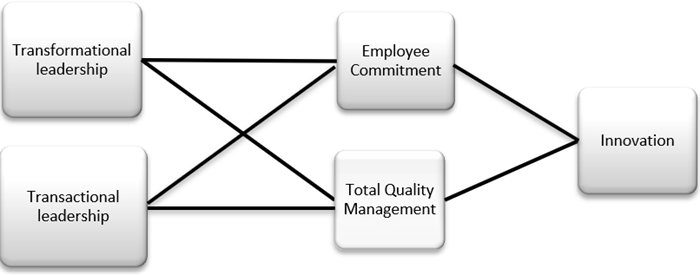
This study aims to identify the most effective pathway through which leadership contributes to innovation, recognising that leadership style, employee commitment, and TQM are interrelated dimensions that jointly enhance organisational performance. Figure 1 illustrates the conceptual research model and the hypothesized relationships among transformational leadership, transactional leadership, employee commitment, TQM, and innovation.
Figure 1Theoretical Framework
Research Methodology
Research Design
This study employs a quantitative, cross-sectional research design to examine the relationships among transformational leadership, transactional leadership, employee commitment, TQM implementation, and organisational innovation.
Sampling and Data Collection
The study employed a non-probability convenience sampling approach. The questionnaire was distributed electronically via official institutional channels, including the Chamber of Commerce of the Republic of North Macedonia and affiliated business networks. The respondents consisted of employees working in private sector organisations. Given their direct involvement in internal organisational processes, they can be considered competent to assess leadership practices, employee commitment, and quality management activities. Although the respondents may not have been formally trained in quality management systems, the study focuses on employees’ perceptions of organisational practices such as leadership behaviour, continuous improvement, and employee involvement, which can be reliably assessed from an employee’s perspective.
This approach is consistent with prior empirical research that frequently relies on employee perceptions and self-reported data to assess organisational practices (Hair et al., 2019).
Questionnaire
The questionnaire was divided into five sections. The first section included questions regarding the participants’ demographic profiles. A descriptive question regarding ISO 9001 certification was also included to provide contextual information about the organisations. It is important to note that ISO 9001 certification is not treated as equivalent to Total Quality Management (TQM) in this study. Rather, it is used solely as a background indicator of formal quality systems and was not included as a variable in the empirical model.
The second section focused on leadership styles and was adapted from Bass et al. (1996). Specifically, transformational and transactional leadership styles were examined. The third section addressed employee commitment within the organisation, while the fourth section focused on Total Quality Management (TQM). In this study, TQM was conceptualised as a multidimensional construct reflecting key principles such as quality orientation, continuous improvement, and employee involvement. To operationalise this construct, three items were selected to capture these core dimensions. Specifically, the items measure (1) the organisation’s commitment to quality, (2) the presence of continuous improvement practices, and (3) the extent to which employees are encouraged to contribute suggestions and initiatives. This approach provides a parsimonious yet theoretically grounded representation of TQM suitable for structural equation modelling.
The final section covered organisational innovation, focusing on the extent to which organisations are open to new ideas, support changes and improvements, and encourage employee involvement in innovation-related processes (Hurt et al., 1997; Prajogo & Sohal, 2003). To operationalise the construct in this study, three items were used: openness to new ideas, support for change and improvement, and employee involvement in the innovation process.
In addition to demographic questions, the questionnaire included five-point Likert-scale items to measure each variable. For each construct, three items were used to ensure reliable and robust measurement.
Table 1 provides an overview of the variables included in the PLS-SEM model, along with their descriptions based on the questionnaire items adapted from the original sources.
Table 1Variable Description
| Variable code | Variable Name | Description (employee perspective) | Adapted by |
| TLF | Transformational Leadership Style | Assessment of the extent to which leaders motivate employees, encourage innovative thinking, and communicate a clear organisational vision and goal | Bass et al. (1996) |
| TL | Transactional Leadership Style | Assessment of the extent to which leaders monitor performance, enforce work standards, and provide rewards based on the achievement of objectives | Bass et al. (1996) |
| ECM | Employee Commitment | Assessment of the extent to which employees feel committed to the organisation and its goals | Mowday et al. (1979) |
| TQM | Total Quality Management | Assessment of the extent to which the organisation demonstrates commitment to quality, applies continuous improvement practices, and encourages employee involvement in quality-related activities | Grandzol & Gershon (1998); Yusuf et al. (2007) |
| INNO | Innovation | Assessment of the extent to which the organisation supports new ideas, encourages innovation, and adapts to changes in the market and technology | Hurt et al. (1997); Prajogo & Sohal (2003) |
The study sample consisted of 100 respondents employed in the private sector in the Republic of North Macedonia. A multivariate approach was employed to examine the multidimensional relationships among the variables using PLS-SEM. PLS-SEM is a multivariate statistical technique used to analyse complex relationships between variables without requiring normally distributed data (Hair et al., 2019). As noted by Hair et al. (2019), this method is particularly suitable for small sample sizes and focuses on maximising the explained variance of the dependent variables.
The sample size is therefore adequate to ensure sufficient statistical power to detect the relationships examined in the model.
To assess the significance of the path coefficients, a bootstrapping procedure with 5,000 resamples and a 95% confidence interval was performed using SmartPLS 4.1.4. SPSS was employed to generate descriptive statistics.
Sample Characteristics
Table 2 presents the demographic and organisational characteristics of the study sample. The sample consisted of 100 employees, with 32% male and 68% female respondents. Most participants were in the 34-44-year-old (50%) or 25-34-year-old (30%) age group. Regarding work experience, 48% reported more than 6 years, while 18% reported less than 1 year. Regarding ISO 9001 certification, 46% indicated that their organisation is ISO 9001 certified, 21% reported no certification, and 33% were unsure.
Table 2Descriptive Statistics
| Variable | Category | Frequency (n) | Percentage (%) |
| Gender | Male | 32 | 32 |
| Female | 68 | 68 | |
| Age | 25-34 years | 30 | 30 |
| 35-44 years | 50 | 50 | |
| 45-54 years | 7 | 7 | |
| 55+ years | 3 | 3 | |
| Below 25 years | 10 | 10 | |
| Work Experience | 1-3 year | 19 | 19 |
| 4-6 years | 15 | 15 | |
| More than 6 years | 48 | 48 | |
| Less than 1 year | 18 | 18 | |
| Quality Certification | Yes (ISO 9001) | 46 | 46 |
| No | 21 | 21 | |
| Not sure | 33 | 33 |
PLS-SEM Model
Figure 2 presents a visualisation of the PLS-SEM model illustrating the hypothesised relationships among the study variables (see Table 1 for variable descriptions).
The arrows in the figure represent the structural paths, indicating the effects of leadership styles on ECM and TQM, the influence of ECM on TQM, and the effects of both ECM and TQM on INNO.
Figure 2PLS-SEM Visualisation
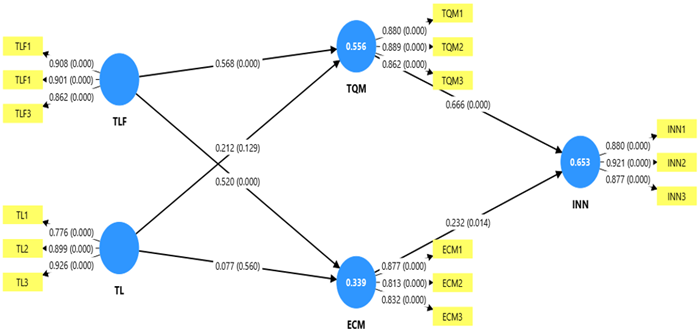
Note. TLF = Transformational Leadership; TL = Transactional Leadership; TQM = Total Quality Management; ECM = Employee Commitment; INN = Innovation.
Measurement Model Evaluation
To prevent common method bias (CMB), several measures were implemented during the design and distribution of the questionnaire. The questionnaire was anonymous, items for each variable were presented in separate sections, and a Likert scale was used to ensure consistency.
Table 3 presents the outer loadings and variance inflation factor (VIF) values for all measurement items. As shown, all items exhibit outer loadings above the recommended threshold of 0.70, indicating that the indicators reliably measure their respective constructs (Hair et al., 2019). Furthermore, all VIF values are below 3.3 (Kock, 2015), suggesting that common method bias is not a concern in this model.
Table 3Measurement Model Results: Outer Loadings and Variance Inflation Factors (VIF) (Items → Constructs)
| Constructs | Item | Outer loadings | VIF |
| Transformational Leadership (TLF) | TLF1 ← TLF | 0.901 | 2.679 |
| TLF2 ← TLF | 0.908 | 2.543 | |
| TLF3 ← TLF | 0.862 | 1.974 | |
| Transactional Leadership (TL) | TL1 ← TL | 0.776 | 1.593 |
| TL2 ← TL | 0.899 | 2.475 | |
| TL3 ← TL | 0.926 | 2.748 | |
| Total Quality Management (TQM) | TQM1 ← TQM | 0.857 | 2.396 |
| TQM2 ← TQM | 0.880 | 2.090 | |
| TQM3 ← TQM | 0.889 | 2.195 | |
| Employee Commitment (ECM | ECM1 ← ECM | 0.862 | 1.513 |
| ECM2 ← ECM | 0.877 | 1.905 | |
| ECM3 ← ECM | 0.813 | 2.036 | |
| Innovation (INNO) | INNO1 ← INNO | 0.832 | 2.303 |
| INNO2 ← INNO | 0.880 | 2.831 | |
| INNO3 ← INNO | 0.921 | 2.169 |
Table 4 presents the VIF values for all structural paths in the model. All values are below the critical threshold of 3, ranging from 1.335 to 2.610, indicating that multicollinearity is not a concern. This confirms that the relationships identified between constructs are reliable and not biased by overlapping information among predictor variables. The results complement the indicator reliability assessment shown in Table 3, supporting the robustness of the measurement model.
Table 4VIF Values for Structural Paths (Constructs → Constructs)
| VIF | |
| ECM → INN | 1.335 |
| TL → ECM | 2.610 |
| TL → TQM | 2.610 |
| TLF → ECM | 2.610 |
| TLF → TQM | 2.610 |
| TQM → INN | 1.335 |
Table 5 presents the reliability and validity of the constructs using Cronbach’s alpha, composite reliability, and average variance extracted (AVE). The values of Cronbach’s alpha, rho_a, and rho_c exceed the recommended threshold of 0.70 (Hair et al., 2020), indicating satisfactory internal consistency. In addition, all AVE values are above 0.50, confirming the convergent validity of the constructs.
Table 5Composite Reliability
| Cronbach’s alpha | Composite reliability (rho_a) | Composite reliability (rho_c) | Average variance extracted (AVE) | |
| TLF | 0.870 | 0.876 | 0.920 | 0.793 |
| TL | 0.838 | 0.873 | 0.902 | 0.756 |
| TQM | 0.850 | 0.851 | 0.909 | 0.769 |
| ECM | 0.803 | 0.877 | 0.878 | 0.707 |
| INN | 0.873 | 0.876 | 0.922 | 0.798 |
Note. TLF = Transformational Leadership; TL = Transactional Leadership; TQM = Total Quality Management; ECM = Employee Commitment; INN = Innovation.
This can be explained by the fact that TQM and innovation are theoretically related constructs, as TQM involves continuous process improvement, which is closely associated with organisational innovation. Henseler et al. (2015) note that for conceptually related constructs, higher HTMT values may be expected, and that concerns regarding discriminant validity arise primarily when HTMT values approach or exceed 1.
Table 6
Heterotrait-Monotrait (HTMT)
| Heterotrait-monotrait ratio (HTMT) | |
| INN ↔ ECM | 0.630 |
| TL ↔ ECM | 0.555 |
| TL ↔ INN | 0.824 |
| TLF ↔ ECM | 0.651 |
| TLF ↔ INN | 0.881 |
| TLF ↔ TL | 0.906 |
| TQM ↔ ECM | 0.560 |
| TQM ↔ INN | 0.906 |
| TQM ↔ TL | 0.766 |
| TQM ↔ TLF | 0.851 |
Another method to measure the discriminant validity of the model is the Fornell-Larcker criterion (Fornell & Larcker, 1981). The Fornell-Larcker rule is that the square root of the AVE for a construct should be greater than its correlations with other constructs. As shown in Table 6, all constructs meet the Fornell-Larcker criterion, which means that the discriminant validity is confirmed and the constructs are distinct from each other.
Table 7Fornell-Larcker Criterion
| ECM | INN | TL | TLF | TQM | |
| ECM | 0.841 | ||||
| INN | 0.566 | 0.893 | |||
| TL | 0.485 | 0.715 | 0.869 | ||
| TLF | 0.580 | 0.771 | 0.785 | 0.891 | |
| TQM | 0.501 | 0.783 | 0.658 | 0.734 | 0.877 |
Note. ECM = Employee Commitment; INN = Innovation; TL = Transactional Leadership; TLF = Transformational Leadership; TQM = Total Quality Management.
Table 7 shows the model fit values. In PLS-SEM, many authors consider the SRMR and NFI values important for assessing model fit (Hair et al., 2019; Sivo et al., 2006; West et al., 2012). The SRMR value in this case is 0.094, which is acceptable according to the rule of thumb (< 0.010), while the NFI exceeds the threshold of 0.70, suggesting an acceptable and suitable model.
Table 8Model Fit
| Saturated model | Estimated model | |
| SRMR | 0.082 | 0.094 |
| d_ULS | 0.813 | 1.062 |
| d_G | 0.406 | 0.445 |
| Chi-square | 243.738 | 254.703 |
| NFI | 0.786 | 0.777 |
Note. SRMR = Standardized Root Mean Square Residual; d_ULS = Unweighted Least Squares Discrepancy; d_G = Geodesic Discrepancy; Chi-square = Chi-square statistic; NFI = Normed Fit Index.
Empirical Results
Table 8 presents the coefficients of determination (R²) for each endogenous construct of the structural model. The R² value for employee commitment is 0.34, indicating that 34% of the variance in ECM is explained by leadership styles. The R² value for innovation is 0.65, suggesting that 65% of the variance in INN is explained by leadership styles, TQM, and ECM. Furthermore, the R² value for TQM is 0.56, meaning that transformational and transactional leadership styles explain 56% of its variance.
Table 9R Square
| Endogenous construct | R-square | R-square adjusted |
| ECM | 0.339 | 0.325 |
| INN | 0.653 | 0.646 |
| TQM | 0.556 | 0.547 |
Table 10 presents the structural relationships among the variables. The structural coefficients (β) indicate the magnitude of the effects, while the p-values indicate their statistical significance. As shown in Table 10, transformational leadership positively affects TQM, with a coefficient of β = 0.57 and a statistically significant p-value (p < 0.001). In contrast, transactional leadership has no statistically significant effect on TQM. Thus, Hypothesis 1 is supported, whereas Hypothesis 2 is rejected.
Transformational leadership also has a strong and statistically significant influence on employee commitment (ECM), with β = 0.520 (p < 0.001), whereas transactional leadership does not exhibit a statistically significant effect on ECM. Hence, Hypothesis 3 is supported, and Hypothesis 4 is rejected.
Furthermore, both TQM and ECM positively affect innovation. Specifically, TQM has a strong positive impact on innovation (β = 0.666, p < 0.001), while ECM also exerts a positive and statistically significant effect (β = 0.232, p = 0.014). Therefore, Hypotheses 5 and 6 are supported.
The mediation results indicate that both TQM and ECM mediate the relationship between leadership styles and innovation. Specifically, transformational leadership has a positive and statistically significant indirect effect on innovation through employee commitment (β = 0.121, t = 1.966, p = 0.049). Therefore, Hypothesis 7 is supported. In contrast, transactional leadership does not have a statistically significant indirect effect on innovation through employee commitment (β = 0.018, t = 0.021, p = 0.591); therefore, this mediation effect is not supported.
Moreover, transformational leadership shows a statistically significant indirect effect on innovation through TQM (β = 0.378, t = 3.740, p < 0.001), supporting the mediating role of TQM. However, the indirect effect of transactional leadership on innovation through TQM is not statistically significant (β = 0.141, t = 1.466, p = 0.143); thus, Hypothesis 10 is rejected.
Table 10Structural Relationships
| Hypothesis | Path | β | t-value | p-value | Result |
| H1 | TLF → TQM | 0.568 | 4.295 | 0.000 | supported |
| H2 | TL → TQM | 0.212 | 1.519 | 0.129 | rejected |
| H3 | TLF → ECM | 0.520 | 4.024 | 0.000 | supported |
| H4 | TL → ECM | 0.077 | 0.582 | 0.560 | rejected |
| H5 | TQM → INN | 0.666 | 8.589 | 0.000 | supported |
| H6 | ECM → INN | 0.232 | 2.467 | 0.014 | supported |
| H7 | TLF → ECM → INN | 0.121 | 1.966 | 0.049 | supported |
| H8 | TL → ECM → INN | 0.018 | 0.021 | 0.591 | rejected |
| H9 | TLF → TQM → INN | 0.378 | 3.740 | 0.000 | supported |
| H10 | TL → TQM → INN | 0.141 | 1.466 | 0.143 | rejected |
Note. TLF = Transformational Leadership; TL = Transactional Leadership; ECM = Employee Commitment; TQM = Total Quality Management; INNO = Innovation.
Discussion
The results obtained using the PLS-SEM method answer the research questions and confirm several theoretical expectations. Transformational leadership (TLF) has a positive and statistically significant impact on employee commitment (ECM), whereas transactional leadership does not show a significant effect. These findings are consistent with previous studies (Abasilim et al., 2019; Clinebell et al., 2013).
Similarly, transformational leadership has a positive, statistically significant effect on TQM implementation, whereas transactional leadership does not. These results are in line with prior research (Bouranta, 2021; Kumar & Sharma, 2018; Teoman & Ulengin, 2018).
Regarding the impact of TQM and employee commitment on innovation, both variables exhibit positive, statistically significant effects, supporting earlier findings (Hakimian et al., 2016; Nguyen et al., 2019; Prajogo & Sohal, 2003; Xerri & Brunetto, 2013).
To address the key question raised in the literature regarding whether leadership influences innovation primarily through TQM or through employee commitment, the results indicate that TQM exerts a stronger effect. This is evident both in its mediating role between transformational leadership and innovation and in its direct contribution to innovation (see Table 5).
Overall, these findings provide not only empirical contributions but also practical implications for organisations seeking to adapt to a rapidly changing business environment and achieve long-term sustainability. The PLS-SEM results suggest that fostering innovation requires a combination of effective leadership and well-structured internal processes that support continuous improvement.
Limitations
This study has several limitations. First, the sample includes respondents from only one country, the Republic of North Macedonia, which may limit the generalisability of the findings. Future research could expand the sample to include other countries in the Western Balkans or beyond to provide a broader understanding of the relationships examined.
Second, the use of convenience sampling may weaken the external validity of the results, as the sample may not fully represent the broader population. Future studies should consider using probabilistic sampling techniques to improve generalisability.
Third, the relatively small sample size, although appropriate for PLS-SEM analysis, may limit the robustness of the findings. Future research with larger samples could provide more stable estimates.
Additionally, this study focuses on selected dimensions of TQM rather than capturing the full scope of Total Quality Management, which may influence innovation in different ways.
Finally, the study relies on self-reported data, which may be subject to respondent bias. Future research could incorporate multiple data sources to enhance the validity of the findings.
Conclusion
This study examined the impact of transformational and transactional leadership styles on the implementation of Total Quality Management (TQM) practices and employee commitment. It also investigated the impact of employee commitment on TQM, as well as the effects of TQM and employee commitment (ECM) on innovation in private enterprises in the Republic of North Macedonia. The empirical analysis confirmed the suitability of the proposed model, and the results were subsequently presented and interpreted.
The main findings indicate that transformational leadership is essential for fostering Total Quality Management and employee commitment within organisations. Moreover, a positive relationship was identified among employee commitment, TQM, and innovation.
The results of the PLS-SEM model further reveal that the mediating effect of leadership on innovation through TQM is stronger than the pathway mediated by employee commitment. This finding highlights TQM practices as the primary mechanism through which leadership enhances organisational innovation.
Future Research Directions
Future studies could expand the sample to include other Balkan countries in order to enhance the generalisability of the findings. Another promising avenue for research would be to compare the impact of Total Quality Management and employee commitment on innovation across the manufacturing and service sectors, with the aim of identifying which factors exert the strongest influence in each context.
This topic could also be explored within the public sector to determine whether similar patterns emerge. Furthermore, future research could examine the impact of artificial intelligence (AI) on TQM practices and innovation, particularly in developing countries such as North Macedonia, where the adoption of digital technologies may lag behind that in more developed economies.

References
- Abasilim, U. D., Gberevbie, D. E., & Osibanjo, O. A. (2019). Leadership styles and employees’ commitment: Empirical evidence from Nigeria. SAGE Open, 9(3). https://doi.org/10.1177/2158244019866287
- Ahinful, A. A., Opoku Mensah, A., Koomson, S., Nyarko, F. K., & Nkrumah, E. (2024). A conceptual framework of total quality management on innovation performance in the banking sector. The TQM Journal, 36(4), 1193–1211. https://doi.org/10.1108/TQM-11-2022-0334
- Al-Amin, M. (2017). Transformational leadership and employee performance mediating effect of employee engagement. North South Business Review, 7(2), 28–40.
- Al-Qahtani, N. D., Alshehri, S. S. A., & Aziz, A. A. (2015). The impact of Total Quality Management on organizational performance. European Journal of Business and Management, 7(36), 119–127.
- Anil, A. P., & Satish, K. P. (2016). Investigating the relationship between TQM practices and firm's performance: A conceptual framework for Indian organizations. Procedia Technology, 24, 554–561. https://doi.org/10.1016/j.protcy.2016.05.103
- Antunes, M. G., Mucharreira, P. R., Justino, M. R. T., & Texeira-Quirós, J. (2021). Effects of Total Quality Management (TQM) dimensions on innovation—Evidence from SMEs. Sustainability, 13(18), 10095. https://doi.org/10.3390/su131810095
- Argia, H. A., & Ismail, A. (2013). The influence of transformational leadership on the level of TQM implementation in the higher education sector. Higher Education Studies, 3(1), 136–146. https://doi.org/10.5539/hes.v3n1p136
- Azim, M. T., Fan, L., Uddin, M. A., Jilani, M. M. A. K., & Begum, S. (2019). Linking transformational leadership with employees’ engagement in the creative process. Management Research Review, 42(7), 837–858. https://doi.org/10.1108/MRR-08-2018-0286
- Baftijari, A. Y., Ismaili, R., & Aziri, B. (2020). Client expectations and preferences for service quality dimensions in bank services in Republic of North Macedonia. Economic Vision-International Scientific Journal in Economics, Finance, Business, Marketing, Management and Tourism, 7(13–14), 13–21.
- Bass, B. M., & Avolio, B. J. (1990). Developing transformational leadership: 1992 and beyond. Journal of European Industrial Training, 14(5). https://doi.org/10.1108/03090599010135122
- Bass, B. M., Avolio, B. J., & Atwater, L. (1996). The transformational and transactional leadership of men and women. Applied Psychology, 45(1), 5–34. https://doi.org/10.1111/j.1464-0597.1996.tb00847.x
- Bouranta, N. (2021). Does transformational leadership influence TQM practices? A comparison analysis between manufacturing and service firms. The TQM Journal, 33(3), 706-728. https://doi.org/10.1108/TQM-12-2019-0296
- Chin, T. L., Yap Peng Lok, S., & Kee Peng Kong, P. (2019). Does transformational leadership influence employee engagement? Global Business & Management Research, 11(2), 92-97.
- Clinebell, S., Skudiene, V., Trijonyte, R., & Reardon, J. (2013). Impact of leadership styles on employee organizational commitment. Journal of Service Science (Online), 6(1), 139.
- Crosby, P. B. (1979). Quality is free: The art of making quality certain. McGraw-Hill.
- Das, A., Kumar, V., & Kumar, U. (2011). The role of leadership competencies for implementing TQM: An empirical study in Thai manufacturing industry. International Journal of Quality & Reliability Management, 28(2), 195–219. https://doi.org/10.1108/02656711111101755
- Deming, W. E. (1986). Out of the crisis. MIT Press. https://doi.org/10.7551/mitpress/11457.001.0001
- Demirbag, M., Tatoglu, E., Tekinkus, M., & Zaim, S. (2006). An analysis of the relationship between TQM implementation and organizational performance: Evidence from Turkish SMEs. Journal of Manufacturing Technology Management, 17(6), 829–847. https://doi.org/10.1108/17410380610678828
- Emini, E., & Dearı Zeqiri, H. (2025). Empirical analysis of balanced scorecard perspectives: Pathways to financial performance. Management & Prospective, 42. https://doi.org/10.3917/g12000.421.0152
- Emini, E., Ibraimi, S., & Rexhepi, G. (2023). The role of democratic leadership style and organisational learning in innovations and financial performance of enterprises. International Journal of Environment, Workplace and Employment, 7(3), 260–273. https://doi.org/10.1504/IJEWE.2023.135481
- Fonseca, L. (2022). The EFQM 2020 model. A theoretical and critical review. Total Quality Management & Business Excellence, 33(9-10), 1011-1038. https://doi.org/10.1080/14783363.2021.1915121
- Fornell, C., & Larcker, D. F. (1981). Evaluating structural equation models with unobservable variables and measurement error. Journal of Marketing Research, 18(1), 39-50. https://doi.org/10.2307/3151312
- Fotopoulos, C. V., & Psomas, E. L. (2010). The structural relationships between TQM factors and organizational performance. The TQM Journal, 22(5), 539–552. https://doi.org/10.1108/17542731011072874
- Grandzol, J. R., & Gershon, M. (1998). A survey instrument for standardizing TQM modeling research. International Journal of Quality Science, 3(1), 80–105. https://doi.org/10.1108/13598539810203887
- Hair Jr, J. F., Howard, M. C., & Nitzl, C. (2020). Assessing measurement model quality in PLS-SEM using confirmatory composite analysis. Journal of Business Research, 109, 101–110.
- Hair, J. F., Risher, J. J., Sarstedt, M., & Ringle, C. M. (2019). When to use and how to report the results of PLS-SEM. European Business Review, 31(1), 2–24. https://doi.org/10.1108/EBR-11-2018-0203
- Hakimian, F., Farid, H., Ismail, M. N., & Nair, P. K. (2016). Importance of commitment in encouraging employees’ innovative behaviour. Asia-Pacific Journal of Business Administration, 8(1), 70–83. https://doi.org/10.1108/APJBA-06-2015-0054
- Henseler, J., Ringle, C. M., & Sarstedt, M. (2015). A new criterion for assessing discriminant validity in variance-based structural equation modeling. Journal of the Academy of Marketing Science, 43(1), 115–135. https://doi.org/10.1007/s11747-014-0403-8
- Hoang, D., Igel, B., & Laosirihongthong, T. (2006). The impact of total quality management on innovation: Findings from a developing country. International Journal of Quality & Reliability Management, 23(9), 1092–1117. http://dx.doi.org/10.1108/02656710610704230
- Hurt, H. T., Joseph, K., & Cook, C. D. (1977). Scales for the measurement of innovativeness. Human Communication Research, 4(1), 58–65. https://doi.org/10.1111/j.1468-2958.1977.tb00597.x
- Jiatong, W., Wang, Z., Alam, M., Murad, M., Gul, F., & Gill, S. A. (2022). The impact of transformational leadership on affective organizational commitment and job performance: The mediating role of employee engagement. Frontiers in Psychology, 13, 831060. https://doi.org/10.3389/fpsyg.2022.831060
- Juran, J. M. (1988). Juran on planning for quality. Collier Macmillan.
- Khalfallah, M., Zorgati, H., Ben Salem, A., & Lakhal, L. (2025). The impact of TQM on organizational performance: The mediating role of entrepreneurial orientation. The TQM Journal. https://doi.org/10.1108/TQM-03-2024-0127
- Khassawneh, O., Mohammad, T., & Ben-Abdallah, R. (2022). The impact of leadership on boosting employee creativity: The role of knowledge sharing as a mediator. Administrative Sciences, 12(4), 175. https://doi.org/10.3390/admsci12040175
- Kock, N. (2015). Common method bias in PLS-SEM: A full collinearity assessment approach. International Journal of e-Collaboration (IJeC), 11(4), 1-10. https://doi.org/10.4018/ijec.2015100101
- Kotter, J. P., & Heskett, J. L. (1992). Corporate culture and performance. The Free Press.
- Kumar, V., & Sharma, R. R. K. (2018). Leadership styles and their relationship with TQM focus for Indian firms: An empirical investigation. International Journal of Productivity and Performance Management, 67(6), 1063–1088. https://doi.org/10.1108/IJPPM-03-2017-0071
- Mahfouz, S. A. (2019). The impact of transactional leadership on employee commitment. International Journal of Innovation, Creativity and Change, 8(8), 1–13.
- Milhem, M., Muda, H., & Ahmed, K. (2019). The impact of transformational leadership style on employee engagement: Using structural equation modeling (SEM). International Journal of Modern Trends in Social Sciences, 2(8), 162–173.
- Mowday, R. T., Steers, R. M., & Porter, L. W. (1979). The measurement of organizational commitment. Journal of Vocational Behavior, 14(2), 224–247. https://doi.org/10.1016/0001-8791(79)90072-1
- Ngambi, M. T., & Nkemkiafu, A. G. (2015). The impact of Total Quality Management on firm's organizational performance. American Journal of Management, 15(4), 69–85.
- Nguyen, V. T., Siengthai, S., Swierczek, F., & Bamel, U. K. (2019). The effects of organizational culture and commitment on employee innovation: Evidence from Vietnam’s IT industry. Journal of Asia Business Studies, 13(4), 719–742.
- Prajogo, D. I., & Sohal, A. S. (2001). TQM and innovation: a literature review and research framework. Technovation, 21(9), 539-558. https://doi.org/10.1016/S0166-4972(00)00070-5
- Prajogo, D. I., & Sohal, A. S. (2003). The relationship between TQM practices, quality performance, and innovation performance: An empirical examination. International Journal of Quality & Reliability Management, 20(8), 901–918. https://doi.org/10.1108/02656710310493625
- Qasrawi, B. T., Almahamid, S. M., & Qasrawi, S. T. (2017). The impact of TQM practices and KM processes on organisational performance. International Journal of Quality & Reliability Management, 34(7), 1034–1055. https://doi.org/10.1108/IJQRM-11-2015-0160
- Sedighi, M., Sarcheshmeh, B. S., & Bagheri, R. (2022). Employee commitment to innovation performance: Investigating the role of knowledge acquisition and knowledge sharing. International Journal of Systematic Innovation, 7(1), 1–17.
- Sivo, S. A., Fan, X., Witta, E. L., & Willse, J. T. (2006). The search for "optimal" cutoff properties: Fit index criteria in structural equation modeling. The Journal of Experimental Education, 74(3), 267–288. https://doi.org/10.3200/JEXE.74.3.267-288
- Teoman, S., & Ulengin, F. (2018). The impact of management leadership on quality performance throughout a supply chain: An empirical study. Total Quality Management & Business Excellence, 29(11–12), 1427–1451. https://doi.org/10.1080/14783363.2016.1266244
- Twaissi, N. M., Al Zoubi, M. O., Masa’deh, R. E., Zoubi, J. Z. A., & Alhelalat, J. A. (2025). The mediating role of TQM interventions and benchmarking in the impact of organizational culture on organizational performance. Journal of Industrial Engineering and Management, 18(1), 10–32. https://doi.org/10.3926/jiem.7899
- Valmohammadi, C. (2011). The impact of TQM implementation on the organizational performance of Iranian manufacturing SMEs. The TQM Journal, 23(5), 496–509. https://doi.org/10.1108/17542731111157608
- West, S. G., Taylor, A. B., & Wu, W. (2012). Model fit and model selection in structural equation modeling. In R. H. Hoyle (Ed.), Handbook of structural equation modeling (pp. 209–231). The Guilford Press.
- Xerri, M. J., & Brunetto, Y. (2013). Fostering innovative behaviour: The importance of employee commitment and organisational citizenship behaviour. The International Journal of Human Resource Management, 24(16), 3163–3177. https://doi.org/10.1080/09585192.2013.775033
- Yukl, G. (2002). Leadership in organizations (5th ed.). Prentice Hall.
- Yusuf, Y., Gunasekaran, A., & Dan, G. (2007). Implementation of TQM in China and organisation performance: An empirical investigation. Total Quality Management, 18(5), 509–530. https://doi.org/10.1080/14783360701239982
 https://orcid.org/0000-0002-0281-2040