

About the article
DOI: https://www.doi.org/10.15219/em112.1734
The article is in the printed version on pages 57-66.
 Download the article in PDF version
How to cite
Brzozowska, A., Matysová, K., & Volfová, J. (2025). The hybrid model of business education – preferences, challenges, and recommendations. e-mentor, 5(112), 57-66. https://www.doi.org/10.15219/em112.1734
E-mentor number 5 (112) / 2025
Table of contents
- Introduction
- Hybrid Teaching Model
- Methodology
- Analysis of Empirical Material
- Conclusions
- Recommendations for Universities and Lecturers in the Context of a Hybrid Education Model
- Limitations
- Funding
- References
About the author
The Hybrid Model of Business Education – Preferences, Challenges, and Recommendations
Agnieszka Brzozowska, Kamila Matysová, Jitka Volfová
Abstract
Hybrid education has become a lasting feature of higher education following the COVID-19 pandemic, particularly in business programs that combine theoretical instruction with practical and collaborative learning. This study examines how business students experience hybrid education in the post-pandemic context, focusing on perceived benefits, challenges, and conditions supporting effective engagement. The analysis is based on qualitative, semi-structured interviews with undergraduate business students conducted at leading universities in the Visegrad countries. Adopting a student-centred perspective, the study explores recurring patterns in students’ accounts of learning flexibility, autonomy, interaction, and instructional design. The findings indicate that students generally prefer hybrid arrangements that combine online lectures with in-person practical classes, valuing flexibility, improved time management, and access to digital materials. At the same time, challenges related to concentration, limited social interaction, and insufficient adaptation of teaching and assessment practices were identified. The study concludes that the effectiveness of hybrid education depends on intentional pedagogical design, institutional context, and alignment between structural flexibility, student control, and engagement.
Keywords: hybrid learning, business education, student engagement, learning flexibility, digital transformation
Introduction
The rapid transformation of educational systems triggered by the COVID-19 pandemic posed one of the most significant challenges for contemporary higher education, particularly in business education. According to UNESCO (2020), school closures affected more than 1.5 billion students worldwide, forcing educational institutions to adopt elements of remote learning, often without adequate infrastructural or pedagogical preparation. Although the pandemic demonstrated the potential of digital technologies and online tools to support teaching, it also exposed persistent challenges. Business education increasingly emphasises the integration of theoretical knowledge with experiential learning, practical problem-solving, and reflective competencies aimed at preparing students for complex economic and organisational environments (Sliż et al., 2024). As business programs rely heavily on direct interaction, teamwork, and international mobility (D’Abate, 2010), the abrupt shift to hybrid and remote models tested both curriculum effectiveness and institutional resilience.
The hybrid model of education (blended learning), defined as the intentional combination of in-person and remote learning supported by digital technologies (Garrison & Vaughan, 2008), evolved during the pandemic toward more flexible approaches, such as rotational models (Horn & Staker, 2014) and flex models (Graham et al., 2019).
In business education, where soft skills (e.g., negotiation, leadership) are as essential as analytical abilities, hybridisation has been met with mixed reactions. On the one hand, it enabled broader access to theoretical content (Means et al., 2010); on the other hand, it limited opportunities to develop practical competencies through direct interaction (Moskal et al., 2013).
At the same time, the pandemic significantly impacted student educational mobility. Programs such as Erasmus+, traditionally seen as a cornerstone for developing international competencies (Teichler, 2017), were replaced with virtual exchanges. While these exchanges foster collaboration skills in digital environments, they do not fully replicate the benefits of physical presence abroad (Lewis & O’Dowd, 2016).
Although the literature widely describes the technological aspects of hybridisation, there is still limited research on the long-term impact of the pandemic on student motivation and the effectiveness of virtual internationalisation (Pandya et al., 2025). Prior studies have examined student motivation and engagement in remote and hybrid learning, particularly during the pandemic. This body of research remains largely descriptive and focuses on general outcomes rather than students’ lived experiences of engagement (Krzyżak & Walas-Trębacz). Moreover, the literature acknowledges pedagogical challenges and resistance to change in the transition to hybrid learning environments (Clifft & Assiouras, 2023), there is still a lack of empirical evidence on how students perceive their own engagement and which factors, such as social interaction, teaching practices, and learning design, enhance or hinder this experience. Importantly, existing research rarely links students’ experienced engagement with concrete pedagogical strategies that could effectively address these challenges and support a more sustainable adoption of hybrid learning models. Addressing these gaps may provide a valuable basis for strategic recommendations for higher education institutions.
Conducting the study in the immediate post-pandemic period, shortly after the most restrictive lockdowns, provided a unique opportunity to capture feedback from students who, under different circumstances, might not have engaged in online or hybrid learning formats, thereby allowing for the inclusion of diverse perspectives that are often underrepresented in traditional educational settings.
The aim of this article is to analyse business students' preferences for educational models in the post-pandemic era and to identify the challenges and opportunities associated with the hybrid model. The main research question is: What challenges, opportunities, and benefits arise in a hybrid education environment based on students’ experience at leading universities in the Visegrad countries? The findings have practical implications for the design of curricula that integrate the flexibility of remote education with the essential practical component.
Hybrid Teaching Model
Internet and multimedia tools have become popular long before COVID-19 (Artal-Sevil & Romero, 2018). Over the last few decades, we have seen a push to develop the online environment for both business and academic purposes. The development of software supporting the online ‘on-distance’ connection of people has advanced significantly, and both research on the perception of telework in business (Matysová & Volfová, 2023; Volfová et al., 2023) and on online tools used within the academic environment are available to us. Academics face the challenge to fit the changing needs of students. Studies arising from the COVID-19 situation report both advantages and disadvantages, as well as positive and negative perceptions of the usability of online distance tools, impacts, consequences, etc. (Henze et al., 2022; Hitch & Zaman, 2022; Ndovela et al., 2022). Account is taken of various learning styles, perceived engagement and satisfaction (Ho et al., 2021; Shohel et al., 2020). As a result, the combination of online and in-person learning models may be the solution (Almahasees et al., 2021). Although hybrid education is often discussed as a single category, the literature clearly indicates that it encompasses several distinct instructional models rather than one homogeneous approach (Raes et al., 2020). These models differ in terms of the balance between online and in-person activities, the level of student autonomy, and the role of physical presence in the learning process. For the purposes of this study, hybrid education is treated as the focal construct, understood as an umbrella concept that intentionally combines in-person instruction with online or distance-learning components. The terms ‘online learning’ and ‘distance learning’ are used only to refer to specific modes within hybrid education rather than as independent constructs.
Based on recent research and educational approaches, hybrid learning in business education emerges as a versatile, scalable, and efficient method for building competencies. It supports personalised learning paths while also fostering the attainment of practical objectives and alignment with labour market demands (Tila, 2020). Hybrid teaching offers students the flexibility to choose between attending classes in person or online, presenting both opportunities and challenges related to accessibility, interpersonal connectedness, and digital proficiency (Mayer et al., 2024). This approach enables the inclusion of learners who may face geographical, personal, or other constraints that prevent participation in traditional on-site classes (Menzies & Tickle, 2024). This approach combines both online and face-to-face activities, unlike traditional university teaching, which relies solely on in-person sessions. In such environments, student-instructor interaction and teacher empathy, characterised by understanding, care, and authentic communication, are essential to fostering a sense of community and creating an inclusive learning space. Hybrid teaching integrates digital tools to create a more interactive learning experience and has been shown to enhance student engagement and satisfaction, particularly when learners have greater autonomy (Teoh et al., 2025).
Hybrid learning, referred to as blended learning, combines elements of in-person and remote education, using digital technologies to optimise learning outcomes. According to Garrison and Vaughan (2008), a key feature of this model is the integration of synergy between online and offline interactions, a point confirmed by recent studies in business education.
In business education, particular attention is given to the practical context. Research by Moskal et al. (2013) indicates that hybrid models are more effective for analytical subjects (e.g., finance), whereas courses requiring soft skills (e.g., negotiation, leadership) are better suited for in-person formats. This is echoed in student interview transcripts, where remote teamwork exercises were often criticised as ‘unnatural’ and lacking the dynamics of direct interaction.
The pandemic acted as a catalyst for the digital transformation of universities, forcing the widespread adoption of hybrid solutions. Research shows that during the pandemic, students complained about the decline in teaching quality in remote environments and requested that programs be redesigned to account for hybridisation (Hodges et al., 2020). At the same time, the pandemic highlighted the advantages of flexibility - 67% of students in a QS (2022) study expressed a preference for blended learning models. The future of business education will increasingly depend on the strategic use of artificial intelligence technologies, learning management systems, and innovative teaching methods, such as the flipped classroom model (Senali et al., 2022). Research shows that flexible learning environments combining physical and digital spaces are increasingly seen as essential for future universities, requiring holistic design to meet diverse needs (Miller et al., 2021). Student engagement varies notably between on-site and remote participants, with factors such as interactive teaching, social connection, and well-designed learning spaces playing a key role (Raes, 2022). Crucially, evidence from post-pandemic qualitative research in Visegrad business schools indicates that student engagement in remote and hybrid learning is relational and interdependent, as declining student involvement was found to reduce lecturers’ engagement, which in turn further undermined student motivation, creating self-reinforcing negative cycles (Brzozowska et al., 2025). Hybrid learning models relying on direct substitution of face-to-face teaching with digital platforms (e.g., MS Teams) may fail to generate meaningful student engagement, as they represent a critical gap between pedagogical intention and technological implementation (Baker & Spencely, 2023). Effective hybrid education therefore requires purposeful instructional redesign rather than like-for-like technological replacement. What is more, the extent to which such engagement-enhancing practices can be implemented is strongly shaped by national regulatory frameworks governing higher education. Taken together, these findings suggest that student engagement should be understood as a dynamic and context-dependent process, which underscores the importance of in-depth research into how students experience their engagement and which factors shape it within hybrid learning environments.
Methodology
To gain a deeper understanding of the studied phenomenon, a qualitative primary research approach was employed between October 2022 and June 2023. Data collection was carried out through semi-structured interviews conducted by experienced researchers. The participants were undergraduate business students aged 18-22. The study focused on students from the four Visegrad countries: Poland, the Czech Republic, Slovakia, and Hungary.
These nations, forming the Visegrad Group (V4), are informally allied through a regional partnership based on geographical proximity, similar geopolitical conditions, and a shared historical and cultural background. Interviews were conducted in the respective national languages: Polish, Czech, Slovak, and Hungarian. The Visegrad context is not treated in this study as a representative or comparative case of global business education. Rather, it is approached as a shared institutional and regulatory setting in which hybrid education emerged amid rapid, pandemic-driven transformation. This regional configuration allows for an in-depth qualitative examination of how students experience hybrid learning in higher education systems characterised by centralised governance structures, limited pre-pandemic exposure to blended models, and accelerated digital adaptation in post-communist countries.
Across all analysed universities, the introduction of hybrid and remote teaching followed a similar pattern. Teaching procedures were implemented abruptly in response to the pandemic, and neither institutions nor academic staff were fully prepared for this transition. The shift occurred rapidly and without a comprehensive pedagogical plan. However, over time, universities gradually developed internal guidelines, training courses for academic staff, and basic standards for online and hybrid teaching. As a result, no substantial cross-institutional differences were observed in the overall deployment of hybrid education. Across the four universities, deployment followed a broadly similar trajectory: abrupt emergency adoption, followed by gradual institutionalisation through guidelines, staff training, and standardised procedures. Therefore, students’ perceptions are interpreted primarily as responses to course-level design quality and interaction patterns, rather than to strongly divergent university strategies.
A total of 40 interviews were carried out – 10 per country. Each conversation, lasting approximately one hour, was recorded and later transcribed. The discussions centred around students’ mental health during the pandemic and periods of online learning. Special attention was paid to factors that either supported or hindered their learning processes, as well as to lecturer behaviours that students found beneficial for their mental well-being.
The collected material was analysed using an inductive coding strategy, where codes are derived directly from empirical data before being conceptualised in the analytical phase (Bryda, 2014).
Analysis of Empirical Material
Recent post-pandemic evidence nuances the relationship between students’ experiences and learning outcomes in hybrid education. Ochs et al. (2024) demonstrate that students attending hybrid classes online are more prone to off-task digital activities than their on-site peers, which negatively affects learning performance, a pattern that resonates with students’ accounts in the present study, particularly regarding difficulties with concentration and sustained engagement in the online component of hybrid education. Complementing these findings, Ragni et al. (2024) show that the effects of hybrid teaching on academic performance are modest and context-dependent: hybrid formats may support study progress, such as the accumulation of earned credits, without necessarily translating into higher grades.
This observation aligns closely with student experiences documented in this study. One respondent described how hybrid education enabled her to pursue additional coursework that would otherwise have been impossible due to time constraints: “For example, during my bachelor's studies, I managed to take some master's courses, and I think I wouldn't have enrolled in them otherwise. I would have been more worried about the time if they had been in person, and I probably wouldn't have dared to take them. But this way, I thought, it's online, I can watch the lectures, I have nothing to lose. And to this day, it has helped me in terms of time” [R1].
This testimony reveals an important distinction: the value of hybrid education lies not necessarily in improving academic grades but in expanding access and enabling participation that would otherwise be unavailable.
Adding further nuance, Zunino et al. (2024) highlight a fundamental tension between digital distance and physical presence in hybrid teaching, showing that while physical attendance may hinder individual learning outcomes, it can simultaneously enhance team-based learning. Taken together, this body of research suggests that hybrid education does not automatically improve learning outcomes; rather, its effectiveness depends on how online and in-person components are strategically combined, how student engagement is managed, and how course design balances individual learning with collaborative interaction in the post-COVID context. The following discussion builds on these insights to interpret students’ experiences of hybrid education in light of learning-relevant conditions and post-pandemic institutional practices. These interpretations provide the basis for the conclusions, which synthesise the implications of student perceptions for the design and effectiveness of hybrid education.
The study reveals several noteworthy themes. Firstly, the respondents discussed how education has evolved and what aspects they now consider important. This insight opens the door to exploring various solutions that could be particularly appealing and effective for business students. For most students, the opportunity to learn remotely represented a breakthrough in education. Previously, such options were rare and typically limited to individual courses. Suddenly, it became evident that remote learning could be integrated into mainstream, regular education: “I am definitely a supporter of the distance learning system. I think it was a really cool experience. And later I also noticed that this is probably a breakthrough moment, we can experience such a breakthrough moment, thanks to which the approach to learning will simply change” [R2].
According to the respondents, one of the significant advantages of the hybrid learning method is flexibility and the ability to use one’s time most effectively.
This quote illustrates a key advantage of hybrid models: the ability to combine education with work. The student emphasises the practical benefits of saving time on commuting and greater flexibility in managing responsibilities: “University is more of a hybrid. I think that for some lectures, classes that are more about listening, the remote form is okay. I could work more remotely, even full-time, because it was convenient for me, that I didn't have to commute, that these lectures are more like listening than being active” [R1].
Students observed that the pandemic and the shift to remote learning pushed lecturers to move beyond traditional teaching schemes and adopt more engaging methods. Interestingly, although remote learning is often associated with challenges in group work, one respondent viewed it as an opportunity to discover how important collaboration is to her and to recognise her ability to work effectively in a team. This highlights that online learning is not only a way to acquire knowledge but also a space for self-discovery, helping students better understand their competencies, needs, and potential areas for growth.
I think that many teachers could even partially force it, a different perspective on the classes they run and the need to change the form. Maybe greater integration of students into what is happening. Because many classes that were previously quite... or maybe not much, maybe that's the wrong word. But there were classes that were previously more talkative, and during the pandemic they became more interactive. And I really liked it. And there was definitely more group work, it probably depends on whether someone likes this type of work or not, but there was definitely more of it, which I think also affects the development of certain competences, or even the possibility of determining whether such group work is for me or whether I prefer individual work. [R2]
The next interviewee mentioned that a hybrid or remote model may be beneficial for students who prefer independence, autonomy, and flexibility in organising their learning. At the same time, the quote indicates a potential limitation in support from teachers, who engage mainly when a clear problem occurs rather than on a continuous basis: “Everyone prepared individually. It was more useful than sitting in classes, because I prepared by myself, studied more, and didn’t waste time sitting in class. I could contact the teachers with a problem” [R8].
“But still, the structure of the course remained the same. Let's say, as I mentioned, that there really has to be exactly this test, and it will be taken online, but there will also be this component of supervision and sharing and everything. I think that, for example, they could have approached it more openly, like: even if the syllabus says something else, the final assessment of the course could look different, so that it would be more adapted to the technologies” [R16]. The quote shows that although teaching delivery was changed, the intention behind assessment remained the same as in the traditional on-campus mode. While instructional methods were modernised, assessment practices were not. The student highlights the need to adapt assessment to the technological and social possibilities of hybrid education, which aligns with the literature suggesting that without redesigning assessment, the transformative potential of blended learning remains limited (Raes et al., 2020).
The home environment can significantly enhance the comfort of learning by providing a familiar, low-stress setting that supports focus and individual pace. For many students, this translates into a greater sense of psychological safety and the ability to tailor their surroundings to their personal learning preferences. However, this increased comfort also raises important questions about the level of professionalism and sustained concentration during academic activities. The lack of formal structure and potential for distractions at home may challenge students’ ability to remain fully engaged, prompting a broader reflection on how to balance flexibility with academic discipline in hybrid education models: “It was definitely a positive that I could turn it on, let it run and sit comfortably in a chair rather than having to sit at a desk and especially I could have a snack or a drink or something” [R15]. “For me, it was certainly partly a comfort, because these defences took place in places that were friendly to us, i.e. I defended myself in my own apartment, which also gave me the feeling that I was in a safe space” [R2].
The flexibility of remote learning enabled them to structure their day according to their natural rhythm, which not only enhanced productivity but also reduced the stress often associated with rigid academic schedules. This highlights how hybrid or remote models can cater to individual learning styles and promote greater autonomy: “I like to read, so I could always be at home and be calm and I was able to plan my time better that way, so I always just wrote on the board what I was going to do that day and I had it all in one place” [R21].
Below statement reflects a strong preference for autonomy and self-paced learning. The respondent appreciates having the freedom to work independently, without constant supervision or external control. The remote or hybrid learning environment suited them well because it allowed for a sense of calm, personal space, and flexibility in organising their work. What mattered most to them was not strict adherence to a predefined process, but the ability to focus on achieving meaningful outcomes in a way that aligned with their own working style. This underscores the importance of offering learning models that respect individual preferences, especially for students who thrive when given trust, independence, and control over their learning process: “From my point of view, for example, it suited me quite well and I'm like, let's say, I like to have my own peace of mind and that kind of allows me to do it, let's say, and I like to do things at my own pace. Actually, when there wasn't that chance, as if someone was checking on me as I was doing it, I could do it as I wanted, and it really depended more on the outcome than the process” [R28].
In some ways, online learning can prepare you to take responsibility for your work, which can be good preparation for future employers. This is why we should not hesitate to grant students greater autonomy and actively support them in learning how to manage their knowledge independently. The insights shared by our respondents clearly indicate that they value this freedom and feel empowered by the opportunity to take responsibility for their own learning process. Encouraging autonomy not only aligns with their needs but also helps develop essential skills such as self-discipline, time management, and critical thinking, competencies that are crucial for success in both academic and professional settings.
In distance learning, students appreciated the fact that all materials were easily accessible in electronic form: “We didn't have to lug around notebooks or search for it in notes, everything was in files” [R10].
For individuals who are easily distracted, the ability to attend lectures and participate in classes from environments with fewer stimuli proved to be a significant advantage. This setting allowed them to better focus and fully utilise their learning potential: “It was definitely harder to listen, there was really only one stimulus that stimulated, namely hearing” [R5].
As evidenced in the participants’ statements, the issue of difficulty with concentration emerges repeatedly as a recurring theme. This suggests that maintaining focus during learning activities is a common challenge, further underscoring the relevance of flexible and accessible educational models that accommodate diverse cognitive needs and attention spans: “If some students don't pay attention to the 90% during the whole exercise or lecture, they can catch up with the remaining 10% by looking back at it, for example” [R18].
This quote illustrates a significant advantage of hybrid and distance learning, namely, the possibility of revisiting instructional materials after classes have concluded. It demonstrates that, even in cases where maintaining full concentration during a lecture or practical session proves challenging, learners are afforded the opportunity to review recordings or study materials at a later time. As a result, the hybrid learning model facilitates greater flexibility in managing the learning process and enables learners to supplement and reinforce knowledge according to their individual schedules and needs.
The complex social impact of online learning during periods of isolation, such as the COVID-19 pandemic. From the respondent’s perspective, the shift to remote education not only altered academic routines but also significantly reshaped social dynamics. Increased time spent at home led to the deepening of relationships with immediate family members and those in close proximity, while connections with more distant acquaintances or casual friends weakened or disappeared entirely. The topic of building online relationships was also discussed during the interviews: “We spent more time together with family, personally, than in any other area, because with some people, for example, I became closer to those closest to me and with people we saw rarely or very little, I kind of completely lost contact. So I didn't see many people for a very long time. And we barely recognised each other on the street when we met later. So it also had an impact on such friendships. As I mentioned, the closest people, those are the ones who strengthened those bonds” [R33].
In the context of online learning, this highlights how the lack of physical presence in educational and social spaces can contribute to a narrowing of social circles. It suggests that while online education offers flexibility and safety, it may also reduce opportunities for informal interactions, peer bonding, and spontaneous social contact, elements that are important for student well-being and a sense of community. Thus, the social dimension should be carefully considered when designing hybrid or fully online learning environments, to mitigate potential feelings of isolation and to foster meaningful interpersonal connections.
Across the interviews, it became evident that students’ experiences with hybrid education were not uniform, reflecting the diversity of hybrid configurations they encountered. These distinctions matter because treating hybrid education as a uniform concept risks oversimplifying both its opportunities and its limitations. The findings suggest that students’ positive or negative evaluations are not directed toward hybrid education per se, but toward specific configurations of hybrid delivery. This highlights the importance of intentional design rather than ad hoc adoption of digital tools.
Conclusions
This study responds to the need for in-depth qualitative analyses of students’ experiences in hybrid environments, which remain underrepresented in previous research dominated by quantitative approaches and a focus on academic effectiveness (Raes et al., 2020). The analysis of the interviews allowed us to identify both benefits (flexibility, the possibility of individualising the pace of learning, better time management) and challenges (limited support from teachers, difficulties with concentration, the need for a new didactic philosophy), which have not been widely described so far in the context of business education in the countries of Central and Eastern Europe. The results of qualitative analyses show that hybrid teaching models can effectively support the development of independence, responsibility and digital competences, but at the same time require well-thought-out organisational and psychological support.
The quotes indicate a preference among business students for a hybrid model, combining the flexibility of online lectures with practical classroom instruction. However, they also mention challenges such as a lack of standardised tools, low engagement in remote groups, and the need to change the didactic approach (not only technological).
Our research revealed a clear polarisation of experiences: while some appreciated the flexibility of remote learning, others pointed to the loss of development opportunities related to international internships or networking. It is also crucial to include students' voices in the design process, e.g., through consultation panels or educational hackathons. Insights gathered from student perspectives indicate a clear demand for more flexible, hybrid learning models. Many students express a desire for educational formats that allow greater autonomy, adaptability to individual needs, and the ability to balance academic responsibilities with personal and professional commitments. This growing interest stands in contrast to the still limited availability of hybrid options in the curricula of top universities, highlighting a gap between student expectations and current institutional practices. Such a model would be particularly valuable in the context of inclusive education, which is still in the early stages of development in higher education. Only recently have researchers and educators begun to systematically examine the challenges some students face, such as sensory overload and neurodivergence-related difficulties. In line with inclusive education research emphasising the need to remove structural and pedagogical barriers to participation, universities have the opportunity to better adapt their structures and teaching methods to support diverse student needs (Messiou, 2017). Students’ perspectives offer valuable insights into how educational models can be adapted to enhance engagement, accessibility, and learning outcomes. Incorporating student feedback into the design of hybrid and inclusive learning formats can significantly contribute to the development of more responsive and effective higher education practices. As one of the interviewees summed up: “Hybrid learning won't work if it's a copy of the old system. We need a new philosophy, not just new tools” [R21].
The interviews show that, on the one hand, the introduction of hybrid education increases students’ flexibility (e.g., in terms of time management, reduced commuting, and learner autonomy). On the other hand, it introduces consequences that are not the same for all students. For example, some participants reported a greater sense of control over the learning process, which increased their engagement. Another group indicated that the lack of imposed structure and greater flexibility intensified the need for self-regulation, sometimes leading to reduced engagement. At the same time, the findings raise an important question regarding what different students perceive as engaging and attractive, pointing to a broader debate on personalised education and differentiated learning pathways. The figure presents a conceptual framework of hybrid education, illustrating key domains and their interrelationships. Student engagement is positioned at the centre of the framework and is shaped by elements such as structural flexibility, perceived control over the learning process, learning opportunities and challenges, as well as teaching and assessment methods. The arrows indicate the declared mutual influence among these elements. The framework is embedded within a broader institutional and regulatory context, which may both enable and constrain the implementation of individual components of hybrid education. Future quantitative research could empirically test the relationships proposed in the conceptual framework, particularly the relative strength of structural flexibility, perceived control, learning opportunities and challenges, and teaching and assessment methods in predicting student engagement. This study provides insight into how hybrid education generates both opportunities and challenges through a dynamic interplay of mechanisms rather than linear effects.
Figure 1Conceptual Framework of Hybrid Education
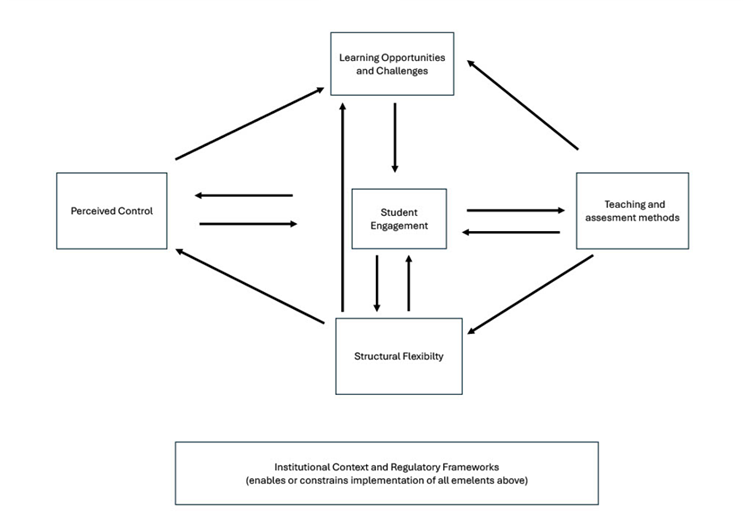
Source: authors’ own work.
It is important to pay greater attention to hybrid teaching, as it remains relatively underdeveloped, particularly within universities in Eastern Europe. Despite the easing of the pandemic, many institutions in this region have yet to fully leverage the potential of combining in-person and online instruction, which limits both flexibility and accessibility for students. Therefore, advancing research and practical implementation in this area is crucial to support universities in optimally adopting hybrid learning models.
Recommendations for Universities and Lecturers in the Context of a Hybrid Education Model
The following recommendations are based on the findings of business school students in the Visegrad countries and reflect the conditions of this context. A key recommendation concerns the selective use of teaching modes depending on the type of classes. Research indicates that online theoretical lectures can be as effective as in-person classes when supported by high-quality multimedia materials and interactive platforms (Means et al., 2010). This approach has already been partially implemented at several analysed universities, where some lectures, mainly electives, are offered online or in hybrid formats, while core subjects remain on-site. Some institutions have also introduced online exams conducted in computer rooms, enabling faster assessment and efficient question randomisation.
A second recommendation concerns instructional design and staff preparedness for online interactions. Students’ accounts indicate that remote engagement depends strongly on lecturers’ ability to moderate discussions, structure group work, and remain visibly present in online settings. The use of interactive platforms and moderated breakout rooms is therefore essential. Previous research shows that supervised online group work significantly increases student activity (Graham et al., 2019).
The pandemic also highlighted the need for systemic mental health support for students. Interview data revealed experiences of chronic fatigue, isolation, and reduced motivation that frequently went unnoticed by universities. Recommended measures include a 24/7 crisis support platform, mandatory first-year workshops on time and stress management, and regular well-being surveys with referral mechanisms.
Finally, the study underscores the importance of inclusive and accessible hybrid learning environments, particularly in relation to neurodiversity and sensory sensitivity. While hybrid formats may reduce structural barriers through greater flexibility and learner control, this potential remains largely underrecognised in institutional practice (Armstrong, 2025). Overall, both student perspectives and prior research suggest that hybrid education is a desirable post-pandemic model in business education, provided that teaching formats are aligned with didactic goals and supported by appropriate organisational and technological structures (Chen et al., 2024).
Limitations
This study has several limitations that should be considered when interpreting the findings. First, the analysis adopts a student-centred perspective, focusing on learners’ interpretations of hybrid education and their lived experiences of teaching practices. Although students’ accounts reveal differences in engagement, digital competence, and pedagogical organisation, the findings remain perception-based. As in most interview studies, narratives may be affected by recall bias or socially desirable responses. The use of semi-structured interviews focused on concrete situations helped reduce this risk; however, the study relies primarily on self-reported data. Future research could strengthen triangulation by combining interviews with institutional evaluations, incorporating both instructor and student perspectives, and applying mixed-method designs that link experiences to course-level outcomes.
Second, the study is based on qualitative interviews conducted within a specific regional and institutional context, undergraduate business programs at leading universities in the Visegrad countries, which may limit transferability to other disciplines, levels of education, or regions.
Third, the empirical material reflects experiences shaped by rapid and largely unplanned educational transformation during the COVID-19 pandemic. Some challenges may therefore be specific to emergency-driven hybrid arrangements rather than fully developed hybrid models.
Finally, the broadly similar implementation trajectories across the analysed universities restrict systematic cross-institutional comparison. Students’ perceptions should thus be interpreted mainly in relation to course-level practices and interaction patterns rather than distinct institutional strategies.
Funding
The project is co-financed by the Governments of Czechia, Hungary, Poland and Slovakia through Visegrad Grants from the International Visegrad Fund. The mission of the fund is to advance ideas for sustainable regional cooperation in Central Europe.
References
- Almahasees, Z., Mohsen, K., & Amin, M. O. (2021). Faculty’s and students’ perceptions of online learning during COVID-19. Frontiers in Education, 6, 638470. https://doi.org/10.3389/feduc.2021.638470
- Armstrong, R. L. (2025). How can technology support young people’s mental health and wellbeing? Use of technology in education to support neurotypical and neurodiverse students. Mental Health and Digital Technologies, 2(2), 124-128. https://doi.org/10.1108/MHDT-01-2025-0005
- Artal-Sevil, J. S., & Romero, E. (2018). Content Curation: What is it? How to apply this technique in higher education? Resources and tools available. In ICERI2018 Proceedings (pp. 5313-5323). IATED. https://doi.org/10.21125/iceri.2018.2227
- Baker, L. A., & Spencely, C. (2023). Is hybrid teaching delivering equivalent learning for students in higher education? Journal of Further and Higher Education, 47(5), 674–686. https://doi.org/10.1080/0309877X.2023.2183357
- Bryda, G. (2014). CAQDAS a badania jakościowe w praktyce [CAQDAS and qualitative research practice]. Przegląd Socjologii Jakościowej, 10(2), 12-38. https://doi.org/10.18778/1733-8069.10.2.02
- Brzozowska, A., Kajanová, J., Ludek, M., Matysová, K., Musilová, M., Sipos, N., Szabó-Bálint, B., Wąsowska, A., Venczel-Szakó, T., & Volfová, J. (2025). Remote education and well-being in academia during (post) pandemic times: insights from business schools in V4 countries. Studia i Materiały. Wydział Zarządzania Uniwersytetu Warszawskiego, 2, 5-16. https://doi.org/10.7172/1733-9758.2025.43.1
- Chen, M., Wang, Z., Liang, L., Ma, Z., & Liu, Y. (2024). Typical practical cases in blended learning. In M. Li, X. Han, & J. Cheng, (Eds.), Handbook of educational reform through blended learning (pp. 231-378). Springer. https://doi.org/10.1007/978-981-99-6269-3_6
- Clifft, S., & Assiouras, I. (2023). The transformation of post pandemic hybrid teaching and learning through experiences of remote digital learning in French business schools. Innovations in Education and Teaching International, 60(6), 810-823. https://doi.org/10.1080/14703297.2022.2132982
- D'Abate, C. (2010). Developmental interactions for business students: Do they make a difference? Journal of Leadership & Organizational Studies, 17(2), 143-155. https://doi.org/10.1177/1548051810370795
- Garrison, D. R., & Vaughan, N. D. (2008). Blended learning in higher education: Framework, principles, and guidelines. John Wiley & Sons.
- Graham, C. R., Borup, J., Pulham, E., & Larsen, R. (2019). K–12 blended teaching readiness: Model and instrument development. Journal of Research on Technology in Education, 51(3), 239-258. https://doi.org/10.1080/15391523.2019.1586601
- Henze, S.M., Fellmer, F., Wittenberg, S., Hoeppner, S., Maerdian, S., Willy, C., & Back, D. A. (2022). Digital adaptation of teaching disaster and deployment medicine under COVID-19 conditions: A comparative evaluation over 5 years. BMC Medical Education, 22(1), 717. https://doi.org/10.1186/s12909-022-03783-z
- Hitch, G., & Zaman, S. (2022). COVID-19 pandemic experiences of students from BAME and White ethnic groups pursuing higher education in the UK: A qualitative comparative exploration. Frontiers in Psychiatry, 13. https://doi.org/10.3389/fpsyt.2022.1078479
- Ho, I. M. K., Cheong, K. Y., & Weldon, A. (2021). Predicting student satisfaction of emergency remote learning in higher education during COVID-19 using machine learning techniques. PLoS ONE, 16(4), e0249423. https://doi.org/10.1371/journal.pone.0249423
- Hodges, Ch., Moore, S., Lockee, B., Trust, T., & Bond, A. (2020). The difference between emergency remote teaching and online learning. Educase Review, March. https://er.educause.edu/articles/2020/3/the-difference-between-emergency-remote-teaching-and-online-learning
- Horn, M. B., & Staker, H. (2014). Blended: Using disruptive innovation to improve schools. John Wiley & Sons.
- Krzyżak, J., & Walas-Trębacz, J. (2024). Challenges in remote education: analysis of social interaction, motivation and engagement. e-mentor, 2(104), 44-53. https://doi.org/10.15219/em104.1654
- Lewis, T., & O’Dowd, R. (2016). Online intercultural exchange. and foreign language learning: A systematic review. In R. O’Dowd, & T. Lewis (Eds.), Online intercultural exchange: Policy, pedagogy, practice (pp. 21–66). Routledge. https://doi.org/10.4324/9781315678931
- Matysová, K. & Volfová, J. (2023). Udržitelné vedení v Digitálním pracovním prostředí [Sustainable leadership within the digital working environment]. MANažment a EKOnomika, 15(2), 111-117. https://doi.org/10.61544/mnk/VYJK1188
- Mayer, S., Abou Refaie, R., & Uebernickel, F. (2024). The challenges and opportunities of hybrid education with location asynchrony: Implications for education policy. Policy Futures in Education, 24(1), 82-104. https://doi.org/10.1177/14782103231224507
- Means, B., Toyama, Y., Murphy, R., Bakia, M., & Jones, K. (2010). Evaluation of evidence-based practices in online learning: A meta-analysis and review of online learning studies. https://www.ed.gov/media/document/evaluation-of-evidence-based-practices-online-learning-meta-analysis-and-review-of-online-learning-studies-revised-september-2010-107159.pdf
- Menzies, L., & Tickle, M. (2024). Empathetic and inclusive teaching via hybrid learning: Lessons from teaching staff. Developing Academic Practice, 57-62. https://doi.org/10.3828/dap.2024.12
- Messiou, K. (2017). Research in the field of inclusive education: time for a rethink? International Journal of Inclusive Education, 21(2), 146-159. https://doi.org/10.1080/13603116.2016.1223184
- Miller, A. N., Sellnow, D. D., & Strawser, M. G. (2021). Pandemic pedagogy challenges and opportunities: instruction communication in remote, HyFlex, and BlendFlex courses. Communication Education, 70(2), 202–204. https://doi.org/10.1080/03634523.2020.1857418
- Moskal, P., Dziuban, C., & Hartman, J. (2013). Blended learning: A dangerous idea? The Internet and Higher Education, 18, 15-23. https://doi.org/10.1016/j.iheduc.2012.12.001
- Ndovela, N., Risinamhodzi, D. T. & Matobobo, C. (2022). Impact of using Microsoft Teams for teaching and learning: A Case of WSU Butterworth Campus. IEEE World Engineering Education Conference (EDUNINE). IEEE. https://doi.org/10.1109/EDUNINE53672.2022.9782376
- Ochs, C., Gahrmann, C., & Sonderegger, A. (2024). Learning in hybrid classes: the role of off-task activities. Scientific Reports, 14(1), 1629. https://doi.org/10.1038/s41598-023-50962-z
- Pandya, B., Cho, B., & Patterson, L. (2025). Impact of digital capabilities of countries on the pedagogical transitions in business schools. Global Knowledge, Memory and Communication, 74(5/6), 1826-1842. https://doi.org/10.1108/GKMC-06-2023-0201
- Raes, A. (2022). Exploring student and teacher experiences in hybrid learning environments: Does presence matter? Postdigital Science and Education, 4(1), 138-159. https://doi.org/10.1007/s42438-021-00274-0
- Raes, A., Detienne, L., Windey, I., & Depaepe, F. (2020). A systematic literature review on synchronous hybrid learning: gaps identified. Learning Environments Research, 23, 269-290. https://doi.org/10.1007/s10984-019-09303-z
- Ragni, A., Ippolito, D., & Masci, C. (2024). Assessing the impact of hybrid teaching on students’ academic performance via multilevel propensity score-based techniques. Socio-Economic Planning Sciences, 92, 101824. https://doi.org/10.1016/j.seps.2024.101824
- Senali, M. G., Iranmanesh, M., Ghobakhloo, M., Gengatharen, D., Tseng, M. L., & Nilsashi, M. (2022). Flipped classroom in business and entrepreneurship education: A systematic review and future research agenda. The International Journal of Management Education, 20(1), 100614. https://doi.org/10.1016/j.ijme.2022.100614
- Shohel, M. M. C., Cann, R., & Atherton, S. (2020). Enhancing student engagement using a blended learning approach: Case studies of first-year undergraduate students. International Journal of Mobile and Blended Learning, 12(4), 51–68.https://doi.org/10.4018/IJMBL.2020100104
- Sliż, P., Berniak-Woźny, J., Brzychczy, E., Gabryelczyk, R., Gdowska, K., Grzesiak, M., Napieraj, A., Podobińska-Staniec, M., Potoczek, N. R., Szelągowski, M., Senkus, P., & Kluza, K. (2024). Business Process Management education in Poland: A manifesto for academic teaching. e-mentor, 2(104), 91–98. https://doi.org/10.15219/em104.1661
- Teichler, U. (2017). Internationalisation trends in higher education and the changing role of international student mobility. Journal of International Mobility, 5(1), 177-216. https://doi.org/10.3917/jim.005.0179
- Teoh, S. H., Boon Zik Hong, J., Md Shamsudin, N., Singh, P., & Hartono, R. (2025). Students’ engagement in a hybrid classroom: a comparison between face-to-face and virtual environments. Cogent Education, 12(1), 2451497. https://doi.org/10.1080/2331186X.2025.2451497
- Tila, D. (2020). Shifting to blended online learning and its impact on student performance: A case study for students enrolled in economic courses prior to COVID-19 emergency remote instruction. e-mentor, 4(86), 62-71. https://doi.org/10.15219/em86.1483
- UNESCO. (2020). National education responses to COVID-19: Summary report of UNESCO’s online survey. https://unesdoc.unesco.org/ark:/48223/pf0000373322.locale=en
- Volfová, J., Matysová, K., Vránceanu, M. D. & Tuclea, E. C. (2023). Telework perception and implications during COVID-19 in the Czech Republic. Central European Business Review, 12(4), 59-76. https://doi.org/10.18267/j.cebr.332
- Zunino, D., Castellaneta, F., & Dibiaggio, L. (2024). Tension between digital distance and physical presence in hybrid teaching: evidence from two natural experiments during the COVID-19 pandemic in a French business School. M@n@gement, 27(1), 38-56. https://doi.org/10.37725/mgmt.2023.8661
 https://orcid.org/0000-0002-9908-6427