

About the article
DOI: https://www.doi.org/10.15219/em111.1727
The article is in the printed version on pages 13-21.
 Download the article in PDF version
How to cite
Kwiatkowska, W., Wiśniewska-Nogaj, L., & Skibińska, M. (2025). Information overload and coping strategies among online learning students. e-mentor, 4(111), 13-21. https://www.doi.org/10.15219/em111.1727
E-mentor number 4 (111) / 2025
Table of contents
- Introduction
- Research Methodology
- Findings
- Discussion of Study Findings
- An Ethics Statement
- References
About the author
Footnotes
1 In accordance with Order No. 162 of the Rector of the Nicolaus Copernicus University in Toruń, the online learning referred to in this text may be conducted as e-classes, in which the entire course programme and ongoing monitoring of participants’ progress are carried out remotely, or as complementary forms, in which only part of the classes is conducted using distance learning methods and techniques. For the purposes of this text, this term refers to any of the above forms of education carried out using distance learning methods and techniques.
2 As a result of the COVID-19 pandemic, complementary forms of education have gained significance, with an emphasis on synchronous distance learning. Currently, students can complete the entire subject in either a synchronous or asynchronous format. It is also permitted to conduct up to 20% of the teaching hours for a given course in a synchronous online format.
Information Overload and Coping Strategies among Online Learning Students
Wioletta Kwiatkowska, Lidia Wiśniewska-Nogaj, Małgorzata Skibińska
Abstract
This study aims to analyse the sources of information overload and the coping strategies used by students who learn online. The students’ opinions were analysed using a survey method, including a set of questions prepared by the authors. A sample of N = 131 students from various fields of study at the Nicolaus Copernicus University in Toruń (Poland) were interviewed in the survey. The findings of the study indicate that students declare more anxiety and difficulties in the form of on-site rather than online classes. The respondents primarily cited sources of information that triggered information overload, including instructions and assignments to be completed during their studies and social media content. Among the coping strategies, the highest percentage of respondents indicated making selections, reading only selected teaching materials, compiling their notes, and dividing tasks over time.
Keywords: information overload, online learning, student, digital literacy, cognitive load
Introduction
As a result of the development of digital technologies and educational experiences during the COVID-19 pandemic, interest in online learning1 has increased dramatically among researchers and academic practitioners (Atlam et al., 2022; Khan, 2023; Zheng et al., 2020). Despite the increasing availability of technological solutions and opportunities to support the learning process, this form of learning can contribute to information overload for some individuals (Bawden & Robinson, 2020; Masrek & Baharuddin, 2023). It can also result in problems remembering large volumes of information, reduced ability to process and understand it, increasing frustration and lack of engagement in learning (Bawden & Robinson, 2020; Feroz et al., 2022). It is necessary to acquire and develop the above competencies, including those essential to managing information in different contexts, not only academic ones. Designing e-courses to avoid or minimise information overload for learners is a crucial aspect of creating motivating and valuable learning experiences. More research is still needed on this issue in Poland. Hence, there is a need to undertake the following theoretical and empirical analyses.
Cognitive Load Theory
One prominent theory presenting the limitations of learning processes resulting from digital technologies is John Sweller’s cognitive load theory (Sweller, 2003; Sweller et al., 2019; van Merriënboer & Sweller, 2005). It assumes that the properties of working memory contribute to the limitation of learning processes, resulting in a so-called cognitive load. The load stems from the finite capacity of the working memory and the short-term storage of information in it (approximately 20 seconds). Processing limitations mainly concern learning processes based on acquiring new information through the senses. Organising knowledge into cognitive schemas is necessary to reduce the burden on working memory. Their construction involves interpreting, giving examples, classifying, inferring, differentiating, organising (Mayer, 2002; Mayer & Moreno, 2003) and relating processed information to knowledge structures stored in long-term memory. We can distinguish three types of cognitive load (van Merriënboer & Sweller, 2005):
- intrinsic load – describes cognitive load of an intrinsic nature. It is a result of the type and structure (complexity) of the learning material and the learner’s knowledge and experience of it;
- extraneous load – describes cognitive load of an external nature. This is due to how the learning material is presented and the conditions in which the learning process takes place (distractors will intensify the cognitive load, e.g. mobile phone, television, noise, distraction effect – so-called multitasking, etc.);
- germane load – refers to the load of part of the working memory resources that results from the need for cognitive processing of educational material.
Cognitive load is the mental effort required to perform a task, depending on the volume of cognitive resources employed. Thus, attention to irrelevant information deprives the individual of cognitive resources that could otherwise influence task outcome.
According to the above theory, tasks should be designed to minimise the extraneous load, maximise the germane load and optimise the intrinsic load. The intrinsic load should also be adjusted to an appropriate level to optimise learning, taking into account the interaction between the task’s difficulty and the learner’s knowledge in the area (Sweller, 2010). The extraneous load can be lowered by modifying the instructional procedure accordingly – in this case, some working memory resources can be freed up to process the intrinsic load (van Merriënboer & Sweller, 2005).
An essential element of this theory is the concept of expertise. This knowledge is formed when simple structures are captured in complex cognitive schemas, and automation occurs due to repeated use of these schemas (Sweller et al., 2019). An automated schema allows memory processes to be managed efficiently, saving memory resources for other cognitive activities (van Merriënboer & Sweller, 2005). Given the critical role of cognitive schemas in the development of expertise, tasks should be structured so that new information aligns with existing knowledge (van Merriënboer & Sweller, 2010). The theory analysed assumes that the cause of working memory load is the interactivity of the learning materials (task elements). Interactivity is understood as the interaction between the structures of the information being processed and the learner’s existing knowledge and experience (van Merriënboer & Sweller, 2005). The task’s interactivity may vary depending on the learner’s knowledge and experience. When the learner has experience solving tasks with a specific repetitive pattern, a new task in a familiar form will be perceived as less interactive than when the learner is dealing with such a task for the first time (Ciesielska & Szczepanowski, 2019). Cognitive load theory assumes that when a learner has prior knowledge of a topic, the intrinsic load is lower (Ciesielska & Szczepanowski, 2019, p. 80). A high level of previous knowledge means the information is readily available and can be retrieved quickly. For complex problems, some novices may underestimate this complexity and thus declare a lower intrinsic load than experts (Endress et al., 2022, pp. 307-309). On the other hand, Martin Valcke (2002) – in addition to the previously mentioned load types – introduced the metacognitive load. He demonstrates that some learners can cope with extraneous mental load through metacognitive activities such as monitoring, controlling, selecting, and organising sensory information (Valcke, p. 151).
Cognitive load theory is one of many approaches to analysing learning, and its application is relevant to the design of effective teaching methods and digital learning materials (cf. van Merriënboer & Sweller, 2010). It also provides a framework for understanding how people process information and what factors influence the effectiveness of the learning process. Applying this theory in education can lead to more effective and tailored educational practices for learners, thus reducing their cognitive load and information overload.
Educational technologies, by providing access to a large number of diverse information resources, contribute not only to cognitive load but also to information overload resulting from an excess of processing capacity, as will be further discussed later on (Graf & Antoni, 2021; Feroz et al., 2022; Surbakti et al., 2024).
Information Overload vs Cognitive Load
Information overload is defined in various contexts. In terms of education, it is indicated as a condition resulting from information excess beyond the learner’s capacity (Feroz et al., 2022). Regarding cognitive load, information overload occurs when learners’ working memory capacity is exceeded, and excessive information and stimuli in the computer-based learning environment interfere with the learning process (Chen et al., 2011).
The causes of overload can be considered under four headings: too much information; diversity, complexity, and novelty of information; pervasive and pushed information; and personal factors and individual differences (Bawden & Robinson, 2020). Research reveals the causes of information overload, which include the amount and fragmentation of information, the need to constantly log on to keep up with information in a discussion forum, the reception of information beyond one’s ability to process it; information entropy occurring when there is uncertainty about the source of information or difficulty in recognising the meaning of information; stress caused by the inability to access, understand or use necessary information (Bawden & Robinson, 2020; Shahrzadi et al., 2024). Another reason may be inadequate organisation or presentation of information, or a need for more understanding of the information environment (Bawden & Robinson, 2020; Shahrzadi et al., 2024).
Researchers indicate the multiple causes of information overload, highlighting the importance of the level of information literacy, the complexity of the task, lack of prior subject knowledge, motivation level, and modes of content presentation (Arnold et al., 2024; Bawden & Robinson, 2020; Bond et al., 2021; Ritter, 2025; Roetzel, 2019). Research also shows that students with higher metacognitive skills tend to process more information and achieve deeper learning (understood as knowledge application, analysis, evaluation and synthesis) (Chen et al., 2011). To relieve the cognitive load of students, it is therefore worth employing cognitive software tools (graphical user interfaces, developed multimedia), including optimally designed animations in educational content (Chang & Yang, 2010; Dwyer & Dwyer, 2006; Le Cunff et al., 2025), digital maps and models, as well as more interactive tasks, (including collaborative tasks) (Kwiatkowska & Wiśniewska-Nogaj, 2022). Information management skills are also essential, contributing to learning effectiveness and helping to understand and cope with information overload (Shahrzadi et al., 2024).
Martin Valcke argues that information overload and cognitive load can interfere with cognitive and metacognitive processes (Valcke, 2002, pp. 103-104). Attention overload occurs when a person experiences something; the accompanying distractions result in a loss of information due to limited sensory and working memory capacity. Storage and retrieval processes become overloaded, resulting, among other things, in an inability to link new information to previously acquired knowledge (Valcke, 2002, p. 104). Valcke assumes that information overload initiates cognitive load. Furthermore, he equates information overload with external cognitive load. Finally, based on his research, he finds that those identified as ‘at risk’ (i.e., declaring low levels of prior knowledge, knowledge of the language of instruction and information skills) reported more significant difficulties related to information overload. He also identified their sources, i.e.: (a) problems with the videoconferencing connection and its configuration; (b) navigational difficulties with excessive hypertext structure, problem with identifying discussion authors; (c) discomfort with online communication – lack of computer skills, poor typing skills, time-consuming and time constraints due to work and family commitments, difficulty reading long texts from the computer screen; (d) problems resulting from an excess of ongoing discussions – too many incoming discussion messages, numerous resources available on the course website, insufficient information selection skills; (e) difficulties in organising – learning due to too many ongoing learning tasks and discussions, (f) problems with reading comprehension (slow reading of text due to poor language skills, need to print out extensive studies).
An analysis of existing research on information overload and cognitive load points to the need to identify the sources of these phenomena and to develop strategies for addressing them in distance learning contexts.
Research Methodology
This paper assumed the following objectives: 1) to learn about the sources of information overload in student learning, and 2) to learn how students can cope with information overload.
This paper details the following research questions:
P1. Has distance learning increased the sense of information overload?
P2. Does online learning cause more anxiety and difficulty than on-site learning?
P3. What sources of information make students feel overloaded?
P4. What coping strategies do students employ to cope with information overload?
Findings
Material and Method
The findings described below form part of a more extensive research programme (additional results can be found here: Wiśniewska-Nogaj et al., 2025). The survey was posted online in a closed system (i.e., it could only be completed via a link). The survey’s authors received a favourable opinion from the NCU Research Ethics Committee. Respondents received a survey link at the e-mail address associated with their student account. The survey was conducted between April and May 2023. Before completing the survey, information was provided about respondents’ rights, how the data would be used, and how to contact the person in charge of the research programme. The students were allowed to continue only after accepting this information and agreeing to participate. The landing page was visited more than 540 times, but not all visitors chose to proceed with the survey. From the entire group of respondents, those who had experienced information overload in the past four weeks were included in the study (N = 223). Subsequently, those who had not taken online classes in the last four weeks were excluded (N = 92, 41.2%)2. The final study group consisted of 131 people.
The research tool was a set of questions aimed at answering the following research questions:
- Has online learning increased the sense of information overload?
- Has online learning caused more anxiety and difficulties?
- What do students consider to be sources of information overload?
- What coping strategies in online learning do students present to cope with information overload?
The results obtained are presented and analysed below.
Results
The data from 131 respondents were analysed using the PS Imago 9 package (SPSS for Windows, version 29).
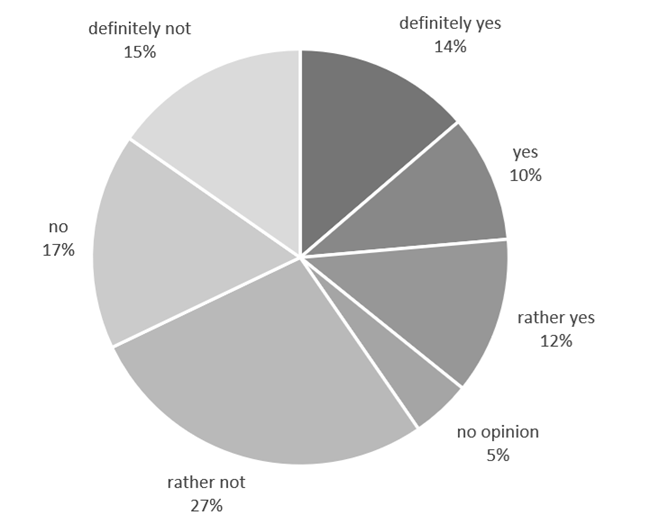
The first issue considered whether online learning has increased the sense of information overload. Most respondents answered that this did not happen (definitely not: N = 20, 15%; no: N = 22, 17%, rather not: N = 36, 27%). More than a third of respondents answered in the affirmative (definitely yes: N = 18, 14%; yes: N = 13, 10%; rather yes: N = 16, 12%). Only less than 5% of respondents (N = 6, 4.6%) had no opinion on this issue.
Figure 1Online Learning as a Form of Information Overload, as Perceived by Students
Source: authors’ own work.
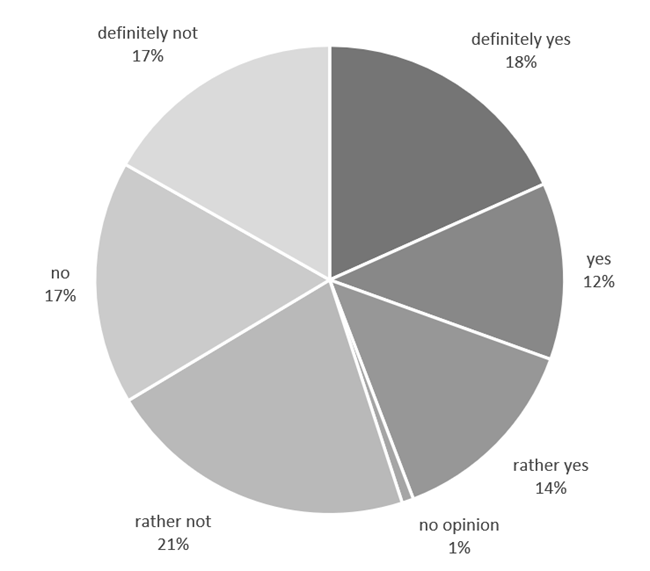
Another question concerned whether online learning causes more anxiety and difficulty than on-site learning. Most respondents answered negatively (definitely not: N = 22, 17%; no: N = 22, 17%, rather not: N = 28, 21%). 44% respondents answered affirmatively (definitely yes: N = 24, 18%; yes: N = 16, 12%; rather yes: N = 18, 14%). One respondent was undecided.
Figure 2Online Learning as a Source of Anxiety and Difficulties as Perceived by Students
Source: authors’ own work.
Students were then asked about different sources of information overload, including those regarding their studies, as well as their personal lives. The highest percentage of respondents (61.1%) favoured instructions and tasks to be completed during their studies. Social media content was cited by 40.5% of respondents compared to (35.1%) for Internet content and (28.2%) for traditional educational material. Interestingly, when given a choice of different sources of overload, respondents were more likely to identify on-site classes (36.6%) rather than online classes as causing a sense of information overload.
Table 1Different Sources of Information Triggering a Sense of Overload as Perceived by Students
| Sources of information triggering a sense of overload | N | % |
| Instructions and tasks to be completed during the course of study | 80 | 61.1 |
| Social media content | 53 | 40.5 |
| On-site classes | 48 | 36.6 |
| Internet content | 46 | 35.1 |
| Traditional educational materials | 37 | 28.2 |
| E-mails | 36 | 27.5 |
| Social media notifications | 34 | 26.0 |
| Digital educational materials | 29 | 22.1 |
| Television content | 21 | 16.0 |
| Online classes | 19 | 14.5 |
| Electronic communicators | 18 | 13.7 |
| Telephone calls | 15 | 11.5 |
| Discussions and meetings with friends | 12 | 9.2 |
| Radio news | 6 | 4.6 |
Note. * Students could select a maximum of 3 answers.
** Sources were arranged from most to least frequently selected.
Source: authors’ own work.
Another area concerned coping strategies. An analysis of the data in Table 2 shows that the most commonly used strategies relate to self-directed activities such as selection (chosen by 66.4% of the students) and content visualisation (54.2%), as well as activities with others – collaboration with other course participants (54.2%).
Figure 1Online Learning as a Form of Information Overload, as Perceived by Students
Source: authors’ own work.
Another question concerned whether online learning causes more anxiety and difficulty than on-site learning. Most respondents answered negatively (definitely not: N = 22, 17%; no: N = 22, 17%, rather not: N = 28, 21%). 44% respondents answered affirmatively (definitely yes: N = 24, 18%; yes: N = 16, 12%; rather yes: N = 18, 14%). One respondent was undecided.
Figure 2Online Learning as a Source of Anxiety and Difficulties as Perceived by Students
Source: authors’ own work.
Students were then asked about different sources of information overload, including those regarding their studies, as well as their personal lives. The highest percentage of respondents (61.1%) favoured instructions and tasks to be completed during their studies. Social media content was cited by 40.5% of respondents compared to (35.1%) for Internet content and (28.2%) for traditional educational material. Interestingly, when given a choice of different sources of overload, respondents were more likely to identify on-site classes (36.6%) rather than online classes as causing a sense of information overload.
Table 2Coping Strategies in Online Learning Overload
| Dealing with online learning overload | N | % |
| Selection and reading only singled out teaching materials | 87 | 66.4 |
| Making one’s own short notes, use of content visualisation techniques | 71 | 54.2 |
| Cooperation with other students | 71 | 54.2 |
| Dividing tasks over time and making sure there is time for rest | 55 | 42.0 |
| Avoiding action, i.e. not doing the tasks during the course | 17 | 13.0 |
| Report this to the academic teacher with a request to adjust the volume of learning material accordingly | 3 | 2.3 |
Source: authors’ own work.
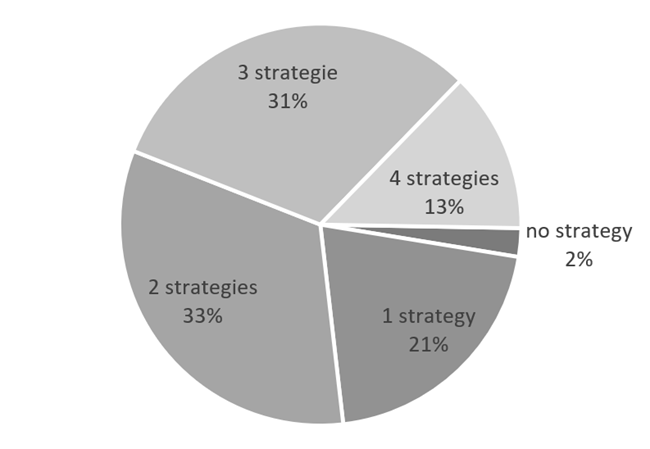
The next step was to analyse the number of strategies students employed (Figure 3). Of those surveyed, 3 persons (2.3%) do not use any of the proposed strategies (or propose their own). Just over a fifth (N = 27, 21%) use a single strategy. A similar number of students use two (N = 43, 33%) and three (N = 41, 31%) strategies. Most respondents (13%; N = 17) use 4 of the 6 proposed strategies.
Students were also allowed to describe their ways of dealing with information overload in online learning. Nine respondents used this option, of whom three replied that they do not cope with the situation. Other responses highlighted difficulties in coping and the high emotional cost of stress and anxiety or minimising effort (downloading, learning on the fly, skipping some information).
Figure 3Number of Coping Strategies in Online Learning Overload
Source: authors’ own work.
Notably, respondents experience the adverse effects of information overload during on-site rather than online classes. In contrast, the three persons who declared they could not cope with the overload described their own ways, including making their own notes, learning materials, and selecting information. Therefore, they undertake certain activities to address the problem.
The next step in the data analysis was to assess which strategies co-occurred most frequently.
Table 3Co-Occurrence of Information Overload Coping Strategies
| Help | Selection | Visualisation | Division | Avoiding | Cooperation | |
| Help | X | 2 | 2 | 2 | 0 | 3 |
| Selection | 2 | X | 48 | 33 | 13 | 46 |
| Visualisation | 2 | 48 | X | 33 | 3 | 35 |
| Division | 2 | 33 | 33 | X | 4 | 35 |
| Avoiding | 0 | 13 | 3 | 4 | X | 9 |
| Cooperation | 3 | 46 | 35 | 35 | 9 | X |
Source: authors’ own work.
Analysis of the data in Table 3 shows that more than one-third of the students select learning materials and make their notes based on them, using various visualisation methods (N = 48). A similar number of students familiarise themselves only with selected materials and simultaneously seek to collaborate with others (N = 46). In contrast, around one-fourth of students collaborate with others and 1) visualise content (N = 35) and 2) schedule task completion over time (N = 35). Slightly fewer students divide tasks over time, taking care of their resources (e.g. relaxation time) while aiming for 1) the selection of learning materials (N = 33) and 2) visualisation of them (N = 33). Interestingly, just under 7% of students, on the one hand, avoid activities in an online course but simultaneously seek to collaborate with other students, and around 10% avoid assignments and select materials.
Discussion of Study Findings
Previous studies indicate that information overload is a problem experienced by online learners. In contrast, the study shows that on-site studying is a more significant source of information overload for students. This can be explained by the need to be more active, more frequent communication directly with the teacher and other students, multiple responsibilities and tasks. Presumably, factors such as the need to commute and inadequate social conditions (including lack of rest and regeneration opportunities between classes) play a role in the poorer coping with information overload in university studies. Among the sources of information, the most overwhelming sense of overload is caused by the instructions and tasks to be completed during the study, which may be due to their quantity, complexity, and the vagueness of their wording. It appears that the instructional format – whether in-person or online – does not significantly influence this. What matters is the careful assignment of tasks and the clarity and precision of the instructions provided.
In a situation of perceived information overload, the students surveyed overwhelmingly select messages, make brief notes, visualise educational content, collaborate with peers, and stagger tasks. Therefore, their actions can be considered proactive and focused on changing the situation – both through their own actions (evident in the use of strategies such as information selection, visualisation, or appropriate planning) and in collaboration with others. The latter group of remedial behaviours can be considered to enable the sharing of duties and responsibilities, perhaps resulting in a greater sense of security and a greater level of commitment or openness to new challenges. Notably, one-fifth of students in online learning use a single coping strategy, whereas two groups, each approximately one-third, use two or three. It seems that the development of remedial skills may be particularly important, as it is essential to recognise that not every method will be effective for every learning task.
Our studies indicate that instructions and assignments during the course of study are the most significant source of information overload, affecting almost two-thirds of the students surveyed. Reference can therefore be made to Sweller’s cognitive load theory, which provides several insights to enable the design of learning materials that minimise learners’ cognitive load and improve their mental performance and learning attitudes, regardless of the instructional form. Therefore, learners mobilise their learning resources, which positively affects their greater engagement (Sohrabi et al., 2023, p. 4).
One way stemming from Sweller’s theory is to reduce the amount of text, divide it into smaller sections, eliminate unnecessary information, etc. Another is to develop the ability to select and organise information. Hence, it may be necessary for a teacher to signal applicable content, manage it, choose keywords, etc.
To help learners with information overload, teachers can also introduce a two-week preparation period in their classes, discuss work methodology and a detailed task schedule, point out specific sources of information and examples of good practice, and encourage networking with other learners (Feroz et al., 2022).
The three most commonly mentioned categories of learning support tools are cognitive, collaborative, and metacognitive. When analysing our own research findings, it is worth noting that more than half of the students surveyed indicate collaboration with others as one of the leading strategies for coping with information overload in class. Thus, it can be concluded that students deliberately choose collaboration to minimise overload by using each other’s resources.
The co-occurrence of collaboration and information selection is particularly evident. It is also worth noting that students avoid assignments while striving for collaboration. This may be due to their low level of own resources and their willingness to compensate with other learners’ resources. Furthermore, it is worth noting that respondents rarely ask the teacher for help. This is consistent with other research findings, which confirm that students try to reach a solution independently and, if they cannot, seek help first from their group mates and then from the teacher (Kwiatkowska, 2018).
Therefore, it is crucial to make a thoughtful and appropriate choice of tools and technologies to support the education process, characterised by interactivity, ease of use, and the possibility of collaboration and sharing on the chosen project. Thus, it can be concluded that dealing with information overload requires self-discipline and the ability to organise and plan time, as well as to prioritise tasks.
The results obtained from our own study on how to deal with information overload are supported by the literature (Shrivastav, & Hiltz, 2013, p. 6), which recommends that, when receiving information, one should first specify the goal one wants to achieve, so that the relevance of individual details can be assessed (Arnold et al., 2023). Information prioritisation can also support managing information overload. The importance of mindfulness as a technique based on being consciously present, focusing on what is essential and avoiding distractions is also emphasised (Arnold et al., 2023; Ioannou, 2023; Masrek & Baharuddin, 2023; Stich et al., 2018).
The results of our study also confirmed the significant contribution of social media to the emergence of information overload among respondents. While social media offers many benefits, such as easy access to information, social support and networking opportunities, it can also lead to information overload (Koroleva & Kane, 2016; Lee et al., 2016; Melinat et al., 2014; Sasaki et al., 2015). According to the Harvard Business Review, information overload is not just about the volume of information to search, but also about the incoming information that needs to be tracked (He, 2020, p. 2). The snowballing pace of information creation and spreading on social media is increasing, while users’ ability to process it effectively is not growing at the same rate. When the information shared reaches users’ cognitive threshold, they will feel too exhausted to process new information (Kominiarczuk & Ledzinska, 2014; Liu et al., 2021). Moreover, the lack of logical presentation of information on social media (compilation of complex or irrelevant information) can also induce fatigue (Fu et al., 2020). Social media overload also stems from excessive social interaction (Chaouali et al., 2026; Chen & Lee, 2013; LaRose et al., 2014). Users may feel exhausted by a sense of obligation to respond to their friends or to specific content on social media (social overload), which can overburden their mental resources (Kaufhold et al., 2020).
Thus, social media is not only a place to obtain and share information but – as confirmed by the opinions of the students surveyed – a source of overload, leading to stress, feelings of overwhelm, fatigue, and pressure. Notably, the students surveyed found that coping with information overload in academia involved conscious information selection, collaboration with other learners, sharing responsibility, gaining support, and understanding, with a greater possibility of success in the educational endeavour.
In summary, the research presented above confirms the negative impact of information overload on student functioning. It also opens up new research areas related to the concept of cognitive overload described in the text. Perhaps it is not the information itself that becomes a challenge, but other factors, such as excessive assignments or instructions (Pastore, 2012). Therefore, an important question remains how to structure study programmes, individual classes, and even messages to students, both online and offline, to avoid overloading them.
An Ethics Statement
All subjects provided informed consent for inclusion in the study before participating. The Ethics Committee of NCU number 13/2023/FT approved the study.
References
- Arnold, M., Goldschmitt, M., & Rigotti, T. (2023). Dealing with information overload: a comprehensive review. Frontiers in Psychology, 14. https://doi.org/10.3389/fpsyg.2023.1122200
- Atlam, E. S., Ewis, A., El-Raouf, M. M. A., Ghoneim, O., & Gad, I. (2022). A new approach in identifying the psychological impact of COVID-19 on university student’s academic performance. Alexandria Engineering Journal, 61(7), 5223–5233. https://doi.org/10.1016/J.AEJ.2021.10.046
- Bawden, D., & Robinson, L. (2020). Information overload: An introduction. Oxford Research Encyclopedia of Politics. https://oxfordre.com/politics/view/10.1093/acrefore/9780190228637.001.0001/acrefore-9780190228637-e-1360
- Bond, M., Bedenlier, S., Marín, V. I., & Händel, M. (2021). Emergency remote teaching in higher education: Mapping the first global online semester. International Journal of Educational Technology in Higher Education, 18(50), 1–24. https://doi.org/10.1186/s41239-021-00282-x
- Chang, C.-C., & Yang, F.-Y. (2010). Exploring the cognitive loads of high-school students as they learn concepts in web-based environments. Computers & Education, 55(2), 673-680.
- Chaouali, W., Nasr, H. E., Woodsid,e A. G., Khalil, A., & Ben Saad, S. (2026). Social media fatigue among university students: a configural modeling of stressors and distractions. Marketing Intelligence & Planning, 44(1), 166–188. https://doi.org/10.1108/MIP-09-2023-0481
- Chen, C. Y., Pedersen, S., & Murphy, K. L. (2011). Learners' perceived information overload in online learning via computer-mediated communication. Research in Learning Technology, 19(2), 101–116. https://doi.org/10.1080/21567069.2011.586678
- Chen, W., & Lee, K.-H. (2013). Sharing, liking, commenting, and distressed? The pathway between Facebook interaction and psychological distress. Cyberpsychology, Behavior, and Social Networking, 16(10), 728-734. https://doi.org/10.1089/cyber.2012.0272
- Ciesielska, M., & Szczepanowski, R. (2019). Wykorzystanie teorii obciążenia poznawczego w projektowaniu multimedialnych materiałów edukacyjnych [The cognitive load theory of learning and its use in designing multimedia educational resources]. Edukacja, 1(148), 75-95. http://doi.org/10.24131/3724.190106
- Dwyer, F., & Dwyer, C. (2006). Effect of cognitive load and animation on student achievement. International Journal of Instructional Media, 33(4), 379-388.
- Endres, T., Lovell, O., Morkunas, D., Rieß, W., & Renkl, A. (2023). Can prior knowledge increase task complexity? – Cases in which higher prior knowledge leads to higher intrinsic cognitive load. British Journal of Educational Psychology, 93(22), 305–317. https://doi.org/10.1111/bjep.12563
- Feroz, H. M. B., Zulfiqar, S., Noor, S., & Huo, C. (2022). Examining multiple engagements and their impact on students' knowledge acquisition: the moderating role of information overload. Journal of Applied Research in Higher Education, 14(1), 366–393. https://doi.org/10.1108/JARHE-11-2020-0422
- Fu, S., Li, H., Liu, Y., Pirkkalainen, H., & Salo, M. (2020). Social media overload, exhaustion, and use discontinuance: Examining the effects of information overload, system feature overload, and social overload. Information Processing & Management, 57(6), 102307. https://doi.org/10.1016/j.ipm.2020.102307
- Graf, B., & Antoni, C. H. (2021). The relationship between information characteristics and information overload at the workplace - a meta-analysis. European Journal of Work and Organizational Psychology, 30(1), 143–158. https://doi.org/10.1080/1359432X.2020.1813111
- He, T. (2020). Preliminary research of information overload from information search and information follow. Marketing of Scientific and Research Organizations, 38(4), 1-20. https://doi.org/10.2478/minib-2020-0024
- Ioannou, A. (2023). Mindfulness and technostress in the workplace: a qualitative approach. Frontiers in Psychology, 14. https://doi.org/10.3389/fpsyg.2023.1252187
- Kaufhold, M. A., Rupp, N., Reuter, C., & Habdank, M. (2020). Mitigating information overload in social media during conflicts and crises: design and evaluation of a cross-platform alerting system. Behaviour & Information Technology, 39(3), 319–342. https://doi.org/10.1080/0144929X.2019.1620334
- Khan, A. N. (2023). Students are at risk? Elucidating the impact of health risks of COVID-19 on emotional exhaustion and academic performance: role of mindfulness and online interaction quality. Current Psychology, 43, 12285–12298. https://doi.org/10.1007/s12144-023-04355-0
- Kominiarczuk, N., & Ledzińska, M. (2014). Turn down the noise: information overload, conscientiousness and their connection to individual well-being. Personality and Individual Differences, 60, 76. https://doi.org/10.1016/j.paid.2013.07.343
- Koroleva, K., & Kane. G. C. (2016). Relational affordances of information processing on Facebook. Information and Management, 54(5), 560-572. https://doi.org/10.1016/j.im.2016.11.007
- Kwiatkowska, W. (2018). Mozaikowy wizerunek uczących się w uniwersyteckim kształceniu on-line [A mosaic image of learners in university online education]. Wydawnictwo Naukowe Uniwersytetu Mikołaja Kopernika.
- Kwiatkowska, W., & Wiśniewska-Nogaj, L. (2022). Digital skills and online collaborative learning: The study report. The Electronic Journal of e-Learning, 20(5), 510-522. https://doi.org/10.34190/ejel.20.5.2412
- LaRose, R., Connolly, R., Lee, H., Li, K., & Hales, K. D. (2014). Connection overload? A cross cultural study of the consequences of social media connection. Information Systems Management, 31(1), 59–73. https://doi.org/10.1080/10580530.2014.854097
- Le Cunff, A. L, Martis, B. L, Glover, C, Ahmed, E., Ford, R., Giampietro, V., & Dommett, E. J. (2025). Cognitive load and neurodiversity in online education: a preliminary framework for educational research and policy. Frontiers in Education, 9, 1437673. https://doi.org/10.3389/feduc.2024.1437673
- Lee, A. R., Son, S. M., & Kim, K. K. (2016). Information and communication technology overload and social networking service fatigue: A stress perspective. Computers in Human Behavior, 55, 51–61. https://doi.org/10.1016/j.chb.2015.08.011
- Liu, H., Liu, W., Yoganathan, V., & Osburg, V. S. (2021). COVID-19 information overload and generation Z’s social media discontinuance intention during the pandemic lockdown. Technological Forecasting and Social Change, 166, 120600. https://doi.org/10.1016/j.techfore.2021.120600
- Masrek, M. N., & Baharuddin, M. F. (2023). Screens, streams, and stress: A qualitative study on how distance learning students cope with information overload. International Journal of Membrane Science and Technology, 10(5), 47–58. https://doi.org/10.15379/ijmst.v10i5.2417
- Mayer, R. E. (2002). Rote versus meaningful learning. Theory into Practice, 41, 226–232.
- Mayer, R. E., & Moreno, R. (2003). Nine ways to reduce cognitive load in multimedia learning. Educational Psychologist, 38(1), 43–52. https://doi.org/10.1207/S15326985EP3801_6
- Melinat, P., Kreuzkam, T., & Stamer, D. (2014). Information overload: A systematic literature review. In B. Johansson, B. Andersson, & N. Holmberg, (Eds.), Perspectives in Business Informatics Research. BIR 2014. Lecture Notes in Business Information Processing, vol. 194, 72-86. Springer. https://doi.org/10.1007/978-3-319-11370-8_6
- Pastore, R. (2012). The effects of time-compressed instruction and redundancy on learning and learners' perceptions of cognitive load. Computers & Education, 58(1), 641-651. https://doi.org/10.1016/j.compedu.2011.09.018
- Ritter, L. A. (2025). Learning motivation vs. information overload: The importance of structure in digital learning environments. European Journal of Research and Reflection in Educational Sciences, 13(3), 29–36.
- Roetzel, P. G. (2019). Information overload in the information age: A review of the literature from business administration, business psychology, and related disciplines with a bibliometric approach and framework development. Business Research, 12, 479–522. https://doi.org/10.1007/s40685-018-0069-z
- Sasaki, Y., Kawai D., & Kitamura, S. (2015). The anatomy of tweet overload: how number of tweets received, number of friends, and egocentric network density affect perceived information overload. Telematics and Informatics, 32(4), 853–861. https://doi.org/10.1016/j.tele.2015.04.008
- Shahrzadi L., Mansouri A., Alavi M., & Shabani, A. (2024). Causes, consequences, and strategies to deal with information overload: A scoping review. International Journal of Information Management Data Insights, 4(2), 100261. https://doi.org/10.1016/j.jjimei.2024.100261
- Sohrabi, Z., Nosrati, S., Nouri Khaneghah, Z., Ramzanpour, E., Ghanavati, S., & Zhianifard, A. A. (2023). Comparative study of the effect of two methods of online education based on Sweller's cognitive load theory and online education in a common way on the academic engagement of medical students in anatomy. Medical Journal of The Islamic Republic of Iran, 37, 73. https://doi.org/10.47176/mjiri.37.73
- Stich, J.-F., Tarafdar, M., & Cooper, C. L. (2018). Electronic communication in the workplace: boon or bane? Journal of Organizational Effectiveness: People and Performance, 5(1), 98–106. https://doi.org/10.1108/JOEPP-05-2017-0046
- Surbakti, R., Umboh, S. E., Pong, M., & Dara, S. (2024). Cognitive load theory: Implications for instructional design in digital classrooms. International Journal of Educational Narratives, 2(6), 483-493. https://doi.org/10.70177/ijen.v2i6.1659
- Sweller, J. (2003). Evolution of human cognitive architecture. In B. H. Ross (Ed.), The psychology of learning and motivation: Advances in research and theory, 43, 215–266. Elsevier Science.
- Sweller, J. (2010). Element interactivity and intrinsic, extraneous and germane cognitive load. Educational Psychology Review, 22, 123–138. https://doi.org/10.1007/s10648-010-9128-5
- Sweller, J., van Merriënboer, J. J. G., & Paas, F. (2019). Cognitive Architecture and Instructional Design: 20 Years Later. Educational Psychology Review 31, 261–292. https://doi.org/10.1007/s10648-019-09465-5
- Wiśniewska-Nogaj, L. A., Skibińska, M., & Kwiatkowska, W. (2025). Information overload among students – the role of coping strategies and self-esteem. A research report. Przegląd Badań Edukacyjnych, 1(49), 101–122. https://doi.org/10.12775/PBE.2025.007
- Valcke, M. (2002). Cognitive load: Updating the theory? Learning and Instruction, 12(1), 147–154. https://doi.org/10.1016/S0959-4752(01)00022-6
- van Merriënboer, J. J. G., & Sweller, J. (2005). Cognitive load theory and complex learning: Recent developments and future directions. Educational Psychology Review, 17(2), 147–177. https://doi.org/10.1007/s10648-005-3951-0
- van Merriënboer, J. J. G., & Sweller, J. (2010). Cognitive load theory in health professional education: design principles and strategies. Medical Education, 44(1), 85–93. https://doi.org/10.1111/j.1365-2923.2009.03498.x
- Zheng, F., Khan, N. A., & Hussain, S. (2020). The COVID 19 pandemic and digital higher education: Exploring the impact of proactive personality on social capital through internet self-efficacy and online interaction quality. Children and Youth Services Review, 119, 105694. https://doi.org/10.1016/j.childyouth.2020.105694
 https://orcid.org/0000-0001-8374-1370